Home Decorators: Pick a Line Art Canvas That Lasts for 24x36+ Prints
A line art canvas is a print of a minimalist contour drawing, usually a face, figure, plant, or abstract shape rendered in one continuous or broken line, mounted on stretched canvas. The fastest way to choose one: pick a motif that matches your room’s mood, then check for archival canvas and pigment ink once you’re sizing anything above 24x36 inches. If you want a source with deep customization and no lengthy search, A line art collection from various sellers covers most of what buyers need.
TL;DR:
- Line art pieces should be proportioned to about two-thirds the width of the furniture they’re placed above to achieve visual balance.
- For large canvases, choose pigment-based ink prints on archival canvas and consider gallery-wrapped options for a modern, borderless look.
- Custom resizing and recomposition are crucial to maintain line clarity and proportion when scaling artwork to different sizes.
- Proper placement at eye level, about 57 to 60 inches from floor to center, enhances visual harmony and room flow.
- Minimalist line art remains timeless because of its neutral impact, but selecting a bold, sizeable piece over small or multiple works maximizes its aesthetic impact.
Table of Contents
- Popular Line Art Styles and Motifs for Canvas Wall Art
- Materials and Print Quality: What Actually Makes a Canvas Last
- How to Size and Place Your Line Art Canvas
- Why Print Specs and Customization Matter When You’re Buying
- Where Line Art Came From
- How to Create Line Art, Digitally or by Hand
- Caring for a Line Art Canvas So It Lasts
- Artists Who Shaped the Line Art Look
- Customizing or Commissioning Your Own Line Art Canvas
- Quick Picks for Common Rooms
- Sense Canvas: A Direct Way to Order Your Line Art Canvas
- Why Minimalist Line Art Keeps Winning Over Trend-Driven Decor
- Sources
- FAQ
Popular Line Art Styles and Motifs for Canvas Wall Art
Line art isn’t one look. It’s a family of styles that all share the same restraint: minimal marks, maximum suggestion. Picking the right family matters more than picking the “best” piece, because a style that clashes with your room’s energy will bother you every time you walk past it.
- Continuous one-line figures and faces. A single unbroken line traces a body, a face in profile, or two figures embracing. This style reads as intimate and a little playful, and it works especially well in bedrooms, hallways, and entryways where you want warmth without visual noise.
- Botanical and architectural outlines. Leaves, branches, or building facades rendered in clean, spare linework. These feel calmer and more grounded than figure-based pieces, which makes them a natural fit for living rooms and home offices where you want focus, not drama.
- Abstract geometric and contour pieces. Overlapping curves, negative-space compositions, and shapes that suggest a form without depicting it literally. These tend to work best as large-scale statement pieces because the eye reads the whole composition at once.
- Single-accent-color and metallic variations. A black line drawing gets a gold, terracotta, or muted blue accent on one element. This shifts a piece from strictly minimalist to something with a bit more personality, without abandoning the clean-line foundation.
Color accents change how a room feels more than most buyers expect. A pure black-and-white line drawing recedes into the wall, while even a small metallic highlight pulls the eye and can anchor a whole color scheme in a room.
Materials and Print Quality: What Actually Makes a Canvas Last
Not all canvas is built the same, and the differences show up years down the road, not on day one. Poly-cotton blends are the most common budget option. They hold ink reasonably well but can sag slightly over time in humid rooms. Textured matte finishes reduce glare, a real advantage if your line art hangs across from a window.
Ink type is where quality separates fastest. Pigment-based giclée printing uses microscopic ink droplets that resist fading far longer than dye-based ink, which is why archival-grade prints hold their contrast for years while cheaper prints can visibly yellow or fade within a couple of seasons. On a line art piece, where the entire composition depends on crisp, unbroken lines, ink quality is not a minor spec. A slightly blurred or faded line ruins the piece’s whole point.
Mounting style affects both look and installation:
- Stretched canvas wraps the print around a wooden frame, ready to hang with no additional framing needed.
- Gallery-wrapped canvas extends the image around the sides, so there’s no visible border, which suits the borderless look most line art benefits from.
- Framed canvas adds a traditional frame for buyers who want a more formal presentation or need to match existing framed pieces nearby.
Price tracks size, material, and customization together. Commercial print providers commonly offer both stretched and gallery-wrapped options at multiple price points, and larger formats cost more largely because they demand thicker canvas backing and more ink coverage, not just more square footage.
Pro Tip: Before buying any large-format line art, zoom into the product photo at 100 percent if the seller allows it. Blurry or jagged lines at zoom usually mean the same on your wall.
How to Size and Place Your Line Art Canvas
Getting size and placement right is where most buyers either nail a room or waste a purchase. A few rules do most of the work.
- Use the two-thirds rule for a single piece. Your canvas should span roughly two-thirds the width of the furniture below it, whether that’s a sofa, bed, or console table. Too small and it looks like an afterthought; too large and it overwhelms the piece of furniture entirely.
- Hang at eye level, roughly 57 to 60 inches to the center of the piece. This is the museum standard, and it holds for line art canvases as much as any other wall art.
- For gallery walls, pick a template before you order. A grid layout suits multiple same-size line art prints in a uniform pattern. A linear layout works well over a long hallway or staircase. A salon-style cluster mixes sizes and works best when every piece shares the same color palette, so the collection reads as one voice instead of clutter.
- Match orientation to the architecture. A tall, narrow botanical line drawing suits a slim wall segment between windows; a wide continuous-line piece suits open wall space above a low console or headboard.
- Check weight and wall type before mounting. Larger stretched canvases, especially anything above 30x40 inches, need proper wall anchors rather than a single nail, particularly on plaster or drywall.
Pro Tip: Lay out your gallery wall on the floor first, using painter’s tape to mark the wall dimensions. It takes ten extra minutes and saves you from a dozen unnecessary nail holes.
Why Print Specs and Customization Matter When You’re Buying
A reputable canvas seller earns your trust on the product page, not in marketing copy. Some canvas sellers build catalogs around this idea: a large number of designs, customizable for size and composition, with a range of prices. That range matters because line art in particular loses impact when it’s forced into a size it wasn’t composed for. A face rendered in one fine line looks elegant at 16x20 inches and can look thin or awkward stretched to 40x60 without recomposition.
Custom cropping solves this. When a design can be resized and recomposed rather than just stretched, the line weight and spacing adjust to stay proportional, which keeps the drawing looking intentional at any scale instead of pixelated or sparse.
Before buying from any seller, check these signals on the product page:
- A clearly stated return or satisfaction policy.
- Real customer photos showing the piece installed in an actual room.
- Materials and ink type spelled out, not just “premium quality” language with no specifics.
- Size options that go beyond two or three fixed dimensions.
Where Line Art Came From
Line art’s minimalism looks modern, but the technique is old. Continuous-line drawing traces back to ancient pottery and cave art, where artists worked with a single tool and no erasing. The style resurfaced dramatically in the 20th century through Pablo Picasso’s single-line drawings of animals and faces, made in the 1940s and 1950s as a deliberate exercise in reducing form to its essentials. Henri Matisse pushed a related idea with his cut-out and line-based figure studies later in his career, favoring economy of gesture over detail.
The mid-century modern design movement embraced line art alongside its stripped-down furniture and open floor plans, and that pairing never really went away. What changed is accessibility. Line art used to require either fine art training or a printmaker’s plate. Now anyone can generate a clean line drawing from a photo in seconds, which is part of why the style surged back into home decor over the past decade. It photographs well, prints cleanly at almost any size, and doesn’t compete with a room’s other colors or textures, which makes it forgiving for people decorating without a strong design background.
How to Create Line Art, Digitally or by Hand
Traditional line art starts with a pencil and a steady hand, often working from a photo reference to map proportions before committing to ink. Artists typically block in major shapes lightly, then commit to a single confident line, since the whole aesthetic depends on looking effortless even when it isn’t. Continuous-line drawing, where the pen never lifts from the paper, takes real practice. Most artists sketch the route mentally before starting.
Digital tools have made the style far more accessible to non-artists. Adaptive thresholding and edge-detection algorithms, the kind used in browser-based converters like MakeLineArt, analyze a photo’s contrast and extract just the contour information, preserving both highlight and shadow detail better than a flat filter would. MakeLineArt runs this process entirely in the browser using WebAssembly, so a personal photo never leaves your device, which matters if you’re converting a family portrait for canvas printing rather than a stock image.
Separately, AI line art generators can build a design from a text prompt or a reference photo in a matter of seconds, and most let you adjust style and composition before exporting. The tradeoff is consistency. Results vary depending on the source image, so it’s worth generating a few versions and previewing each one at your intended print size before settling on a final file. Detail that reads clearly on a screen can vanish or blur once stretched across a 40 inch canvas.
Caring for a Line Art Canvas So It Lasts
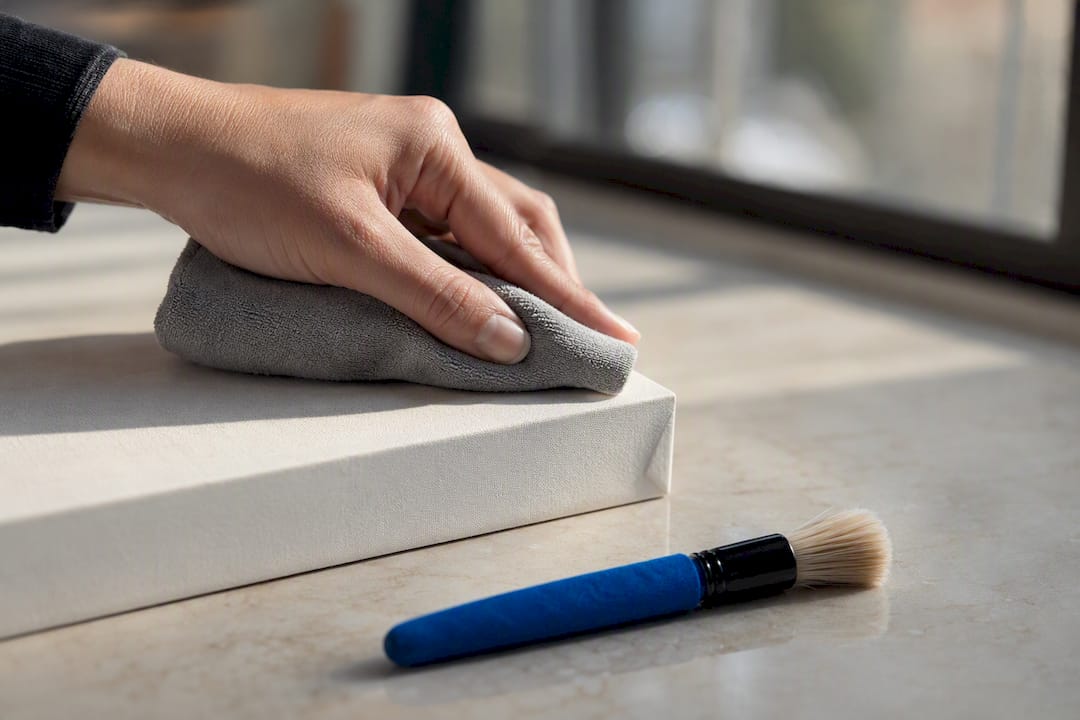
Canvas art needs less maintenance than most home decor, but the little it does need is easy to skip. Dust buildup is the biggest everyday threat, since it dulls contrast on white or light backgrounds where line art depends on clean tonal separation. A dry microfiber cloth, used in gentle straight strokes rather than circles, handles this in under a minute per piece. Never use household glass cleaner or water on canvas. Moisture can seep into the fibers and cause warping or mildew over time, especially on gallery-wrapped pieces where the canvas wraps around exposed wood.
Sunlight is the second real threat. Direct sun exposure fades even archival-grade pigment ink eventually, and since line art relies on stark contrast between line and background, fading shows up faster visually than it would on a busy, colorful print. Hang line art canvases away from south-facing windows when possible, or use UV-filtering window film if the wall placement is otherwise ideal.
Temperature swings and humidity cause canvas to expand and contract slightly, which over years can loosen the staples on the back of a stretched frame. If you notice slight sagging, most framing shops can re-tension a canvas for a modest fee rather than requiring a full replacement. Rotate or dust your pieces every few months, and a well-made line art canvas should hold its look for well over a decade.
Artists Who Shaped the Line Art Look
Pablo Picasso remains the reference point most people picture when they think of expressive single-line portraiture, particularly his line drawings of bulls, doves, and faces done with almost no lifted pen strokes. Henri Matisse’s later work leaned into similar economy, using continuous contour lines in his figure studies to suggest movement with minimal marks. Both artists proved that reducing a subject to its essential lines could carry as much emotional weight as a fully rendered painting.
Contemporary illustrators and independent designers have carried that tradition into home decor territory, producing continuous-line couples, botanical outlines, and abstract face studies specifically sized and composed for print. Much of what fills modern line art canvas collections today draws direct visual lineage from this history, simplified further and adapted for wall display rather than gallery exhibition. The style’s popularity on platforms like Instagram and Pinterest over the last several years has also pushed a wave of newer digital artists into the space, many of whom design specifically with canvas printing in mind rather than paper.
Customizing or Commissioning Your Own Line Art Canvas
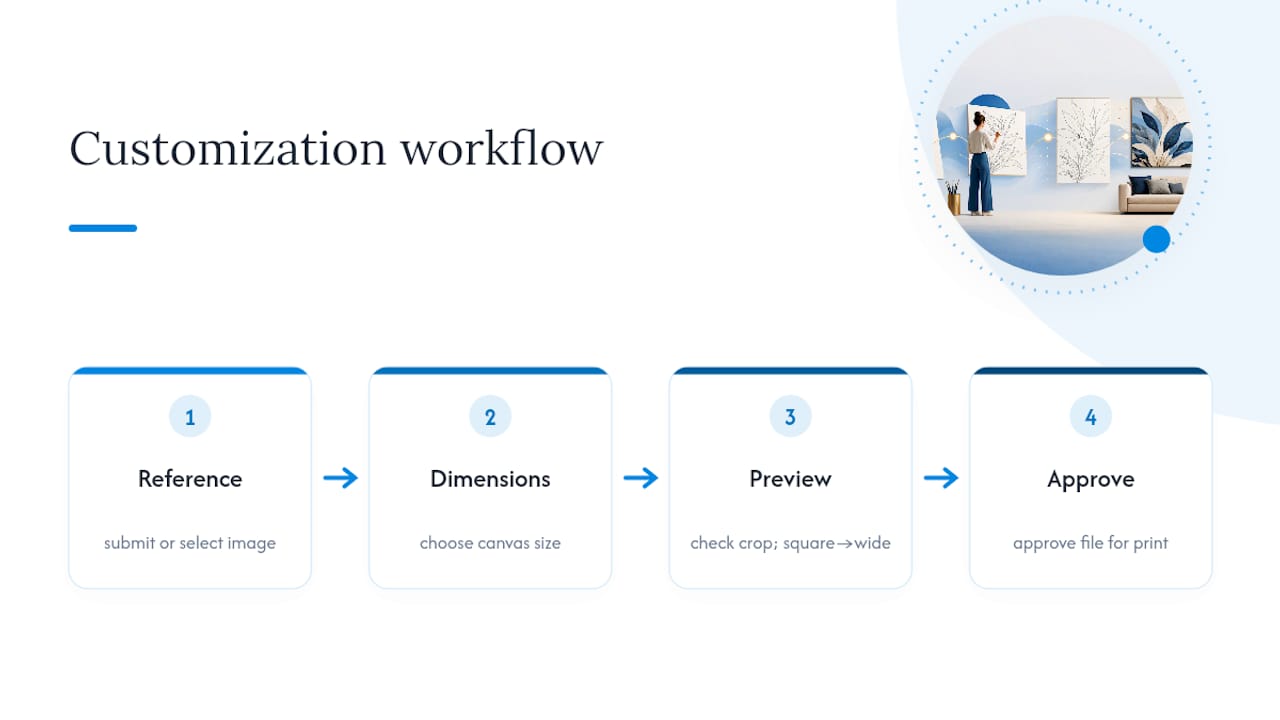
If none of the ready-made designs fit exactly what you want, customization is usually the better route rather than commissioning an original from scratch, unless you specifically want one-of-a-kind original artwork. Most canvas sellers that offer customization let you submit a reference photo, choose a size, and specify crop or composition adjustments before the file goes to print.
The process generally works like this: submit or select your reference image, choose your target canvas dimensions, and review a preview before checkout. This preview step matters more for line art than for photography prints, because a line drawing composed for a square format can look off-balance if simply stretched into a wide rectangle without recomposition. A seller who offers real cropping and resizing, rather than just scaling the same file up or down, will produce a noticeably better result.
If you want a fully custom design, such as a portrait of your own family or pet, look for sellers who explicitly list personalized or portrait-style options rather than assuming any print shop can handle it. Turnaround times for custom line art typically run longer than in-stock designs, so order with enough lead time if you’re planning around a specific date like a move-in or a gift.
Quick Picks for Common Rooms
Bedrooms call for calm. A single botanical line drawing or a soft continuous-line figure above the headboard sets a restful tone without competing with bedding or nightstands. Living rooms can handle more presence: either one large statement continuous-line canvas centered above the sofa, or a balanced two or three piece layout that reads as one composition rather than scattered art. Home offices benefit from a vertical portrait-orientation piece or a small, tightly grouped cluster positioned to hold focus rather than pull the eye around the room.
The mistake to avoid across all three: mixing too many line weights or styles on one wall. Minimalism depends on consistency, so pick one visual voice per room and let it do the work.
Sense Canvas: A Direct Way to Order Your Line Art Canvas
Some canvas sellers focus on helping buyers find line art pieces sized appropriately for their walls. Large collections include continuous-line figures, botanical outlines, and abstract contour pieces, with customization options for size and composition instead of fixed dimensions.
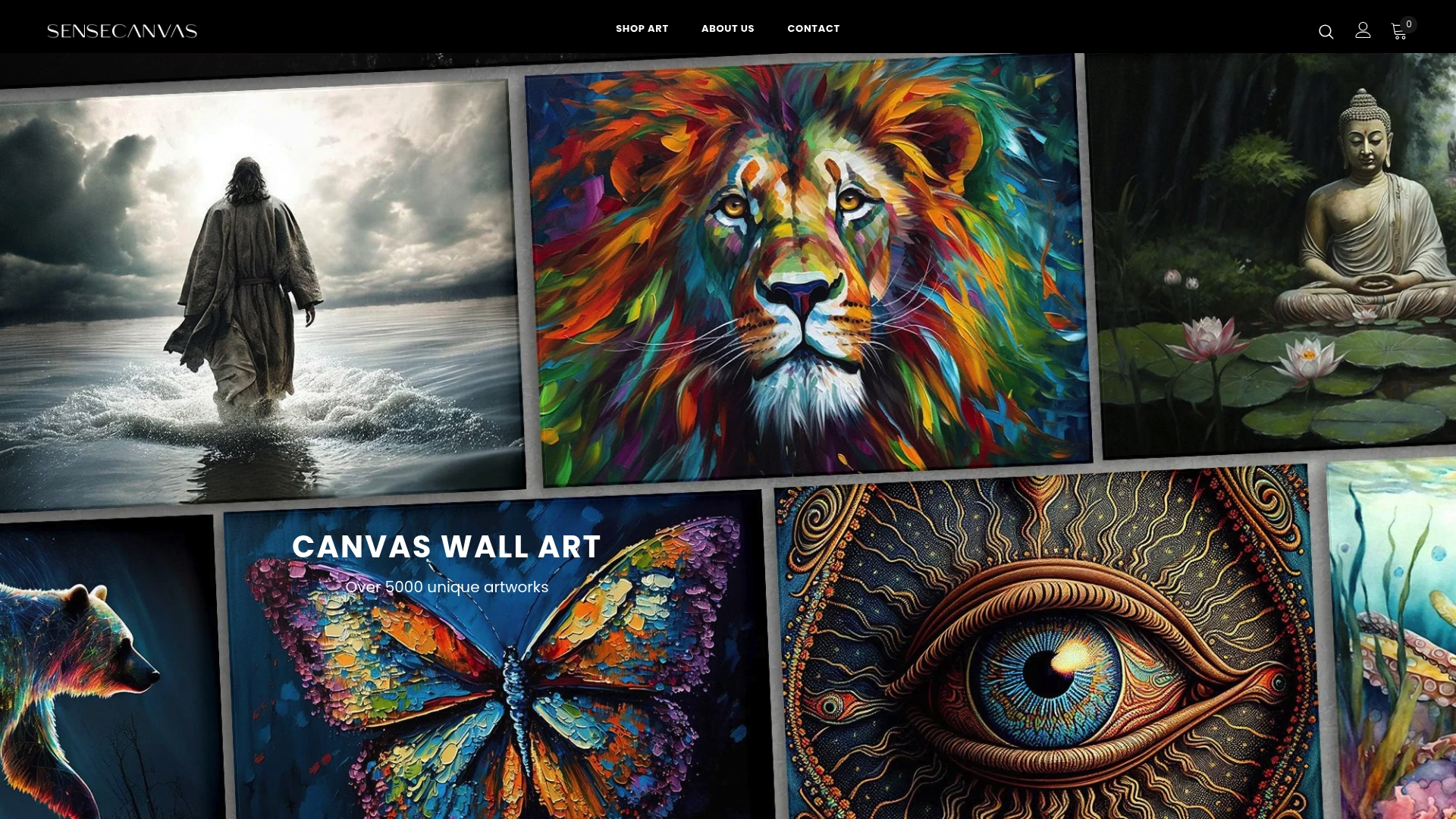
Ordering follows a simple path. Browse the line art and canvas wall art collection, pick the motif that matches your room’s mood, choose your size, and use the preview tool to check the crop before checkout. Because every design can be recomposed rather than just stretched, a piece composed for a 16x20 frame won’t lose its line clarity if you scale it up for a living room statement wall. Product pages list the canvas material and print details up front, so you’re not guessing at quality before you commit.
If you’re decorating a single accent wall or planning a full gallery layout, start by browsing Sense Canvas’s full range to see how the sizing and customization options work on an actual design you like.
Why Minimalist Line Art Keeps Winning Over Trend-Driven Decor
Most wall art trends cycle out within a few years. Line art has held on for over a decade now, and the reason isn’t really about style at all. It’s about how little it demands from a room. A bold graphic print or a saturated photograph forces everything around it to negotiate, color, texture, furniture style. A well-chosen line art canvas asks nothing. It sits quietly against nearly any wall color, any furniture era, any lighting condition, and still reads as intentional.
That’s also why so many people get it wrong on the first try. They treat “minimalist” as synonymous with “safe” and pick the smallest, plainest option available, when the better move is usually the opposite: commit to one confident piece, sized generously, rather than a handful of timid small ones scattered across a wall. The single-line portrait or the oversized botanical outline works precisely because it doesn’t apologize for taking up space. It just does it with less ink than anything else on the wall.
The other overlooked point is durability of taste, not just materials. A trendy graphic print looks dated in five years. A well-composed continuous-line drawing, rooted in a technique that goes back to Picasso and beyond, tends to age the way good design usually does: unnoticed, because it never looked wrong to begin with.
— Sense
Sources
- Photo to Line Art & Sketch Converter | MakeLineArt
- AI Line Art Generator - Create Line Art Drawing For Free
FAQ
What Is Line Artwork Called?
Line artwork is commonly called line art, line drawing, or contour drawing, and when done in a single unbroken stroke, it’s specifically called continuous-line drawing. These terms are used interchangeably across the art world and in home decor listings.
Can Canva Turn a Photo Into Line Art?
General design tools like Canva offer basic filters, but they aren’t built specifically for clean line extraction. Purpose-built converters such as MakeLineArt use adaptive thresholding to preserve highlight and shadow detail more accurately, producing a crisper result for printing.
What Is the Best Website to Buy Canvas Art?
It depends on whether you want a ready-made print or a fully customizable one. Some canvas sellers offer large collections of line art and abstract designs with a range of prices, including customization of sizing and composition in the ordering process. Marketplace options like Society6 offer U.S.-made print-on-demand with published sizing and material specs.
How Much Does Line Art Cost?
Line art canvas prices vary mainly by size, material, and customization level. Prices for line art canvases vary widely by size and customization. Current prices can be found on sellers’ pricing pages.
What Size Line Art Canvas Should I Buy for Above a Sofa?
Aim for a canvas or gallery wall grouping that spans roughly two-thirds the width of your sofa. The exact width varies depending on your furniture and wall space.