The Right Way to Size and Hang Art Above a Sofa
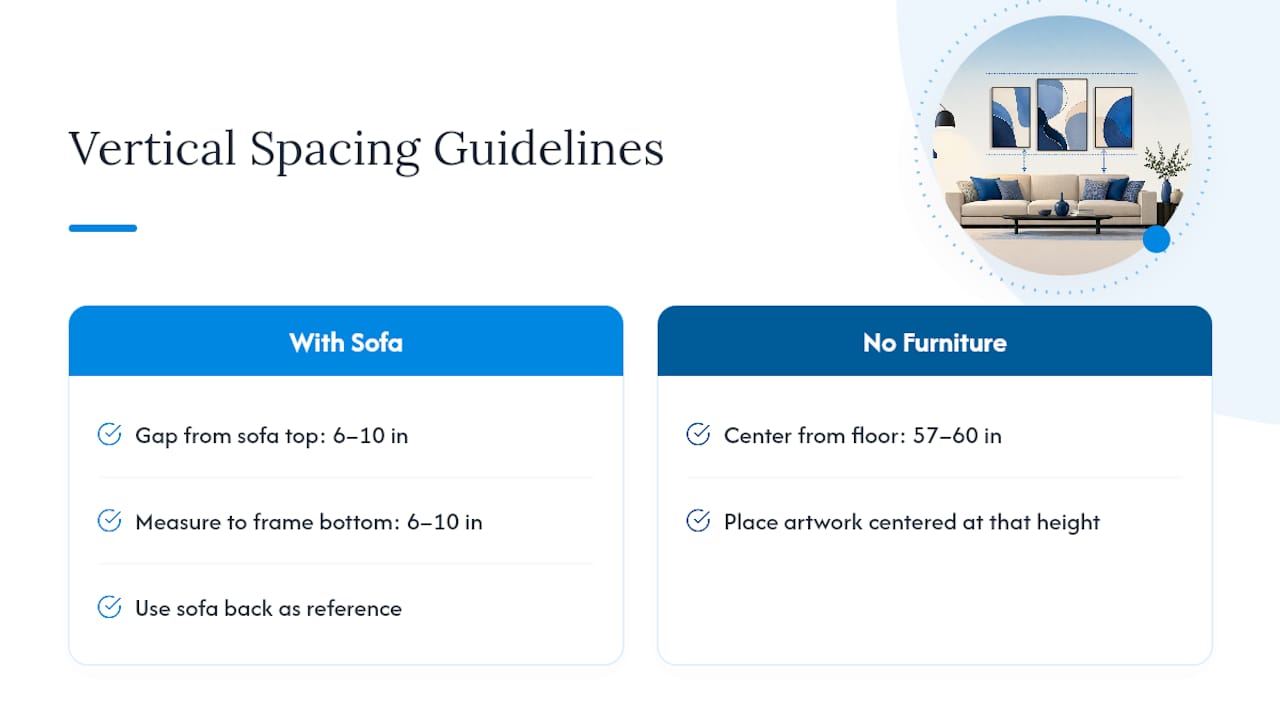
Your artwork above the sofa should span about two-thirds to three-quarters of the sofa’s width, with its bottom edge landing 6 to 8 inches above the sofa back. If you’re working without furniture as a reference point, or hanging on an empty wall nearby, centering the piece around 57 to 60 inches from the floor is the gallery-standard fallback.
Three rules cover almost every situation:
- Width rule: measure your sofa, then aim for artwork (or a grouping) that covers 60 to 75% of that length.
- Height/gap rule: leave 6 to 10 inches between the top of the sofa back and the bottom of the frame.
- Center it on the sofa, not on the wall. The furniture is your anchor point, not the room’s dimensions.
One exception worth flagging now: sectionals, high-back sofas, and rooms with tall ceilings all bend these numbers slightly. More on that next.
Key Takeaways
| Point | Details |
|---|---|
| Width rule | Size art or groupings to cover 60 to 75% of your sofa’s total width. |
| Height gap | Leave 6 to 10 inches between the sofa back and the bottom of the frame. |
| Center on furniture | Align art to the sofa’s midpoint, not the wall’s, for a connected look. |
| Template before drilling | Use a paper template or painter’s tape to test placement before hanging. |
| Custom sizing solves odd walls | Sensecanvas offers custom-size canvas prints for sofas and walls that don’t match standard art dimensions. |
Table of Contents
- Sizing Artwork for Sofa Width and Wall Height
- How to Measure, Mark, and Hang Art Correctly
- Designing a Gallery Wall or Multi-Piece Grouping
- Choosing the Right Hanging Hardware for Your Artwork’s Weight
- Which Artwork Width Fits Your Sofa Size?
- Renter-Friendly Ways to Decorate Above the Sofa
- When to Order a Custom-Size Canvas
- Why Proportion Matters More Than Exact Measurements
- Get a Canvas That Actually Fits Your Wall
- Frequently Asked Questions
- Sources
Sizing Artwork for Sofa Width and Wall Height
The two-thirds to three-quarters width rule exists because undersized art visually “floats” above furniture, disconnected and accidental-looking, while properly scaled art reads as a deliberate design choice. If your sofa is of a typical size, aim for artwork that covers roughly two-thirds to three-quarters of its width, whether it’s one large canvas or a grouped arrangement.
For height, stick with the 6 to 10 inch gap between the sofa back and the frame’s bottom edge. Go tighter than 6 inches and the piece feels cramped; push past 12 inches and the art starts to disconnect from the furniture below it. When there’s no furniture to reference, the 57 to 60 inch center height keeps things at a comfortable eye level for most standing adults.
A few situations call for adjustment:
- Tall ceilings (9 feet or higher): you can push toward the 75% width mark or even slightly beyond it, since a taller wall makes smaller art look shrunken by comparison.
- High-back sofas: measure from the actual top of the back cushions, not the frame, since cushion height varies.
- Sectionals: treat the longest continuous run of seating as your “sofa width,” or split the wall into zones with separate pieces.
Pro Tip: When you’re stuck between two sizes, size up. Oversized art reads as curated and intentional; undersized art reads as an afterthought, even if it’s only a few inches off.
How to Measure, Mark, and Hang Art Correctly
This is the part most people skip, and it’s why so much living room art ends up crooked or floating too high. Follow this sequence once and you’ll never eyeball it again.
What you’ll need: tape measure, pencil, level, painter’s tape or kraft paper for a template, stud finder, and the appropriate hanging hardware for your piece’s weight.
- Measure your sofa’s width and multiply by 0.6 and 0.75 to get your target artwork width range.
- Mark the horizontal center of the sofa on the wall, using a pencil dot or painter’s tape.
- Measure from the top of the sofa back to the floor, then add your chosen gap (6 to 10 inches) to find where the bottom edge of your art should sit.
- Cut a paper template matching your artwork’s exact dimensions, or outline the shape directly on the wall with painter’s tape.
- Step back, take a photo from across the room, and judge the placement with fresh eyes. A photo strips away the emotional bias that makes people second-guess perfectly good placements.
- Locate studs with a stud finder, or plan for wall anchors if you’re not landing on framing.
- Hang temporarily with a single nail or hook, confirm level and position, then finish with proper hardware.
Skip the template step and you’re guessing. Skip the stud finder and you’re gambling with anything over 10 pounds.
Designing a Gallery Wall or Multi-Piece Grouping
Treat a grouping of frames as one artwork when it comes to sizing.

Spacing matters more than people expect. Keep gaps between individual frames tight, around 3 to 4 inches, so the collection reads as a single cohesive unit instead of scattered pieces. Start with your largest frame, position it first, then build outward from there.
Three layouts work reliably above a sofa:
- Linear triptych: three same-size pieces in a horizontal row, evenly spaced.
- Centered focal piece with flanking pieces: one larger central image with smaller pieces symmetrically placed on either side.
- Stepped grid: mixed sizes arranged in a loose grid, held together by consistent spacing rather than matching dimensions.
Pro Tip: Lay the entire grouping out on the floor first, or trace each piece onto kraft paper and tape it to the wall. Live with it for a day before you pick up the drill.
Choosing the Right Hanging Hardware for Your Artwork’s Weight
Hardware choice comes down almost entirely to weight and wall type. Adhesive strips work fine for anything under about 10 pounds, but medium pieces in the 10 to 30 pound range need wall anchors or screws, ideally into a stud. Anything heavier than 30 pounds should go straight into studs with load-rated screws, no exceptions.
- Under 10 lb: adhesive strips or a single nail into drywall.
- 10 to 30 lb: hollow-wall anchors or screws into a stud.
- Over 30 lb: stud-mounted screws only, with a level check before final tightening.
Mirrors and glass-framed pieces deserve extra caution regardless of size. A cracked frame from a fall is one thing; a shattered mirror above a sofa is a different problem entirely. If your wall has a nearby window or overhead light, check for glare at seating height before you commit to final placement. Glossy canvas prints and glass frames both catch light differently depending on the time of day.
Which Artwork Width Fits Your Sofa Size?
Once you know your sofa’s measurements, sizing gets simple. Here’s a quick reference using the same 60 to 75% width guideline:
- 72 inch sofa: artwork roughly 43 to 54 inches wide.
- 84 inch sofa: artwork roughly 50 to 63 inches wide.
- 90 to 96 inch sofa: artwork roughly 54 to 72 inches wide.
Narrow sofas or loveseats under 65 inches often look better with a vertical piece or a small stacked pair rather than one wide horizontal canvas. For sectionals, measure only the section directly behind the seating area you’re decorating, not the full L-shape.
One detail people forget: frame width and matting count toward your total visual footprint. A 48 inch canvas in a 3 inch frame is really a 54 inch piece on the wall. Factor that in before you order, or you’ll end up a size smaller than you planned.
Renter-Friendly Ways to Decorate Above the Sofa
You don’t need a drill to fill that space well. Leaning a large framed piece against the wall on a console table behind the sofa creates the same visual weight as hanging it, minus the holes, and it’s easy to restyle whenever you want a change.
Textiles, woven baskets, macrame, and rugs hung as wall art all work as substitutes for framed pieces, and large mirrors add depth to a room while bouncing light around. For actual mounting without wall damage, look at Command hanging strips, removable picture hooks rated for your item’s weight, or a picture ledge that lets you lean and layer pieces.
- Lean a large framed piece on a console table behind the sofa.
- Try a rug, macrame hanging, or woven basket as a textured alternative.
- Use a picture ledge or removable hooks instead of drilling.
- Consider a framed wallpaper panel for an oversized art look without the size or cost of a single custom canvas.
When to Order a Custom-Size Canvas
Standard sizes don’t always fit unusual sofa lengths, awkward wall proportions, or a room that really needs one dominant piece instead of a grouping. That’s when custom sizing solves a problem off-the-shelf art can’t.
Measure the visible width you want covered, including any frame if one’s included, and note your preferred hanging gap before you contact a supplier. Custom pieces generally cost more than stock sizes and take longer to produce, so plan ahead rather than ordering the week you’re hosting guests.
- Measure your target width and hanging gap before requesting a quote.
- Ask for a mockup or proof before final printing.
- Match the aspect ratio to your wall’s actual shape, not a standard frame size.
Pro Tip: If your wall is unusually wide and short, or tall and narrow, a custom aspect ratio will look more intentional than cropping a standard size to fit.
Why Proportion Matters More Than Exact Measurements
Art anchored to furniture creates a sense of cohesion that art centered on a bare wall never quite achieves. Every rule in this piece exists to serve that one idea: visual balance, not measurement worship. If your piece looks right from across the room, it is right, even if it’s an inch outside the “official” gap.
Get a Canvas That Actually Fits Your Wall
Standard art sizes assume a standard sofa, and most living rooms aren’t standard. Sensecanvas builds custom-size canvas prints from a catalog of over 15,000 designs, so instead of settling for the closest stock size, you order the exact width your sofa and wall proportions call for.

Browse the full catalog for styles from abstract to motivational, or check out a ready-made option like the abstract ocean canvas sized for above-sofa placement. Pieces start at $85, and custom sizing means you measure once and order the size that actually fits, instead of hanging something that’s close enough.
Frequently Asked Questions
How high should art hang above a sofa? Leave 6 to 10 inches between the top of the sofa back and the bottom of the frame. If there’s no furniture nearby, center the piece around 57 to 60 inches from the floor instead.
How wide should artwork be compared to my sofa? An 84 inch sofa pairs well with artwork between roughly 50 and 63 inches wide.
Can I hang art above a sofa without drilling holes? Yes. Command strips, removable hooks rated for your item’s weight, or leaning a framed piece on a console table behind the sofa all avoid permanent damage.
What if my sofa is an unusual size or shape? Sectionals and oversized sofas often need custom-width artwork or a multi-piece grouping. Measuring your exact wall and ordering a custom canvas size solves this more reliably than resizing a stock print.
How do I arrange multiple frames above a sofa?