How to Scale Artwork for Commercial Interiors
Scaling artwork in commercial interiors means choosing art dimensions that match the wall size, room function, and viewer distance to create spaces that feel intentional and complete. Get the scale wrong and even expensive furniture looks weak. Get it right and a single canvas can anchor an entire lobby or boardroom. This guide covers measurement techniques, material selection, design integration, and installation coordination for interior designers and business owners who want results that hold up in 2026.
How to scale artwork in commercial interiors: measuring your walls first
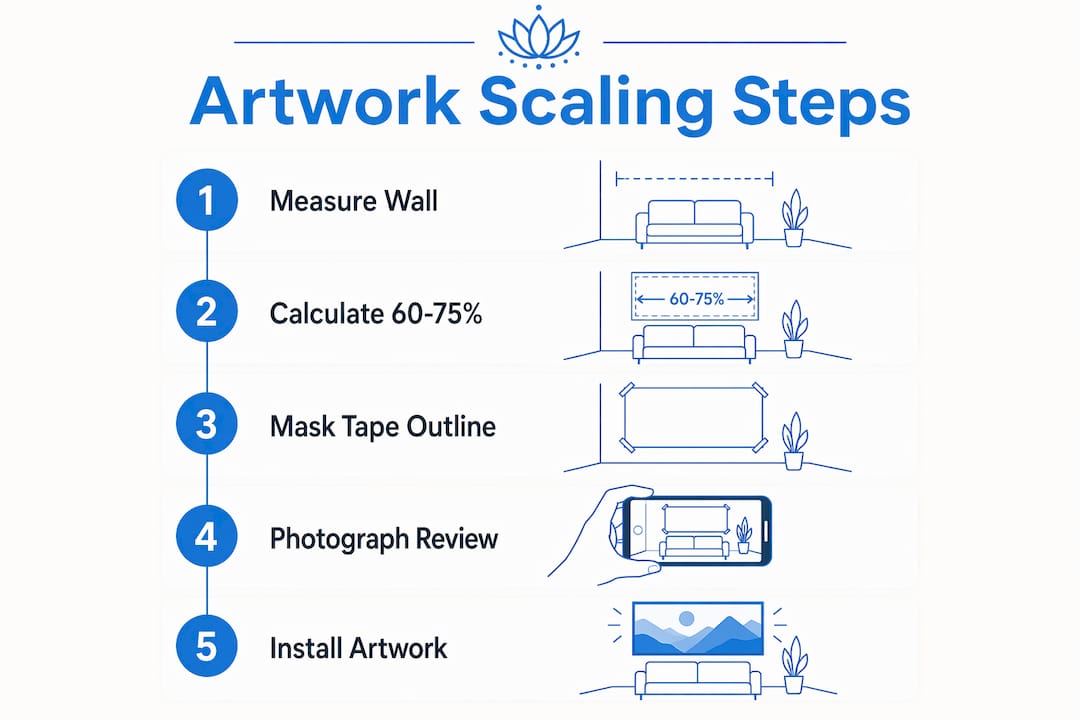
The single most reliable rule in commercial art placement is the 60–75% guideline. Artwork above furniture should cover 60–75% of the available wall width. On empty walls with no furniture anchor, the target drops to 40–60% of total wall area. These percentages exist because the human eye reads negative space as intentional only within a certain range. Too much empty wall makes art look like an afterthought.
Start every project by measuring wall width and usable height separately. Usable height accounts for baseboards, crown molding, and any architectural interruptions. Wall function matters just as much as raw dimensions. A client-facing reception wall calls for a bolder, larger piece than a transitional corridor where viewers pass quickly and rarely stop.

The most underused technique in commercial art planning is the masking tape method. Tape out the proposed dimensions directly on the wall before ordering anything. Stand at the primary viewing distance, which is typically 10–15 feet for lobbies and conference rooms, and assess whether the footprint reads as commanding or timid. This costs nothing and prevents the most common and expensive mistake in commercial installations.
| Measurement step | Tool | What to assess |
|---|---|---|
| Wall width | Laser measure or steel tape | Total span minus architectural interruptions |
| Usable height | Steel tape | Floor to ceiling minus moldings and fixtures |
| Furniture anchor zone | Tape measure + masking tape | Width of sofa, credenza, or table below |
| Viewing distance | Laser measure | Primary sightline from entry or seating |
| Scale visualization | Masking tape on wall | Proposed artwork footprint before ordering |
Pro Tip: Photograph the taped wall from the primary entry point. Review the photo on a phone screen. If the taped rectangle disappears into the background, the proposed size is too small.
What materials work best for large-scale commercial wall art?
Material choice determines how large-scale art performs under commercial conditions, not just how it looks on day one. Metal and dimensional installations resist fading and glare far better than flat canvas under LED or fluorescent lighting. This matters in open-plan offices and hospitality spaces where lighting is bright, consistent, and often angled.
Canvas prints remain a strong option, but their best application is in private offices, executive suites, and breakout rooms where lighting is softer and viewing distances are shorter. In high-traffic areas with overhead commercial lighting, flat canvas can wash out or create unwanted glare at certain angles.
High-resolution images are non-negotiable for large-scale commercial work because viewers in office environments approach walls closely. A mural or oversized print that looks sharp from 20 feet must also hold detail at 3 feet. This dual-distance requirement rules out low-resolution files and most consumer-grade printing processes.
- Canvas prints: Best for private offices and breakout rooms. Affordable, lightweight, and easy to swap. Vulnerable to glare under direct commercial lighting.
- Metal prints: Excellent glare resistance. Durable under high-traffic conditions. Higher cost but longer lifespan in lobby and conference settings.
- Dimensional and relief installations: Maximum visual impact at scale. Absorb sound and add texture. Require structural wall assessment and higher budgets.
- Modular panel systems: Ideal for walls over 25 feet. Allow phased installation and future reconfiguration. Coordination with trades required.
Pro Tip: Request a printed sample at 12x12 inches before approving a large-scale canvas order. View it under the actual lighting conditions of the target space, not in a studio or showroom.
How does scaled artwork integrate with commercial interior design?
Large-scale artwork functions like a structural finish in commercial spaces. It anchors sightlines, defines zones, and even absorbs sound during meetings. This means artwork decisions belong in the early design phase, not as a final decoration layer after construction ends.
The relationship between art scale and furniture scale is direct. A boardroom table that runs 12 feet long needs artwork that matches its visual weight. Undersized art above an expensive conference table creates a mismatch that diminishes both elements. The art should feel like it belongs to the same design family as the furniture, not like it was added later.
Artwork developed in parallel with architecture aligns better with sightlines, circulation paths, and architectural features. Early BIM modeling that includes art specifications prevents conflicts with lighting fixtures, electrical outlets, and hardware installations. Designers who treat art as a finish material from day one avoid costly rework.
| Space type | Integration priority | Scale approach |
|---|---|---|
| Corporate lobby | Sightline from entry | Single large anchor piece, 60–75% of feature wall |
| Open-plan office | Zone definition | Modular sequence across long walls |
| Conference room | Focal wall behind presenter | Art width matches table length |
| Hospitality corridor | Movement and wayfinding | Sequenced pieces with deliberate spacing |
| Retail environment | Brand identity and customer engagement | Bold graphics at eye level, high resolution |
For walls longer than 25 feet, a single piece rarely works. Using 3–5 coordinated pieces with deliberate spacing maintains visual balance across open-plan commercial spaces. The spacing between pieces should be consistent and proportional to the piece widths, typically 6–12 inches for a tight sequence and 18–24 inches for a more open arrangement.
What are the best practices for commissioning large-scale artwork?
Commissioning large-scale art for a commercial space requires a project brief that describes the wall, not the brand. The wall’s dimensions, function, lighting conditions, and primary viewer distance are the brief. Brand colors and logo guidelines come second. Designers who lead with brand guidelines often end up with art that fits the brand deck but fails the physical space.
Budget ranges vary widely based on scale, material, and engineering requirements. A cast metal relief at 6 feet differs significantly in cost from a 20-foot modular installation that requires structural wall anchoring and electrical coordination. Always request itemized quotes that separate fabrication, shipping, installation labor, and any required engineering sign-off.
- Measure and document the wall. Record width, usable height, substrate material, and any obstructions. Note lighting type and fixture positions.
- Define the wall’s function. Client-facing, team-facing, or transitional. This determines appropriate scale and visual complexity.
- Tape the proposed footprint. Use masking tape to visualize dimensions on-site before finalizing the order.
- Specify resolution and viewing distance. Confirm that the artwork file or fabrication method supports close-range viewing.
- Coordinate with trades early. Share art specifications with electricians and painters before final finishes are applied.
- Sequence installation after construction. Schedule art installation after painting, flooring, and lighting are complete to avoid damage.
- Document the finished installation. Photograph from primary sightlines and record hardware specifications for future maintenance.
Timing is the most overlooked variable in commercial art projects. Art ordered after construction begins often arrives before the space is ready or, worse, after trades have installed fixtures that conflict with the planned placement. Treat the art installation as a trade in its own right and schedule it accordingly.
Key Takeaways
Correct artwork scale in commercial interiors requires measuring wall dimensions, matching art size to furniture and room function, selecting materials suited to commercial lighting, and coordinating installation with other trades from the earliest design phase.
| Point | Details |
|---|---|
| Follow the 60–75% rule | Artwork above furniture should cover 60–75% of available wall width for visual impact. |
| Use masking tape to visualize | Tape proposed dimensions on the wall before ordering to prevent costly scale errors. |
| Match material to lighting | Choose metal or dimensional work for bright commercial lighting; reserve canvas for softer spaces. |
| Integrate art in early design | Include art specifications in BIM models to align with sightlines, lighting, and hardware. |
| Brief the wall, not the brand | Lead with wall dimensions and function when commissioning; brand guidelines come second. |
What I’ve learned from watching designers get scale wrong
The most common mistake I see is not choosing bad art. It’s choosing good art at the wrong size. A beautifully printed canvas that measures 24x36 inches disappears on a 14-foot lobby wall. The client approves it in a catalog, it arrives, and suddenly a $3,000 installation looks like a poster from a college dorm. The wall wins every time.
What I’ve found actually works is treating scale as the first creative decision, not the last logistical one. Before any style discussion, before any color palette conversation, the wall gets measured and the footprint gets taped. Only then does the design conversation begin. This sequence changes everything because it forces the space to set the terms.
The other thing I’ve noticed is that designers often confuse visual restraint with small scale. A single large abstract piece in a muted palette reads as restrained and confident. Three small pieces clustered together reads as indecisive. Boldness at the right scale is not the same as loudness. The Bull Wall Street canvas is a good example of a piece that commands a wall without overwhelming it, because the composition is built for scale.
Trends in 2026 are moving toward dimensional and textured surfaces in corporate environments, particularly in spaces where acoustic performance matters. Flat art is not going away, but the most interesting commercial installations I’m seeing combine canvas prints with dimensional elements to create depth that reads well from both 20 feet and 3 feet.
— Sense
Sensecanvas collections for commercial-scale wall art
Interior designers and business owners working on commercial spaces need art that performs at scale without requiring a custom fabrication budget for every project.
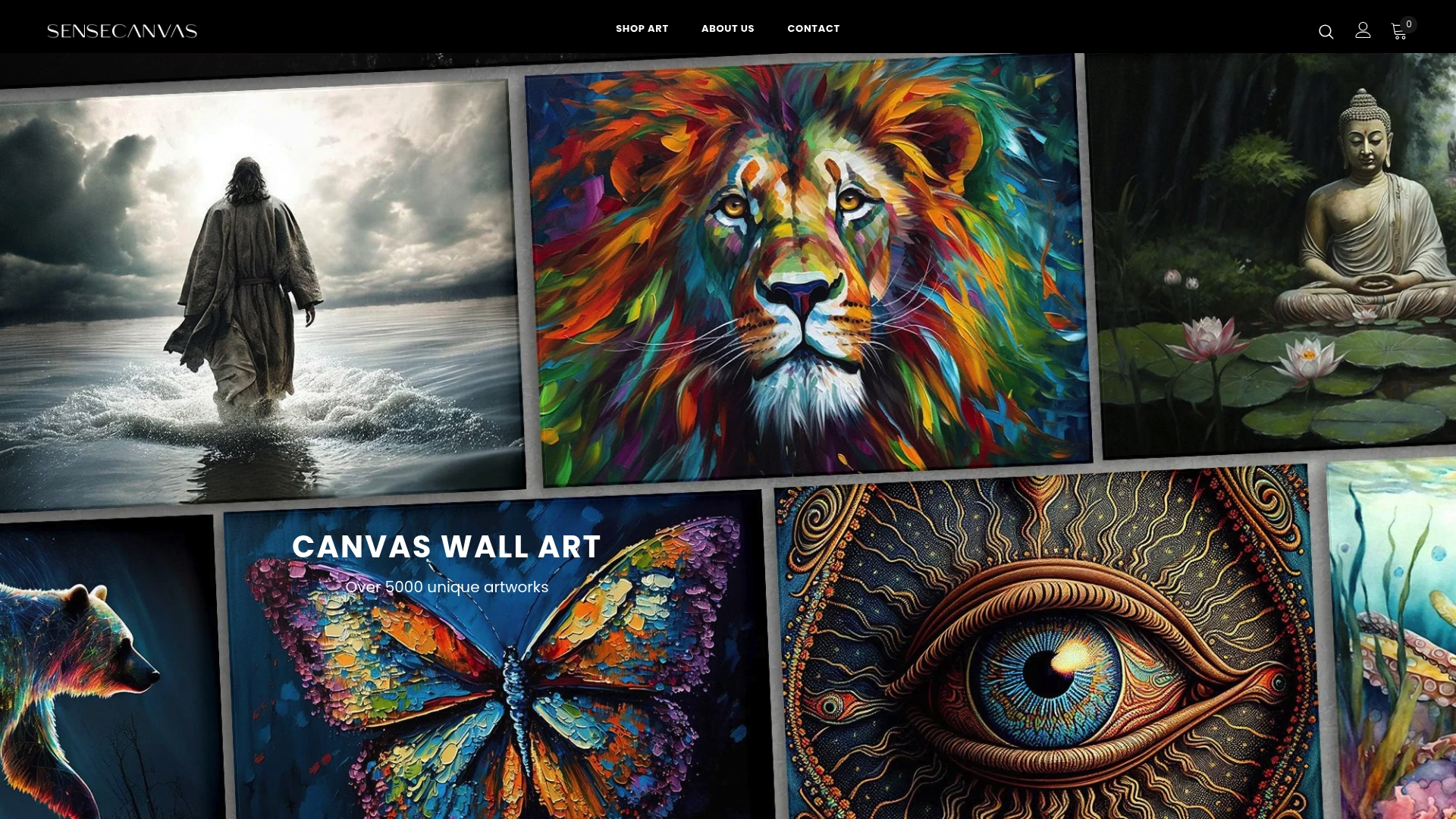
Sensecanvas offers over 15,000 canvas artworks with custom sizing options, starting at $85, making it practical to order pieces sized to actual wall dimensions rather than settling for standard catalog sizes. The collection covers abstract compositions, motivational pieces, and bold graphic prints suited to corporate offices, hospitality spaces, and retail environments. A New York City canvas print scaled to a feature wall in a hotel lobby, or a motivational office art piece sized to anchor a conference room wall, are the kinds of applications the Sensecanvas catalog supports directly. Browse the full canvas wall art collection to find pieces that fit your wall dimensions and space function.
FAQ
What percentage of a wall should artwork cover in a commercial space?
Artwork above furniture should cover 60–75% of the available wall width. On empty walls, target 40–60% of total wall area to maintain visual balance.
How do I visualize artwork scale before ordering?
Use masking tape to outline the proposed artwork dimensions directly on the wall. View the taped footprint from the primary sightline to confirm the scale reads correctly before placing an order.
What is the best material for large-scale artwork in offices?
Metal and dimensional installations perform best under commercial LED and fluorescent lighting because they resist glare and fading. Canvas prints work well in private offices and breakout rooms with softer lighting conditions.
When should artwork be integrated into a commercial design project?
Art specifications should enter the design process during early planning, alongside architecture and interiors. Including art dimensions in BIM models prevents conflicts with lighting fixtures, electrical outlets, and hardware installations.
How many pieces should cover a wall longer than 25 feet?
A sequence of 3–5 coordinated pieces with deliberate, consistent spacing works better than a single piece on walls longer than 25 feet. This approach maintains visual balance across open-plan commercial environments.
Recommended
- New York City Canvas Wall Art Print Decor Artwork Picture Painting Poster Souvenir Statue Liberty Empire Building – Sense Canvas
- M4 Gun Canvas Wall Art Print Decor Artwork Picture Painting Poster Gold Rifle M4A4 Military Firearm – Sense Canvas
- Grind Canvas Wall Art Print Decor Artwork Picture Painting Poster Neon Motivation Office Inspiration – Sense Canvas
- 100 Bill Gold Canvas Wall Art Print Decor Artwork Picture Painting Poster Hundred Benjamin Franklin Money Cash – Sense Canvas