Map Wall Art Ideas: 3 Weekend DIY Projects and Custom Canvas Options
The strongest map wall art ideas share one trait: scale and material matched to purpose. A large canvas focal map anchors a living room, a framed vintage grid warms a library wall, a layered wooden relief adds texture to an entryway, and a push-pin travel tracker earns its spot in a hallway people actually walk past. Pick the style that fits your room first, then match the support, size, and finish, or order a custom canvas built to those exact dimensions.
TL;DR:
- Large-scale relief maps require wall dimensions of at least 100 by 150 centimeters to retain detail and should be displayed on prominent, spacious walls.
- Monochrome or neutral maps are preferable in busy rooms or with patterned backgrounds, while colorful maps serve as focal points in neutral spaces.
- Support choice affects durability and appearance; canvas offers a matte finish ideal for focal points, whereas paper or acrylic enhances detail and color for smaller or vintage pieces.
- Marking options like pins or removable stickers are best for travel maps on cork or foam backing to prevent wall damage over time.
- For optimal visual balance, maps should occupy roughly two-thirds of the furniture width, with an ideal hanging height around 57-60 inches from the floor.
Table of Contents
- Map Wall Art Ideas by Style: What Each Looks Like and Where It Belongs
- Choosing the Right Material for Your Map Style
- Personalizing and Arranging Map Art on Your Wall
- Getting the Size, Height, and Color Right
- DIY Map Wall Art Projects Worth a Weekend
- A Curator’s View on What Makes Map Art Actually Land
- Order a Custom Map Canvas from Sensecanvas
- Sources
- FAQ
Map Wall Art Ideas by Style: What Each Looks Like and Where It Belongs
Not every map style belongs in every room. A sepia-toned antique chart reads as heirloom in a library; the same map in neon pop colors reads as a dorm poster. Matching the style to the space is the whole game.
- Vintage and antique maps. Sepia tones, aged paper texture, and old-world typography suit libraries, studies, and traditional living rooms. Framed in small grids of three or four, they read as a curated collection rather than a single decoration.
- Minimalist and monochrome maps. Black-and-white line work or a single accent color on a neutral ground fits modern apartments and offices where you want geography without visual noise. These work especially well as a world map canvas decor piece hung solo above a desk or console.
- Colorful and pop-style maps. Bright, saturated palettes energize kids’ rooms and eclectic living spaces, but designers generally cap the palette at three or four colors so the piece reads as intentional, not chaotic.
- Topographic and relief maps. Mountain ranges and ocean trenches rendered in raised or shaded detail only register at scale. Alessio Cacciatore’s guide to map wall decor notes that relief detail gets lost below roughly 100 by 150 centimeters, so this style demands your biggest wall, not your smallest one.
- Wooden and laser-cut layered maps. Stacked plywood layers cast real shadows and read more like sculpture than print, which is why maker communities favor them for entryways and console walls where texture matters as much as image. Makers who work with layered plywood note it casts natural shadows that give the piece a sculptural quality no flat print can match, according to Atomm’s roundup of world map wall art ideas.
- Travel tracker and push-pin maps. Cork-backed or thick-panel canvases built for pins turn a wall into a running log of trips taken, which makes them a favorite for hallways, home offices, and family rooms.
- Murals and feature walls. Oversized wallpaper or custom-printed murals turn an entire wall into the map itself, ideal for stairwells, home offices, or a statement behind a bed.
- Single-state or single-country cutouts. A silhouette of a hometown state or a family’s country of origin makes a smaller, more sentimental piece than a full world map, and it tends to carry more emotional weight per square foot.
- Map plus quote or illustrated landmarks. Adding a travel quote, a set of hand-drawn icons, or small illustrated landmarks personalizes an otherwise generic print without requiring a full custom redesign.
Homes & Gardens’ guide to decorating with maps lists ten approaches that lean on exactly this range, from formal grids to quirky gallery walls, and specifically calls out small spaces like home offices and cloaklooms as places where a single well-chosen map does more work than a larger, busier piece.
Choosing the Right Material for Your Map Style
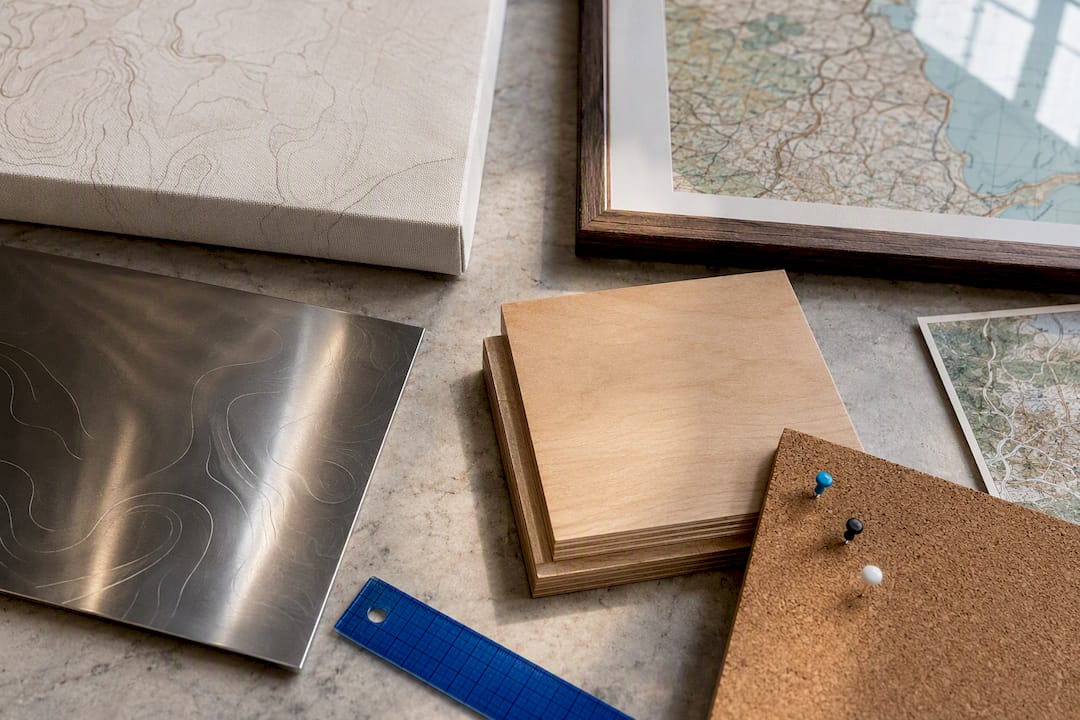
The support you choose changes both the look and the lifespan of the piece. Gallery-wrapped canvas gives a matte, low-glare finish that reads as museum-grade, which is why it’s the go-to for large focal maps and most custom canvas map artwork. Paper prints framed under glass render fine detail better, so they suit vintage engravings and typographic maps where you want to read every place name.
Aluminum and Dibond, along with acrylic face-mounts, deliver punchy color and a glossy, contemporary look, better suited to bold pop-style maps than antique ones. Plywood and laser-cut wood are the only real option for layered relief pieces, and a thickness of around half an inch per layer with a light matte seal tends to hold up well. Cork or foam-backed boards are non-negotiable for any push-pin travel map, since canvas or acrylic alone won’t hold a pin. Whatever the support, ask your printer for 150 to 300 DPI at final print size, and crop tightly around the region you actually want featured rather than shrinking a full world map to fit a small frame.
Personalizing and Arranging Map Art on Your Wall
A map becomes personal the moment you start marking it, but not every marking method ages well. Push-pin systems need a cork or foam backing, and color-coding pins by trip type (family, solo, work) keeps a busy map readable years in. Repositionable stickers and laminated overlays let renters mark places visited without committing to holes in the wall.
Framing should follow the map’s personality: thin black frames read modern, raw or reclaimed wood frames suit vintage pieces, and float frames work well for maps with deckled or torn edges. For arrangement, three layouts cover almost every situation: a formal gallery grid, an asymmetric cluster, and a triptych of three matching panels. Homes & Gardens recommends grids for a formal look and looser gallery walls for eclectic rooms, which lines up with what actually holds up over time.
- Lay pieces out on the floor in your planned arrangement before hanging anything.
- Add a picture light or concealed LED strip behind layered wood maps to deepen the shadow effect at night.
- Skip scratch-off world maps if you want a piece that still looks good in five years; Cacciatore’s guide points out they tend to look visually unbalanced once partially scratched, and dry-erase markers or simple pins hold up better as a marking system.
Pro Tip: Cut a paper template the exact size of your planned map and tape it to the wall for a day before you commit. You’ll catch scale problems a tape measure alone won’t show you.
Getting the Size, Height, and Color Right
Most map art fails not because of style but because of scale. Follow the two-thirds rule: your map’s width should run about two-thirds the width of the furniture below it, so a 70-inch sofa pairs well with a map roughly 45 to 48 inches wide. For a solo piece with no furniture beneath it, center the artwork so its middle sits 57 to 60 inches from the floor, which is the standard eye-level gallery height.
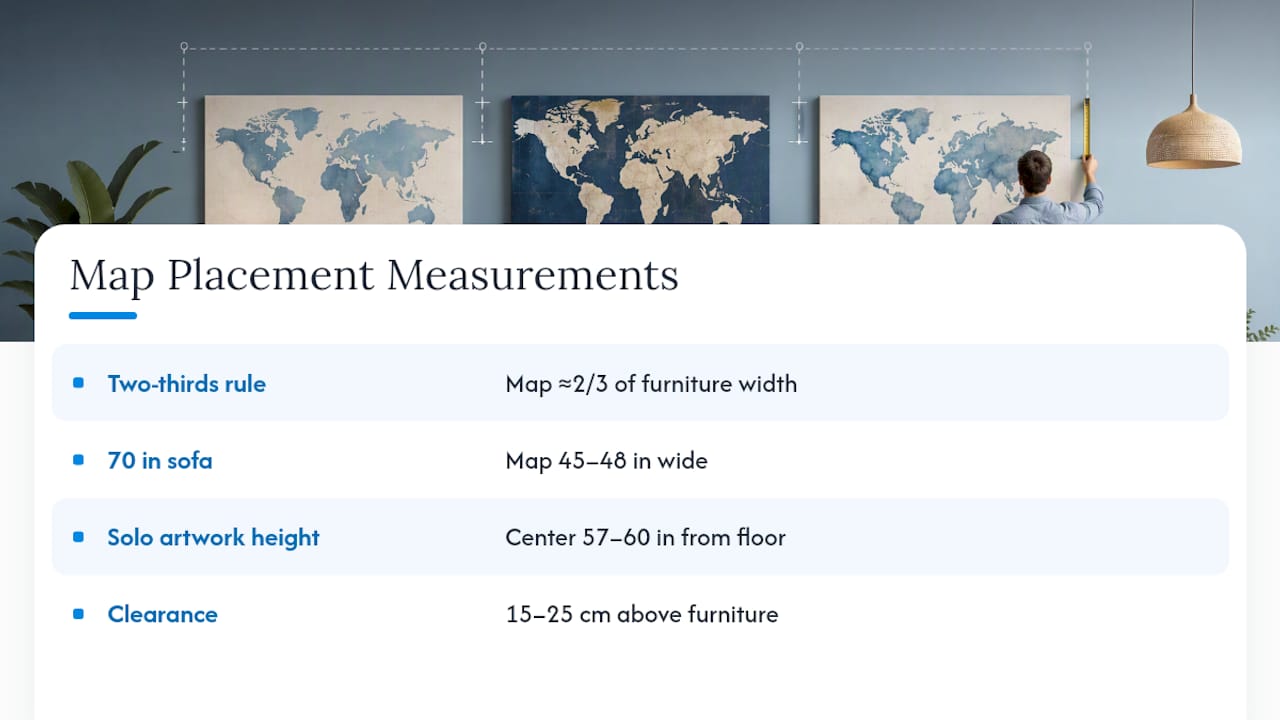
When hanging above a sofa, bed, or console, leave 15 to 25 centimeters of space between the top of the furniture and the bottom of the frame.
Color matters as much as size. In a room with patterned wallpaper or busy textiles, a restrained monochrome map keeps things calm; in a neutral room, a bold, colorful map becomes the focal point the space is missing. Homes & Gardens makes this exact trade-off explicit: quiet palette for busy rooms, bold statement piece for plain ones. Before buying, measure your wall, tape up a paper template, and check the room at different times of day for glare on glossy finishes.
DIY Map Wall Art Projects Worth a Weekend
If you’d rather make something than order it, three projects cover most skill levels.
- Framed collage from map scraps (easy). Cut sections from old road maps or atlases, arrange them in a grid inside a single mat, and glue with acid-free adhesive so the paper doesn’t yellow unevenly over time.
- Decoupage furniture piece (intermediate). Seal map paper onto a small tabletop or chest with decoupage medium, sanding lightly between coats and finishing with a matte sealant in a ventilated space.
- Layered plywood relief or single-country cutout (advanced). Prep your file in vector layers, cut plywood at roughly half-inch thickness per layer, and mount with spacers so each layer casts its own shadow, an approach maker communities favor for exactly that sculptural effect.
Keep a utility knife, cutting mat, adhesive, sandpaper, and a respirator or well-ventilated room on hand for any sealant work. For anything beyond these scales, a large mural, a high-resolution city crop, or a museum-quality print, commissioning tends to produce a cleaner result than a DIY attempt.
A Curator’s View on What Makes Map Art Actually Land
Curating thousands of canvas designs teaches you that a map wall doesn’t succeed because of trend timing. It succeeds when the map means something: a hometown, a honeymoon route, a color palette pulled from the room itself. Choose DIY when you want the process and have the time; choose a custom canvas when you want permanence and a clean finish without the sanding and sealing.
— Sense
Order a Custom Map Canvas from Sensecanvas
You can order a finished, gallery-quality map canvas without the cutting mat, decoupage medium, or weekend commitment, at a fraction of what a commissioned mural costs. Prices for custom pieces start from accessible price points, and the catalog includes a wide variety of designs, allowing a world map wall decor piece to be resized, recolored, or cropped to your exact wall before it ever ships.
Ordering is straightforward: measure your wall using the two-thirds rule above, pick your finish (matte canvas for a large focal map, a crisper substrate if you want bold color), choose your size, and submit any custom crop or location request at checkout. Pieces arrive ready to hang, so there’s no separate framing step to plan around. If you already know the look you want, start with a world map canvas as a template for size and finish, or head to the Sensecanvas homepage to browse the full range of custom map prints and get a size that matches your wall exactly.
Sources
Design guidance drawn from Homes & Gardens, Alessio Cacciatore’s map decor guide, Atomm’s maker roundup, and PushPin Travel Maps.
FAQ
What are the trends in wall art for 2026?
Layered wooden maps, large-format topographic canvases, and personalized push-pin travel trackers are leading the shift toward map art with texture and a story, rather than flat decorative prints.
What is the two-thirds rule for wall art?
Your artwork’s width should measure roughly two-thirds the width of the furniture it hangs above, and the frame should sit 15 to 25 centimeters above that furniture’s top edge.
What can I make with old maps?
Old maps work well as framed collages, decoupage surfaces on small furniture, or cut into layered relief pieces, and sections can also be trimmed down into single-country cutouts for a more personal display.
How do I display a map on a wall?
Center a solo piece at 57 to 60 inches from the floor, or group several into a grid, asymmetric cluster, or triptych, testing the layout on the floor before you hang anything.
Should I buy a custom map canvas or make one myself?
DIY suits smaller, lower-stakes projects where you have time to spare, while a custom canvas from a provider like Sensecanvas makes more sense for large focal pieces, precise sizing, or when you want a finished, ready-to-hang result without the sanding and sealing.