Hallway Wall Art: 3 Narrow Space Solutions With Exact Hanging Rules
The three approaches that work in almost any hallway are a vertical statement piece, a slim gallery wall, and a well-placed mirror. Choose the vertical piece for narrow corridors, a tight gallery grid for wider or longer runs, and a mirror for windowless or dim stretches that need light. Custom canvas prints in hallway-friendly sizes are available, which helps when a standard frame won’t fit an awkward wall.
TL;DR:
- Choosing a vertical statement piece or a slim gallery wall depends on the hallway’s width and ceiling height, with vertical art ideal for narrow corridors.
- Proper sizing involves measuring the usable wall space, centering art at 57 to 60 inches from the floor, and mock-up testing with painter’s tape before hanging.
- Durable materials like canvas prints or acrylic-glazed giclée prints are recommended to withstand frequent bumps and foot traffic, with hardware rated at least twice the frame’s weight.
- Lighting techniques such as wall sconces, reading mirrors opposite light sources, and using reflective or light-colored art can make dim hallways appear larger and more inviting.
- Budget-friendly ideas include framing postcards, printing personal photos, or creating DIY art, emphasizing repetition and restraint for a polished, cohesive look.
Table of Contents
- Hallway Wall Art Ideas That Actually Work in Tight Spaces
- How to Size and Hang Hallway Art Without Guesswork
- Materials and Framing That Hold Up in a Hallway
- Lighting and Mirror Tricks That Make a Hallway Feel Bigger
- Layout Checklists for Narrow Halls, Stair Landings, and Long Runs
- Refreshing Hallway Decor With Thematic and Seasonal Art
- Wall Decals and Wallpaper as an Alternative to Framed Art
- Mixing Art Styles Without the Wall Looking Like a Mess
- Keeping Hallway Wall Art Looking Good Over Time
- DIY Hallway Art Ideas That Won’t Break the Budget
- Why Restraint Beats Decoration in Every Hallway
- Finding the Right Canvas Size for Your Hallway
- Sources
- FAQ
Hallway Wall Art Ideas That Actually Work in Tight Spaces
Most hallway art fails for one reason: it was picked for a living room, then squeezed into a space that behaves nothing like one. A hallway is a transition zone people walk through, not a room they sit in. That changes which ideas actually earn their spot on the wall.
Gallery wall. A tight grid of three pieces, spaced 2.5 to 3 inches apart, reads as one composition instead of clutter. Keep frame finishes matched (all black, all natural wood) so the eye reads a set rather than a scavenger hunt. A limited number of pieces works best for narrow halls; too many starts crowding a walking plane that’s already tight.
Vertical single statement piece. This is the default answer for narrow corridors and anything with tall ceilings, since a tall, slim canvas draws the eye up rather than out. Curated hallway roundups consistently favor vertical orientation for exactly this reason: it works with the shape of the space instead of against it. Hanging one above a console table? Aim for about two thirds the width of the table for balanced scale.
Mirrors. A slim or frameless mirror hung opposite a window or light fixture reflects light back down the hall and makes the whole run feel wider. Skip chunky, ornate frames here. They eat into the visual width you’re trying to create.
Textured or sculptural wall art. Shallow relief pieces add depth without demanding much floor clearance, and in tiled or hard-surfaced entries, texture can even help absorb some sound that would otherwise echo. Skip this option in already-narrow corridors where anything projecting more than an inch or two becomes a shoulder hazard. For a hallway with real square footage to spare, sculptural pieces can anchor a wall in a way flat prints can’t.
Console vignette with layered art. A shallow shelf, a lamp, and a piece of art that leans rather than hangs gives you a display you can swap out in five minutes. It’s the lowest-commitment option on this list.
Framed photo lineup or linear series. For long, straight runs, repeat a consistent frame size at a steady rhythm down the wall. The repetition itself becomes the design; matching mats and frames matter more here than in almost any other layout, since one mismatched frame breaks the whole line.
Not sure how these grids come together in practice? A gallery wall guide walks through spacing and mockups in more detail.
Pro Tip: Before buying anything, tape the exact art dimensions to the wall with painter’s tape and walk past it for two days. If you catch a shoulder on it once, it’s hung too low or sized too wide for that corridor.
How to Size and Hang Hallway Art Without Guesswork
Getting the numbers right matters more in a hallway than almost anywhere else in the house, because there’s no sofa or rug to visually anchor the piece. Follow this sequence:
- Measure the clear wall area after subtracting door swing and any trim. That’s your actual usable plane, not the wall’s total width.
- Center art at 57 to 60 inches from the floor as a baseline. In high-traffic hallways, raise the center to 62 to 64 inches to keep frames clear of shoulders and bags.
- Apply the two-thirds rule above consoles: the art should span roughly two thirds of the table’s width, with 6 to 8 inches of breathing room between the tabletop and the frame’s bottom edge.
- Mock it up with paper templates taped to the wall before you commit to hardware. Live with it a day or two, then transfer to the real piece once it feels right.
Materials and Framing That Hold Up in a Hallway
Hallways take more foot traffic and more accidental bumps than any other wall in the house, so material choice matters more here than in a bedroom.
- Canvas prints need no glazing at all, which means less to clean and nothing to shatter. Just confirm the stretcher bar depth against your corridor width before ordering. A 1.5 inch profile can eat into door swing clearance in a genuinely narrow hall.
- Giclée prints with acrylic glazing offer archival-quality color and UV resistance, and acrylic weighs less and is far less likely to shatter than glass if a doorway gets slammed.
- Anchors and hardware should be rated at least twice the frame’s weight. Screw into studs whenever you can rather than relying on drywall anchors alone.
- Sealed backing and deep rabbet frames cut down on dust getting behind the glass or acrylic, which matters in a space that gets swept less often than a living room.
Lighting and Mirror Tricks That Make a Hallway Feel Bigger
Light does more work in a hallway than in almost any other room, because hallways so often lack their own windows.
- Install wall sconces or picture lights for even illumination without the glare a single overhead fixture creates.
- Hang mirrors opposite windows or light sources to bounce light back down the corridor; slim or frameless styles preserve width in tight spots.
- Pick lighter-value art or pieces with reflective highlights for genuinely dim corridors, where a dark, moody canvas will just disappear.
- Add dimmable fixtures so you can shift the mood and control where the eye lands.
One consistent finding across entryway styling roundups is that a mirror paired with a small lamp and a simple vase reads as intentional design rather than an afterthought. That layered vignette does more visual work than a single oversized piece ever could in a dim, windowless stretch.
Layout Checklists for Narrow Halls, Stair Landings, and Long Runs
Different hallway shapes call for different rules. Run through whichever checklist matches your space before you pick up a hammer.
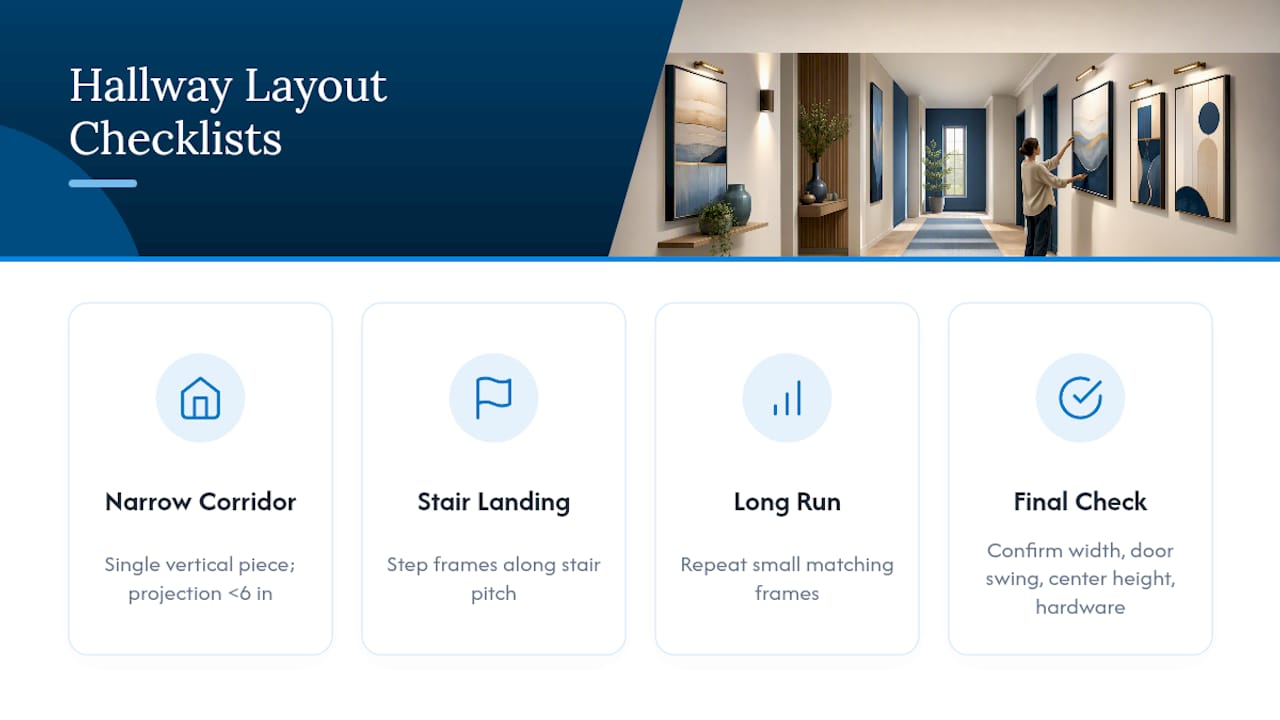
Narrow corridor: Go with a single vertical piece, keep frame projection under 6 inches, and raise the center height if the hall sees heavy foot traffic.
Stair landing: Use a slope-aware layout that steps frames along the stair’s pitch rather than a straight horizontal line. A staircase wall art guide covers the slope math and staggered spacing in more depth.
Long straight run: Repeat smaller, matching frames in a steady rhythm. Consistency in mat and frame color matters more than any single piece here.
Final measurement pass: Confirm clear plane width, door swing clearance, center height, and hardware rating before you drill a single hole.
Refreshing Hallway Decor With Thematic and Seasonal Art
A hallway is one of the easiest rooms in the house to refresh seasonally, precisely because it’s usually a small, contained wall plane rather than an entire room to redecorate. Swapping one or two pieces for autumn foliage prints, winter botanicals, or a warm-toned abstract for spring costs far less effort than repainting or re-furnishing.
The trick is committing to a rotation system rather than a one-off swap. Pick a frame size and mounting hardware you’ll keep permanently, then rotate inserts or canvases seasonally within that same footprint. This avoids repatching drywall every few months and keeps the hallway’s overall proportions consistent year-round.
Thematic runs work well too: a coastal series for summer, a set of botanical studies that stays up most of the year with one accent piece that changes. Holiday-specific art can work in a hallway if it’s subtle. A muted, abstract piece with warm tones reads as festive without looking like a decoration you’ll want to take down by mid-January.
If you’re building toward a full seasonal rotation, buy your permanent frame or canvas size once and treat every seasonal piece as an insert that fits that exact dimension. It saves money over time and keeps the wall from looking like a different, unrelated decision every few months.
Wall Decals and Wallpaper as an Alternative to Framed Art
Not every hallway needs framed pieces at all. A bold wallpaper or a single papered accent wall can do the job of several framed prints combined, especially in a small foyer where wall space is already at a premium. Design roundups have made the case that a striking wallpaper pattern often reduces the need for additional wall decor entirely. Once the wall itself is the statement, you don’t need to compete with it.
Removable wall decals sit at the more flexible end of this spectrum. They’re a genuinely practical option for renters who can’t paint or wallpaper but still want more than bare drywall. A large botanical decal or a geometric pattern applied to one wall of a windowless hallway can mimic the effect of framed art at a fraction of the cost, and it comes down cleanly at move-out.
The tradeoff is durability and texture. Decals and wallpaper don’t offer the tactile depth a canvas or textured piece provides, and busy patterns can start to feel chaotic in a hallway that’s also carrying foot traffic, coat hooks, and shoes. If you go this route, pair it with restraint elsewhere. One statement wall covered in pattern, with the opposite wall left mostly clear, keeps a narrow hallway from feeling like it’s closing in.
Mixing Art Styles Without the Wall Looking Like a Mess
Mixing styles in a hallway is riskier than in a living room simply because there’s less visual buffer between pieces. A gallery wall that mixes a photograph, an abstract print, and a botanical illustration can absolutely work, but it needs at least one unifying thread holding it together.
Color is the easiest thread to pull. Choose a palette (say, warm neutrals with one accent tone) and let every piece, regardless of subject matter, draw from that same range. Frame finish is the second easiest lever: matching frame color across mismatched art styles makes the grouping read as curated rather than accidental.
Scale consistency helps too. If you’re combining a large abstract canvas with smaller framed photographs, group the small pieces tightly together so they read as one visual unit next to the larger piece, rather than scattering them at random intervals down the hall.
The one combination to be careful with is texture plus pattern plus multiple colors all at once. Pick two of those three variables to vary and hold the third steady. A hallway mixing a heavily textured relief piece, a busy patterned print, and five different colors will feel chaotic no matter how good each individual piece is on its own.
Keeping Hallway Wall Art Looking Good Over Time
Hallways collect more dust and grime than most rooms simply because of foot traffic, and art hung there needs a maintenance routine that matches.
Canvas prints hold up well with a dry microfiber cloth wipe every few weeks; skip liquid cleaners entirely, since moisture can warp canvas fibers or dull the print surface over time. For giclée prints under acrylic glazing, a slightly damp microfiber cloth followed immediately by a dry one keeps the surface clear without streaking, and acrylic won’t fog the way glass sometimes does in humid entryways near an exterior door.
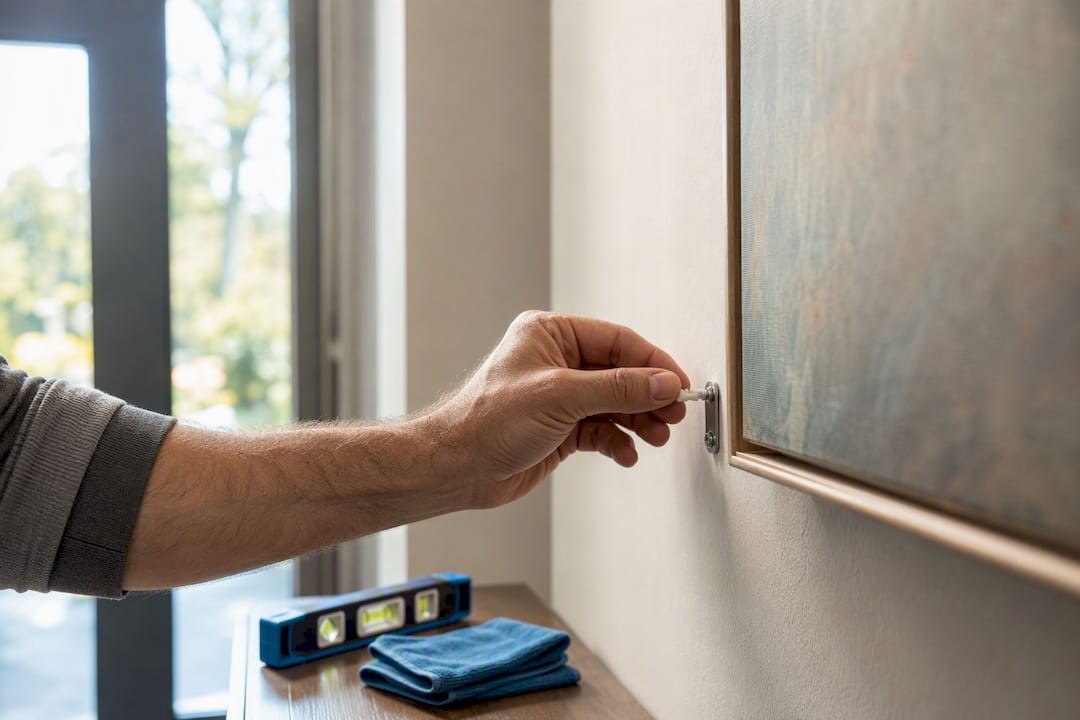
Check hanging hardware every six months or so, especially in older homes where wall anchors can loosen with vibration from foot traffic or door slams. A frame that’s shifted even slightly is often the first sign an anchor needs replacing before the piece actually falls.
Direct sunlight is the bigger long-term threat, particularly for hallways near a front door with a sidelight window. Rotating pieces seasonally, as covered above, has the side benefit of limiting any single print’s UV exposure. If a hallway gets consistent direct sun for part of the day, acrylic glazing’s UV resistance becomes less of a nice-to-have and more of a real requirement.
DIY Hallway Art Ideas That Won’t Break the Budget
You don’t need a large budget to make a hallway feel finished. A few low-cost approaches consistently punch above their price:
- Frame a set of postcards, vintage maps, or fabric swatches in matching inexpensive frames for an instant gallery grid.
- Print your own black-and-white photography at a local shop and hang it in uniform frames down a long run.
- Paint a single abstract canvas yourself in two or three colors that echo your existing decor. Imperfection reads as intentional at hallway viewing distance.
- Repurpose a large mirror you already own by adding a slim frame kit rather than buying new.
- Create a botanical pressed-leaf display in shallow shadow boxes for a textured look without the cost of dimensional art.
The common thread across every one of these ideas is repetition and restraint. A handful of $10 frames, hung with the same spacing and height discipline covered earlier, will look more finished than one expensive piece hung without any real plan.
Why Restraint Beats Decoration in Every Hallway
Designers consistently call hallways “transition zones,” and that framing explains why the best hallway walls often have less on them, not more. Negative space isn’t wasted space here. It’s what keeps a narrow corridor from feeling like a hoarder’s gallery.
A large catalog of designs exists partly because no two hallways share the same proportions, and starting prices make it realistic to size a piece specifically for an awkward wall rather than force-fitting something off the shelf. Custom sizing a narrow vertical canvas down to something like 18 by 36 inches, for instance, keeps it clear of a door’s swing radius in a way a standard 24 by 48 inch print never could.
— Sense
Finding the Right Canvas Size for Your Hallway
Once you know which idea fits your hallway, the harder part is usually finding a piece sized correctly for it. Standard art sizing wasn’t built with narrow corridors or awkward stair landings in mind, which is a common challenge: many designs can be customized to fit a specific wall, not just a standard frame size.

Browsing options for a narrow hallway usually means looking at the vertical abstract and photography categories first, since tall, slim orientations fit tight walking planes without projecting into the path. Affordable options make it practical to size a piece for one wall rather than settling for whatever fits a pre-cut frame. A few things to check before ordering:
- Confirm your exact clear wall width and height against the customization options on each product page.
- Pick canvas over glazed prints if door swing clearance is tight, since canvas has no glass or acrylic layer adding depth.
- Use the mockup and measurement steps covered earlier before finalizing a custom size.
Ready to see what fits your space? Browse the full Sensecanvas catalog, or start with a hallway-friendly option like this vertical abstract canvas sized to order.
Sources
- HGTV — Designer decorating ideas for entryways
- Elle Decor — Hallway decor ideas
- Havenly — Entryway wall decor ideas
FAQ
What kind of art looks good in a hallway?
Vertical statement pieces, tight gallery grids of three frames, and slim mirrors all work well, with the right choice depending on whether your hallway is narrow, long, or lacking natural light.
What are some good wall decor ideas for a hallway?
A console vignette with layered art, a repeated series of matching frames along a long run, or a wallpaper accent wall all create a finished look without overcrowding a tight space.
What are the trends for decorating hallways in 2026?
Thematic and seasonal art rotations within a fixed frame size are gaining traction, alongside custom-sized canvas pieces from sources like Sensecanvas, which fit awkward walls precisely instead of forcing a standard size.
What are some modern wall decor ideas for a hallway?
Textured or sculptural relief pieces, frameless mirrors paired with dimmable sconces, and mixed-media gallery walls unified by a single color palette all read as current without feeling trend-dependent.