10 Hotel Wall Art Ideas Sized for Procurement Teams
For hotels, the best approach splits by zone: bold, identity-defining pieces in lobbies, restaurants, and corridors, and calm, restrained imagery in guest rooms and spa areas, all sized and finished for heavy daily wear. Customizable canvas options like Sense Canvas make it possible to match unusual wall dimensions across dozens of rooms without sacrificing consistency. The sections ahead cover specific concepts by space, exact sizing rules, durable materials, sourcing paths, and rough budget bands so you can move from idea to purchase order.
TL;DR:
- Customizable canvas sizes are essential for fitting unusual wall dimensions and simplifying replacements in hotel rooms, reducing long-term costs.
- Hang above-bed art at 50 to 75 percent of the headboard width, and maintain consistent sizing for gallery groupings and corridor displays.
- Durable materials like metal and acrylic are best suited for high-humidity or outdoor areas, with UV coatings preventing fading in light-exposed zones.
- Pilot smaller orders with a sample print to verify color and texture matching, before committing to large-scale or full-property installations.
- Standardizing sizing, framing, and material durability minimizes operational costs and prevents long-term replacement issues.
Table of Contents
- Hotel Wall Art Ideas for Every Space
- What Hang Height and Sizing Rules Should You Follow?
- Which Materials Hold Up Best in Hospitality Settings?
- How Should Hotels Source and Commission Wall Art?
- Budgeting and ROI for a Hotel Art Program
- A Practical Path to Sizing and Piloting Hotel Art
- The Real Problem With Most Hotel Art Programs
- Sense Canvas for Scalable, Customizable Hotel Art
- Sources
- FAQ
Hotel Wall Art Ideas for Every Space
Ten concepts cover most hospitality needs, from a grand entrance to a quiet spa corridor. Each one solves a different operational or design problem, so pick based on the zone’s traffic, lighting, and guest dwell time.
- Destination-story lobby mural. A large-scale mural depicting local landmarks, terrain, or history turns a lobby wall into a narrative anchor. Murals work best when a hotel wants total wall coverage and a “wow” moment; oversized prints work better when you need flexibility to swap the piece later without repainting or reprinting an entire surface.
- Oversized statement piece for arrival. One dominant artwork, roughly floor-to-ceiling or at least 6 feet wide, gives arriving guests a single focal point instead of scattered decor competing for attention.
- Coherent corridor gallery. Repeated frames at matched spacing and identical mat widths build a rhythm guests notice subconsciously as they walk to their room. Coherent framing and repetition in corridors reinforces brand identity the same way a logo does.
- Calm guest-room art. Landscape photography, black-and-white studies, and soft abstracts dominate guest rooms because they support rest and integrate easily with existing palettes rather than competing with them.
- Feature wall behind the bed. Wallpaper, printed panels, or a fabric-wrapped headboard can double as the room’s art statement, reducing the need for a separate framed piece.
- Themed rooms or floors. Boutique properties can dedicate a floor to a local artist or a design era, which gives marketing a story to tell, though it requires more inventory planning than a single house style.
- Restaurant or bar feature wall. Higher contrast, bolder color, and graphic patterns work well here because these are social spaces built for photos, not sleep.
- Spa and wellness walls. Low-contrast botanical prints and water motifs support the restorative mood spas are selling; a botanical series fits this brief without shouting for attention.
- Leaning and shelf-mounted art. Unframed canvases leaned on a floating shelf or console let housekeeping rotate pieces seasonally without patching walls.
- Outdoor and rooftop graphics. Photographic backdrops on pool decks or rooftop bars need weatherproof printing, since UV exposure and humidity degrade standard finishes within a season.
Pro Tip: Order one sample print before committing to a full floor. Color shifts between a digital proof and a printed canvas are common, and catching that on one piece is far cheaper than reprinting forty.
What Hang Height and Sizing Rules Should You Follow?
Precise measurements remove the guesswork that leads to crooked galleries and awkwardly small above-bed art. A few rules cover most hospitality scenarios:
- Hang lobby and lounge art with its center at roughly 57 to 60 inches from the finished floor, the standard museum eye-line; drop that slightly in seating areas where guests view art from a chair rather than standing.
- Size above-bed art to 50 to 75 percent of the bed or headboard width, and leave a 15 to 25 centimeter gap between the top of the headboard and the bottom of the frame.
- Apply the two thirds rule to groupings: the combined width of a gallery cluster should span about two thirds of the furniture or wall segment it sits above, with consistent margins between pieces.
- In corridors, repeat identical frame sizes and spacing at regular intervals, typically one piece every several feet, so the eye reads a pattern instead of a random scatter.
- For identical guest rooms, standardize framing so maintenance can swap a damaged piece without resizing or reordering hardware.
- Use screw anchors rated for the wall type and quick-release hangers where housekeeping needs to remove art for deep cleaning or repainting.
Full step-by-step guidance, including exact size charts, is covered in this above-bed sizing guide.
Which Materials Hold Up Best in Hospitality Settings?
Canvas, framed giclée prints, acrylic face-mounts, and metal prints each behave differently under daily hotel wear. Canvas resists minor impacts and doesn’t reflect glare the way glass-framed pieces do, which matters in corridors where housekeeping carts brush past walls. Framed paper prints look sharp but are more vulnerable to humidity and require glazing to protect the surface. Acrylic face-mounts deliver vivid color and a premium look for lobbies but show fingerprints and scratches more readily. Metal prints handle spa humidity and pool-deck moisture well, making them a strong pick for wellness zones and outdoor bars.
- UV-resistant coatings prevent fading in lobbies with heavy window exposure; anti-graffiti varnish adds protection in high-traffic public corridors.
- Modular, standardized frame profiles speed up room turnover since maintenance can pull one damaged unit without touching the rest.
- Wipe canvas and acrylic surfaces with a dry microfiber cloth monthly; avoid ammonia-based cleaners, which can strip coatings over time.
- Check local fire and building codes before large mural or panel installations in public areas, and loop in the facilities team before mounting anything over a certain weight or width.
Pro Tip: Keep one spare unit per standardized size on hand. A single reserved canvas saves weeks of reorder lead time when a piece gets damaged during a room refresh.
How Should Hotels Source and Commission Wall Art?
Procurement teams have five real paths: in-stock prints for speed, bulk print programs for consistency across many rooms, licensed photography for budget-friendly variety, commissioned originals for a signature look, and UV wall printing for full-wall murals.
- In-stock prints work for fast turnarounds and small budgets, especially for guest rooms where consistency matters more than originality.
- Commissioning a local artist adds authenticity and a press-worthy story, which pays off in lobbies and themed floors where guests expect something they can’t find elsewhere.
- Licensing existing photography splits the difference: lower cost than a commission, more originality than stock.
- UV wall printing is now a recognized approach for scaling destination murals across multiple rooms or public zones quickly and at lower cost than hand-painted murals.
- Batch printing on canvas suits standardized guest rooms where every unit needs to match.
Before signing any contract, confirm usage rights, request final file deliverables, insist on a physical color proof, and negotiate a replacement clause for damaged units. Pilot one floor or one public zone first, then standardize sizes once you know what works, which shortens future reorder timelines.
Budgeting and ROI for a Hotel Art Program
Cost bands vary widely by approach. Off-the-shelf prints sit at the low end, custom canvas prints in the mid-range, and commissioned originals or full murals at the top. Standardizing sizes and choosing durable materials lowers total cost of ownership because replacements cost less and arrive faster when everything matches a known spec.
- Track guest review mentions of decor and room aesthetics before and after a refresh as a rough sentiment signal.
- Watch social media tags and geotags near renovated public zones, since social-forward feature walls tend to generate more guest photography than generic decor.
- Compare occupancy or rate performance in renovated rooms against untouched inventory over the following two quarters.
- Budget line items should include unit cost, framing, installation labor, color proofing, and a contingency for damaged pieces.
- Piloting a single floor before a system-wide rollout limits exposure if a concept doesn’t land with guests.
A Practical Path to Sizing and Piloting Hotel Art
Unusual wall formats, oddly proportioned alcoves, and multi-room consistency needs are where most hotel art programs stall. Customizable canvas sizing solves that by letting you specify exact dimensions instead of forcing a piece into a size that almost fits. Before ordering at scale, request one sample print to check color accuracy and canvas texture against your room’s lighting, since screen previews rarely match printed results exactly.
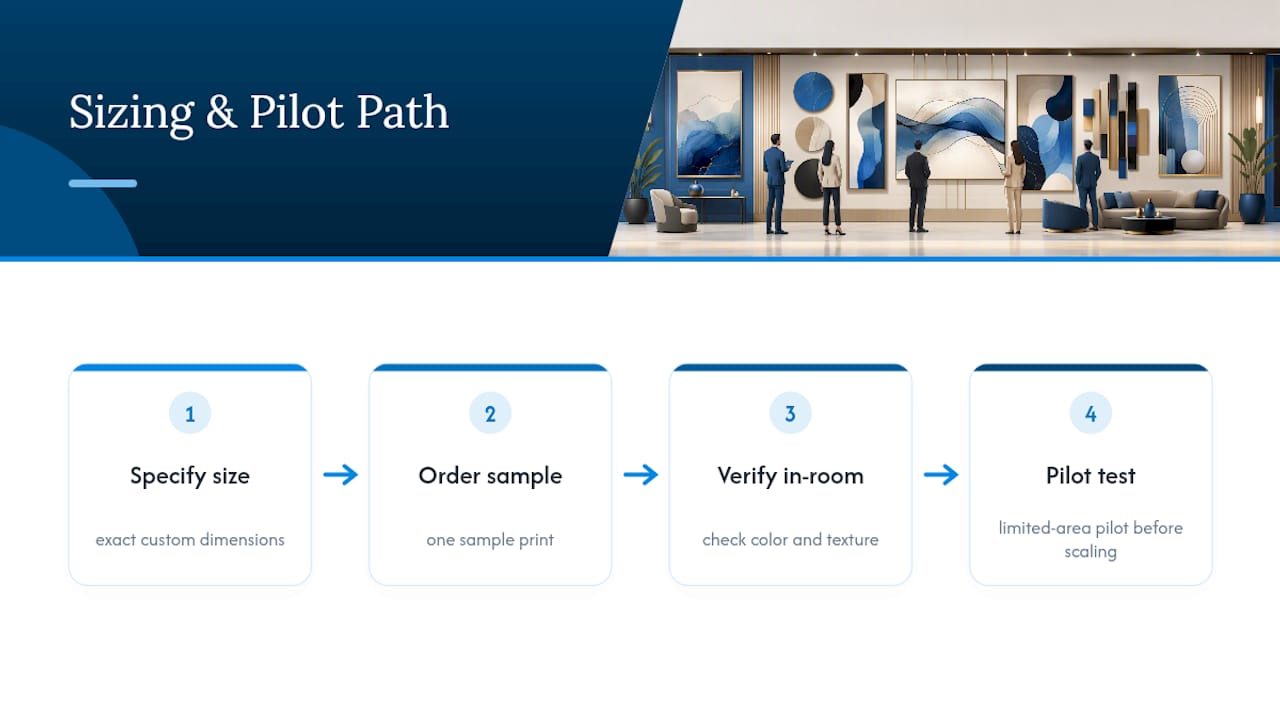
Entry pricing details vary; small pilot orders can be a practical approach for testing art selections in a limited area before a full-property commitment. That lower barrier matters when a general manager wants proof of concept before signing off on a bigger budget.
The Real Problem With Most Hotel Art Programs
Most hotels get the ideas right and the execution wrong. Everyone knows a mural looks good in a lobby and a landscape print calms a guest room. Where properties actually lose money is in the details nobody photographs: mismatched frame depths across identical rooms, art sized for a mockup instead of the real wall, and no replacement plan when housekeeping dings a canvas with a cart.
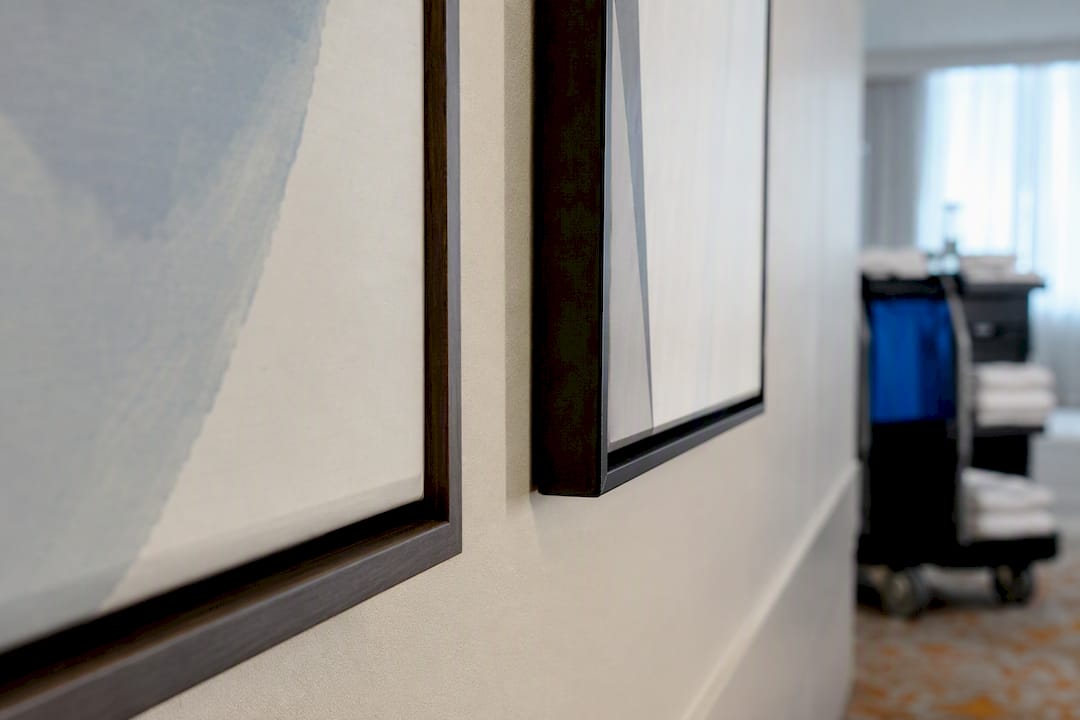
The conventional advice treats wall art as a one-time design decision. It isn’t. It’s an operational line item that needs the same standardization as linens or bathroom fixtures, because it gets damaged, faded, and eventually replaced. Hotels that skip standardized sizing end up custom-ordering a single replacement piece years later, paying a premium and waiting weeks for something that should have taken days.
If you take one thing from this article, prioritize sizing consistency and material durability before you fall in love with a concept. A stunning mural that fades in eighteen months or a gallery wall with three different frame depths costs more in the long run than a slightly less dramatic choice that holds up and matches across every room.
— Sense
Sense Canvas for Scalable, Customizable Hotel Art
Customizable canvas prints sized to exact wall dimensions offer flexibility for standardizing art programs across multiple rooms. Options include diverse design themes to suit various spaces.
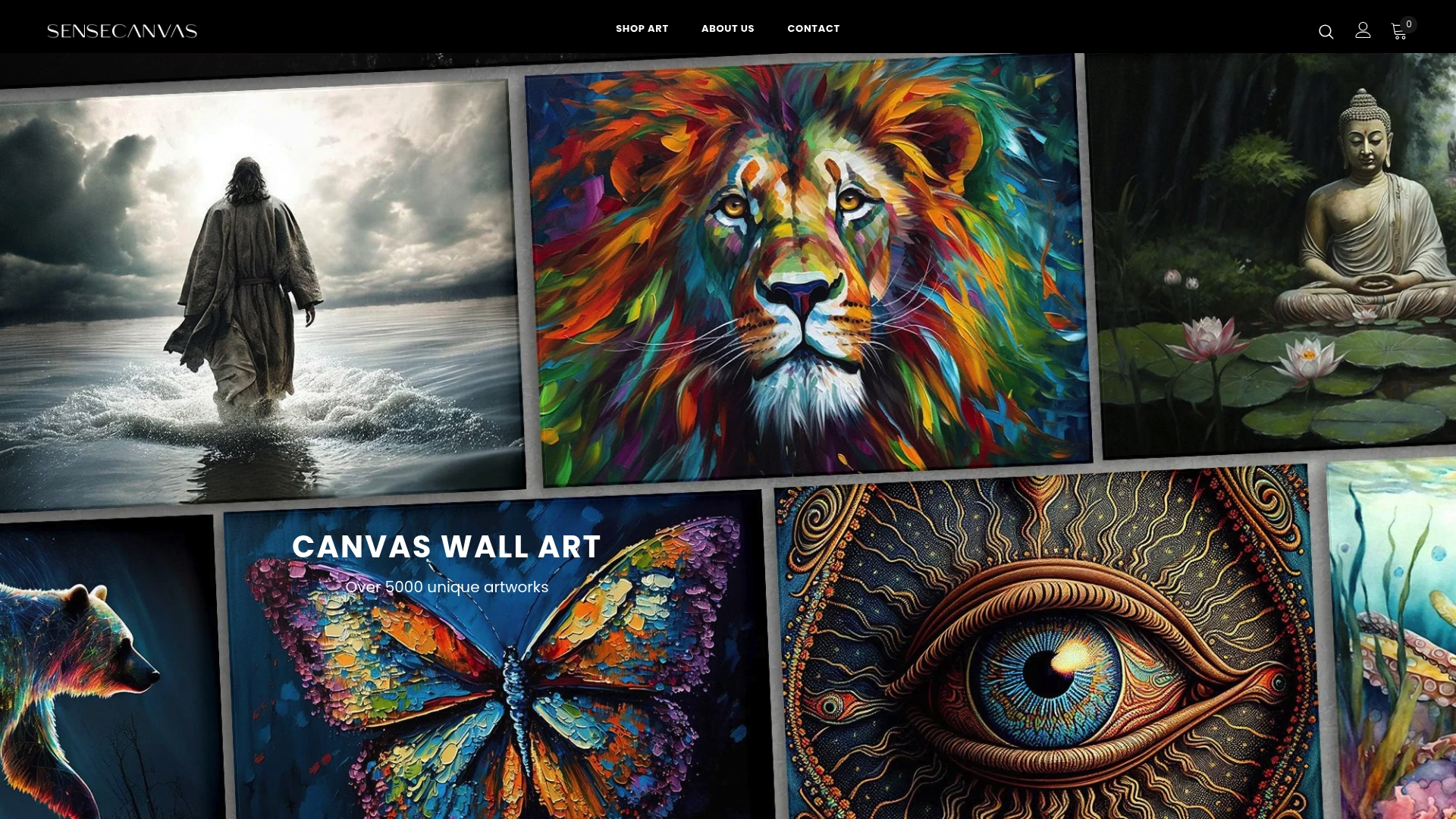
Sizing flexibility helps address awkward alcove spaces that off-the-shelf framed prints may not fit well, and centralized ordering can simplify multi-room purchases. If a spa wing needs a calming botanical series or a lounge needs a bold abstract statement piece, browse the collections to find a starting point, then request a sample before committing to a full floor. For guest-room feature walls, pairing canvas with layered textiles is covered in this guide to layering textures. Start with one sample order at sensecanvas.com to check color and texture before scaling to a full property.
Sources
Sizing and photography guidance draws on Martin Vorel’s hotel art photography guide, mural and wall-printing trends from Tudox, styling advice from Architectural Digest, and design tips from Good Housekeeping. For general styling that pairs well with statement art, see this luxe interior styling guide and this boho area rug guide.
- How To Choose Fine Art Photography Prints For Hotels | Martin Vorel
- Wall Printing for Hotels and Hospitality: 10 Stunning Ideas | Tudox
FAQ
How Do You Decorate a Room to Feel Like a Hotel?
Combine one dominant art piece or feature wall with layered lighting and a few curated accessories rather than scattering many small items, since strategic lighting and edited styling do as much work as the art itself.
What Are the Wall Art Trends for 2026?
Hyper-local storytelling through murals and UV wall printing leads the trend list, since destination-based graphics let hotels tell place-specific stories that generic stock art can’t match.
What Is the Two Thirds Rule for Wall Art?
The two thirds rule means sizing artwork or a gallery grouping to span about two thirds the width of the furniture or wall segment below it, which keeps the composition proportional instead of looking too small or overwhelming.
Where Can Hotels Buy Wall Art?
Hotels can order in-stock or customizable canvas prints directly from suppliers like Sense Canvas, commission local artists for signature pieces, or work with wall-printing vendors for full mural installations, depending on budget and timeline.