Size Bedroom Wall Art to Two Thirds of Your Bed and Hang 15–25 cm
The safest, most effective choice for most bedrooms is one large, calming canvas hung above the bed, sized to roughly two-thirds of the headboard’s width and mounted 15 to 25 centimeters above it. That single move solves the two problems people run into most: art that’s too small for the wall and art that’s too busy to relax in front of. From there, everything else — gallery walls, textiles, mirrors — is optional layering. Sense Canvas makes this easy because you can size and color a piece to your exact wall before you commit to a nail hole.
TL;DR:
- Art sizing should be about two-thirds of the bed or headboard width, with a recommended hang height of 15 to 25 centimeters above the headboard.
- Large calm single pieces, paired prints, or leaners are safer choices for promoting relaxation and avoiding visual clutter in most bedrooms.
- REMovable options like textiles, leaning canvases, or no-drill hooks are ideal for renters or when drilling isn’t feasible, and they still create a polished look.
- Use muted or desaturated personal photos and cropped images to add personal touches without disrupting the room’s calming atmosphere.
- Matching wall art color and style to bedding and furniture enhances harmony, with planned spacing preventing overcrowding and visual chaos.
Table of Contents
- Top Bedroom Wall Art Ideas With Quick Usage Notes
- How to Pick the Right Size and Hang It: Exact Rules to Use Now
- Materials, Textures and Rental-Friendly Installation Options
- Common Mistakes and Quick Fixes
- Practical Examples: How Customizable Canvas Art Solves Sizing, Color, and Rental Constraints
- Styling by Bedroom Theme or Decor Style
- Personalizing Wall Art Without Losing the Calm
- Balancing Wall Art With Bedding and Furniture
- Designer Perspective: When to Hire and What to Ask
- How Sense Canvas Can Help: A Quick Path From Blank Wall to Finished Bedroom
- Sources
Top Bedroom Wall Art Ideas With Quick Usage Notes
Not every idea below fits every bedroom, and that’s the point. Match the approach to your wall shape, your landlord situation, and how much visual noise you can tolerate before bed.
1. A large calm single piece above the bed
This is the default for good reason. A queen bed pairs well with a canvas sized to about two-thirds of the bed width, typically a large calm piece in landscape orientation with one focal image rather than a busy scene. Design guides consistently point to a single large piece as the safest bedroom choice because it gives the eye one place to land instead of several.
2. A gallery wall
Gallery walls work when you commit to a grid or a tight color story, not when you toss up whatever frames you own. Architectural Digest and other design outlets list them among top bedroom ideas, but every source pairs the recommendation with a warning: curate hard or it reads as clutter.
3. Paired prints for symmetry
Two matching prints, one on each side of a headboard or flanking a window, read as intentional and formal. Choose this over a gallery wall when you want calm structure rather than eclectic texture.
4. Textile hangings and macramé
Woven pieces add warmth without a single nail if you use a tension rod or removable hook. Textiles also help dampen sound in a room, which matters if your bedroom faces a street or shares a wall with a living room.
5. Leaning canvases and oversized prints
When drilling isn’t an option, an oversized canvas leaned against the wall behind a dresser or on a floor ledge does the job of a hung piece without a single hole.
6. Mirrors as art
A mirror bounces light and makes a small room feel larger, but position it so it doesn’t reflect the bed directly. Some sleep experts flag facing mirrors as a minor disruption to rest, so angle it toward a window or empty wall instead.
7. An accent mural or painted feature wall
This is the highest-commitment option on the list. Before you start, check three things: can you repaint over it easily, does the pattern scale to the whole wall without repeating awkwardly, and will it still feel calm in six months.
8. Small vignettes for secondary walls
A floating shelf with one small print, a plant, and a candle turns a blank side wall into something styled without competing with your main piece above the bed.
9. Sculptural wall pieces in wood or metal
Textured, dimensional pieces add visual interest through shadow and shape rather than color, which makes them a strong option if you’ve already committed to a muted palette everywhere else — explore more decorative options like small wall decor accents to complement your space.
How to Pick the Right Size and Hang It: Exact Rules to Use Now
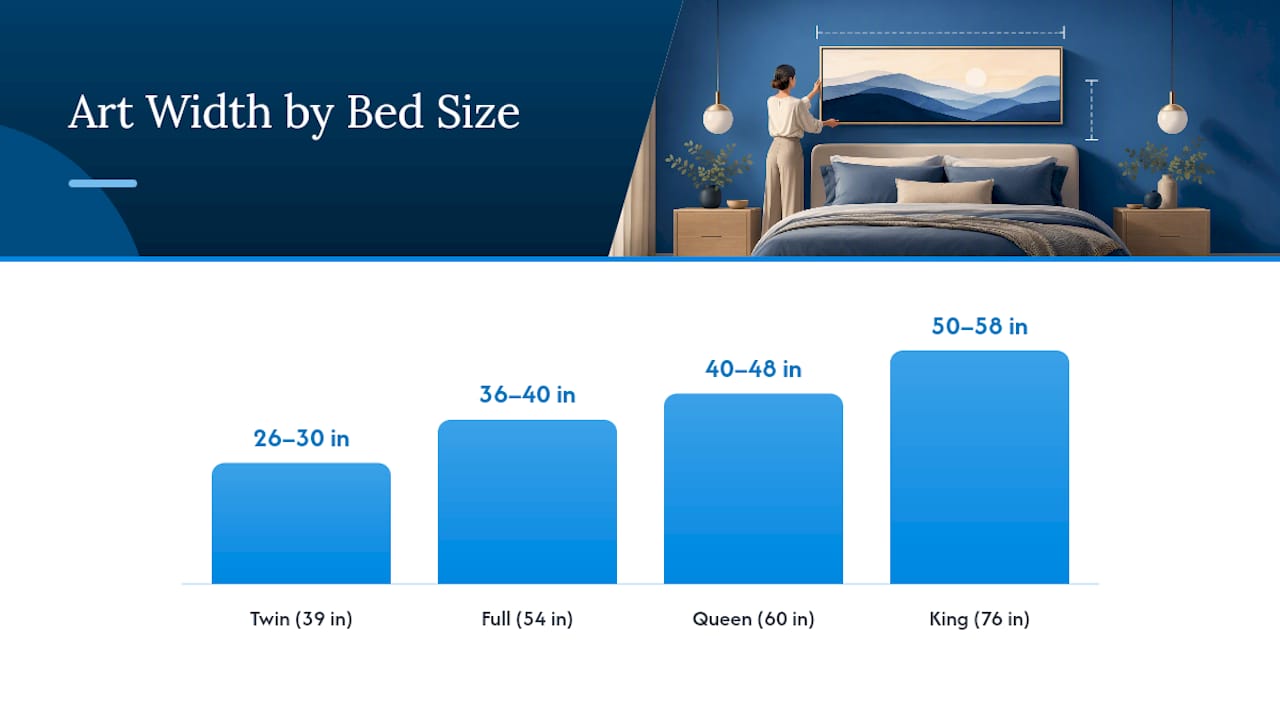
Guesswork is what causes most of the “why does this look off” moments. The two-thirds width rule is the fix: your art should span about two-thirds the width of your bed or headboard.
- Twin bed (39 inches wide): aim for art 26 to 30 inches wide.
- Full bed (54 inches wide): aim for 36 to 40 inches wide.
- Queen bed (60 inches wide): aim for 40 to 48 inches wide.
- King bed (76 inches wide): aim for 50 to 58 inches wide, or a two- to three-piece grouping totaling that width.
Hang the bottom edge 15 to 25 centimeters above the headboard. No headboard? Center the piece so its middle sits about 120 to 130 centimeters from the floor, roughly eye level for someone standing. Thin metal frames read lighter on the wall; a chunky wood or gallery-style frame adds visual weight, useful if your art is on the small side and needs to feel more substantial. Warm picture lights or a pair of sconces flanking the piece do more for mood than any overhead fixture. Wide walls favor landscape orientation; narrow walls between two windows often call for portrait.
Pro Tip: Before you buy anything, cut a piece of kraft paper or cardboard to your target size and tape it to the wall for a day. You’ll spot sizing mistakes for free instead of after checkout.
Materials, Textures and Rental-Friendly Installation Options
Canvas resists glare and holds up well at large sizes, which is why it dominates over-bed placements. Framed prints under glass can catch window light at odd hours; paper prints are the most budget-friendly but show wear faster in humid rooms.
- Canvas: best for large scale, matte finish, minimal glare.
- Framed prints: good for smaller pieces and gallery walls, watch for glare near windows.
- Paper prints: affordable but less durable over years of sun exposure.
- Textile hangings: add texture and help absorb sound, ideal for renters using tension rods.
- No-drill options: removable adhesive hooks, picture rails, or simply leaning an oversized canvas against the wall.
Keep any piece out of direct sun to prevent fading, and dust canvas or frames every couple of weeks with a dry microfiber cloth.
Common Mistakes and Quick Fixes
- Too small for the wall: if your art looks lost above the bed, either size up or group two or three smaller pieces to fill the two-thirds width.
- Hung too high: reposition so the bottom edge sits 15 to 25 centimeters above the headboard, not at standard gallery height.
- Every wall covered: designers recommend leaving at least one wall quiet so the room has a place to rest visually.
- Stimulating subject matter: swap high-contrast or busy scenes for muted, calm imagery if the goal is better sleep.
Practical Examples: How Customizable Canvas Art Solves Sizing, Color, and Rental Constraints
Picture a queen bed with a 24 inch print that’s swimming on a blank wall. Resized to 44 inches wide and cropped to a single calming subject, the same wall suddenly looks finished. That’s the most common fix custom sizing solves: nobody needs a new piece of art, they need the right dimensions for the wall they already have.
Color matching works the same way. You can request a crop that keeps a sentimental photo’s meaning while trimming out the busier background elements that would otherwise compete with sleep.
- Order checklist: measure your headboard width, decide on a mood (calm, romantic, grounded), pick your finish, then order.
Sense Canvas offers more than 15,000 designs with custom sizing, starting from $85, which covers most of the sizing gaps above without waiting on a custom framer.
Styling by Bedroom Theme or Decor Style
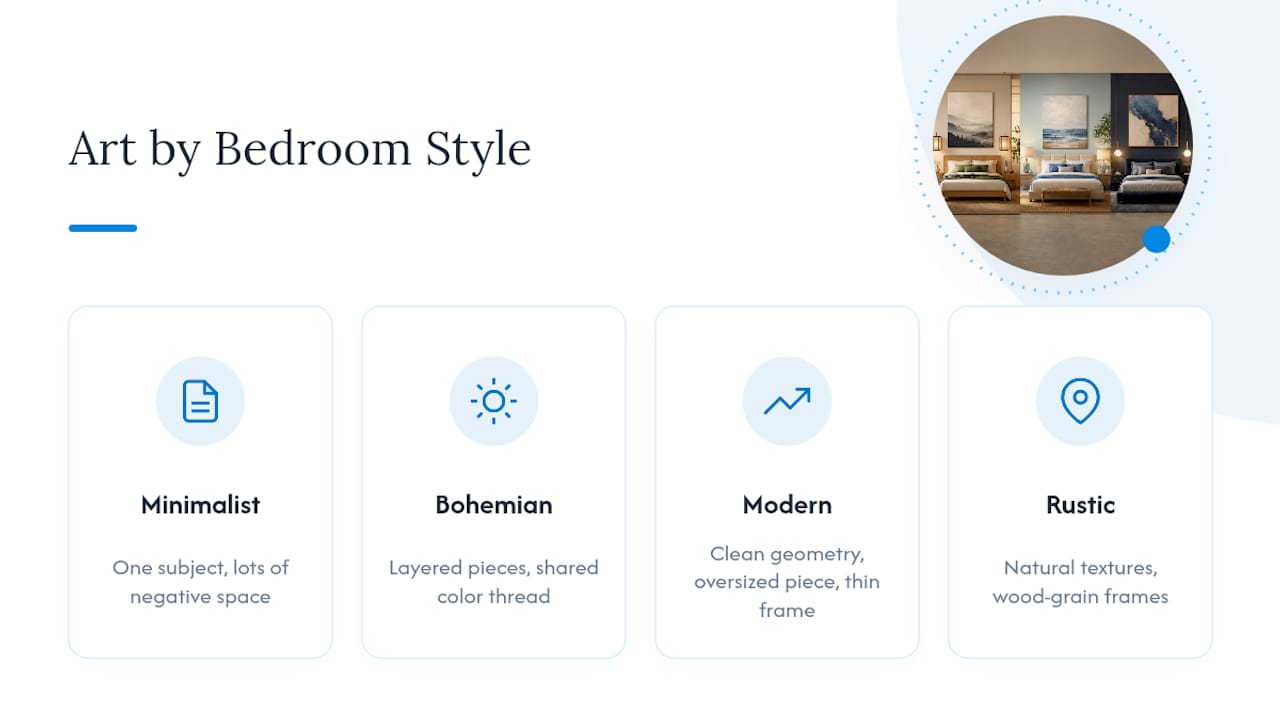
A minimalist bedroom wants one piece, one subject, generous negative space, think a single abstract line drawing or a soft gradient in black, white, or one accent tone. Anything more competes with the whole point of the style.
Bohemian bedrooms lean into layering: a woven macramé piece next to a botanical print, warm terracotta and rust tones, maybe a small vintage mirror in the mix. The trick is a shared color thread running through everything so the layering reads as curated rather than random.
Modern bedrooms favor clean geometry and cooler palettes, grays, deep blues, and crisp whites, often in a single oversized piece with sharp lines rather than soft brushwork. Metal or thin black frames suit this look better than heavy wood.
Rustic bedrooms call for natural textures: wood-panel prints, landscape photography, warm neutral tones, and frames that show grain rather than hide it. A sculptural wood piece fits naturally here in a way it wouldn’t in a modern room.
Whatever style you’re working in, the two-thirds sizing rule and the muted-palette guidance for sleep don’t change. Only the subject matter and frame finish shift to match the theme.
Personalizing Wall Art Without Losing the Calm
Personal touches make a bedroom feel like yours, but sleeping spaces punish visual clutter faster than any other room in the house. A custom print of a family photo, a favorite travel shot, or a meaningful quote can absolutely work above the bed, as long as it’s cropped tight and printed in a muted color treatment rather than the original bright snapshot colors.
Black-and-white or sepia conversions of personal photos tend to read as calmer and more intentional than full-color versions, especially at large sizes. If you want color, desaturate it slightly rather than printing it at full saturation.
For smaller personal touches, save the secondary walls, that shelf vignette mentioned earlier is a good spot for a cluster of smaller framed photos or a favorite postcard, while the main canvas above the bed stays simple and singular.
Balancing Wall Art With Bedding and Furniture
Your wall art doesn’t exist in isolation. If your bedding has a bold pattern, busy florals, graphic stripes, your wall art should pull back and stay quiet, maybe a solid-toned abstract or a single muted landscape. If your bedding is a plain neutral duvet, that’s your opening to bring more personality to the wall.
Match temperature, not just color. Warm wood furniture pairs naturally with warm-toned art (terracotta, amber, soft browns), while cooler furniture finishes, black metal, white lacquer, look better against blues, grays, and greens. Planning the visual weight across the room before you buy anything prevents the mismatched feeling that comes from picking each piece separately.
Leave breathing room, too. A wall crammed with art next to a nightstand crowded with lamps and books reads as chaotic no matter how nice each individual piece is on its own.
Designer Perspective: When to Hire and What to Ask
Complex gallery walls, oddly angled walls, or a full mural are the three situations where paying a designer earns its cost. For anything else, DIY with the sizing rules above gets you most of the way there.
If you do hire someone, ask three things: how will the piece scale against this specific wall, what lighting will hit it at night, and what mood are we actually designing for. Budget-conscious and short on time favors DIY; high-impact statement walls favor a professional.
— Sense
How Sense Canvas Can Help: A Quick Path From Blank Wall to Finished Bedroom
Custom framing shops make you wait weeks and charge a premium for exact sizing. Sense Canvas skips that wait entirely: you pick a design from over 15,000 options, tell it your exact wall dimensions, and get a canvas built to that size, starting from $85.

The process is simple. Measure your headboard width and apply the two-thirds rule to land on your target size. Pick a mood, calm, romantic, or grounded, since that decision matters more than the specific subject. Choose your finish and confirm the size fits the 15 to 25 centimeter hang-height rule. Then order.
If you’re drawn to a bold statement piece rather than a soft landscape, Sense Canvas’s abstract ocean canvas shows how a calming subject can still feel striking at large scale above a bed. Measure your wall today and see what size actually fits before you buy anything else for the room.