Why 'Ships in 24 Hours' Usually Means 2–3 Days for U.S. Canvas Prints
Most standard canvas print orders arrive in 5 to 10 business days once you add production time to shipping. Rush production can shrink the printing side down to 24 to 72 hours, but you still need transit time on top of that. Large, framed, or bulk orders routinely push past two weeks, especially around holidays. If you need one fast, skip ahead to the checklist below before you check out.
TL;DR:
- Large or oversized canvases over 40 inches require additional handling time, custom packaging, and often longer drying before shipping.
- Custom framing, finish choices, and low-resolution images can add one or more days to the production timeline, especially for bulk or intricate orders.
- Rush production typically covers only the printing stage and adds 1 to 3 days, with shipping times varying based on chosen carrier service and order cutoff times.
- Planning for holidays or last-minute gifts requires at least 4 days of lead time, with larger or framed orders needing two to three weeks minimum.
- Proper packaging and documentation are crucial to prevent damage during transit, and inspecting the outer box upon arrival helps facilitate claims if necessary.
Table of Contents
- Production vs. shipping: the stages that add up to turnaround time
- What factors change your canvas print turnaround time?
- What does “24 to 72 hour” rush production actually mean?
- How far ahead should you order for gifts, gallery walls, or bulk buys?
- How does packaging affect delivery speed and damage risk?
- Sense Canvas: how to get your custom canvas print on time
- Why we’d rather ship a canvas a day late than damaged
- Where to read more about canvas packing and print timelines
- Sources
Production vs. shipping: the stages that add up to turnaround time
Every canvas print goes through the same basic pipeline before it ships, whether you’re ordering one piece or twenty. Understanding each stage matters because vendors often advertise only one part of it, usually the fastest one.
The full sequence looks like this:
- File check and proof approval: your image gets reviewed for resolution and color, and you sign off on a digital proof
- Printing: the design goes onto canvas material using large-format inkjet printers
- Drying and curing: ink needs time to set fully before the canvas can be handled without smudging or cracking
- Stretching and wrapping: the printed canvas gets pulled taut over a wood frame and stapled or wrapped
- Final quality control: someone checks color accuracy, stretch tension, and edges before boxing
Standard production most commonly runs 2 to 5 business days, and domestic shipping transit typically adds another 1 to 5 business days depending on the carrier and service level you choose.
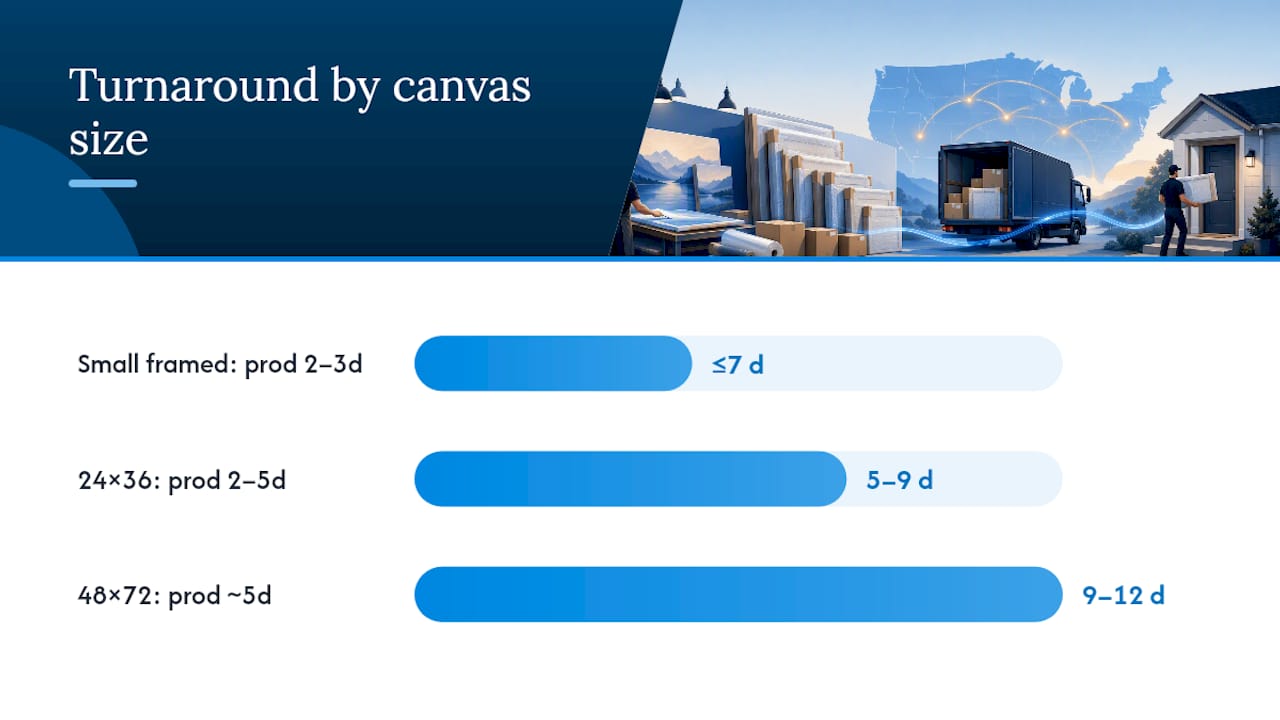
Here’s how that plays out for three common orders. A small framed canvas, say 8x10 or 11x14, often ships within 2 to 3 business days of production and arrives within a week total. A standard 24x36 canvas usually needs the full 2 to 5 day production window plus 3 to 4 days in transit, putting you at 5 to 9 business days. A large 48x72 canvas takes longer on both ends: production stretches toward the 5 day mark because of handling care, and shipping often runs 4 to 5 days because of size and weight, landing somewhere around 9 to 12 business days total.
What factors change your canvas print turnaround time?
Not every order moves through the pipeline at the same speed. Several variables push your timeline toward the slow end, and knowing them ahead of time saves you from a surprise delay right before a deadline.
- Size drives handling time. Anything over roughly 40 inches on the long side needs more careful stretching, extra drying time before it can be boxed, and often a specialized shipping box or crate instead of a standard mailer.
- Framing and finish choices add days. A gallery wrap with no frame ships fastest. A floater frame or a custom hardware finish means an extra production step, sometimes an extra day or two, since the frame has to be built and fitted separately.
- Low-resolution files stall everything. If your uploaded image doesn’t meet print resolution standards, most shops pause the order and email you before printing, which can add a day or more depending on how fast you respond.
- Order volume slows things down. A single canvas moves through the line quickly. A bulk order of ten or more pieces, common for offices or event decor, competes for press time and packing labor, which extends the schedule.
Pro Tip: Upload the highest-resolution file you have, even if the platform accepts smaller images. A file that triggers an automatic quality warning is the single most common reason an order sits untouched for an extra day.
Custom sizing and edge choices affect this timeline more than most people expect, and it’s worth understanding how wrap style and size selection interact with production before you finalize an order.
What does “24 to 72 hour” rush production actually mean?
Vendor rush claims almost always describe production time only, not the full trip to your door. When a print shop advertises “ships in 24 hours,” that phrase typically refers to when the item leaves the building, not the full delivery time to your door.
Some shops list production windows as short as 1 to 3 business days with next-day or same-day start options, but that’s the printing and finishing stage alone. Expedited shipping is a completely separate charge and a separate clock. Overnight or two-day carrier service adds its own transit time on top of whatever production takes, and it typically costs significantly more than ground shipping.
Realistic fastest-case math looks like this:
- 24 to 72 hours of rush production
- Plus 1 to 2 business days of overnight or two-day shipping
- Equals roughly 2 to 3 business days total, assuming no cutoff was missed and no packing delay hit
Same-day and next-day production usually requires you to place your order before a specific afternoon cutoff, often somewhere between noon and 3 PM local vendor time. Miss it, and your “24 hour” order quietly becomes a next-business-day order instead.
How far ahead should you order for gifts, gallery walls, or bulk buys?
Different situations call for different amounts of buffer, and the biggest planning mistake is treating every canvas order like it needs the same lead time.
- Last-minute gift: allow at least 4 business days even with rush production and expedited shipping, since gift-giving deadlines rarely leave room for a delay.
- Standard single canvas: allow 7 to 10 business days for a normal order with standard shipping, which covers typical production plus ground transit.
- Framed, large, or bulk orders: allow 2 to 3 weeks minimum, since these orders are more likely to need custom packing and extra production care.
| Scenario | Recommended lead time | Shipping method |
|---|---|---|
| Last-minute gift | 4+ business days | Rush production + overnight |
| Standard single canvas | 7 to 10 business days | Standard ground |
| Large, framed, or bulk | 2 to 3+ weeks | Ground or freight |
Three things speed up processing on your end: submitting a high-resolution file the first time, approving your digital proof the same day it arrives, and picking a shipping method that actually matches your deadline instead of assuming standard will be fast enough. Holiday weeks, particularly the run-up to December and around Mother’s Day, are when production queues stretch longest, so scheduling outside peak periods often shortens your effective wait. For gift orders specifically, a dedicated timeline checklist walks through exactly when to order for major dates.
How does packaging affect delivery speed and damage risk?
Packaging choice isn’t just about protecting the canvas. It directly affects how fast your order can ship and how much it costs.
- Telescoping boxes work well for unframed canvases under about 48x60 inches and keep prep time reasonable while still protecting the artwork during transit.
- Double-boxing adds a layer of protection for mid-size pieces without the cost jump of a full crate.
- Custom crates get used for oversized or high-value pieces and typically cost $150 to $400 to build, which adds a day or two of prep but drastically cuts damage risk.
Carrier choice matters just as much as the box. Dimensional-weight pricing means large, lightweight canvases can cost more to ship than their actual weight suggests, which is why bigger orders sometimes move to ground freight or white-glove delivery instead of standard parcel service. Most damage happens during last-mile handling, so reinforced packaging at the shipping stage matters more than anything upstream.
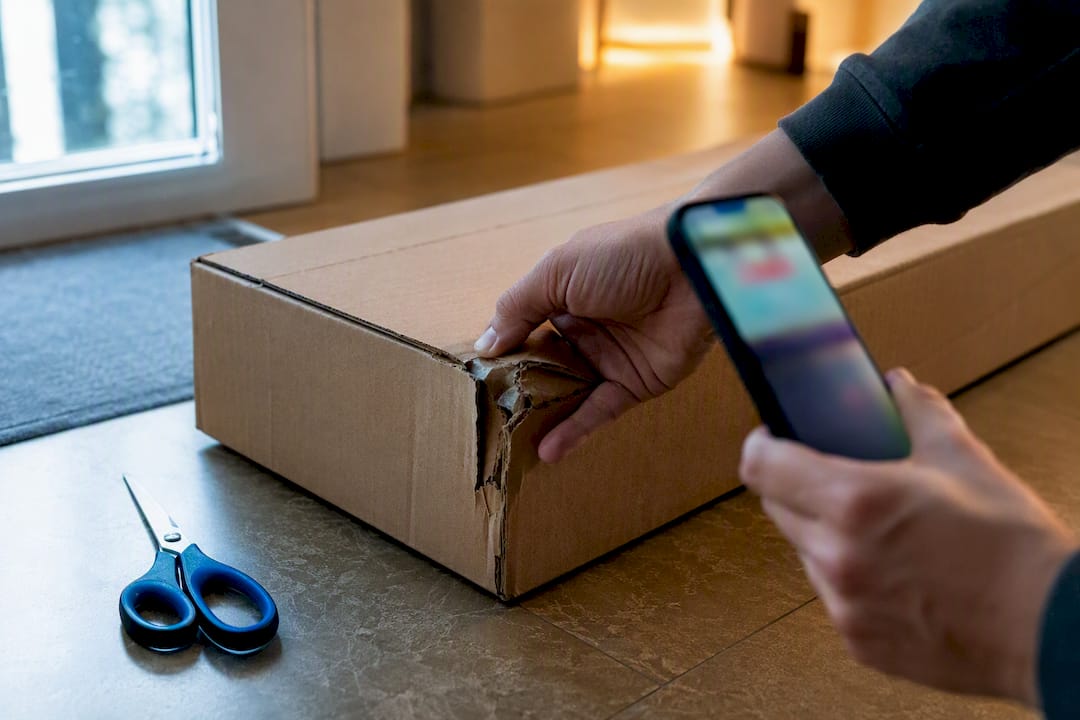
Pro Tip: Inspect the outer box for dents or crushed corners before you even open it, and photograph everything the moment it arrives. Carriers routinely deny damage claims when there’s no documentation from the point of delivery.
Sense Canvas: how to get your custom canvas print on time
Sensecanvas runs over 15,000 unique designs across abstract, animal, motivational, and specialty themes, with every piece customizable to your exact wall dimensions and pricing that starts at $85. That range gives you room to plan around a real deadline instead of settling for whatever ships fastest.
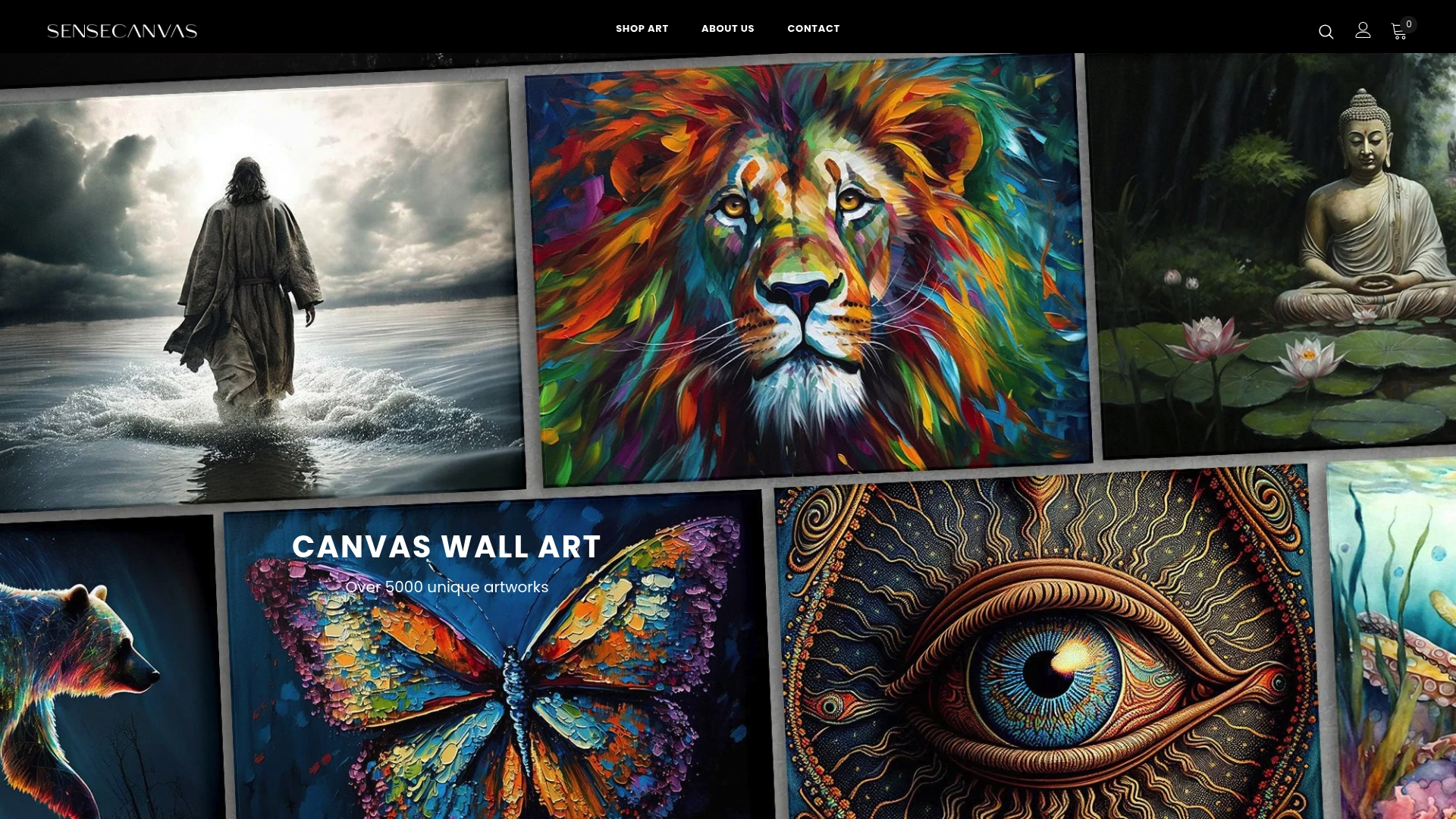
Standard orders through Sensecanvas move through the same production stages covered above, printing, curing, stretching, and quality control, with rush options available for readers working against a tighter date. The checkout process lets you confirm an estimated delivery window before you pay, so you’re not guessing whether a birthday or holiday deadline is realistic. To keep your order on the fast end of that window, upload the highest-resolution image you have and approve your proof the same day it lands in your inbox; every hour spent waiting on approval is an hour added to your production clock.
Browse the full canvas art collection to find a piece that fits your space, or start with a popular pick like this neon motivational print built for a home office. Whichever design you choose, place your order early enough to give production and shipping the days they actually need.
Why we’d rather ship a canvas a day late than damaged
Curing time exists for a reason most customers never see. Ink that hasn’t fully set can smudge during stretching or crack once it’s wrapped around the frame, and a print rushed through that stage is a print that risks coming back as a return.
We’ve seen orders where a single extra day of drying time, added deliberately before stretching, prevented a visible crease that would have forced a reprint and a much longer wait for the customer. That’s the trade-off worth understanding: a short delay at the production stage almost always beats a long delay caused by a damaged piece bouncing back through customer service. If you’re planning around a specific date, reach out before you order so we can map production and shipping against your deadline instead of hoping the standard estimate holds.
— Sense
Where to read more about canvas packing and print timelines
A few outside resources go deeper into the shipping and packing details covered above:
- Austin Gallery’s art shipping guide covers crate building and telescoping box methods for large or high-value pieces.
- ForthMovers’ canvas packing walkthrough details step-by-step protection methods and damage documentation.
- Fulfyld’s shipping cost breakdown explains where last-mile damage most often happens.
- Shay’s Print Shop’s turnaround guide offers useful background on how proof cutoffs work across print production generally.