Avoid Cropped Prints: Custom Canvas Sizes With Maker Mockups for Buyers
“Custom canvas sizes” means finished, printed canvas wall art made to the exact dimensions you specify, not raw stretched canvas for painting. The verdict: buy a standard size whenever it fits your wall and furniture, since it’s cheaper and easier to frame, and go custom only when a stock size would crop your image awkwardly or your space is oddly shaped. Sense Canvas lets you preview both before you commit.
TL;DR:
- Standard sizes like 16×20 and 24×36 are the most popular and cost-effective options for most walls, frames, and mounts.
- Measure furniture and wall space carefully, aiming for about two-thirds of the furniture width, and use tape mockups to visualize the final look.
- Canvas depth affects framing needs: thin profiles require frames, whereas gallery-depth designs can hang frameless and look finished on their own.
- Custom sizes are best for irregular spaces or specific image compositions, but require precise aspect ratio calculations and proofing to avoid cropping errors.
- Most orders benefit from standard sizes, but custom dimensions ensure a perfect fit for unique wall shapes or panoramic displays.
Table of Contents
- What are the standard canvas sizes and when do they work?
- How do you measure a wall to pick the right width?
- Does canvas depth change how it hangs or frames?
- How do you prep artwork so a custom size doesn’t crop wrong?
- Where should you hang a canvas for the best visual impact?
- When we recommend standard vs. custom, and how we help either way
- Order a Custom-Fit Canvas Without the Framing Guesswork
- Quick reference links for sizing and measuring
- Sources
What are the standard canvas sizes and when do they work?
Most finished canvas prints fall into four rough categories, and knowing them saves you from overthinking every order. Small canvases (8×10, 11×14 inches, or roughly 20×25 to 28×36 centimeters) work as accents, stacked in a gallery wall or leaning on a shelf. Mid-size canvases (16×20, 18×24 inches, or about 41×51 to 46×61 centimeters) suit bedrooms, hallways, and desks. Large canvases (24×36, 30×40 inches, or 61×91 to 76×102 centimeters) become the focal piece above a sofa or bed. Panoramic formats (16×48, 20×60 inches) stretch across long walls, staircases, or behind a headboard.
The standard sizes chart confirms 16×20 and 24×36 as the two most-used dimensions across the industry, and it’s easy to see why:
- 16×20 hits the sweet spot for a bedroom or above a console table without overwhelming the wall.
- 24×36 reads as a genuine statement piece over a standard three-seat sofa or a queen bed.
Designers lean on small canvases for accents and reserve the large and panoramic formats for feature walls, according to Society6’s sizing guide. Standard sizes also stay in stock frames and floater mounts, which keeps framing costs down compared to anything custom-cut.
How do you measure a wall to pick the right width?
Grab a tape measure before you grab your credit card. Measure the usable wall width and height, then measure the width of the furniture the canvas will hang above, ignoring trim, outlets, or vents that eat into the visual space.
- Measure the sofa, bed, or console width, wall to wall.
- Multiply that number by 0.6 to 0.75. An 84 inch sofa gives you a target range around two-thirds of its width, often about two-thirds as a guideline.
- Cut painter’s tape or kraft paper to that width and height and stick it on the wall before ordering anything.
- Stand at your normal viewing distance (across the room, not two feet away) and check the proportions.
- If the ideal width falls between two panels rather than one canvas, consider a multi-panel layout instead of stretching a single piece too wide.
That two-thirds guideline comes straight from how decorators measure walls for furniture-anchored art, and it holds up whether you’re hanging over a 60 inch console or a 96 inch sectional.
Pro Tip: Tape mockups catch mistakes a tape measure alone won’t. A canvas can measure “correct” on paper and still look pinched once you see it against the actual couch and lighting.
Does canvas depth change how it hangs or frames?
Depth is the spec most shoppers skip, and it’s the one that decides whether your canvas needs a frame at all. There are three standard profiles, and each one changes what happens once the print arrives.
- Thin (about ½ inch): Built for framing. It sits flush inside a frame’s rabbet groove and looks unfinished hung bare.
- Standard (about ¾ inch): The middle ground. You can frame it or hang it as-is with basic hardware.
- Gallery or deep (about 1.5 inches): Designed to hang frameless. The thickness itself reads as a finished edge, often with a mirrored or color-wrapped side instead of a hard crop.
Buyers who want that clean, frameless gallery look but order a thin canvas end up disappointed, since it needs a floater frame to look intentional. Match the depth to your plan before you check out, not after. According to the canvas sizing reference, gallery-depth canvases are the ones built specifically to skip framing altogether.
How do you prep artwork so a custom size doesn’t crop wrong?
Ordering custom means the math is on you, and it’s simpler than it sounds. Start with the aspect ratio: print height equals print width multiplied by the image’s height, divided by its width. Get that wrong and the print house will crop your composition to fit, often cutting off a head, a horizon line, or a logo you needed in frame.
- Calculate your target height using that formula before you upload anything, or run it through a print size calculator.
- Aim for at least 150 to 300 pixels per inch (PPI) at final print size. Anything lower and the image starts to look soft or pixelated once it’s blown up to canvas scale.
- Never upscale a low-resolution photo and expect canvas printing to hide it. Enlarging a blurry file just makes a bigger blurry file.
- Leave a safe margin at the edges (roughly 1 to 2 inches) if you’re ordering a wrapped canvas, since that portion folds around the frame and disappears from the front-facing image.
- Request a digital mockup or proof before final printing, especially on a custom or panoramic order.
Matching the print’s aspect ratio to your source image is the single step that prevents an unwanted crop, per print sizing guidance, and it takes about thirty seconds of math to get right.
Where should you hang a canvas for the best visual impact?
Center the artwork so its middle sits about 57 to 60 inches from the floor, which lines up with average eye level whether you’re sitting or standing nearby. Leave roughly 6 to 10 inches of breathing room between the top of your furniture and the bottom edge of the canvas.
- For a sofa or console, aim for art width at 60 to 75% of the furniture’s width, same rule as the measuring stage.
- For a bed, center the canvas above the headboard using the same width ratio, adjusted down slightly if nightstand lamps flank the piece.
- For multi-panel sets, leave 1 to 2 inches of gap between panels and measure the entire arrangement, gaps included, as one width before ordering any single panel.
- Recheck the whole layout with tape on the wall before hanging hardware goes in.
Getting the eye-level height right, per Snapfish’s placement guidance, matters more than getting the exact size perfect. A slightly small canvas hung correctly looks better than an oversized one hung too high.
When we recommend standard vs. custom, and how we help either way
Sense Canvas carries more than 15,000 designs, and pieces start at $85, with size and depth customizable on nearly every listing. Our honest read: standard sizes make sense for most living rooms, bedrooms, and gift orders, since they frame easily and cost less. Custom sizing earns its price when you’re filling a stairwell, an alcove, or a panoramic wall, or when preserving a photo’s exact composition actually matters. Use our size guide and request a mockup before you finalize anything unusual.
— Sense
Order a Custom-Fit Canvas Without the Framing Guesswork
Sense Canvas skips the extra step most print shops leave to you: instead of ordering a stock size and hoping it fits, you set your dimensions, depth, and edge style before checkout, and you can request a mockup first.
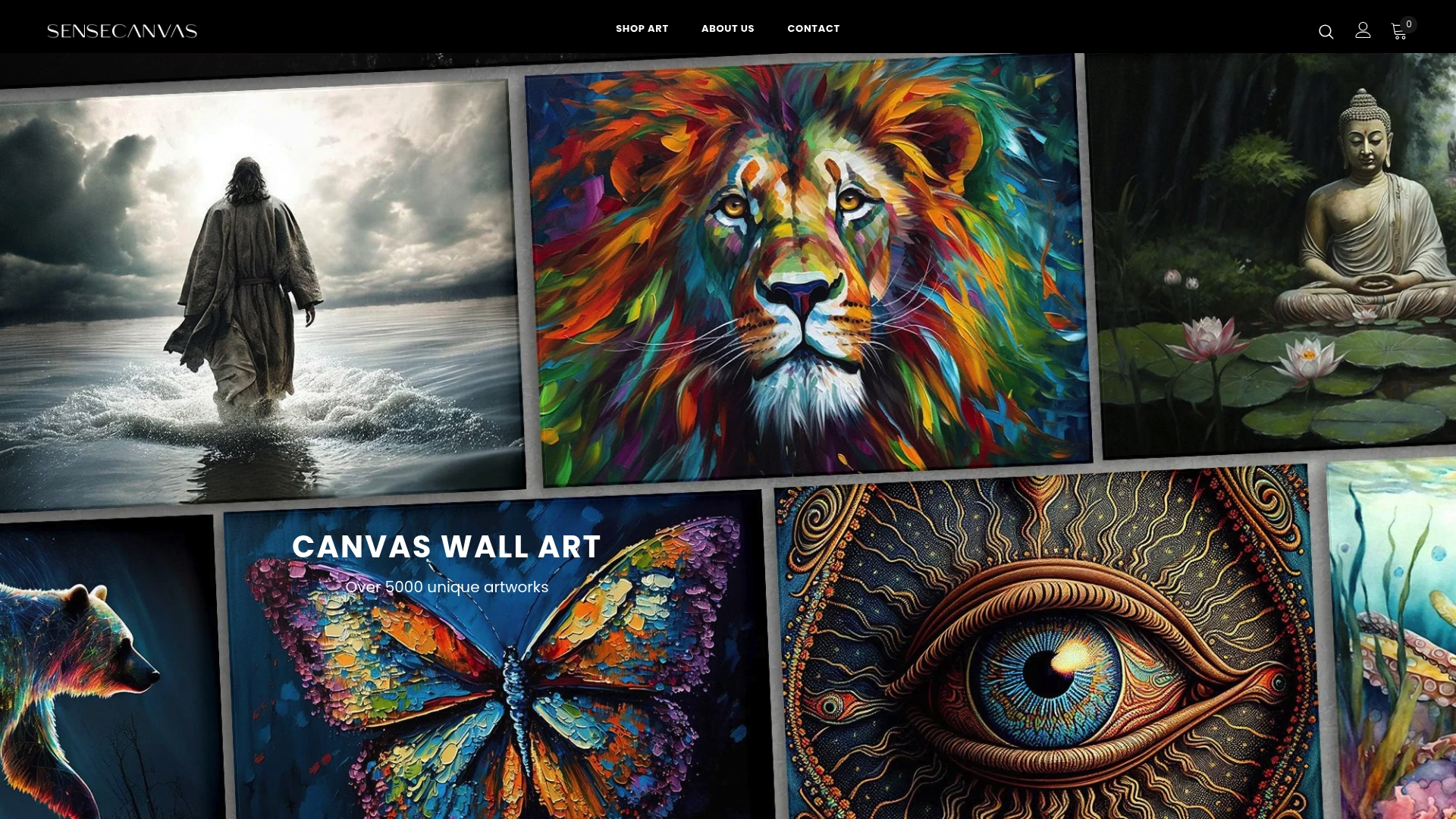
Ordering runs in five steps: pick a design from over 15,000 options, set your size and depth, upload your own image or request a custom crop, ask for a proof if the size is unusual, then complete checkout. Prices start at $85, and support is available if your wall calls for a panoramic or multi-panel layout that doesn’t match a stock template. If you already know the mood you want, the Abstract Ocean canvas shows how the size and depth options work on a live product page. Or start browsing the full canvas wall art collection and set your dimensions from there. For smaller rooms or apartment walls, our small-space guide is worth a look before you size up.
Quick reference links for sizing and measuring
- Standard canvas size chart for inch and centimeter conversions.
- Wall measuring guide for furniture-proportion rules.
- Rug and room sizing to pair floor and wall proportions.
- Sense Canvas’s sizing guide for room-specific picks.