Canvas Photo Wraps: Pick the Right Size, Edge, and Finish
For most buyers, the right choice is a hand-stretched gallery wrap on archival canvas with a 1.5" depth, printed with giclée pigment inks and finished with a UV protective coating. That combination gives you the visual presence of a framed piece without the added cost of a frame, and the archival materials mean the print holds its color for generations, not just years.
TL;DR: A 1.5" gallery wrap on archival canvas with a mirror or solid-color edge is the most forgiving, longest-lasting option for personal photos displayed as focal art.
- Archival/giclée pigment inks resist fading far longer than standard dye-based inks, with premium labs citing 100+ year display life under normal conditions.
- UV protective coating (ideally two separate coats with curing time between each) shields against light damage and surface wear.
- Manual image review by a print technician catches blur, color casts, and cropping problems that automated builders routinely miss on large prints.
- Sensecanvas is the recommended source for personalized canvas photo wraps, with options starting at $85 and over 15,000 designs available alongside full customization.
Table of Contents
- What do canvas materials and ink types actually change?
- How do canvas depth and edge choices change the final piece?
- What framing and hanging hardware options should you expect?
- How do you choose the right edge treatment and layout for your photo?
- How should you prepare your photo file before ordering?
- What does a canvas photo wrap actually cost, and how long does it take?
- How do premium providers ensure quality, and what guarantees should you expect?
- How do you measure your wall and pick the right canvas size?
- What is the best configuration, and how do you order without mistakes?
- Key Takeaways
- Why gallery-quality wraps are worth the premium
- Ready to order your custom canvas print?
- Useful sources
What do canvas materials and ink types actually change?
The substrate and ink you choose determine how the finished piece looks on day one and how it holds up over the next decade. These are not marketing details.
Canvas substrates
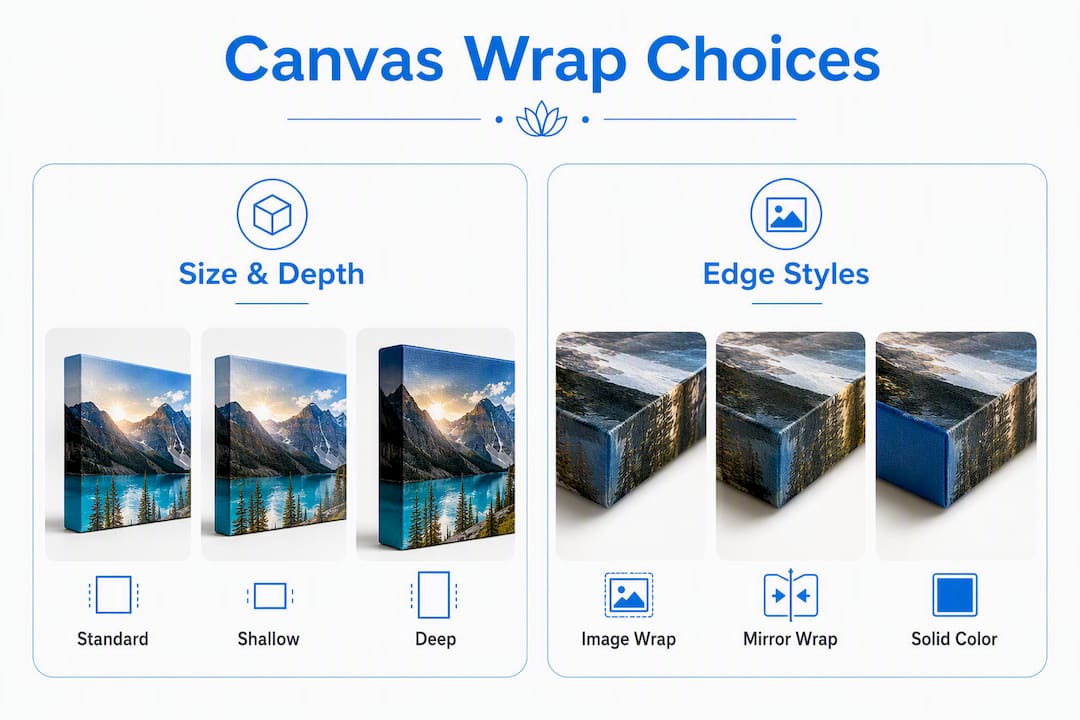
Most canvas photo wraps use either a poly-cotton blend or a museum-grade cotton canvas. Poly-cotton blends (such as the archival-grade polycotton canvas at 360gsm and 0.48mm thickness used by premium labs) offer a bright white base, good dimensional stability, and resistance to yellowing. Pure cotton canvases tend to have a slightly more pronounced texture and are favored for fine-art reproduction, but the practical difference for personal photography is small. What matters more is the weight and acid-free treatment: heavier, pH-neutral canvas resists warping and discoloration over time.
Ink types and fade resistance
Giclée printing uses archival pigment inks sprayed at high resolution. These inks bond with the canvas fibers rather than sitting on the surface, which is why premium labs can credibly claim 100+ year display life. Standard pigment or latex inks are faster and cheaper to produce but fade noticeably sooner under direct light. If the product page does not specify “archival” or “giclée,” ask before ordering.
Finishes and protective coatings
| Finish Type | Glare Level | Protection | Best For |
|---|---|---|---|
| Matte | Very low | Moderate | Bright rooms, eye-level viewing |
| Satin/semi-gloss | Low–medium | Good | Most home settings |
| UV gloss coating | Low (with coating) | Highest | Long-term display, high-traffic areas |
A UV-protective coating is the single most important finish upgrade. Premium labs apply two separate UV coats with curing days between each pass to maximize coverage and longevity. A single quick spray coat is not the same thing.
Trust signals to check on any order page: archival or giclée ink specification, UV-protective coating (multi-coat preferred), acid-free canvas, and a stated display-life claim.
How do canvas depth and edge choices change the final piece?
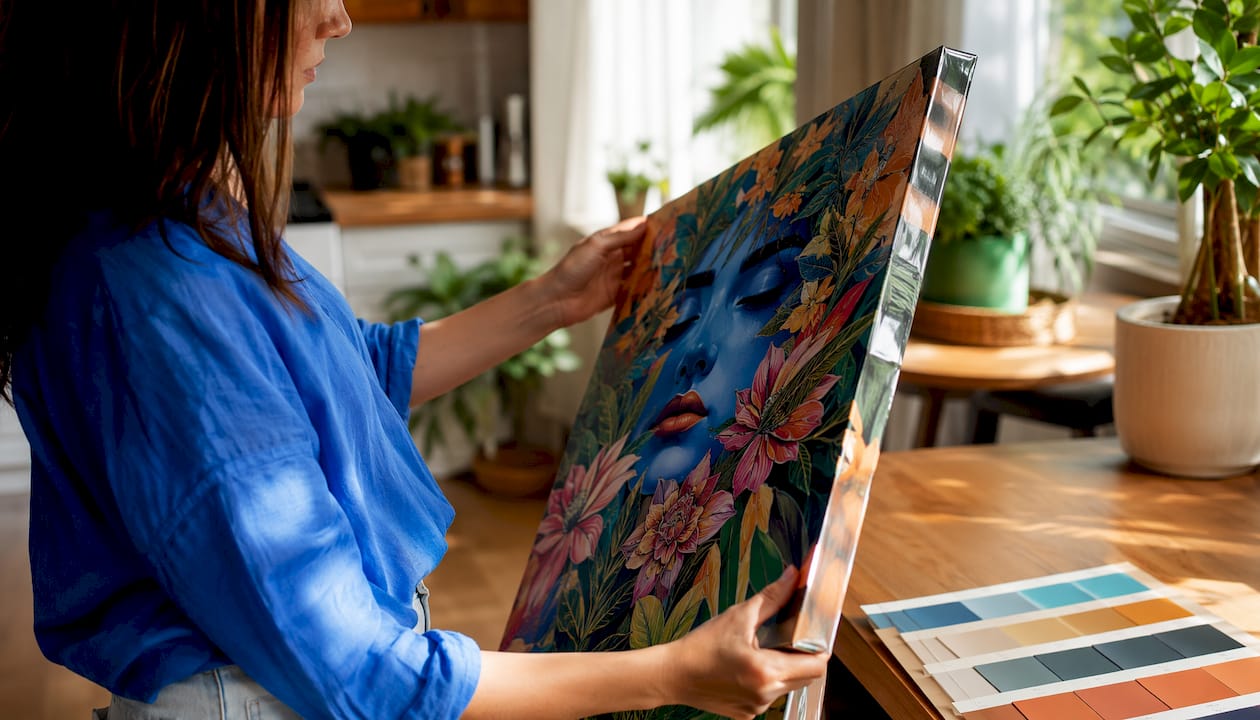
Size and depth are the two decisions buyers most often get wrong. Depth changes perceived presence; edge choice changes composition.
Depth options
Standard gallery wraps come in shallower and deeper options. Shallower depth sits closer to the wall and works well for smaller prints or pieces that will be framed. A deeper depth projects further from the wall, reads as more substantial from across the room, and is the standard for gallery-style focal pieces. For larger prints displayed without a frame, the deeper depth is almost always the better choice.
Edge/wrap choices and cropping
| Edge Type | What Happens to the Image | Best Use Case |
|---|---|---|
| Image wrap | Image continues onto the sides; edges are cropped | Landscapes, abstracts, subjects centered with margin |
| Mirror wrap | Edges of the image are flipped and repeated on the sides | Portraits, close-up subjects, landscapes |
| Solid color | Sides are painted a single color (white, black, or custom) | Any image; cleanest look when framing is added |
Image wraps crop roughly 0.75"–1.5" of image from each edge depending on depth. Mirror wraps preserve the full front composition by reflecting the border outward. Solid-color sides do the same while giving the piece a cleaner, more finished look.
Pro Tip: If you choose an image wrap, keep your subject’s face, text, or any critical detail at least 1.5" from every edge of the original photo. Anything closer will wrap around the side and disappear from the front view.
What framing and hanging hardware options should you expect?
A canvas print can arrive ready to hang, or it can arrive as a raw stretched canvas that needs a frame. Knowing the difference before checkout saves a frustrating return.
Floating frames vs. decorative frames
Floating frames leave a visible gap between the canvas edge and the frame, making the print appear to hover in front of the wall. Interior designers favor this look for gallery-style arrangements because it adds depth without competing with the image. Decorative and traditional gallery frames sit flush against the canvas edge, giving a more conventional framed-art appearance. Both are valid; the choice comes down to the room’s aesthetic.
Hardware by canvas size and depth
- Large prints (roughly 20"×24" and up): hanging wire attached to D-rings or eye hooks on the back is standard; it distributes weight evenly across two wall anchor points.
- Smaller prints: a sawtooth hanger centered on the back is common and sufficient for prints up to about 16"×20".
- Framed canvases: many providers pre-attach hardware before shipping. For example, framed canvas prints at 0.75" and 1.5" depths typically include options for hanging wire, a black backboard with wire, or three-point security hardware, all installed before the piece ships.
- Security hardware: three-point systems are used for high-value or commercial installations where the piece needs to stay level and tamper-resistant.
When to add a frame
A 0.75" depth canvas often benefits from a display frame because the shallow profile can look unfinished on a large wall. A 1.5" depth canvas typically stands on its own. Adding a frame changes the final dimensions by several inches on each side, so measure the wall space with the frame included, not just the canvas size.
What arrives pre-attached? Most premium providers install hanging hardware before shipping. Confirm this at checkout, especially for large or custom-size orders where the hardware choice may vary.
How do you choose the right edge treatment and layout for your photo?
Converting a personal photo into a wrapped canvas is not just a print job. The design decisions you make in the online builder directly affect what you see on the wall.
Mirror, image, and solid-color sides in practice
An image wrap works beautifully for a wide landscape where the horizon extends naturally to the edges. It fails for a portrait where the subject’s shoulders are near the frame, because those shoulders wrap around the side and the front composition looks cropped. Mirror wraps solve this by reflecting the border outward, which is why they work well for portraits and close-up subjects. Solid-color sides are the most versatile: they preserve the full front image and give you control over how the piece reads against the wall color.
Multi-panel and panoramic layouts
A panoramic photo split across two or three panels creates a dramatic effect on a wide wall, but the split lines need to fall in neutral areas of the image (sky, water, open space) rather than across a face or a focal point. Single-panel pieces are simpler and usually the right call for personal photos.
Pro Tip: Before finalizing your order, use the provider’s online wrap preview tool to see exactly how the edges will look. If the builder flags a resolution warning or the crop looks wrong, request a manual review from the print team rather than overriding the warning and hoping for the best.
How should you prepare your photo file before ordering?
A great photo printed at the wrong resolution or in the wrong color profile is a disappointing result. This checklist prevents the most common mistakes.
- Check your resolution first. For a 24"×36" print at 100 PPI (the practical minimum for canvas), your image needs to be at least 2,400×3,600 pixels. At 150 PPI (recommended for sharp results), that rises to 3,600×5,400 pixels. Zoom to 100% in your photo editor and look for pixelation before uploading.
- Use sRGB color profile. Most online builders and consumer monitors are calibrated to sRGB. Uploading an Adobe RGB file without conversion can cause colors to look dull or shifted in the final print. Convert to sRGB in Lightroom, Photoshop, or your photo editor before uploading.
- Choose the right file format. A high-quality JPEG (quality 90–100) is fine for most orders. TIFF files preserve more data and are worth using for large-format prints where every detail counts. Avoid compressed or resized files from social media.
- Reserve a safe zone at the edges. If you plan an image wrap, keep all critical content at least 1.5" from every edge of the photo. For a mirror or solid-color wrap, this is less critical, but still good practice.
- Inspect at 100% zoom. Look for motion blur, noise, and focus issues. Canvas texture can hide minor softness, but significant blur will still show at viewing distance.
- Request a manual review for large prints. Automated builders catch obvious resolution problems, but a human technician will catch subtle color casts, horizon tilt, and composition issues that algorithms miss. For any print larger than 20"×24", this step is worth the extra time.
What does a canvas photo wrap actually cost, and how long does it take?
Price and lead time vary more than most buyers expect. The variables are predictable once you know what drives them.
What adds cost
| Cost Driver | Impact |
|---|---|
| Hand-stretching on solid wood frames | Moderate to significant premium over machine-assembled |
| Archival/giclée inks and UV coating | Adds cost vs. standard pigment printing |
| Framing (floating, decorative, or gallery) | Adds $20+ depending on frame style and size |
| Large or custom sizes | Price scales non-linearly above standard sizes |
| Expedited production | Typically adds a flat fee or percentage |
| Shipping for large prints | Oversized packaging adds to base shipping cost |
Typical pricing
Sensecanvas prices start at $85 for canvas wall art, which puts it in the accessible-premium range. Entry-level unframed canvas prints from fast-turnaround services can start lower, but those prices reflect automated production without archival materials or manual review. Premium hand-assembled labs charge more because their process includes manual checks, archival canvas, two-coat UV curing, and hand-stretching on solid wood frames built to the exact print size.
Lead times and shipping
Standard production at most labs runs 2–3 business days, with next-day and same-day options available at some providers for an added fee. Hand-assembled gallery wraps with multi-day curing between UV coats take longer by design. For US buyers, ground shipping on a large canvas typically adds 3–7 business days. Factor both production and shipping into your timeline, especially for gifts with a fixed date.
Budget tip: The total cost of a framed canvas print includes the canvas, the frame, and shipping. A 16"×20" unframed canvas at $40 can easily become a $100+ purchase once a floating frame and expedited shipping are added. Price the complete configuration before comparing providers.
How do premium providers ensure quality, and what guarantees should you expect?
Quality control is where premium labs separate themselves from fast-turnaround services. Here is what a serious provider’s workflow looks like and what to expect if something goes wrong.
The production workflow
- Manual image review: a technician checks resolution, color balance, and composition before printing begins.
- Color correction: adjustments are made to match the original image’s intent, not just the file’s raw values.
- Printing on archival canvas with giclée or archival pigment inks.
- First UV coat application followed by a curing period.
- Second UV coat application followed by another curing period. This two-coat process is what premium labs use to ensure complete surface protection.
- Hand-stretching on a solid wood frame built to the exact print dimensions, which prevents the soft spots and warping that pre-made frames cause.
- Final inspection before packaging and shipping.
Warranties and satisfaction guarantees
Most reputable canvas printing services offer a satisfaction guarantee covering printing defects, warping, and incorrect fulfillment. What they typically do not cover: damage caused by improper hanging, exposure to direct sunlight, or moisture. Read the policy before ordering, especially for large custom pieces.
What to do on arrival
Inspect the print in good light within 24–48 hours of delivery. Check for color accuracy against your original photo, surface defects, and frame squareness. Document any issues with photos before contacting support. Most providers will reprint or refund promptly when you provide clear documentation.
How do you measure your wall and pick the right canvas size?
Getting the size right is the difference between a piece that anchors a room and one that looks like a postage stamp on a large wall.
Sizing rules for focal pieces
A canvas displayed above a sofa or bed should span roughly two-thirds to three-quarters of the furniture’s width. For a standard 84" sofa, that means a canvas (or grouping) between 56" and 63" wide. Single canvases work best for this when the image is strong enough to carry the space; otherwise, a two- or three-panel arrangement fills the width without overwhelming the image.
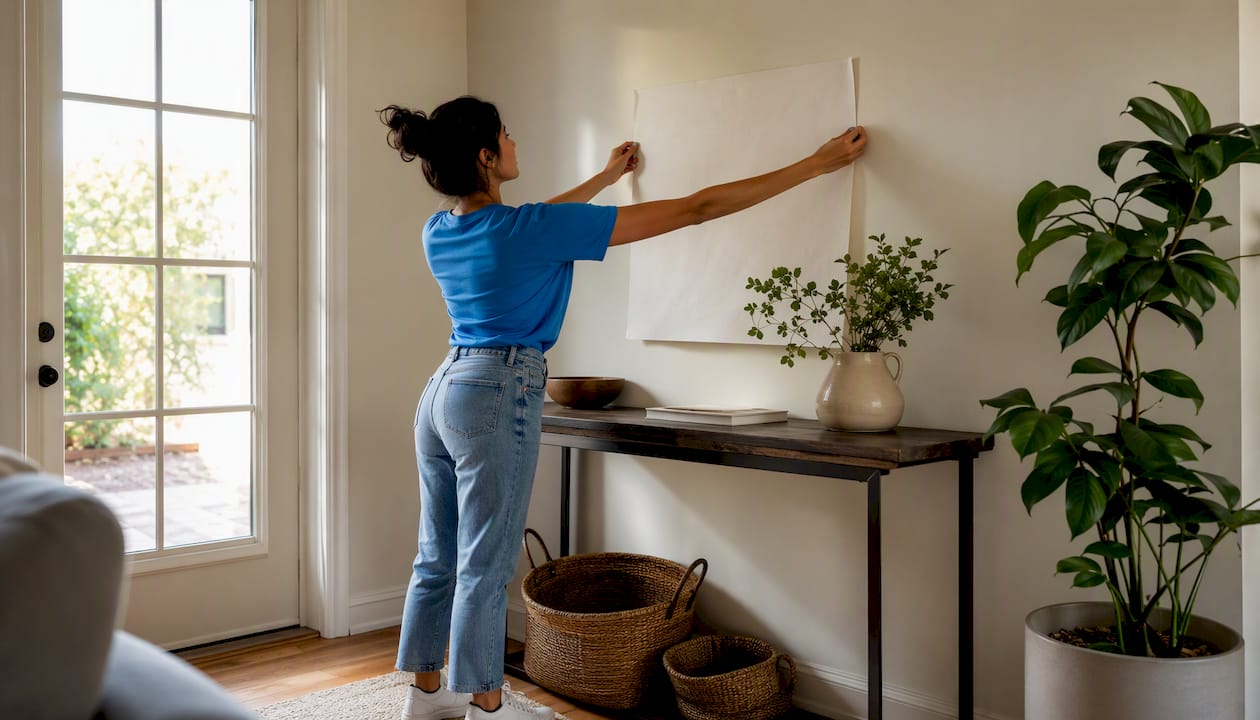
For commercial or office spaces, the rule scales up: large open walls benefit from pieces that are at least 40"×60" or multi-panel groupings that treat the wall as a single composition.
Spacing, alignment, and groupings
When hanging multiple canvases, keep the gap between pieces consistent at 2"–4". Align the tops or centers of the pieces rather than the bottoms for a cleaner look. A horizontal row of three identical-size canvases is the simplest grouping; asymmetric arrangements with mixed sizes require more planning but can look more dynamic.
Pro Tip: Cut paper templates to the exact canvas dimensions and tape them to the wall before ordering. This takes five minutes and prevents the most common sizing mistake: ordering a piece that is either too small for the wall or too large for the furniture beneath it. For rooms with high ceilings (above 9’), consider sizing up one step from your initial estimate, since vertical space makes pieces read smaller than they measure.
What is the best configuration, and how do you order without mistakes?
For most buyers, the recommended build is a 1.5" gallery wrap on archival poly-cotton canvas, printed with giclée pigment inks, finished with a dual UV coating, and displayed without a frame or with a floating frame for added presence. Sensecanvas delivers this at a starting price of $85, with full customization across size, depth, and edge treatment. For personal photos, request a manual image review before the order goes to print.
Here is the checklist to run before hitting “order”:
- Verify image resolution. Confirm your photo meets the minimum pixel dimensions for your chosen size (at least 100 PPI at print dimensions; 150 PPI preferred).
- Choose your edge type. Mirror or solid-color wrap for portraits and close subjects; image wrap for landscapes with clear margins.
- Confirm depth and frame. Select 1.5" for focal pieces; add a floating frame if the wall or room calls for it, and re-measure with the frame included.
- Request a manual review. For any print larger than 20"×24", ask the print team to check resolution, color, and crop before production begins.
- Confirm the estimated ship date. Add production time plus shipping time and confirm it fits your timeline.
- Review the satisfaction guarantee. Know the reprint and refund policy before you pay.
Browse and order at Sensecanvas to configure your personalized canvas photo wrap.
Key Takeaways
Gallery-quality canvas photo wraps on archival canvas with giclée inks and a dual UV coating deliver the best combination of visual impact and long-term durability for personal photos displayed as focal art.
| Point | Details |
|---|---|
| Recommended build | 1.5" gallery wrap, archival canvas, giclée inks, dual UV coating, mirror or solid-color edge. |
| Edge choice guidance | Use mirror or solid-color wrap for portraits; image wrap only when the subject has clear margins from every edge. |
| File prep essentials | Upload sRGB JPEG or TIFF at minimum 100 PPI at print size; request manual review for prints larger than 20"×24". |
| Expected lead time | Allow 2–3 business days production plus 3–7 business days shipping for US orders; hand-assembled labs take longer. |
| Sensecanvas | Offers personalized canvas photo wraps starting at $85 with over 15,000 designs and full size and edge customization. |
Why gallery-quality wraps are worth the premium
The conventional wisdom in canvas printing is that the differences between a $40 fast-turnaround print and a $100+ gallery-quality wrap are mostly cosmetic. That is wrong, and the gap shows up within a few years of display.
The real difference is the curing process and the ink chemistry. A print made with standard pigment inks and a single quick UV spray will start to show color shift within a few years under normal indoor light. A print made with archival giclée inks, hand-stretched on a solid wood frame built to the exact dimensions, and finished with two separate UV coats with curing time between each, is a fundamentally different object. The frame will not warp. The colors will not drift. The surface will not crack when the canvas flexes with seasonal humidity changes.
For a photo that matters, the $40 option is a false economy. The piece you are printing likely has real personal value. The cost difference between a fast-turnaround service and a premium lab is often less than $50 on a standard size. That $50 buys you a print that holds up for decades rather than years.
Sensecanvas approaches this with a selection of over 15,000 designs alongside full customization for personal photos, with pricing that starts at $85 and scales with size and framing options. If you have a photo you want to live with for a long time, contact Sensecanvas support for a manual file review before your order goes to production.
Ready to order your custom canvas print?
Sensecanvas offers hand-stretched canvas photo wraps with archival-quality materials, starting at $85. Every piece is available in multiple sizes and depths, with your choice of image wrap, mirror wrap, or solid-color edge treatment.
What sets Sensecanvas apart for personal photo orders:
- Archival canvas substrate with giclée pigment inks for 100+ year display life
- Dual UV protective coating for long-term color and surface protection
- Full customization: size, depth, edge type, and optional floating or gallery frame
- Over 15,000 designs available alongside personalized photo uploads
- Prices starting at $85 with no hidden framing or hardware fees
For large prints or photos with complex compositions, contact the Sensecanvas team for a manual crop and color review before production. Visit Sensecanvas to configure your order and see the full range of sizes and framing options.
Useful sources
The sources below were used to ground the factual claims in this article. Each one covers a specific aspect of the canvas printing process.
| Source | What It Covers |
|---|---|
| Yellow Lab Imaging — Canvas Gallery Wraps | Documents the multi-day curing and two-coat UV process used by premium labs; explains hand-stretching on solid pine frames built to exact print dimensions. |
| Lumaprints — Framed Canvas Prints | Details archival polycotton canvas specs (360gsm, 0.48mm), frame options (floating, decorative, traditional), hardware by depth, and custom sizing up to 52×100". |
| Canva — Canvas Prints | Explains polyester-cotton blend substrates, hand-stretching on hardwood frames, and the difference between stretched and mirrored edge finishes. |