Canvas Landscape Prints: Your Complete Buying Guide
The fastest way to get professional-looking canvas landscape prints is to order a custom-sized, gallery-wrapped canvas printed on archival-grade canvas with UV-resistant inks. Sensecanvas makes this straightforward: a very large selection of designs, competitive prices, and on-site preview tools that let you confirm crop and framing before you commit.
Before you click “add to cart,” three quick decisions will save you from returns:
- Orientation first: landscape format (horizontal) works above sofas, beds, and conference tables; portrait suits narrow walls and entryways
- Wrap or frame: gallery wrap gives a modern, floating look; a floater frame suits corporate or traditional spaces
- Preview the crop: use the site’s preview tool to confirm nothing important gets cut at the edges, especially for panoramic scenes
Sensecanvas covers abstract, animal-themed, motivational, and photographic styles, so you can match the print to the room’s mood rather than settling for whatever’s in stock.
Table of Contents
- Why do canvas landscape prints work so well in any room?
- How to choose the right landscape style and color palette
- How do you pick the right size and placement for a canvas?
- What materials and printing specs actually matter?
- What should you expect to pay, and how long does it take?
- How to order from Sensecanvas, step by step
- Hanging, styling, and caring for your canvas print
- Key Takeaways
- What most buyers get wrong about landscape canvas prints
- Ready to find your landscape canvas print?
Why do canvas landscape prints work so well in any room?
Landscapes do something most other art categories don’t: they give a room a sense of depth that isn’t physically there. A wide mountain panorama above a sofa makes a living room feel twice as open. A misty forest scene in a bedroom lowers the visual temperature of the space. This isn’t just aesthetic intuition. Nature-themed art is consistently positioned by interior designers as a psychological anchor that reduces stress and creates calm focal points in interiors.
Different landscape subtypes serve different rooms:
- Photographic landscapes (mountain scenery, coastal shots, forest paths): ideal for living rooms, master bedrooms, and hotel lobbies where realism and detail reward close viewing
- Painted or impressionistic landscapes: soften formal dining rooms and reading nooks; the brushstroke texture adds warmth that photography sometimes lacks
- Abstract landscape art (color field, gestural): works in creative offices, lounges, and modern open-plan spaces where bold color matters more than literal scenery
- Cityscape prints: a natural fit for conference rooms and reception areas, especially when the city depicted connects to the company’s identity
- Animal-themed and pastoral scenes: versatile enough for children’s rooms, home offices, and rustic or farmhouse-style living spaces
Large-format prints, particularly panoramic canvases, consistently outperform smaller pieces as focal-wall anchors. The scale commands attention without requiring additional decor around it.
How to choose the right landscape style and color palette
Match the mood to the room’s function before you think about color. Bedrooms and waiting rooms benefit from calming greens, soft blues, and muted earth tones. Creative offices and lounges can handle high-contrast, saturated palettes without feeling overwhelming. A motivational quote overlaid on a mountain scene works in a home gym or studio; the same piece in a bedroom would feel like a to-do list.
Style rules worth knowing:
- Photographic realism rewards high-resolution images and works best in rooms with good natural light, where detail is visible
- Painterly or impressionistic styles hide minor resolution limits and look strong under warm artificial lighting
- Abstract landscapes give you color and mood without literal imagery, which makes them easier to match to existing furniture and textiles
- Animal-themed landscapes (a lone elk in fog, a wolf against a winter sky) add narrative interest without the formality of traditional fine art; see how deer canvas art reads in real rooms for a sense of scale and placement
For color, pick one dominant hue from the print that already appears somewhere in the room — a throw pillow, a rug, a paint accent wall. Then let the print’s secondary tones do the rest. You don’t need to match exactly; you need to not clash.
Pro Tip: Photograph your wall with your phone, then drop a screenshot of the print into the photo using your phone’s editing app. It’s a rough mock-up, but it catches obvious mismatches in color temperature and scale before you order.
How do you pick the right size and placement for a canvas?
Size is where most buyers go wrong. The art looks fine on a product page, then arrives and feels like a postage stamp on the wall.
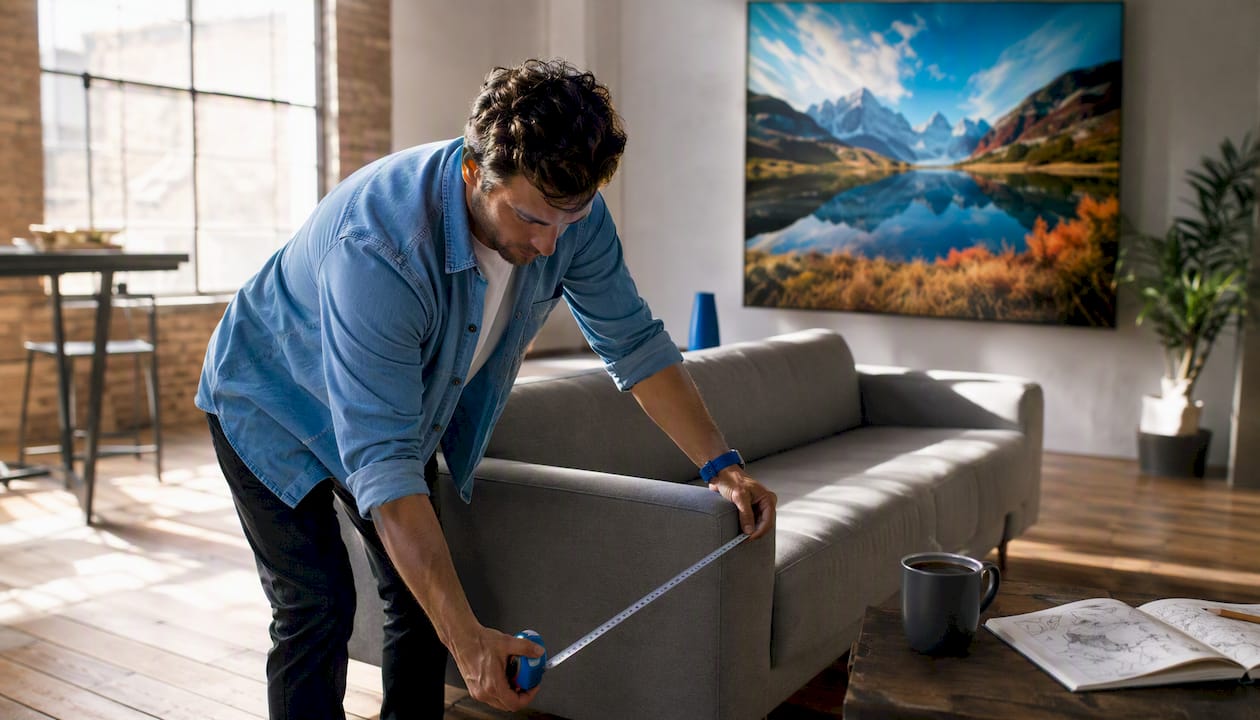
Two rules cover most situations: art width should run roughly 60–75% of the furniture it hangs above, and the center of the piece should sit 57–60 inches from the floor (standard eye level). For large panoramic canvases, scale up to fill the wall rather than centering a modest piece in a sea of empty space.
| Canvas size | Best placement | Notes |
|---|---|---|
| 12" × 16" | Desk, shelf, small accent wall | Works as part of a gallery grouping |
| 24" × 36" | Bedroom above nightstand, hallway | Good standalone for mid-size walls |
| 36" × 48" | Above sofa, dining room focal wall | Most popular living room size |
| 48" × 72" | Statement wall, large conference room | Needs 8-ft+ ceilings for proportion |
| Panoramic (e.g., 20" × 60") | Above a long sofa or bed, reception desk | Confirms horizon alignment before ordering |
Placement checklist:
- Measure the wall width and the furniture below it
- Calculate 60–75% of the furniture width to find your target canvas width
- Mark 57–60 inches from the floor and tape a paper template to the wall
- Live with the template for a day and check it in both natural and artificial light
- Confirm furniture clearance: leave at least 6–8 inches between the bottom of the canvas and the top of the furniture
- For multi-panel layouts, decide on gap spacing (typically 1–2 inches) before ordering
For commercial interiors, scale up aggressively. A conference room that seats 12 needs a canvas that reads from across the table, not from three feet away.
What materials and printing specs actually matter?
Archival-grade canvas and UV-resistant pigment inks are the two specs that determine whether a print looks the same in ten years as it does on day one. Avoid plastic-based surface coatings — they create a sheen that reads as cheap and can crack over time. A matte or lightly textured finish gives the fine-art look that makes a canvas print feel like a painting rather than a photograph on fabric.
Key specs to confirm before ordering:
- Canvas type: archival-grade, acid-free cotton or poly-cotton blend
- Inks: UV-resistant pigment inks (not dye-based, which fade faster)
- Finish: matte or lightly textured for fine-art look; glossy only if the room has controlled lighting
- Stretcher bars: gallery wrap uses 1.25"–1.5" bars for a modern floating look; float frames add a framed finish for corporate settings
- Edge printing: mirrored, color-matched, or black edges — confirm which the provider uses by default
For large panoramas, order at the highest practical DPI and ask whether the provider offers seam-free or multi-panel options. Multi-panel splits must preserve horizon alignment or the scene looks broken.
Sensecanvas uses archival materials and UV-resistant inks across its catalog, which covers the longevity baseline without requiring you to negotiate specs on each order.
What should you expect to pay, and how long does it take?
Prices at Sensecanvas start from $85, with the final cost depending on size, framing choice, and any custom options. A standard 24" × 36" gallery-wrapped canvas typically sits in the mid-range; adding a floater frame or ordering a large panoramic format moves the price up. When comparing prices across platforms, verify the substrate and print method — a cheaper print on dye-based inks on thin canvas is not the same product.
What to expect on timing and logistics:
- Production: most custom canvas prints take 3–5 business days to produce before shipping
- Shipping: standard domestic shipping typically adds 5–7 business days; expedited options are usually available at checkout
- Packaging: quality providers ship canvases in reinforced boxes with corner protection to prevent transit damage
- Payment: Sensecanvas uses HTTPS-secured checkout with standard card processing
- Returns: use the on-site preview tool before finalizing — a reliable crop preview significantly reduces the need for returns on custom sizes and unusual aspect ratios
If you’re ordering for a specific date (a housewarming, an office opening), add at least two weeks of buffer from order to wall.
How to order from Sensecanvas, step by step
The process is straightforward, but a few steps are worth slowing down for.
- Browse by category or filter: use the search or category filters to narrow by style (landscape, abstract, animal, motivational), orientation, and dominant color
- Select size and finish: choose your canvas dimensions, pick gallery wrap or floater frame, and confirm the edge style (mirrored, color-matched, or solid)
- Preview and confirm crop: use the on-site preview tool to check that the focal point of the image isn’t cut off — especially important for panoramic scenes with a centered horizon
- Check DPI if uploading a custom image: for custom photo uploads, confirm the file resolution is sufficient for the size you’ve chosen; the site flags low-resolution files before checkout
- Choose shipping and pay: select your shipping speed, enter payment details on the secured checkout page, and save the order confirmation email — it includes your production ETA
Customer photos and gallery examples on the product pages are worth reviewing before you finalize. Seeing a 36" × 48" mountain print in an actual living room gives you a much more accurate sense of scale than the product image alone.
Hanging, styling, and caring for your canvas print
Hardware: for drywall, use D-ring hangers with drywall anchors rated for the canvas weight. Heavier large-format pieces (anything above 36" × 48") benefit from a French cleat, which distributes weight across a wider span and makes leveling easier. For masonry walls, use masonry anchors and a hammer drill.
Styling tips:
- Center the canvas above furniture, not above the floor
- When grouping multiple canvases, treat the cluster as one unit and center that unit above the furniture
- Pair canvas prints with shelves or mirrors at different heights to break up flat wall arrangements
- Use directional lighting (a picture light or adjustable track light) to bring out texture without creating glare on matte finishes
Care: dust with a dry microfiber cloth every few weeks. Despite UV-resistant inks, avoid hanging prints in direct sunlight for extended periods — UV protection slows fading, it doesn’t eliminate it. Keep humidity below 60% to prevent canvas warping or stretcher bar swelling. Never use wet cleaning agents on canvas.
Pro Tip: Rotating prints seasonally, moving a coastal scene to the bedroom in summer and a warm forest print to the living room in fall, refreshes the feel of a space without buying anything new.
Key Takeaways
Choosing the right canvas landscape print comes down to four decisions made in the right order: style and mood, then size and placement, then materials, then logistics.
| Point | Details |
|---|---|
| Style before size | Decide photographic, painted, abstract, or animal-themed first; the mood drives every other choice. |
| Use the 60–75% rule | Canvas width should cover 60–75% of the furniture below it; center at 57–60 inches from the floor. |
| Archival materials matter | Prioritize archival-grade canvas and UV-resistant pigment inks; avoid plastic coatings for a fine-art finish. |
| Preview before you finalize | Use the on-site crop preview to confirm focal points and horizon alignment, especially for panoramic sizes. |
| Sensecanvas starting point | Over 15,000 designs with custom sizing, gallery wrap options, and prices from $85 at sensecanvas.com. |
What most buyers get wrong about landscape canvas prints
The conventional advice is to “measure your wall and pick a size.” That’s not wrong, but it’s incomplete in a way that leads to the most common complaint: the print arrives and feels disconnected from the room. The measurement is right, but the mood is off.
The real decision is emotional before it’s dimensional. A photographic mountain print and an abstract color-field interpretation of the same mountain are technically the same subject, but they create entirely different rooms. One says “I love the outdoors.” The other says “I care about color and form.” Neither is better, but they don’t belong in the same space.
What Sensecanvas gets right with its 15,000-design catalog is that it forces you to browse by feeling before you browse by size. You land on something that stops you, and then you figure out where it goes. That’s actually the correct order. Most buyers do it backwards — they measure the wall, decide on a size, and then try to find art that fits the rectangle. The result is competent but forgettable.
Archival materials and UV-resistant inks matter, but they’re table stakes at this point. The harder skill is trusting your instinct about which image belongs in your space, then using the preview tool to confirm the crop. That combination of gut and verification is what separates a print you love for years from one you stop seeing after a month.
Ready to find your landscape canvas print?
Sensecanvas gives you over 15,000 designs, custom sizing, gallery wrap and floater frame options, and a preview tool that catches crop problems before they become return problems. Prices start from $85, checkout is secured, and production typically runs 3–5 business days before shipping.
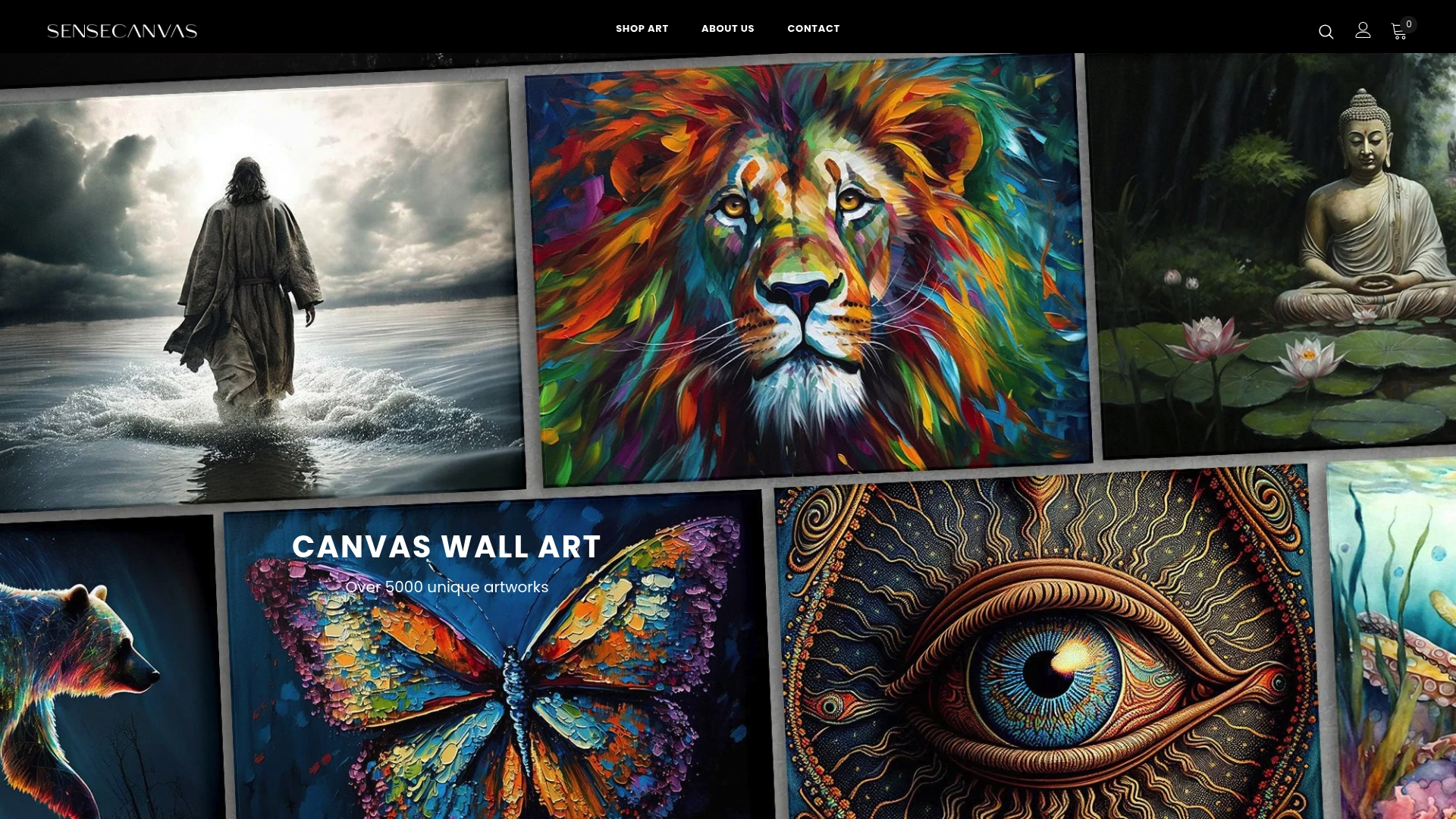
Browse the full catalog at Sensecanvas and use the on-site filters to narrow by orientation, color, and style. If you want to start with an abstract landscape, the abstract ocean print is a strong example of how color-field landscapes translate to canvas. Pick the image that stops you, confirm the crop, and order with confidence.