Measure First: Triptych Wall Art Centered at 57–60 Inches
A triptych is one artwork split across three panels, hung together as a single visual statement. Get two things right and the rest falls into place: keep the gap between panels identical on every side, and center the whole grouping around 57 to 60 inches off the floor. This guide covers picking the right images, doing the sizing math, and hanging the panels so they read as one piece instead of three mismatched frames.
TL;DR:
- Keeping the gap between panels identical and centering the entire triptych around 57 to 60 inches from the floor is essential for a professional look.
- Continuous triptychs work best on wide, unobstructed walls, while thematic sets are more adaptable to irregular wall shapes or spaces with outlets.
- Panel sizes should match the wall and furniture scale, with common choices being 16x24, 24x36, or 30x40 inches, and gaps scaled proportionally from 1.5 to 3 inches.
- Precise measurement, templating with kraft paper, and hanging the center panel first are key steps to prevent misalignment and uneven gaps.
- Using high-resolution images, matching tones, and confirming key visual elements do not land on seams improve the overall cohesion and appearance of the triptych.
Table of Contents
- What Is Triptych Wall Art and When Should You Use It?
- Choosing Images, Colors, and Styles That Work as Triptychs
- Sizing and Spacing Rules: Exact Measurements and Quick Math
- How Do You Hang a Triptych Step by Step?
- Framing, Materials, and Finish Choices That Affect the Look
- Common Mistakes and Quick Fixes
- How Sensecanvas Simplifies a Triptych Project
- Designer Checklist: Three Priority Checks Before You Hang
- Order a Custom Triptych at Sensecanvas
- Sources
- FAQ
What Is Triptych Wall Art and When Should You Use It?
The word comes from art history, where museums define a triptych as three panels unified by a single visual idea, whether that idea spans across all three surfaces or simply connects them by theme or palette. That distinction matters more than most people realize when they start shopping.
There are two main approaches, and picking the wrong one for your space is the most common early mistake:
- Continuous triptychs split one image across three panels, like a mountain range or a cityscape that flows uninterrupted from left to right. These create drama and scale, especially on a long, empty wall behind a sofa or bed.
- Thematic triptychs use three separate but related images, tied together by color, subject, or mood rather than a single continuous scene. A trio of abstract paintings in the same blue and rust palette works this way.
Continuous pieces demand a wide, unbroken wall since cropping or interruptions from a doorway or light switch break the illusion. Thematic sets are more forgiving and adapt better to awkward wall shapes, staircases, or walls with outlets and switches in play. If your wall is at least 6 feet wide with a clear focal point, either style works. Narrower or interrupted walls usually do better with a thematic grouping.
Choosing Images, Colors, and Styles That Work as Triptychs
Not every photo or painting survives being cut into thirds. Landscapes, abstracts, and minimal compositions tend to work best because they don’t rely on a single focal point that could end up hidden behind a gap. A close-up portrait, on the other hand, risks having an eye or a hand line up exactly where two panels meet.
When you’re working with a continuous image, check the crop before you print anything. Move the split points away from faces, horizons, or other elements the eye locks onto immediately, since even the vendor’s default crop lines don’t always land in a flattering spot. Most printers, Sensecanvas included, offer digital mockups or proofs. Use them to confirm nothing important sits on a seam.
Color continuity ties a thematic triptych together even when the subjects differ. Three separate compositions that share a dominant hue or similar tonal contrast will read as a set; three images with wildly different color temperatures will look like three unrelated purchases hung too close together. Some homeowners deliberately break this rule for a “curated gallery” effect, but that’s a stylistic choice, not an accident.
A few practical checkpoints before you send a file to print:
- Confirm resolution is high enough for the final print size. Stretched or blurry enlargements are one of the most common regrets with oversized wall art.
- Match tone and saturation across all three files if you want a seamless look.
- Check the crop against faces, horizons, and text so nothing important lands on a seam.
- Review the coordinating color combinations before committing to three separate pieces.
Pro Tip: Print a small test swatch of each panel’s dominant color on regular paper and hold them together in the actual room lighting. Screen colors and printed colors under lamp light are rarely identical.
Sizing and Spacing Rules: Exact Measurements and Quick Math
Scale is where triptychs go wrong most often. A common rule of thumb: the full grouping, gaps included, should span roughly 60% of the furniture it hangs above, whether that’s a sofa, bed, or console table.
Panel sizing usually follows a few standard sets:
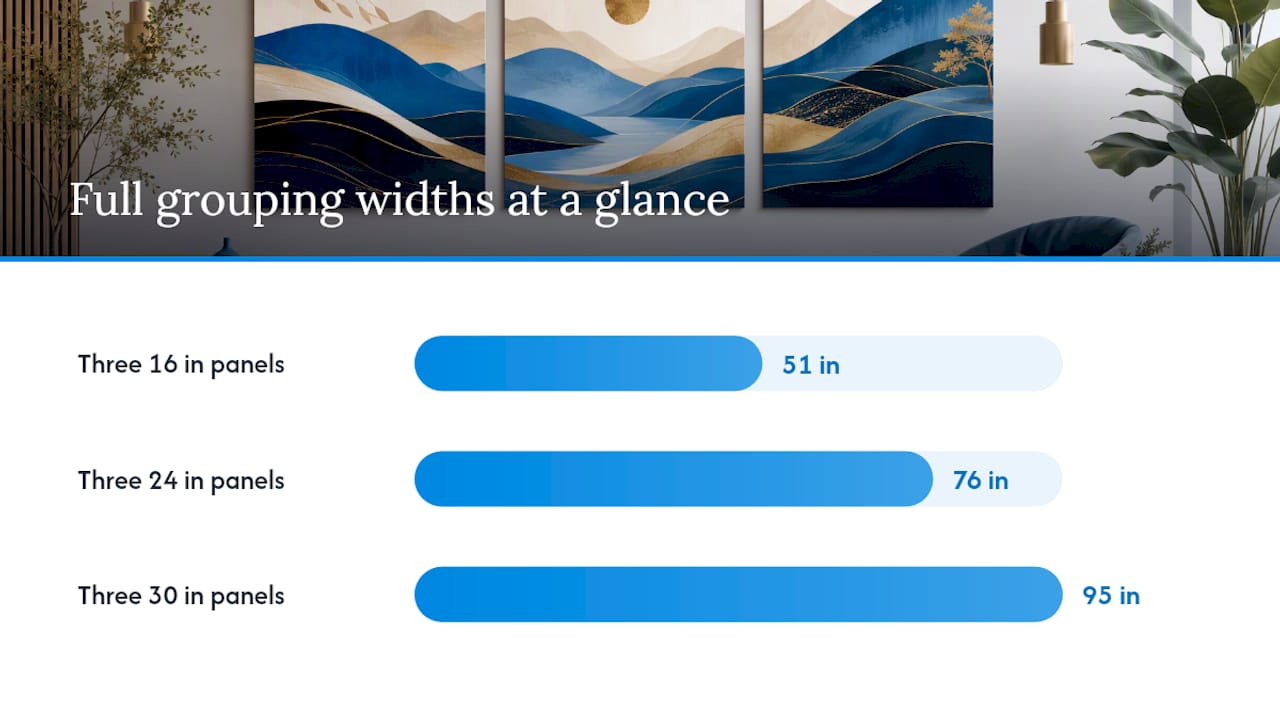
- Three 16x24-inch panels for a moderate space, like a hallway or a smaller bedroom wall.
- Three 24x36-inch panels for a living room wall behind a standard sofa.
- Three 30x40-inch or larger panels for oversized walls, high ceilings, or a statement piece behind a king bed.
Spacing between panels is the detail that separates a professional-looking install from an amateur one. The going rate among framers and designers runs from 1.5 to 3 inches, scaled to panel size:
- Small panels (under 20 inches wide): 1.5-inch gaps keep the set feeling unified.
- Standard/medium panels (20 to 30 inches): 2 inches is the most common default.
- Large panels (30 inches and up): 2 to 3 inches gives the composition room to breathe without looking disconnected.
Whatever number you pick, use it on every gap, not just the two you can see easily. Once you’ve settled on panel width and gap size, the math is simple: multiply panel width by three, add the two gaps, and that total is your full grouping width. Three 24 inch panels with 2 inch gaps gives you 76 inches total (72 inches of canvas plus 4 inches of gap). Center that 76 inch figure over your sofa or wall, and you already know exactly where the outer edges need to land. For furniture-specific sizing logic, the same percentage math applies whether you’re hanging above a sofa or a dining table.
How Do You Hang a Triptych Step by Step?
Skipping the planning stage is how people end up with nail holes in the wrong spot. Here’s the sequence that avoids that:
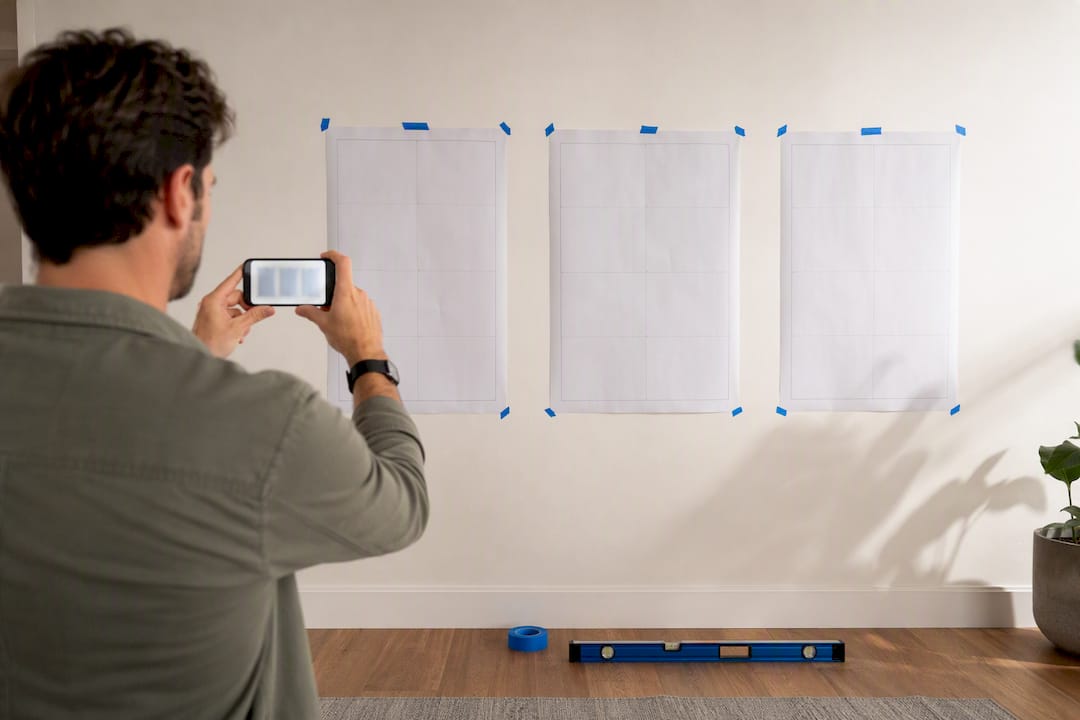
- Cut kraft-paper templates to the exact size of each panel, including the frame if there is one. Tape them to the wall in your planned layout with painter’s tape, using your chosen gap measurement between each. This lets you test the entire arrangement before a single nail goes in.
- Measure the full grouping width (panels plus gaps) and mark the wall’s true center point. If you’re hanging over furniture, center the grouping on the furniture’s midpoint, not the wall’s, since they’re rarely the same.
- Mark the target height. The visual center of the whole grouping should land around 57 to 60 inches from the floor, with 6 to 12 inches of clearance above any furniture below it.
- Hang the side panels, using a level and your fixed gap measurement to set their position relative to the center panel.
- Check level and alignment from a few feet back, and again from the room’s main sightline, like the doorway you walk through most often. A level line at the wall doesn’t always look level from across the room.
Hardware matters as much as the math. Standard picture hooks and drywall anchors rated for 10 to 15 or more pounds per anchor handle most stretched canvas panels. Heavier framed pieces or anything with glass should get two anchors per panel spaced apart, not stacked, to resist tipping forward.
Pro Tip: Before you commit to the final holes, step back and photograph the taped-up templates with your phone. Photos flatten depth and reveal crooked spacing far faster than the naked eye standing three feet from the wall.
Framing, Materials, and Finish Choices That Affect the Look
Gallery-wrapped canvas has no visible frame, sits flush to the wall, and reads as lightweight and modern, which makes gaps between panels look cleaner and more intentional. Framed prints add visual weight and a defined edge, which can help a thematic triptych feel more cohesive if the images vary in color or subject. Acrylic and metal prints add reflectivity and heft; they photograph beautifully but need sturdier hardware and are more prone to glare under direct light.
Frame depth changes how the gap between panels actually looks. A thick frame throws a shadow into the gap and visually widens it, so you may need to tighten your gap measurement slightly if you’re using deep floating frames instead of a raw canvas wrap.
Mounting hardware also affects how forgiving your install is:
- Sawtooth hangers work for lightweight panels but offer little adjustment once hung.
- Wire hanging gives some side-to-side flexibility during leveling.
- D-rings hang flatter against the wall and are the standard for gallery canvas.
- French cleats distribute weight across a wider area, useful for oversized or heavy panels, though they need more precise wall marking upfront.
Standard sizes cost less and ship faster, but nonstandard wall dimensions or a specific gap plan often call for custom framing that matches all three panels exactly, since mismatched frame styles undercut the whole point of hanging them as a set.
Common Mistakes and Quick Fixes
Uneven gaps are the number one giveaway of a rushed install, and framers note that even a half-inch difference between gaps reads as an error, not a design choice. Thin shims behind a frame corner or switching to adjustable sawtooth hangers usually fixes minor tilt without redrilling.
- If the grouping looks too small for the wall, don’t add a fourth panel. Recalculate the total width, and either size up the panels or widen the gaps slightly.
- If it feels oversized or cramped, tighten the gaps by half an inch across the board rather than changing just one.
- Sagging panels usually mean the anchor is underrated for the weight. Swap in a heavier-duty anchor rather than adding a second nail nearby.
- Glare from overhead lighting is fixed by angling the fixture, adding a diffusing filter, or shifting the grouping a few inches so light doesn’t hit the surface directly.
How Sensecanvas Simplifies a Triptych Project
Cropping and exact sizing are the two places most triptych projects stall, and that’s specifically what Sensecanvas is built to solve. With over 15,000 designs across styles like abstract, floral, and animal themes, you’re not stuck making one image work as three; you can browse for pieces already suited to a multi-panel layout.
- Every design can be resized to match panel dimensions you’ve already measured against your furniture and wall.
- Pricing information is available on the Sensecanvas website, with details depending on size and customization choices.
- Customization means you send the exact width and height per panel instead of hoping a standard size happens to fit your gap math.
- Coordinating collections, like the Floral line, make it easier to find three images that already share tone and mood.
Designer Checklist: Three Priority Checks Before You Hang
A cheap toolkit handles the rest: painter’s tape, a level, a second pair of hands, and anchors rated above the panel’s real weight. If there’s one detail worth double-checking twice, it’s the gap consistency. That’s the one flaw a room notices before anything else.
— Sense
Order a Custom Triptych at Sensecanvas
Sensecanvas solves the two problems that trip up most DIY triptych projects: cropping a continuous image without losing key details, and finding a size that actually fits your measured wall space instead of settling for whatever a standard frame set offers. Once you’ve done the math from this guide, you already have the numbers Sensecanvas needs.
Head to the full collection and enter your exact panel dimensions, gap allowance, and preferred finish, whether that’s gallery-wrapped canvas or a framed edge. If you’re drawn to bold statement pieces, the Bitcoin canvas triptych option shows how a single strong image can be split cleanly across three panels. For a themed office or living room set, the Lion Amongst Sheep piece works well as a centerpiece with two coordinating panels around it. When you check out, include your measured height and width for each panel in the order notes so the print team can confirm nothing important falls on a seam before production starts.
Sources
For deeper technical detail beyond this guide, framing specialists at American Frame cover matching-frame guidance, while Pictureframes walks through templating in more depth. For general layout principles that extend beyond triptychs, see how gallery walls apply similar spacing logic.
- Pictureframes
- How to Frame and Display a Triptych or Diptych - American Frame
- How to Hang Triptych Art for Perfect Alignment and Balanced Wall Spacing
FAQ
Are There Rules for Creating a Triptych?
Yes. The two that matter most are keeping the gap between panels identical on every side and coordinating the images, whether through a continuous scene or a shared color palette, so the three pieces read as one artwork rather than three separate purchases.
What Is the Rule for Centering a Grouping on the Wall?
A common guideline is to size the full grouping to roughly 60 to 75% of the wall or furniture width below it. Then center that grouping so its visual midpoint sits around 57 to 60 inches from the floor.
How Do You Hang Triptych Art So It Looks Professional?
Build kraft-paper templates first, mark the wall’s center and your target height, then hang the center panel before the two sides, using a level and matching anchors rated for the panel weight throughout.
Do You Have a General Guide for Hanging Wall Art Like This?
The same principles for triptychs, consistent spacing, centered height, and hardware rated for the weight, apply broadly to any multi-panel wall art, and Sensecanvas’s sizing guidance covers single and grouped pieces alike.
How Much Does a Custom Triptych From Sensecanvas Cost?
Pricing information for custom triptychs is provided on the Sensecanvas website and may vary by size and customization options.