Spa Wall Art Ideas: 9 Ways to Bring Calm to Any Wall
The best spa wall art does three things: it uses a soft, low-contrast palette, it shows something from nature or nothing at all (abstract color and form), and it is sized to the wall so the room feels open. Canvas is a natural fit because it has no glass glare, it looks warm, and it can be made to the exact size your wall needs. At Sense Canvas, our designs are exclusive to us and can be customized for size or composition, so a spa wall does not have to be built around whatever size happens to be in stock.
Below you will find the themes that read as “spa”, the colors that support them, how to size and arrange canvases, and what to think about in a humid room.
TL;DR
- Choose calm subjects: botanicals, water, stones, soft abstracts, or quiet landscapes. Skip busy scenes and bold text.
- Stay in one muted palette: soft blues and greens, warm neutrals, greige or taupe, with one accent at most.
- Size the art to the wall or furniture below it. A single large canvas feels more spa-like than many small ones.
- In a bathroom, hang art away from direct shower spray and run the exhaust fan so moisture does not linger.
- Offices and treatment rooms work best with abstract or nature art, placed where a client’s eyes land when they lie back or sit down.
Table of Contents
- What makes art feel like a spa
- Nine spa wall art ideas
- Colors that work for spa wall art
- Match the art to the room
- Size, orientation and arrangement
- Hanging canvas in a humid room
- Our approach to spa wall art
- Find your spa canvas
- FAQ
- Sources
What makes art feel like a spa
A spa feels calm because nothing in it competes for attention. Designers describe the same recipe again and again: serene color palettes, layers of texture and carefully chosen accessories. Architectural Digest’s guide to creating a home spa quotes designer Vergara Tobin on exactly that mix, and designer Kennedy on natural materials such as wood and stone for grounding texture.
For wall art, that translates into four tests:
- Low contrast. Soft edges and gentle gradients relax the eye. Hard black-on-white graphics energize it.
- One focal point. A spa wall has one piece, or one tidy group, not a gallery of unrelated images.
- Breathing room. Empty wall around the art is part of the look.
- A natural reference. Water, plants, stone, sky and light say “outdoors” even in a windowless treatment room.
Nine spa wall art ideas
1. Botanical and floral canvases
Leaves, ferns, eucalyptus, lotus and water lilies are the classic spa subjects. They bring a living, organic shape to a room full of hard surfaces like tile and porcelain. Choose pieces with plenty of negative space, such as a single bloom on a pale background, rather than dense bouquets. Our floral collection is a good starting point for botanical looks, and a few of our designs pair woman and flower imagery if you want something with more of a portrait feel, like Woman Flowers 1.
2. Soft abstract color fields
Abstract art with no specific subject lets the mind wander, which is exactly the point in a relaxation room. Pure Spa Direct’s guide to relaxation room artwork recommends flowing lines in gentle shades such as muted grays, warm taupes and subtle watercolor washes for a modern, clean look. Our Abstract line has dozens of options to compare, for example Abstract Modern 1, Abstract Modern 18 and Abstract Modern 36. Pick the ones whose dominant colors already appear in your towels, tile or paint.
3. Water, ocean and sky
Sea, horizon lines, rain and mist suit bathrooms especially well because they echo what the room is for. Keep the horizon level and the palette pale. A wide, horizontal canvas over a tub or vanity gives the room a view it never had.
4. Zen stones and candlelight
Stacked stones, a lit candle or a bowl of water are the visual shorthand of a spa. They work best as a single, quiet image. If your room has real candles or a diffuser, a stone-themed canvas repeats the idea without adding clutter.
5. Minimalist line art
A single continuous line drawing of a face, a leaf or a wave suits an esthetician’s room, a salon waiting area or a modern bathroom. It adds personality without adding visual noise. Keep the line thin and the background light.
6. Warm-neutral abstracts for all-white rooms
An all-white bathroom can feel clinical. A canvas in peach, sand or ochre tones adds warmth while staying in the neutral family. Nancy’s Home lists warm peach and ochre abstracts as a way to do this in white bathrooms.
7. Quiet landscapes
Mist over hills, a still lake, dunes at dusk. Landscapes with soft light and no strong human or animal focus read as peaceful. Avoid dramatic skies and saturated sunsets, which are more stimulating than calming.
8. A diptych or triptych
Two or three canvases that form one image give a long wall a calm rhythm. Keep gaps between panels small and equal, and hang them as a single unit. This suits the wall above a bathtub, a massage table or a reception desk.

9. One oversized statement canvas
If you only do one thing, hang one large piece. A single big canvas looks intentional and expensive, and it keeps the wall quiet. This is where a custom size helps most: you measure the wall, and the art is made to fit it.
Colors that work for spa wall art
Start with the room, not the art. Pick one muted palette anchor, such as warm white, greige or soft sage, and repeat it across walls, textiles and tile grout, then add at least two natural textures like linen, teak or stone. That is the approach 101 Home Decor recommends for spa bathrooms, and it is easy to apply to art: choose a canvas that picks up that same anchor.
A simple guide:
| Room mood | Art palette | Pairs well with |
|---|---|---|
| Fresh and airy | Soft blues, pale aqua, white | Chrome, white tile, light wood |
| Earthy and grounded | Sage, olive, sand, taupe | Teak, stone, linen |
| Warm and cocooning | Peach, ochre, cream, blush | Brass, terracotta, warm white |
| Modern and minimal | Muted gray, charcoal wash, off-white | Matte black fixtures, concrete |
Soft blue is widely treated as the safest non-neutral spa color. Designing Idea describes soft blue as calming, low in saturation and close to neutral. If you are unsure, start there, then add one warm accent in the art.
Match the art to the room
Bathroom
The bathroom is where most people look for spa wall art. Aim for a horizontal canvas over the tub, toilet or vanity, or a pair of narrow vertical pieces flanking a mirror. Botanical, water and soft abstract pieces all work. Hang the art where steam and splashes will not hit it directly, and see the hanging section below.
Home spa or relaxation corner
If you have a corner for yoga, meditation, a sauna or a soaking tub, you have more freedom. Hang art at eye level for the position you will actually be in: lower if you sit or lie down, standard height if you stand. A large abstract or landscape gives your eyes somewhere to rest.
Treatment room or salon
Clients in a treatment room spend much of their time on their backs. Put the calming piece where a lying client can see it, usually on the wall opposite the head of the table or on the ceiling-adjacent wall at the foot. Avoid busy imagery and anything with text. Keep the art consistent across rooms so the whole space feels like one brand. Interior designers specifying several rooms can ask us about matching sizes and compositions across a set.
Office or reception
For an office, spa-style art means calm, not sleepy. Abstract pieces in blue-greens and warm neutrals soften a reception desk or a quiet room without making it feel like a day spa. If you want a bolder look in another part of the office, our motivation and pop lines are there for that, but keep the break room or wellness room calm.
As a gift
Spa art makes a thoughtful housewarming or wedding gift for someone with a new bathroom or a self-care routine. Choose a neutral botanical or abstract piece in soft colors so it fits almost any decor, and pick a size that suits a standard wall rather than a tiny nook.
Size, orientation and arrangement
Size is the thing most people get wrong, and too-small art is the most common mistake. A widely used designer rule of thumb is to make art about two-thirds the width of the furniture beneath it. Over a 60-inch vanity or a 72-inch tub wall, that means roughly 40 to 48 inches of art width, whether that is one canvas or a group.
A few practical guidelines:
- Horizontal canvases suit wide spaces: above a tub, a vanity, a daybed or a reception desk.
- Vertical canvases suit narrow walls, beside a door or mirror, and make low ceilings feel taller.
- Square canvases suit symmetrical arrangements and small gaps between fixtures.
- Center the piece at about 57 inches from the floor, the standard gallery eye level, and go lower if the viewer will mostly be seated.
- For groups, keep spacing between canvases equal and small, about 2 to 3 inches.
Before you order, tape paper to the wall at the planned size and leave it up for a day. You will see right away whether it feels too big or too small. With a canvas that can be customized for size, you can adjust the dimensions to what you saw instead of settling for the nearest standard size.
Coordinating with the rest of the room
The art should echo something already there. Pull one color from the tile, the towels or a plant, and let the canvas repeat it. If the room already has a lot of pattern, choose art with soft, simple forms. If the room is plain, a richer, more textured abstract adds depth. Fixtures and cabinetry also matter: a small luxury kitchen and cabinetry guide shows how consistent materials make a space feel cohesive, and the same logic helps you decide whether art should be warm or cool next to wood or stone finishes.

Hanging canvas in a humid room
Steam is the main concern in a bathroom or spa room, so plan for it:
- Choose the wall carefully. Put art on the wall farthest from the shower or tub spray, or on the wall opposite it. Avoid hanging directly over a running shower.
- Ventilate. Run the exhaust fan during and after showers, or crack a window, so moisture clears faster.
- Leave a small gap. Use bumpers on the lower corners so air can move behind the canvas.
- Use secure hardware. Match anchors to your wall type (drywall, tile or plaster). Tile needs the right bit and care, so ask a handyman if you are not comfortable drilling.
- Mind the weight. A large canvas needs two hanging points and a level, not a single nail.
Our canvases are made for easy installation, so the hanging step stays simple. For a steamy room, treat placement and ventilation as part of the design.
Our approach to spa wall art
We start with a simple belief: a calm wall is a designed wall. People do not want a spa wall that looks like a catalog. They want one piece that suits their room, in a size that fits their wall.
That is why we offer more than 15,000 designs, all exclusive to Sense Canvas, and let you customize size or composition. Our canvases are handcrafted using premium artist-grade materials, and every order ships free worldwide with a satisfaction guarantee.
For spa-style rooms, we suggest starting from the palette: pick the soft color you will repeat, then find a floral, abstract or landscape piece that carries it. One well-sized canvas beats five small ones every time.
Sense
Find your spa canvas
If you are ready to choose, start with the Sense Canvas collection. It has more than 15,000 exclusive designs across floral, abstract, animal and other themes, each available in multiple sizes and customizable for size or composition. Our canvases are handcrafted with premium artist-grade materials, easy to install, and covered by a satisfaction guarantee with free global shipping.
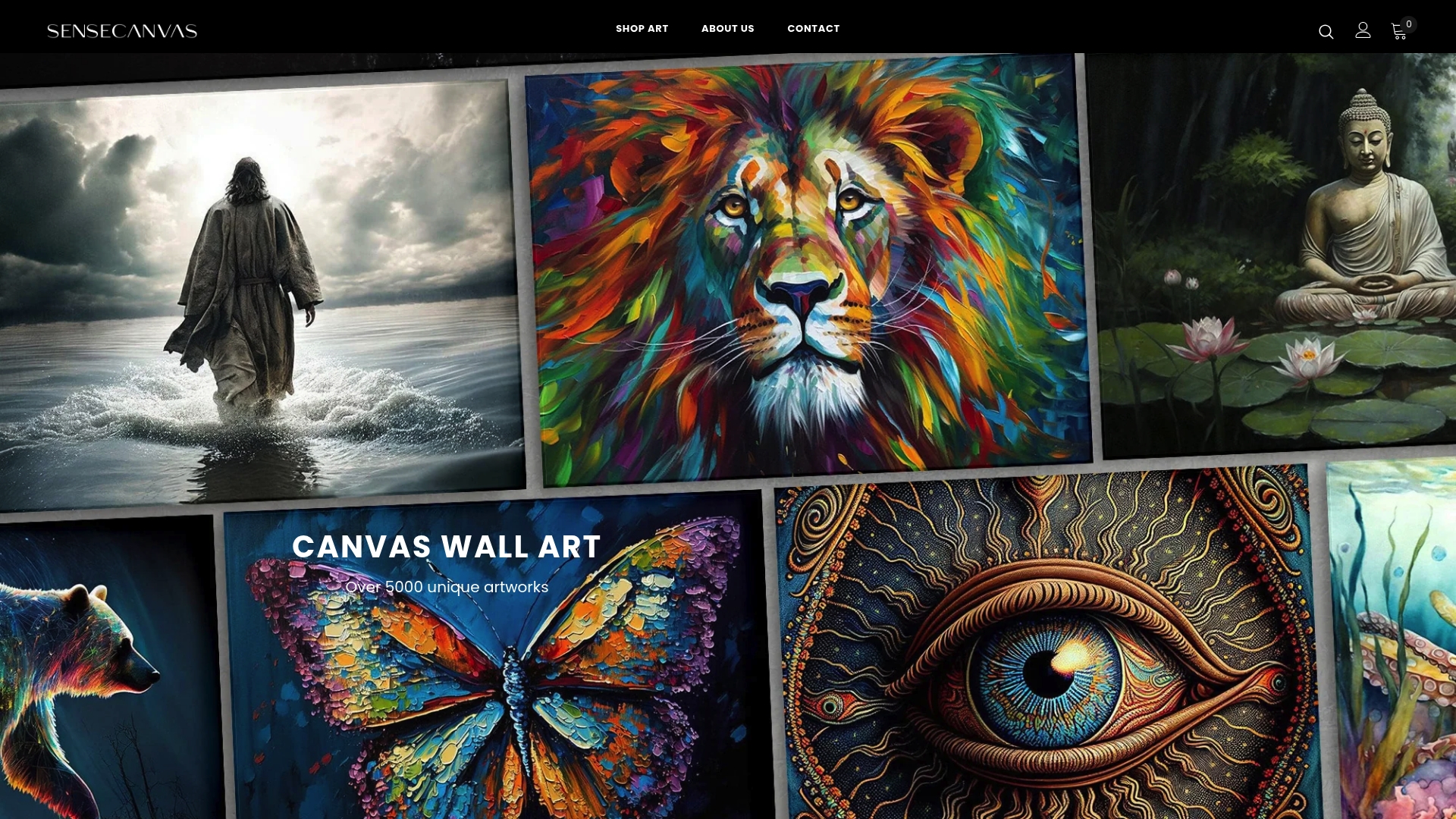
For a botanical look, browse the floral designs. For a soft, subject-free feel, look at the Abstract Modern range, such as Abstract Modern 3 or Abstract Modern 61.
FAQ
What is the best spa wall art for a bathroom?
Botanical prints, soft abstracts, water scenes and zen-stone images work best. Keep the palette to soft blues, greens or warm neutrals, and choose one larger piece rather than many small ones. Hang it away from direct shower spray.
What colors make a room feel like a spa?
Soft blue, sage green, warm white, taupe and greige are the most common choices. They are low in saturation, so the room feels quiet. Add one warm accent such as peach or ochre if the room feels cold.
What size canvas should I hang over a tub or vanity?
A good starting point is about two-thirds the width of the furniture below. For a 60-inch vanity, that is roughly 40 inches. Mock up the size with paper before you order, and consider a custom size if your wall is an unusual width.
Can I use spa wall art in an office or treatment room?
Yes. Calm abstracts and nature scenes suit reception areas, wellness rooms and treatment rooms. In a treatment room, place the art where a client lying down will see it, and keep imagery simple and free of text.