Geometric Abstract Art: Essential Artists and How to Spot It
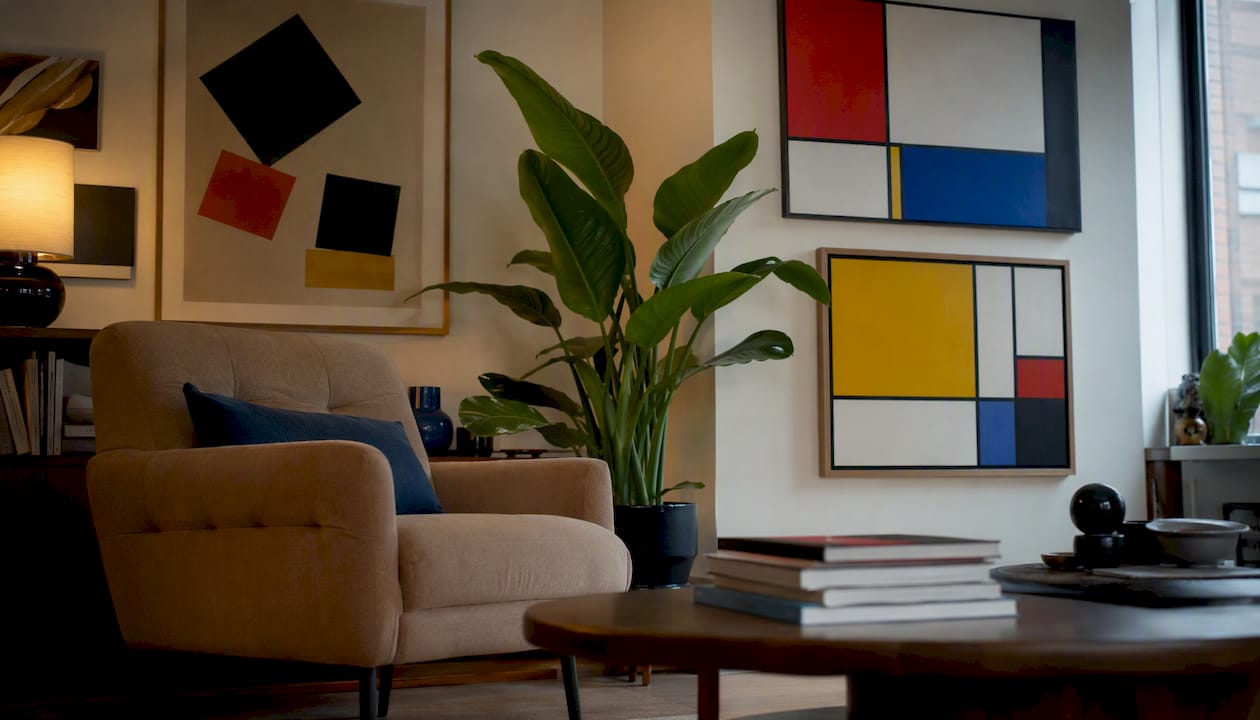
Geometric abstract art uses pure geometric forms — squares, circles, triangles, grids — arranged in nonrepresentational compositions that refer to nothing in the physical world. No landscapes, no faces, no objects. Just shape, color, and the flat surface of the canvas doing all the work. Mondrian’s black-grid compositions with red, yellow, and blue rectangles are the textbook example. So is Malevich’s Black Square (1915), a single black quadrilateral on white that declared painting’s independence from representation entirely. If you want a single image to anchor the style in your mind, find a reproduction of Mondrian’s Composition II in Red, Blue, and Yellow (1930, MoMA collection) and study how the grid holds the eye without depicting anything.
MoMA frames the style as hard-edge and linear forms arranged in the flat picture plane, where shapes refer only to themselves rather than to any external subject. That curatorial definition is the clearest working description you will find.
Key Takeaways
Geometric abstract art is a nonrepresentational style built on geometric forms, flat color, and hard edges, with roots in early-20th-century movements that still shape contemporary visual culture.
| Point | Details |
|---|---|
| Core definition | Geometric abstraction uses shapes, grids, and flat color in compositions that refer to nothing in the physical world. |
| Essential artists | Mondrian, Malevich, Kandinsky, Albers, Stella, Martin, Kelly, and Max Bill are the eight artists every student of the style should know. |
| How to spot it | Look for hard edges, flat unmodulated color, and a composition that honors the flatness of the picture plane rather than creating depth. |
| Buying and displaying | Choose scale carefully, use float frames for hard-edge works, and always request edition and provenance documentation for prints and originals. |
| Sensecanvas | Sensecanvas offers geometric and abstract canvas prints with customizable sizes and finishes for home and office display. |
Table of Contents
- How did geometric abstract art develop historically?
- What does geometric abstract art actually look like?
- Major movements and how the style evolved across decades
- Key artists and signature works you should know
- How geometric abstract works are made
- How geometry connects to music and theory
- How to identify and interpret a geometric abstract painting
- Where can you see major geometric abstract works in the U.S.?
- Practical tips for buying and displaying geometric abstract art
- Why geometric abstraction is still a living language
- Geometric abstract canvas art from Sensecanvas
- Sources
How did geometric abstract art develop historically?
The impulse to organize visual experience through geometry predates modernism by centuries. Islamic decorative arts built entire architectural programs from interlocking geometric patterns — tile work, muqarnas, manuscript borders — with no figurative imagery at all. Those traditions demonstrated that geometry alone could carry visual weight and cultural meaning, a lesson Western avant-garde artists absorbed, consciously or not, when they began stripping representation from painting in the early 1900s.
The catalytic break came between roughly 1910 and 1925, when three movements redefined what a painting could be:
- Suprematism (c. 1915–1925): Kazimir Malevich launched the movement in Russia, arguing that pure geometric form expressed a spiritual absolute beyond the material world. His Black Square and subsequent compositions of floating rectangles and crosses set the template.
- De Stijl (1917–1931): Founded in the Netherlands by Mondrian and Theo van Doesburg, De Stijl reduced painting to horizontal and vertical lines and the three primary colors plus black and white. The goal was a universal visual harmony applicable to architecture, furniture, and typography equally.
- Constructivism (c. 1913–1930s): Russian artists including Alexander Rodchenko and El Lissitzky treated geometric form as a tool for social engineering, designing posters, exhibitions, and objects that could reshape collective life. Geometry here was rational and utilitarian rather than spiritual.
- Bauhaus (1919–1933): The German school synthesized these threads into a design curriculum. Kandinsky and Klee taught there; Josef Albers developed color theory exercises that would become foundational to art education worldwide.
By midcentury, the lineage had branched again. Minimalism in the 1960s pushed geometric reduction to near-nothing: Donald Judd’s industrial boxes, Frank Stella’s shaped canvases. Hard-Edge painting, associated with Ellsworth Kelly and others, used flat, unmodulated color areas separated by crisp boundaries. Op Art (Bridget Riley, Victor Vasarely) exploited geometric repetition to create optical vibration. The Buffalo AKG’s exhibition Abstraction, Geometry, Painting: Selected Geometric Abstract Painting in America Since 1945 traced exactly this postwar American thread through a focused selection of paintings, making it one of the most useful single-exhibition references for placing U.S. works chronologically.
What does geometric abstract art actually look like?
The formal vocabulary is specific enough that you can learn to recognize it quickly. The geometric art movement emphasizes precise shapes, clean edges, structured color arrangements, and formal relationships — a visual language that prioritizes surface logic over illusion.
Key traits to look for:
- Hard edges: Boundaries between color areas are sharp and deliberate, not blended or gestural. A ruler or masking tape often produced them.
- Flat color fields: Individual zones of color are typically unmodulated — no visible brushwork, no tonal gradation within a single shape.
- Grid structures: Horizontal and vertical lines organize the composition, sometimes explicitly (Mondrian) and sometimes as an underlying armature.
- Geometric motifs: Squares, rectangles, circles, triangles, diamonds, and chevrons are the primary vocabulary. Curves appear but are usually arcs of a circle rather than freehand.
- Non-representational composition: Nothing in the image depicts a recognizable object. The shapes are the subject.
- Deliberate use of negative space: The areas between or around shapes carry as much visual weight as the shapes themselves.
- Symmetry and asymmetry in tension: Many works are neither fully symmetrical nor chaotically random — they balance geometric order against subtle asymmetric variation.
Pro Tip: When studying a reproduction online, zoom into the edges between color areas. In an original geometric abstract painting, hard edges often show slight imperfections from masking tape removal or layered paint — evidence of the physical process. A digital reproduction or poster will show perfectly clean edges with no such texture. That difference tells you something real about how the work was made.
Major movements and how the style evolved across decades
Mapping the movements by decade makes the ideological differences clearer than any single description can.
Suprematism and De Stijl (1910s–1930s) shared a utopian ambition: both believed geometric form could express universal truths. Malevich’s version was mystical; Mondrian’s was quasi-mathematical. They disagreed sharply about diagonals — Mondrian refused them; van Doesburg embraced them and split from De Stijl over the argument.
Concrete Art (1930s–1950s) was the rationalist counter to Suprematism’s spiritualism. Max Bill, Theo van Doesburg, and others insisted that geometric works should be understood as purely visual objects with no symbolic or spiritual content. Bill’s mathematically derived compositions are the clearest expression of this position.
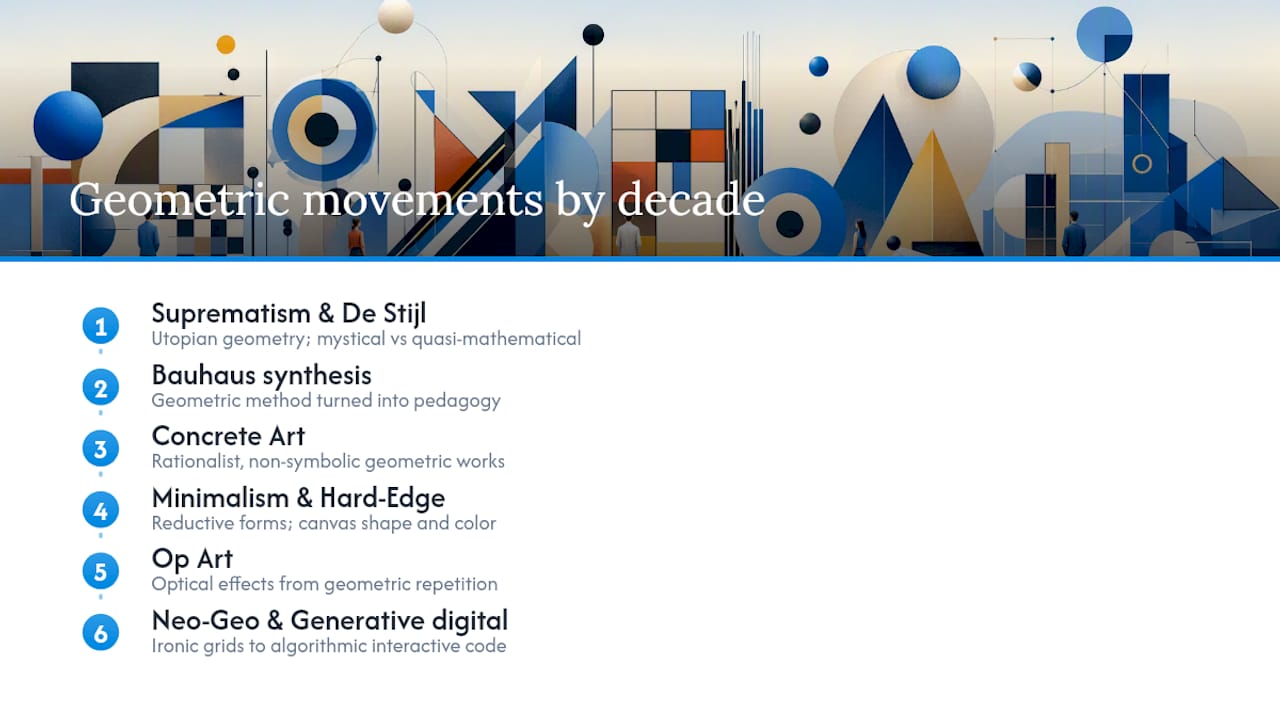
Bauhaus synthesis (1919–1933) turned geometric method into pedagogy. The school’s influence on design education is still felt in every foundation-year art program in the United States today.
Minimalism and Hard-Edge (1960s) stripped geometry to its most reductive form. Frank Stella’s early black paintings used only the shape of the canvas and parallel stripes. Ellsworth Kelly isolated single color forms against white grounds. The critical essay “Geometric Abstraction: Beyond Malevich and Mondrian” argues persuasively that treating these movements as a closed heroic narrative misses the point: geometry has always been a living language with ongoing tensions between spiritual and rational readings, between the handmade mark and the algorithmic line.
Op Art (1960s) weaponized geometric repetition for perceptual effect. The geometry here served neither spirituality nor rationalism but pure optical experience.
Neo-Geo (1980s) returned to geometric form with an ironic, postmodern edge — artists like Peter Halley used grids as metaphors for social infrastructure and surveillance rather than universal harmony.
Generative and digital geometric practices (2000s–present) inherit the grid and the algorithm directly. Code-generated geometric compositions extend the tradition while adding motion, interactivity, and near-infinite variation. The underlying logic — coordinates, repetition, rule-based composition — is the same logic Mondrian applied by hand.
Key artists and signature works you should know
These eight artists are the core study list. Every serious discussion of geometric abstraction returns to them.
-
Piet Mondrian (1872–1944): Reduced painting to horizontal and vertical black lines and primary color rectangles. Signature work: Composition II in Red, Blue, and Yellow (1930), held at MoMA, New York. His approach expressed a belief in universal visual harmony he called Neo-Plasticism.
-
Kazimir Malevich (1879–1935): Founded Suprematism and painted Black Square (1915), now in the Tretyakov Gallery, Moscow. Malevich argued that pure geometric form accessed a spiritual reality beyond the visible world — the most radical claim any painter had made to that point.
-
Wassily Kandinsky (1866–1944): Moved from lyrical abstraction toward geometric form during his Bauhaus years. Composition VIII (1923, Solomon R. Guggenheim Museum, New York) shows circles, triangles, and lines organized with near-musical logic. His book Concerning the Spiritual in Art (1911) remains the foundational theoretical text for understanding why these artists believed geometry could carry emotional and spiritual content.
-
Josef Albers (1888–1976): Taught at the Bauhaus and later at Yale. His Homage to the Square series (begun 1950) used nested squares in subtly varied colors to demonstrate how color perception changes depending on context. Albers used geometric formats to explore color interaction scientifically, and his teaching codified geometric methods in design education across the U.S. The Yale University Art Gallery holds significant Albers holdings.
-
Frank Stella (1936–2024): His early Black Paintings (1958–1960) used parallel black stripes that followed the shape of the canvas edge, eliminating any illusion of depth. Later works introduced shaped canvases and vivid color. MoMA holds several key Stella works.
-
Agnes Martin (1912–2004): Painted grids and horizontal lines in pale, almost imperceptible color — works that sit at the intersection of geometric abstraction and Minimalism. Untitled #5 (1994) is a characteristic example. Martin described her work as expressing happiness and innocence rather than geometry for its own sake, which complicates any purely formalist reading.
-
Ellsworth Kelly (1923–2015): Isolated single geometric color forms — a red rectangle, a blue curve — against white grounds. His Spectrum Colors Arranged by Chance (1951–1953) and later shaped canvases are held at MoMA and the Art Institute of Chicago. Kelly’s approach is the clearest American expression of Hard-Edge painting.
-
Max Bill (1908–1994): Swiss artist and designer who championed Concrete Art. His mathematically derived compositions, including Endless Ribbon (1953–1956), treated geometry as a rational, non-symbolic language. Works are held at the Kunstmuseum Basel and in several U.S. university collections.
The Yale University Art Gallery holds significant works across several of these artists and its traveling exhibitions have been key to circulating geometric abstract works in the U.S.
How geometric abstract works are made
Understanding the process explains why these paintings look the way they do — and why reproductions rarely capture the full experience of the original.
-
Design and planning: Most geometric abstract painters work from precise drawings or diagrams before touching canvas. Mondrian adjusted his compositions with strips of colored tape before committing to paint. Stella used graph paper. The composition is solved intellectually before it is executed physically.
-
Surface preparation: Canvas or wood panel is primed with gesso, often multiple coats sanded smooth, to create a flat, non-absorbent surface. The flatness of the ground supports the flatness of the painted forms.
-
Masking and hard-edge application: Painter’s tape or frisket film is applied along drawn lines to create clean boundaries. Paint — typically acrylic or enamel for hard-edge work, oil for earlier works — is applied within the masked areas. Tape is removed before the paint fully cures to avoid lifting.
-
Layering and color interaction: Multiple coats build opacity. Albers’ Homage to the Square works used oil paint applied directly from the tube with a palette knife, no mixing, so each color retained its full saturation. The sequence of layers affects how colors read against each other.
-
Finishing and framing: Many geometric abstract works are intentionally unframed or float-mounted to preserve the integrity of the edge. A traditional ornate frame would contradict the work’s formal logic. Prints are typically mounted behind UV-protective glass or acrylic.
Conservation note: Flat, hard-edge surfaces show dust, fingerprints, and abrasion more visibly than textured works. For prints, avoid direct sunlight and high humidity. For originals, consult a conservator before cleaning — even a soft cloth can abrade a matte acrylic surface.
Printmaking has always been part of this tradition. Screenprinting suits geometric work naturally because it produces flat, opaque color areas with clean edges. Josef Albers made screenprints; Ellsworth Kelly worked extensively in lithography. Sculpture enters the picture with Minimalism: Donald Judd’s fabricated metal boxes and Max Bill’s mathematical sculptures extend geometric logic into three dimensions.

How geometry connects to music and theory
Kandinsky’s Concerning the Spiritual in Art (1911) is the starting point for understanding why so many geometric abstractionists talked about music. Kandinsky believed that color and form could produce emotional responses analogous to musical tones — that a yellow triangle and a blue circle carried inherent psychological charges the way a major chord differs from a minor one. This was not metaphor for him; it was a working theory he applied to composition.
The connection runs deeper than Kandinsky. Paul Klee, his Bauhaus colleague, analyzed musical structure — counterpoint, rhythm, fugue — and translated those concepts into visual composition. His Pedagogical Sketchbook (1925) lays out a theory of line and movement that reads like a music theory textbook transposed into visual terms.
Composers returned the influence. The serialist composers of the mid-20th century — Schoenberg, Webern, later Boulez — organized sound through mathematical systems that parallel the rule-based compositions of Concrete Art. The structural logic moved in both directions.
For readers who want to go deeper, the primary texts are: Kandinsky’s Concerning the Spiritual in Art (1911); Klee’s Pedagogical Sketchbook (1925); Theo van Doesburg’s Principles of Neo-Plastic Art (1925); and Max Bill’s essays on Concrete Art collected in various exhibition catalogs.
How to identify and interpret a geometric abstract painting
Walk into a gallery and you will encounter works that look geometric but may not be geometric abstraction in the strict sense. Here is a practical checklist for reading what you are looking at.
Identification checklist:
- Are the shapes geometric (circles, squares, triangles, grids) or organic and biomorphic?
- Are the edges hard and precise, or soft and gestural?
- Is the color applied in flat, unmodulated fields, or does it show visible brushwork and tonal variation?
- Does the composition refer to anything in the visible world, even abstractly?
- Is the picture plane honored as flat, or does the work create an illusion of depth?
Geometric abstraction vs. abstract expressionism: Abstract expressionism (Pollock, de Kooning) uses gestural marks, visible process, and emotional immediacy. The edges are soft or nonexistent; the surface is active. Geometric abstraction does the opposite — it suppresses gesture and process in favor of formal clarity. If you can see the brushstroke, you are probably looking at expressionism.
Geometric abstraction vs. decorative pattern: Decorative geometric pattern (wallpaper, textiles) repeats motifs across a surface without compositional hierarchy. Geometric abstract paintings have a specific compositional logic — a center of visual gravity, a relationship between figure and ground — even when they look similar at first glance.
Questions to ask in a gallery:
- What is the scale? Many geometric abstract works depend on scale for their effect — a Stella shaped canvas at 10 feet reads completely differently than a reproduction at 8 inches.
- What is the medium and date? Acrylic versus oil, 1960 versus 1990, changes what you are looking at.
- Does the museum label mention a movement affiliation (Minimalism, Hard-Edge, Concrete Art)?
- Are there artist notes or catalog essays available? Geometric abstract artists were often prolific writers and theorists.
Where can you see major geometric abstract works in the U.S.?
The best collections are concentrated in a handful of institutions, and most have strong online databases.
Museum of Modern Art (MoMA), New York: The deepest U.S. collection for this style. Mondrian, Stella, Kelly, Martin, and Albers are all represented. MoMA’s online collection database lets you filter by movement and medium, and the curatorial glossary entry on geometric abstraction is a reliable reference point.
Solomon R. Guggenheim Museum, New York: Strong on Kandinsky — the museum holds the largest single collection of his work outside Europe. The building itself, a spiral ramp, is a geometric abstraction in architecture.
Yale University Art Gallery, New Haven: Significant Albers holdings (Albers taught at Yale for decades) and a strong collection of postwar American geometric work. The gallery’s traveling exhibitions have been a primary vehicle for circulating these works across U.S. institutions.
Buffalo AKG Art Museum (formerly Albright-Knox), Buffalo, NY: The exhibition Abstraction, Geometry, Painting: Selected Geometric Abstract Painting in America Since 1945 remains a landmark reference for postwar U.S. geometric abstraction, with a catalog that serves as a provenance and chronology tool.
Art Institute of Chicago: Strong Kelly and Minimalism holdings, plus an excellent prints and drawings department where geometric works on paper are accessible to researchers.
Online resources: MoMA’s collection database, the Guggenheim’s online collection, and the Art Institute’s digital archive all allow high-resolution image study. For historical context, the Yale University Art Gallery’s online catalog is particularly useful for exhibition history and provenance research.
Midcentury modern design recycled geometric motifs — atomic shapes, bold color blocks — into furniture, textiles, and commercial graphics, which is why mid century wall art ideas so often overlap with geometric abstraction. The museum gift shops at MoMA and the Guggenheim stock high-quality reproductions if you want to study a work at home.
Practical tips for buying and displaying geometric abstract art
Buying geometric abstract art, whether an original, a limited-edition print, or a canvas reproduction, requires a few specific checks that differ from buying representational work.
Buying checklist:
- Provenance: For originals, ask for exhibition history and any documentation linking the work to the artist. Museum catalog entries and gallery records are the most reliable evidence.
- Edition information: For prints, confirm the edition size, the number of the specific print (e.g., 12/50), and whether the artist signed and numbered it. Open editions have no scarcity value.
- Condition: Hard-edge works show damage more visibly than textured paintings. Examine edges under raking light for chips, abrasion, or inpainting.
- Authentication: For works by major artists, consult the relevant catalogue raisonné (Mondrian’s is published by the Mondrian Trust; Albers’ by the Josef and Anni Albers Foundation).
- Gallery or catalog references: A reputable gallery will provide written documentation. If a seller cannot produce any, treat that as a warning.
Display guidance:
- Scale matters more for geometric abstract work than for almost any other style. A small print of a Stella shaped canvas loses the work’s entire logic. When possible, choose a size that fills at least one-third of the wall it occupies.
- Framing for hard-edge works: float frames (where the canvas sits inside a frame with a visible gap) preserve the integrity of the edge. Ornate or gilded frames actively contradict the work’s formal language.
- Lighting: LED picture lights or track lighting at a 30-degree angle minimize glare on flat, matte surfaces. Avoid direct sunlight, which fades pigment and degrades canvas over time.
- Placement: geometric abstract works read well in rooms with strong architectural lines — hallways, above a fireplace, or on a feature wall with minimal competing visual noise.
Print material comparison:
Price drivers for originals and limited editions: artist reputation, edition size, condition, exhibition history, and whether the work appears in a published catalog raisonné. A work documented in a major museum exhibition catalog commands a significant premium over an undocumented work by the same artist. For collectors new to the field, exhibition catalogs from traveling shows are the most reliable provenance tools available.
For minimalist wall decor contexts, geometric canvas prints work particularly well because their formal clarity complements clean architectural lines without competing with furniture or textiles.
Why geometric abstraction is still a living language
The standard art-history narrative treats geometric abstraction as a heroic early-20th-century project that peaked with Mondrian and Malevich and then got absorbed into Minimalism. That reading is too tidy. Contemporary critics argue that geometry functions as an ongoing visual language with unresolved tensions: spiritual versus rational, handmade versus algorithmic, universal claim versus cultural specificity.
The grid is the clearest example. Mondrian used it to express universal harmony. Agnes Martin used it to express quietness and inner experience. Peter Halley used it to critique social control. A contemporary generative artist uses it because coordinates are how computers think. Same form, radically different intent — which means the form itself is not exhausted. It keeps absorbing new meanings.
Digital tools have extended the tradition in ways the Bauhaus faculty could not have predicted. Generative algorithms produce geometric compositions of genuine complexity; artists like Casey Reas (co-creator of Processing) work explicitly in this lineage. The underlying logic — rule, repetition, variation — is identical to what Albers was doing with nested squares in 1950. The medium changed; the thinking did not.
What this means practically: when you look at a geometric abstract work, resist the impulse to read it as decoration or as a closed historical artifact. Ask what the geometry is doing. Is it expressing order, questioning it, or generating it? The answer changes everything about how the work reads.
Geometric abstract canvas art from Sensecanvas
Sensecanvas carries a wide selection of canvas designs, and the geometric and abstract categories are particularly strong. The practical advantage over hunting through gallery stock or auction platforms: you choose the size, the finish, and the framing style before the piece ships, so what arrives fits the wall you already measured rather than requiring a custom frame order afterward.

Prices start affordably, making high-quality canvas prints accessible without sacrificing print resolution or color accuracy. If you want to see how geometric and abstract compositions translate to canvas at scale, the abstract canvas collection at Sensecanvas is a direct way to compare sizes and finishes side by side. Select your dimensions, review the preview, and order with the confidence that the piece was produced for the wall, not for a gallery storage rack.