Minimalist Wall Decor: Bold Canvas Art for Enthusiasts
Minimalist wall decor is a design approach that uses intentional selection and negative space to give each piece genuine purpose on the wall. It draws from two powerful traditions: the Bauhaus movement’s “form follows function” discipline, which took hold in the early 20th century, and Japanese wabi-sabi, which finds beauty in simplicity and imperfection. Both currents merged into the modern minimalist aesthetic that consolidated in the 1960s–70s. Read on for practical rules on placement, materials, color, and customization so your walls feel vivid and intentional, not bare.
Table of Contents
- What are the core principles of minimalist wall decor?
- Does minimalism mean boring, empty rooms?
- How do you hang minimalist wall art for the best visual impact?
- What materials and finishes make minimalist canvas art feel vivid?
- How do you keep a minimalist room warm and personal?
- How do you care for canvas wall art in a minimalist interior?
- Where can you find vivid, customizable minimalist canvas art?
- How do you customize minimalist wall decor to reflect personal or brand identity?
- How do you mix minimalist wall decor with other interior styles?
- What does minimalist wall decor cost in the U.S. market?
- Key Takeaways
- The case for bold art in restrained rooms
- Vivid, custom canvas art made to fit your walls
- Useful sources
What are the core principles of minimalist wall decor?
The central question minimalism asks of every object is: does this piece earn its place? Not “is it pretty?” Not “was it expensive?” Just: does it serve a purpose or carry genuine meaning in this room? That single filter separates a calm, intentional space from one that just looks empty.
Four principles follow from that question:
- Intentionality: Every piece is chosen, not defaulted to. A blank wall beats a wall covered in art that nobody consciously selected.
- Negative space: The empty wall around a canvas is an active design element, not a failure to fill space. Reduced visual clutter measurably lowers cognitive load and supports focus.
- Tonal restraint: A single accent hue typically anchors a composition to create cohesion, avoiding competing colors that can fragment the visual impact.
- Textural depth: Restraint in quantity does not mean restraint in surface. A matte canvas against a plaster wall reads richer than a dozen framed prints on drywall.
- Unified framing: Consistent frame profiles or a single gallery-wrap canvas keeps the eye from bouncing.
These principles trace back to Bauhaus and wabi-sabi, both of which treated material and form as the message, not decoration layered on top.
Pro Tip: Before hanging anything, hold the piece against the wall and ask aloud: “What would this room lose if I removed it?” If the answer is “nothing,” the piece doesn’t belong there.
Does minimalism mean boring, empty rooms?
The most persistent myth about minimalist interior design is that it means sterile white rooms with no personality. Real minimalism is the opposite: it is rooms where every object gets enough breathing room to actually be seen.
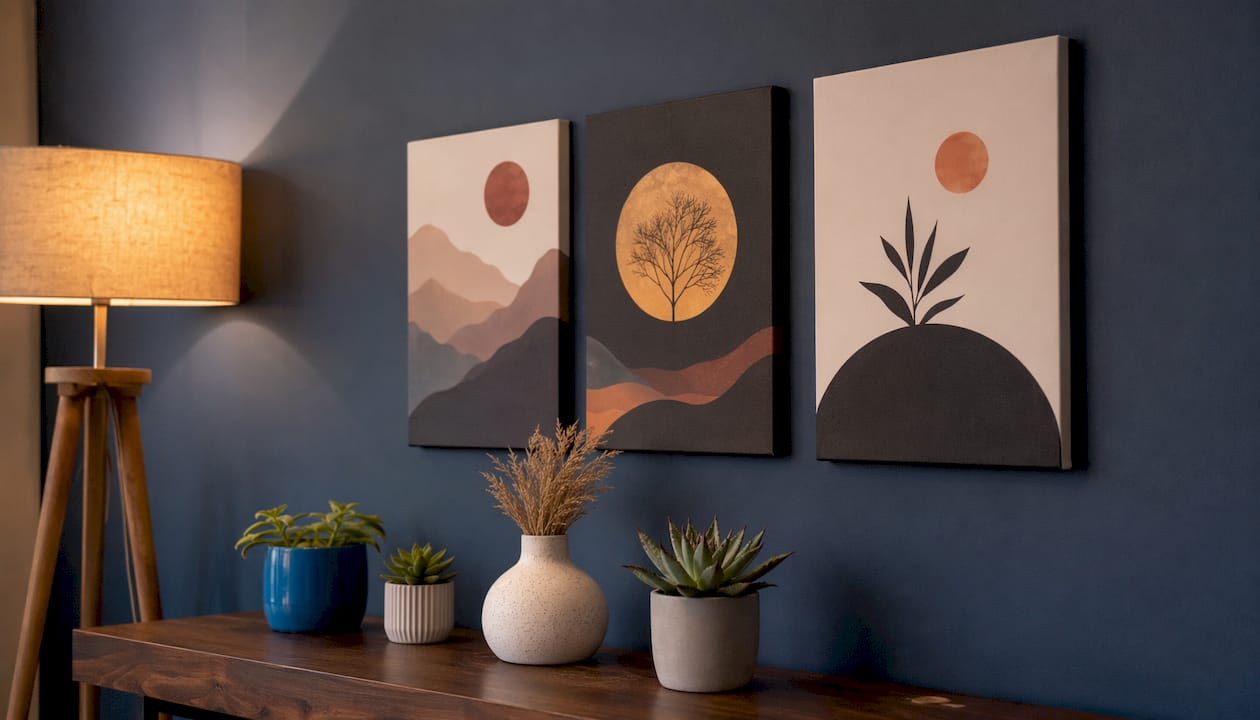
A small living room with one large canvas, a linen sofa, and a wood coffee table reads warmer than the same room stuffed with gallery frames. The canvas has presence. The others would compete with it. For small rooms, a practical display ratio keeps things grounded.
Two-thirds closed storage to one-third open display is the recommended ratio for rooms under roughly 150 sq ft — enough curated display to feel personal, enough concealment to feel calm.
In a home office, that might mean one bold canvas above the desk, a single plant on the shelf, and everything else behind cabinet doors. In a living room, it means one statement piece on the main wall, one meaningful object on the coffee table, and negative space doing the rest of the work. The room-by-room approach matters because minimalism is not a single look; it is a decision made fresh in each space.
How do you hang minimalist wall art for the best visual impact?
Placement is where most people lose the effect. The standard visual guideline is to center artwork near average eye level, which typically corresponds to about mid-height on the wall, and matches gallery hanging practice. Furniture alignment matters too: the canvas should sit within the width of the piece below it, not float unanchored above a narrow console.
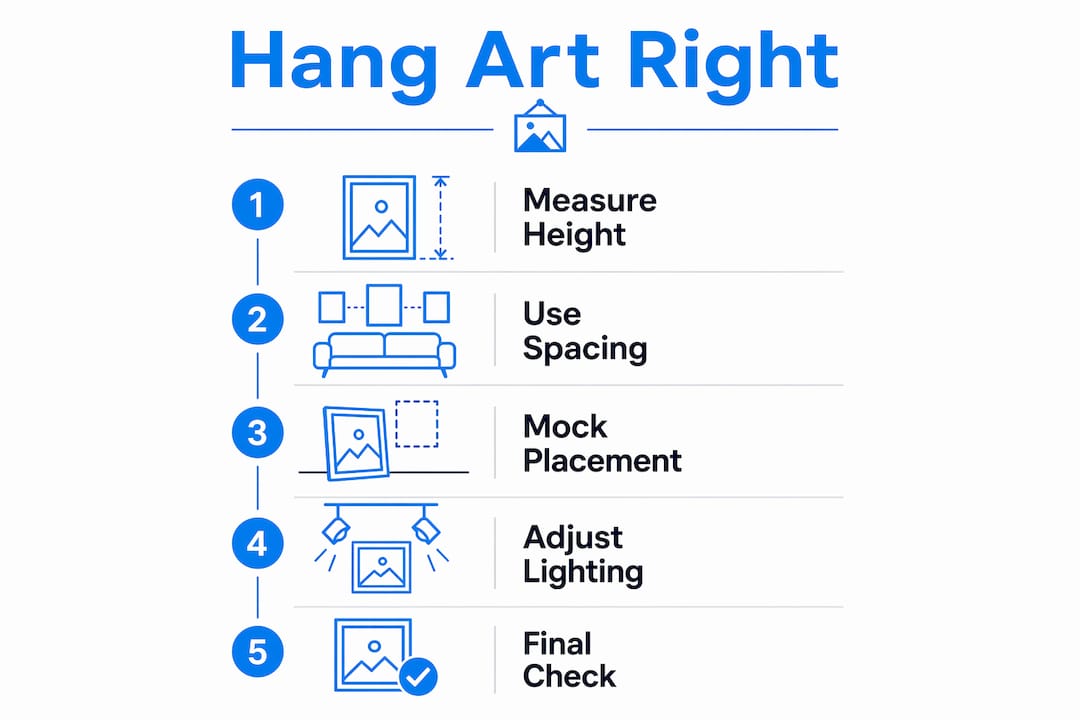
Follow this sequence before driving a single nail:
- Measure the wall and mark the 145–150 cm center point with painter’s tape.
- Cut kraft paper to the canvas dimensions and tape it to the wall.
- Step back to the room’s main sightline and evaluate proportion.
- Confirm the canvas width stays within the furniture footprint below it.
- Check that surrounding negative space feels balanced, not accidental.
For grouped pieces, keep gaps between frames consistent (typically 5–8 cm) and treat the cluster as a single visual unit when measuring center height.
| Rule | Measurement |
|---|---|
| Artwork center height | 145–150 cm from floor |
| Small-room display ratio | Two-thirds closed : one-third open |
| Sensecanvas starting price | From $85 |
Pro Tip: Tape the kraft paper mock-up to the wall and live with it for a day before committing. Lighting changes from morning to evening, and proportion that looks right at noon can feel wrong at 7 PM.
What materials and finishes make minimalist canvas art feel vivid?
Canvas works in minimalist rooms for a specific reason: its texture adds depth without adding visual noise. A flat inkjet print on paper reads thin next to a stretched canvas with a gallery wrap. The woven surface catches light differently across the day, giving a single piece more presence than its subject alone would suggest.
Key choices when ordering:
- Gallery wrap vs. framed: Gallery wrap (image continues around the edges) reads cleaner in minimalist rooms. A thin floating frame in black or natural wood is the only frame style that doesn’t compete.
- Matte vs. satin finish: Matte absorbs light and reads warmer; satin adds slight luminosity that suits high-contrast imagery. For vivid, bold art in a room with natural light, satin often wins.
- Size: One large statement piece anchors a minimalist wall more effectively than several small frames. Aim for a canvas that covers roughly two-thirds of the wall width above the furniture it anchors.
- Color profile: A single accent hue against a neutral field (warm white, soft gray, matte black) keeps the composition restrained while letting the imagery hit hard. Color restraint does not mean dull; it means one color does the work instead of six competing.
For canvas longevity, linen-blend substrates hold color better than standard poly-cotton under UV exposure. If the room gets direct afternoon sun, that detail matters.
How do you keep a minimalist room warm and personal?
Restraint in quantity is not the same as restraint in feeling. The rooms that feel cold are the ones that confused “fewer objects” with “no texture.” Mixing natural materials is the fastest fix.
Pairings that work:
- Wood shelving + linen throw + matte canvas print
- Stone accent wall + gallery-wrap canvas with warm earth tones
- Plaster walls + floating-frame canvas in a single bold hue
- Concrete floors + oversized canvas with organic imagery
Seasonally rotating one focal canvas keeps the room dynamic without adding clutter. Swap a cool-toned abstract for a warm botanical in fall, then back again in spring. One swap, zero new objects on the wall.
For a home office, a single bold motivational canvas above the desk and a small plant on the shelf is enough. For a living room, one large canvas on the main wall paired with a textured throw on the sofa creates warmth without breaking the minimal rule set. Matching the canvas to your broader interior style is easier than it sounds; pairing art to interior styles comes down to repeating one color from the canvas in a textile or accent piece elsewhere in the room.
Pro Tip: For collectors and enthusiasts interested in how minimalist luxury design translates to higher-end displays, the principle is the same: fewer pieces, higher quality, more breathing room.
How do you care for canvas wall art in a minimalist interior?
Canvas is low-maintenance, but a few habits protect the investment. Avoid direct sunlight, control humidity, and dust gently.
- Dust monthly with a dry microfiber cloth; never use water directly on the canvas surface.
- Avoid direct sun: UV exposure fades pigment over time. Hang pieces on walls that receive indirect light, or use UV-filtering glass if framed.
- Humidity: Keep rooms between 40–60% relative humidity. Excess moisture warps stretcher bars.
- Spot cleaning: A barely damp cloth on the frame edge only; never on the printed surface.
- Check mounting hardware every six months; canvas weight shifts with humidity cycles.
Do not use aerosol cleaners, furniture polish, or steam near canvas. Do not lean canvas against radiators or HVAC vents.
Where can you find vivid, customizable minimalist canvas art?
Sensecanvas offers over 15,000 artworks with custom sizing options, starting from $85, covering abstract, nature, spiritual, and motivational themes. That catalog depth matters for minimalist buyers specifically: you need a piece that fits your exact wall dimensions and color story, not whatever standard size happens to be in stock.
Ordering checklist before you buy:
- Measure your wall and confirm the canvas width stays within the furniture footprint below it.
- Choose finish (matte or satin) based on your room’s light conditions.
- Select edge treatment: gallery wrap for a clean look, floating frame for a more formal read.
- Request a digital mockup or soft proof to confirm color profile before production.
- Confirm shipping dimensions and mounting hardware included.
Sensecanvas’s customization options mean you can specify the exact size that fits the 145–150 cm center-height rule and hits the two-thirds wall-width proportion, rather than forcing a standard size to work.
How do you customize minimalist wall decor to reflect personal or brand identity?
Customization is where minimalism stops feeling generic. For personal spaces, the anchor is one image that carries genuine meaning: a place, a symbol, a piece of imagery that connects to something real in your life. For offices and brand spaces, the anchor is usually a color from the brand palette or a visual motif that reinforces the room’s purpose.
A few practical moves: repeat one color from the canvas in a single textile or object elsewhere in the room to create visual cohesion without adding more art. Choose imagery with a clear focal point and generous negative space within the composition itself, so the piece reads minimalist even when the subject is bold. For brand environments, a single large canvas with the brand’s primary color as the dominant hue and a clean, high-contrast subject reads professional and intentional.
How do you mix minimalist wall decor with other interior styles?
Minimalism pairs well with most styles because restraint is a complement, not a competitor. The key is to let the other style’s strongest element lead and to use the canvas as a quiet anchor.
With Scandinavian design, a matte canvas in warm neutrals reinforces the pale-wood-and-linen palette without fighting it. With industrial interiors, a single high-contrast canvas on a brick or concrete wall uses the texture of the wall as part of the composition. With maximalist furniture, one large minimalist canvas on the main wall gives the eye a place to rest amid the richness. The balance of wall decor across styles comes down to one rule: the canvas should not compete with the room’s dominant material or color story; it should echo one element of it.
Avoid the common mistake of adding a minimalist canvas to an already-busy wall. If the wall has architectural detail, molding, or a strong material, the canvas needs more negative space around it, not less.
What does minimalist wall decor cost in the U.S. market?
Pricing for minimalist wall art in the U.S. spans a wide range. Mass-market poster prints start under $20, but they lack the textural depth and scale that make minimalism work. Mid-range canvas prints from specialty retailers typically run $50–$150 for standard sizes. Custom-sized canvases with quality substrates and finish options, like those at Sensecanvas starting from $85, sit in the accessible mid-range while offering the sizing precision that minimalist placement rules demand.
For affordable large-format options, the value calculation shifts: one well-chosen large canvas at $85–$150 outperforms three small prints at $30 each, both visually and in terms of the minimalist effect. Budget for one piece that genuinely earns its place rather than several that collectively dilute the impact.
Key Takeaways
Minimalist wall decor works because intentionality, negative space, and one well-chosen canvas do more for a room than a wall full of competing frames.
| Point | Details |
|---|---|
| Hang at the right height | Center artwork 145–150 cm from the floor for proper visual balance. |
| Use the display ratio | In small rooms, keep two-thirds of storage closed and one-third open for curated display. |
| One large piece beats many small ones | A single statement canvas anchors a minimalist wall more effectively than grouped small frames. |
| Texture adds warmth | Pair canvas with wood, linen, or stone to avoid sterile minimalism without adding clutter. |
| Measure before ordering | Confirm wall dimensions, finish, and edge treatment before purchasing; request a digital mockup. |
| Sensecanvas for custom sizing | Over 15,000 artworks with custom sizing from $85 make it practical to hit exact proportion rules. |
The case for bold art in restrained rooms
The conventional wisdom says minimalism and bold art are opposites. I’d push back on that. A single vivid canvas in a restrained room hits harder than the same image surrounded by competing frames, competing colors, and competing objects. The restraint is what gives the boldness its force.
The “does it earn its place?” framework is not a restriction. It is permission to choose something genuinely striking, because you are only choosing one thing. That is where customizable canvas art becomes the right tool for minimalist enthusiasts: you are not settling for whatever fits the aesthetic. You are specifying exactly the image, size, and finish that makes the room feel like yours.
Vivid, custom canvas art made to fit your walls
If you have measured your wall, chosen your finish, and know the proportion you need, Sensecanvas is built for exactly this moment. With over 15,000 artworks available in custom sizes starting from $85, you can specify the exact dimensions that fit the 145–150 cm center-height rule and hit the two-thirds wall-width proportion, rather than forcing a standard size to work.
Before you order: confirm your wall measurements, select matte or satin finish based on your room’s light, and request a digital mockup to verify color profile. Bold, vivid canvas art that fits a minimalist room is not a compromise. Browse the full catalog at Sensecanvas and find the piece that earns its place.
Useful sources
- Minimalist Interior Design: The Complete Guide — Curated By Hower — storage/display ratios, core minimalist principles
- Minimalist Wall Art Guide — Studio Sarai — hanging height standard (145–150 cm), single statement piece guidance
- The Ultimate Guide to Minimalist Wall Decor — Crafts n Comforts — historical origins, ordering checklist
- Minimalist Home Decor — Home Decor Hub — color restraint and accent hue guidance
- Warmth of Wood — Nills — natural material pairings for textural warmth
- From Accessibility to Neuro-Inclusion — Medium (Illumination) — cognitive load and visual clutter research
- Sensecanvas — Canvas Wall Art — catalog size, customization options, pricing from $85