Top 10 Art Styles for Modern Interiors: Elevate Your Space
The best art styles for modern interiors are abstract, minimalist, geometric, contemporary, large-format photography, figurative, nature-inspired, textured mixed-media, typographic/graphic, and surreal accent pieces. One rule covers all of them: choose contrast to energize a neutral room, or tonal harmony to deepen its calm. Before reading further, measure your largest blank wall and decide which goal it serves.
Quick-scan shortlist:
- Oversized abstract canvas as a living room anchor
- Minimalist line art for bedrooms and hallways
- Geometric prints in dining rooms or home offices
- Large-format photography above a console or sofa
- Textured mixed-media for restrained, monochrome walls
- Typographic or graphic pieces for workspaces and studios
The role of art in home decor goes well beyond decoration. A single well-placed piece can define a room’s entire visual identity. Sensecanvas carries over 15,000 unique canvas artworks, and Jose Art Gallery notes that contemporary art spanning roughly 1970 to the present fits modern, industrial, and eclectic spaces with particular ease.
Table of Contents
- What does “modern interior” actually mean for art selection?
- Which art styles work best in modern interiors?
- How do you choose the right artwork for each room?
- How do you mix art styles without creating visual chaos?
- How Sensecanvas helps you match and customize canvas art
- Key Takeaways
- Art as architectural punctuation, not decoration
- Sensecanvas makes custom sizing straightforward
- Useful sources and further reading
What does “modern interior” actually mean for art selection?
Modern interiors share a recognizable DNA: clean architectural lines, open floor plans, neutral or restrained palettes, and a deliberate focus on proportion and materiality. Wood, concrete, steel, and plaster dominate. Ornamentation is minimal by design.
That restraint is exactly what makes art selection both easier and more consequential. When a room has few competing visual elements, the art you hang carries more weight than it would in a maximalist space. It either becomes the room’s focal point or it disappears into the background entirely.
The practical implication: art in a modern interior should do one of two things. It should provide an energetic focal point that the architecture deliberately withholds, or it should offer a subtle textural complement that reinforces the room’s material language. Trying to do both at once usually produces neither.
Pro Tip: Avoid over-decorating. If your architecture already has strong visual interest, one well-chosen piece outperforms three competing ones every time.
Which art styles work best in modern interiors?
Contemporary wall art spans everything from minimalist line drawings to bold abstract color fields, giving you genuine flexibility. Here is a style-by-style breakdown, followed by a comparison table for fast scanning.
Abstract
Abstract art is the default choice for modern spaces, and for good reason. Its emphasis on form, movement, and color over literal representation mirrors the same priorities modern architecture uses. An oversized abstract canvas above a sofa gives the eye a single architectural anchor, which research from Jose Art Gallery confirms performs better in open plans than multiple small competing works. Best rooms: living room, dining room. Format: large gallery-wrapped canvas, floating frame.
Minimalist
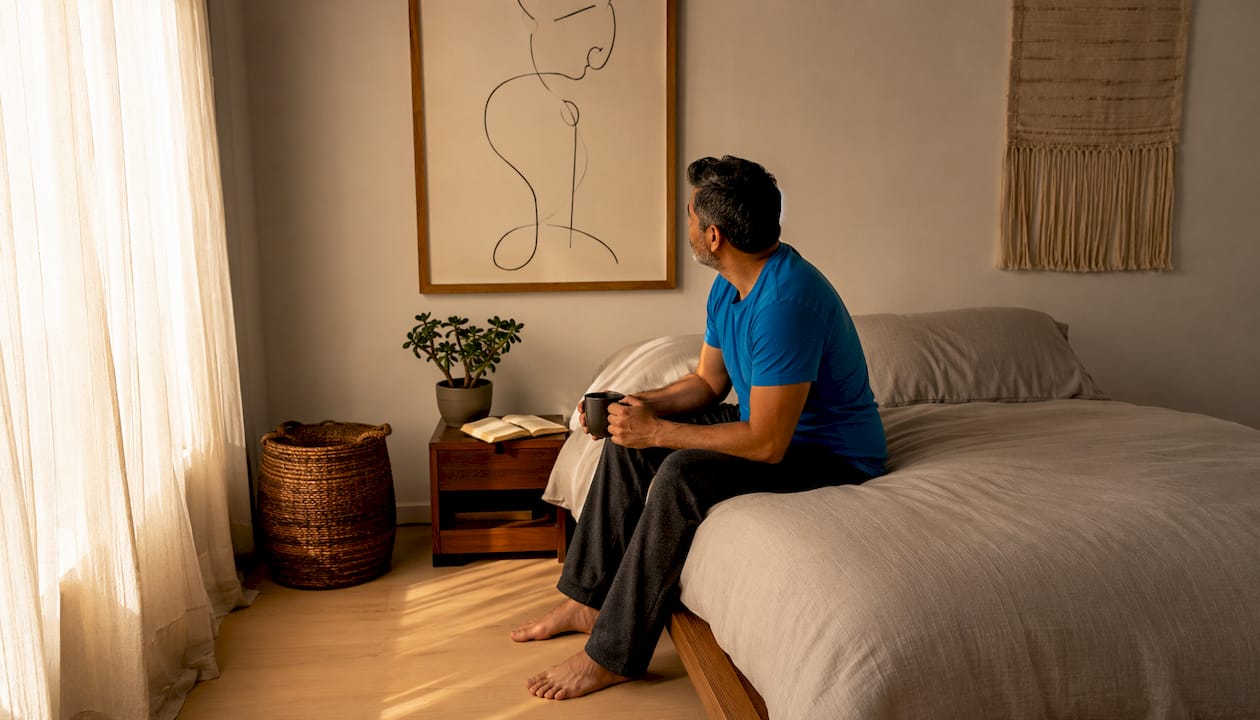
Minimalist art, think single-line drawings, sparse compositions, or monochrome fields, works especially well in bedrooms and hallways where the goal is calm rather than stimulation. It reinforces the architecture without fighting it. Thin black or natural wood frames suit it best; heavy ornate frames undercut the whole point.
Geometric
Hard-edged geometric prints introduce visual rhythm and structure. They pair particularly well with mid-century modern and Japandi-influenced interiors where pattern is otherwise absent. Best rooms: dining room, home office, entryway. Format: framed print or metal panel; avoid canvas wrap, which softens edges.
Contemporary
Contemporary art as a category (roughly post-1970) is broad enough to cover almost any modern substyle, from Scandinavian to industrial. Its adaptability is the point. When in doubt, a contemporary piece in a neutral palette with one accent color pulled from your existing furnishings rarely fails.
Large-format photography and photorealism
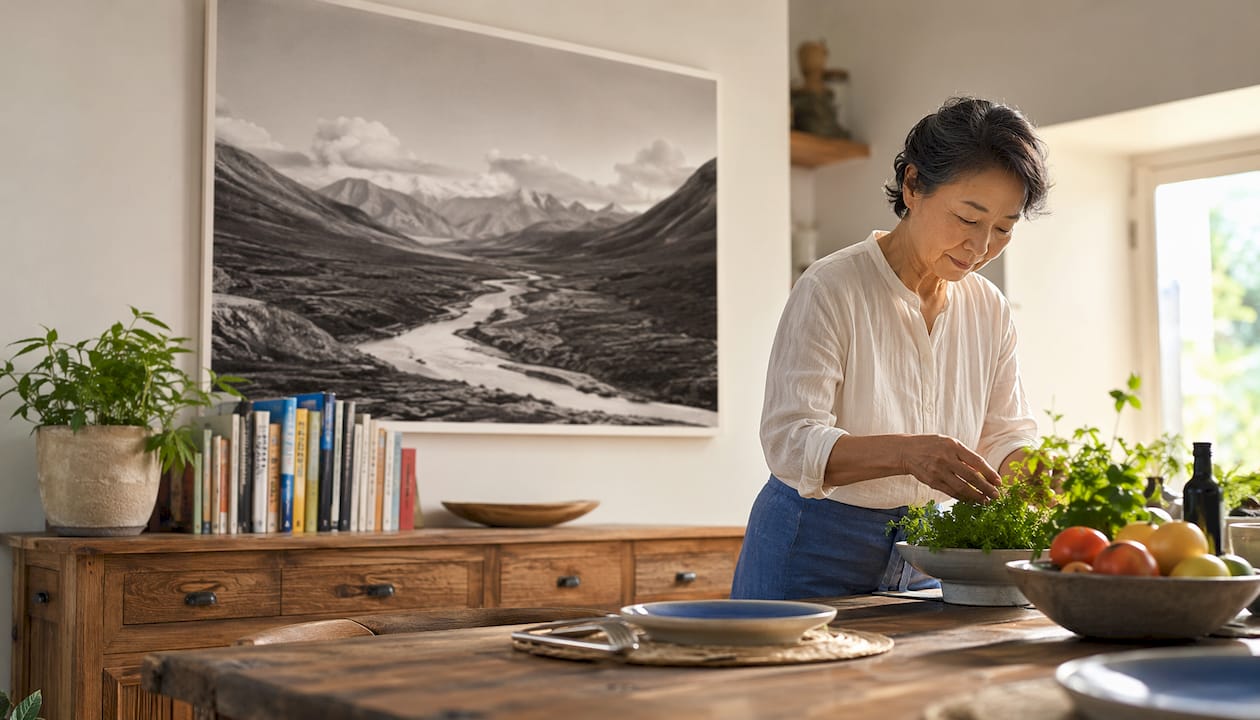
A single large-format photograph, whether a landscape, architectural study, or abstract macro shot, brings a different kind of depth than paint. It reads as documentary and precise, which contrasts interestingly with softer furnishings. Best rooms: entryway, living room, home office. Format: metal print for a sleek finish, or gallery-wrapped canvas for warmth.
Figurative and portraiture
Figurative work introduces human presence into spaces that can otherwise feel impersonal. A single strong portrait or figurative piece creates narrative tension in a modern room. Scale matters here: a small figurative piece gets lost; a large one commands the room. Best rooms: living room, study.
Nature-inspired and landscape
Landscapes and botanical prints soften the hard edges of modern architecture without introducing clutter. Muted, tonal versions work in bedrooms; more saturated, expressive landscapes hold their own in living and dining rooms. Edward Martin specifically recommends soft abstracts and tonal photography for bedrooms, reserving larger, energetic pieces for living and dining areas.
Textured and mixed-media
Textured artwork, pieces incorporating plaster, woven fibers, or layered paper, adds dimension that flat prints cannot. As light shifts across the day, the surface reads differently, creating subtle visual movement. This is particularly valuable in rooms with restrained palettes where color alone cannot carry the wall. Edward Martin’s research highlights these materials as especially effective at reinforcing architectural lines or softening them.
Typographic and graphic
Bold typographic or graphic pieces, whether a stylized word, a graphic poster, or an illustrated motif, bring pop-art energy to modern spaces. They work best in workspaces, studios, game rooms, or anywhere a dose of personality is the explicit goal. Keep the palette tight: one or two colors maximum.
Surreal and expressive accent pieces
A single surreal or expressive piece, used as an accent rather than the room’s primary art, adds an element of surprise that prevents modern interiors from feeling like showrooms. Think of it as punctuation: one unexpected piece in an otherwise restrained collection signals that the space belongs to a real person.
| Style | Why it works | Best rooms | Recommended format |
|---|---|---|---|
| Abstract | Form and movement over literal content | Living room, dining room | Oversized gallery-wrapped canvas |
| Minimalist | Reinforces calm without competing | Bedroom, hallway | Thin-framed print or unframed canvas |
| Geometric | Adds rhythm and structure | Dining room, home office | Framed print or metal panel |
| Contemporary | Broad adaptability across substyles | Any room | Canvas or framed print |
| Large-format photography | Depth and documentary precision | Entryway, living room | Metal print or gallery canvas |
| Figurative | Human presence and narrative | Living room, study | Large canvas, floating frame |
| Nature-inspired | Softens hard architectural edges | Bedroom, living room | Framed print or canvas |
| Textured/mixed-media | Tactile variation as light shifts | Any restrained-palette room | Original or limited-edition piece |
| Typographic/graphic | Personality and pop-art energy | Office, studio, game room | Canvas or poster frame |
| Surreal accent | Prevents sterile, showroom feel | Living room, reading nook | Any format; scale to accent, not anchor |
For visual references, browse Sensecanvas previews, visit a local gallery, or use stock photo platforms to test how a style reads in a room before committing. Canvas art for small spaces follows different scale rules than large open plans, so check format guidance specific to your room size.
How do you choose the right artwork for each room?
A confident art purchase comes down to five decisions made in order. Skip one and you will likely end up with something that looks wrong in the room even if it looked right in the store.
- Measure first. Artwork width should cover a substantial portion of the furniture it hangs above, or a similarly significant part of the wall if it is a standalone piece. For a sofa, the canvas should not extend beyond the sofa’s arms. For a large blank wall, go bigger than your instinct says.
- Decide on contrast or harmony. If your room is neutral and quiet, a bold piece with color or movement energizes it. If the room already has strong architectural interest, a tonal piece that echoes existing materials (wood tones, stone grays) will deepen rather than compete. Avoid matching art colors exactly to furniture; tonal harmony or deliberate contrast both work, but exact-match tends to look dated.
- Choose the medium. Canvas suits warm, residential spaces. Metal prints work in contemporary or industrial rooms where a sleeker finish fits. Textured mixed-media pieces add dimension to monochrome walls. Framed prints offer the most flexibility across styles.
- Set a budget and decide ready-made vs. custom. Ready-made art from a catalog works well for standard wall sizes. Custom sizing, which Sensecanvas offers, solves the problem of nonstandard walls, oversized sofa walls, or stairwell verticals where off-the-shelf dimensions simply do not fit. Sensecanvas offers prices starting at a level designed to be accessible without requiring a gallery budget.
- Ask the right questions before buying online. Check the return policy, confirm whether framing and mounting hardware are included, and ask whether a mockup preview is available for your specific wall dimensions. Red flags: no return policy, no size options, and no framing information listed.
For room-by-room coordination that connects art scale to furniture proportions, a dedicated placement guide will save you from the most common sizing mistakes.
How do you mix art styles without creating visual chaos?
The short answer: unify with one linking element while allowing stylistic contrast everywhere else. That linking element can be color (all pieces share one hue), scale (all pieces are similar in size), or frame (all pieces use the same frame finish). Pick one and hold it consistently.
Gallery wall rules worth knowing:
- Grid arrangements (evenly spaced, same-size frames) read formal and structured; salon-style arrangements (varied sizes, organic spacing) read collected and personal. Modern interiors usually favor grid or loose asymmetric groupings over full salon walls.
- Anchor the arrangement with your largest piece first, then build outward. Never start with the smallest piece.
- Standard spacing between frames is 2–3 inches; tighter spacing (1–1.5 inches) reads more intentional in a modern context.
- Hang art at eye level, which is typically 57–60 inches from the floor to the center of the piece. Adjust downward when the primary viewing position is seated.
Sotheby’s designers recommend mixing old and new intentionally: an imperfect antique piece or a worn-framed work placed within a clean-lined modern space adds human history and prevents the room from feeling like a showroom. The tension between the two is the point, not a problem to solve.
Pro Tip: Culturally specific art, such as African wall art styled into modern layouts, works as a focal piece when linked to surrounding materials by color and proportion. The cultural specificity becomes a strength, not a complication.
Successful art integration also depends on treating pieces as architectural elements rather than accessories. Art that interacts with proportion, sightlines, and natural light feels built into the room; art that ignores those relationships always looks applied. For more on how art styles complement each other within a single space, Sensecanvas’s pairing guide covers the relationships in practical detail.
How Sensecanvas helps you match and customize canvas art
Sensecanvas addresses the most common art-buying problem: the piece you love does not come in the size your wall actually needs.
What Sensecanvas offers:
- Over 15,000 unique canvas artworks across abstract, nature-inspired, motivational, graphic, and figurative styles
- Custom sizing for nonstandard walls, oversized sofa walls, and stairwell verticals
- Multiple finish options including gallery-wrapped canvas, floater frames, and framed prints
- Prices starting at $85, covering a wide range of budgets
- Mockup previews to test how a piece reads in your specific space before ordering
The ordering process is straightforward. Measure your wall and note the aspect ratio you need. Browse by style or room type, then request a custom size if the standard dimensions do not fit. Select your finish and frame, confirm the mockup, and place the order. For an oversized sofa wall, a multi-panel canvas set or a single large canvas (typically 48 inches wide or more) tends to work best. For a stairwell, a tall vertical piece in a floating frame follows the sightline naturally.
Sensecanvas carries abstract ocean canvases and other statement pieces that fit the anchor-piece role in a modern living room without requiring a gallery budget. The abstract canvas collection is a practical starting point if you are working with a neutral-palette room that needs a single energetic focal point.
Key Takeaways
The most effective approach to art in modern interiors is to decide first whether you want contrast or tonal harmony, then choose scale, style, and format to serve that single goal.
| Point | Details |
|---|---|
| Contrast vs. harmony | Choose bold contrast to energize a neutral room, or tonal harmony to deepen its calm. |
| Scale rule | Artwork width should cover 60% of the furniture or wall it anchors. |
| Style-to-room match | Bedrooms favor minimalist and soft abstract; living and dining rooms handle oversized, energetic pieces. |
| Mixing styles | Unify with one linking element (color, scale, or frame finish) and allow contrast in everything else. |
| Sensecanvas starting point | Browse over 15,000 canvases with custom sizing from $85 to fit nonstandard walls and specific room goals. |
Art as architectural punctuation, not decoration
The conventional advice about choosing art for modern interiors tends to focus on color matching and style categories. That framing misses the more useful question: what is this wall supposed to do?
A wall is not a neutral backdrop waiting to be filled. It is a surface with a sightline, a relationship to the furniture in front of it, and a role in the room’s spatial composition. When you treat art as architectural punctuation rather than decoration, the decisions become clearer. A small print above a large sofa is not just undersized; it is the wrong punctuation mark for that sentence.
The swap that changes rooms most reliably is not a style change. It is a scale change. Going from a medium print to an oversized canvas on the same wall often does more for a room than switching from abstract to figurative. The frame edge width matters too: a deep floater frame adds visual weight and separation that a thin frame cannot, and that difference reads from across the room.
One overlooked micro-decision is matting. A wide mat on a smaller piece makes it read larger and more considered. A frameless gallery wrap reads casual and contemporary. Neither is wrong, but they signal different things, and in a modern interior where every element is visible, those signals accumulate.
The most memorable rooms treat art as part of the architecture. The least memorable ones treat it as the last thing added after everything else was decided.
Sensecanvas makes custom sizing straightforward
Finding art you love is one thing. Finding it in the exact dimensions your wall needs is where most online shopping stalls. Sensecanvas solves that directly: with over 15,000 canvases and custom sizing available, you are not limited to whatever standard dimensions happen to be in stock.
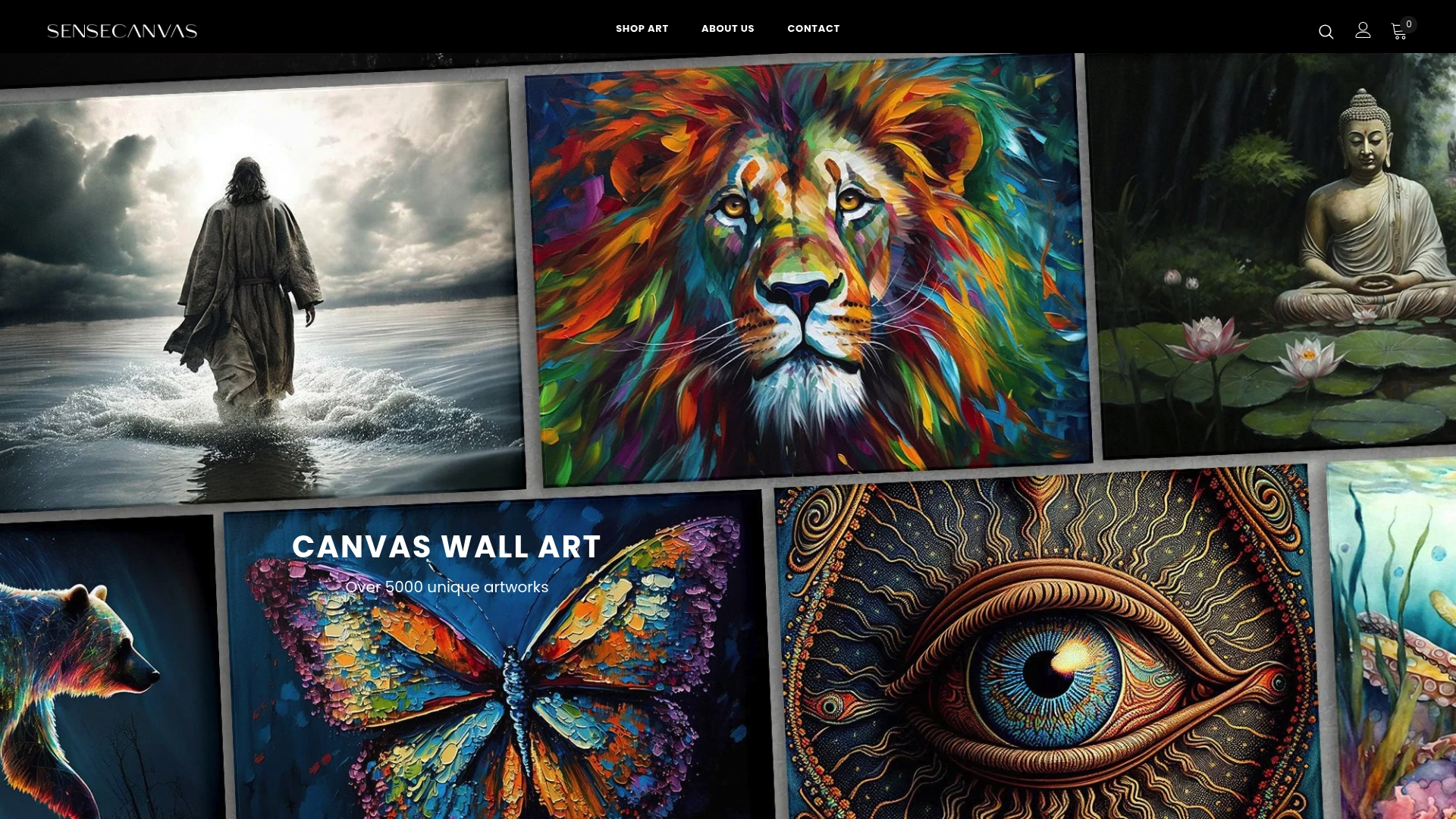
The process takes minutes. Measure your wall, pick your style from the catalog, request the custom dimensions, choose your finish, and preview the mockup before committing. Prices start at $85, so you can put a well-chosen, properly sized piece on a nonstandard wall without a gallery budget or a long lead time.
Browse the full canvas collection at Sensecanvas and use the custom sizing option to match your specific wall, not the other way around.
Useful sources and further reading
External sources:
- Top 5 Art Styles for Modern Interiors, Jose Art Gallery
- What Wall Art Styles Work Best in Modern Interiors?, Edward Martin
- Inside the Modern Home an Interior Designer Filled with Old Masters, Sotheby’s
- Selecting the Perfect Contemporary Art Style for Your Interior Design Projects, The Artling
- A Dialogue Between Architecture and Art, i2DINSPIRATION
- 7 Ways to Style African Wall Art in Modern Interiors, Noirci Studio
Sensecanvas resources: