Art Curation for Interiors: A Practical Guide
Art curation for interiors is the intentional selection, scaling, and placement of artworks so they shape a room’s mood and visual narrative rather than simply filling empty wall space. The difference between decorating and curating is decisive: decoration is additive, curation is purposeful. A single well-chosen piece can anchor a furniture arrangement, establish a color story, and give a home an identifiable personality that no sofa or rug can replicate. Sensecanvas offers a large variety of customizable canvas prints at affordable prices, making it possible to apply genuine curation principles at any budget.
Table of Contents
- What is art curation for interiors, and why does it matter?
- Core principles every curator applies
- How to curate a room from start to finish
- Designing gallery walls that feel curated, not cluttered
- Where to source art and what to budget
- Common curation mistakes and fast fixes
- Sizing templates, digital mockups, and conservation basics
- Key Takeaways
- What designers actually think about when they curate
- Ready to put these principles into practice?
What is art curation for interiors, and why does it matter?
Art curation for interiors is the practiced discipline of selecting and arranging artworks so they create a cohesive visual narrative across a space. As art advisor Arushi Kapoor puts it: “Furniture defines function, but art defines feeling.” That distinction matters practically. A room without art can be well-furnished and still feel inert. The right piece introduces tension, serenity, or curiosity in a way that materials alone cannot.
The functional benefits of thoughtful interior design art selection include:
- Mood control: A bold abstract in a foyer signals energy from the moment someone enters; a soft landscape in a bedroom supports rest.
- Spatial anchoring: Art placed above a sofa or console gives furniture arrangements a visual terminus, preventing the floating-furniture effect common in open-plan rooms.
- Narrative and identity: A cohesive home art theme tells visitors something true about who lives there that no finish or fixture can.
- Perceived value: Properly scaled and lit artwork makes architecture read as more considered, which influences how buyers and guests experience a property.
Consider a foyer with a single large-format canvas hung at precise eye level, lit by a dedicated accent fixture. That one decision reframes every other element in the entry. The console table below it looks intentional. The mirror beside it looks chosen. Nothing else changed.
Core principles every curator applies
Scale is the principle most homeowners get wrong first. A piece that looks substantial in a gallery can disappear on a residential wall. As a rule, artwork above a sofa should span roughly two-thirds of the sofa’s width. Above a console or fireplace, aim for 60–75% of the surface width. When in doubt, go larger rather than smaller — under-scaling is the single most common curation error in residential spaces.
Color harmony does not mean matching. It means repeating two or three tones from the art across the room’s textiles, furniture, or architectural finishes so the eye moves comfortably between them. A painting with a warm ochre passage reads as intentional when the throw pillows carry a similar tone. Forced matching, where the art literally copies the sofa fabric, looks staged.
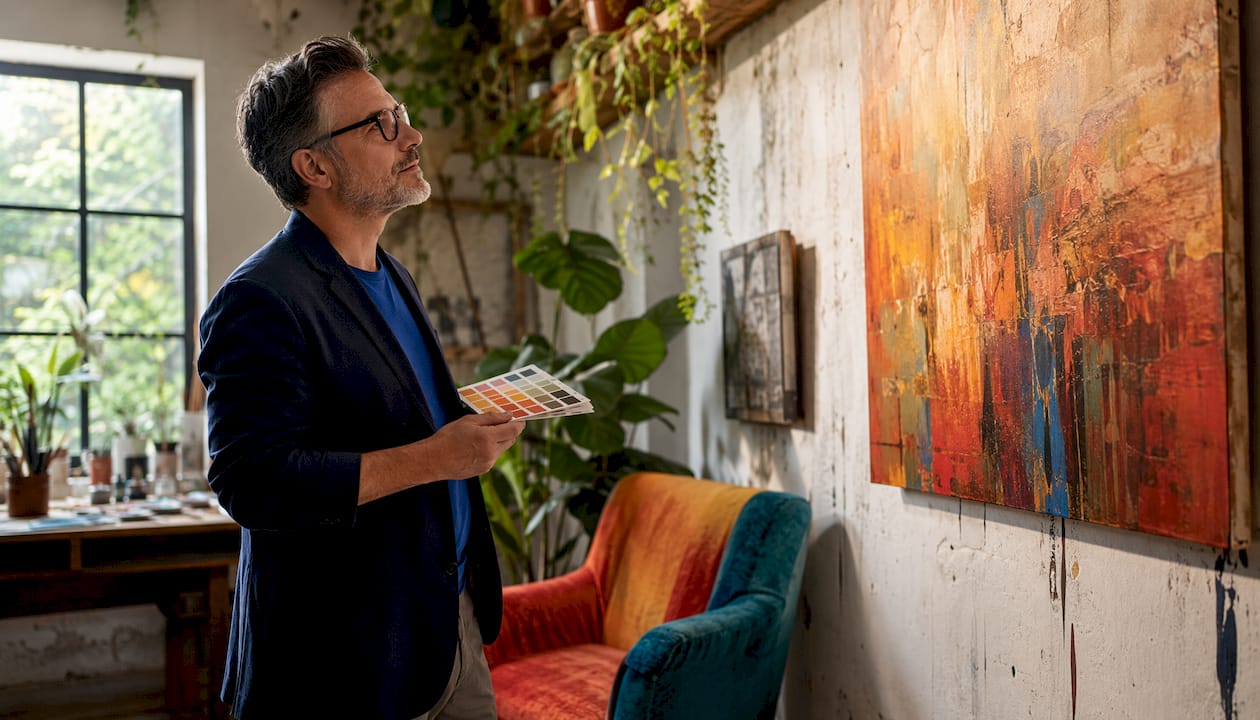
Balance and visual rhythm operate across sightlines, not just individual walls. Stand at the room’s main entry point and notice where your eye travels. Art should punctuate that path at intervals that feel neither crowded nor sparse. In open-plan spaces, this often means placing works at the end of circulation paths where the eye naturally pauses.
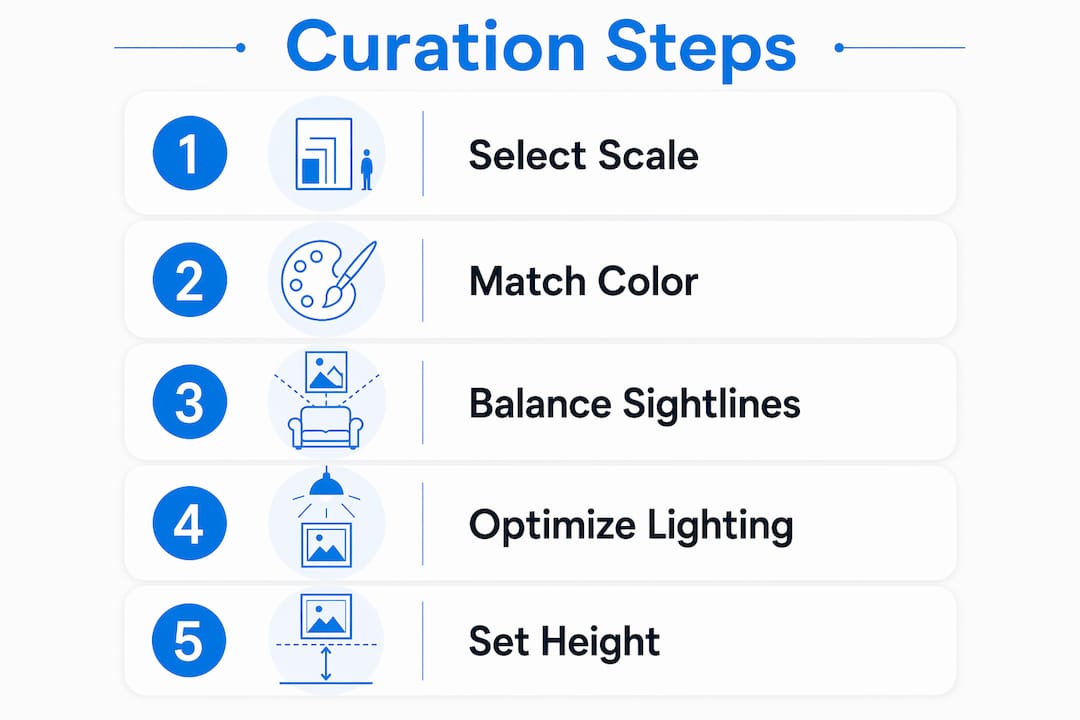
Lighting is where most residential displays fall short. Standard residential LEDs typically run CRI 80–85, which compresses tonal range and flattens pigment. Display zones benefit from fixtures specified at CRI 95–99, which render color accurately and preserve pigment fidelity. A wall-mount accent fixture aimed at a 30-degree angle from the wall minimizes glare while illuminating the full surface.
Hanging height: the standard centerline is 57–60 inches from the floor, which corresponds to average eye level. When hanging above furniture, maintain a 6–8 inch gap between the top of the piece and the bottom of the art. Gallery walls can break this rule, but the centerline of the entire arrangement should still land near 57–60 inches.
Pro Tip: Before committing to a final hanging location, lean the piece against the wall and live with it for two or three days. Observe how morning light hits it, how it reads from the sofa, and whether it still feels right after the novelty wears off. That’s usually a better guide than any fixed formula.
How to curate a room from start to finish
A reliable workflow prevents the most common mistakes: buying art that doesn’t fit, hanging it too small, or ending up with a wall that looks assembled rather than curated.
- Assess the architecture. Note ceiling height, wall dimensions, natural light direction, and existing finishes. A double-height foyer needs a different strategy than a low-ceilinged bedroom. Sightlines from entry points matter as much as the wall itself.
- Define the intent. Decide how the room should feel: calm, energized, contemplative, playful. This filters every subsequent decision and prevents impulse purchases that don’t serve the space.
- Choose the anchor piece first. As Kapoor advises, start with one strong piece rather than several safe ones. The anchor sets the palette, scale, and emotional register for everything that follows.
- Select supporting works. Supporting pieces should share a quiet logic with the anchor — a repeating color, a similar tonal range, or a complementary subject — without copying it. Mixing media (a canvas, a small sculpture, a framed textile) adds dimension.
- Mock up the layout before hanging anything. Cut paper templates to the exact dimensions of each piece and tape them to the wall. Photograph the arrangement from the room’s main entry point. Adjust until the composition reads well in the photo, which approximates how a visitor sees it.
- Digital mockup option. Apps like Hutch or a simple phone photo with scale overlays in Canva let you test placements without touching the wall. For gallery walls, a floor layout (arranging frames on the ground before hanging) is faster and more accurate than guessing.
- Hang and verify. After installation, check the display at multiple times of day — morning, midday, and evening with artificial light on. Glare, shadow, and color shift all reveal themselves differently across those windows. Adjust fixture angles before declaring the installation done.
Coordinating art with furniture at each step prevents the common problem of a beautiful piece that fights its surroundings.
Designing gallery walls that feel curated, not cluttered
Gallery walls fail for one reason: they look assembled. The fix is a unifying logic applied before the first nail goes in.
Common gallery formats:
- Grid: Identical frames in a tight, even matrix. Works best in modern or minimal interiors where the geometry itself is the statement. Requires precise measurement — even a quarter-inch variance reads as a mistake.
- Salon hang: Varied sizes arranged organically around a central anchor. More forgiving and warmer in feel; suits traditional, eclectic, or collected interiors.
- Linear floating shelf: Frames and objects leaned on picture ledges. Easiest to reconfigure and ideal for renters or anyone who wants to rotate pieces seasonally.
Spacing and sizing rules:
- Maintain 2–3 inches between frames in a tight grid; 3–5 inches in a salon arrangement.
- The 3–5–7 grouping rule: odd numbers of pieces read as more dynamic than even groupings. A cluster of three, five, or seven feels intentional; four or six can look symmetrical to the point of stiffness.
- The largest piece in a salon hang should anchor one corner or the visual center, not the literal center of the wall.
Mixing media in a gallery arrangement works when there is a shared element — frame finish, tonal range, or subject matter — that ties the pieces together. A canvas print, a small ceramic wall piece, and a framed textile can coexist if they share a warm neutral palette. Without that thread, the wall reads as a storage display. For guidance on mixing art styles without losing cohesion, the principle is always the same: one unifying variable, freedom in everything else.
An entryway gallery benefits from a bold anchor at eye level with smaller supporting pieces radiating outward. A bedroom cluster should stay intimate — three to five pieces maximum, quieter in subject and palette, positioned so they’re visible from the bed without demanding attention.

Where to source art and what to budget
Amy Kartheiser’s core point is worth repeating: meaningful curation is not a price-class exercise. Some of the most resonant pieces in a collection cost $15 and came from a roadside market during travel. Connection and story matter more than provenance or price tag.
Sourcing channels:
- Local galleries and artist studios: Best for originals with direct provenance. Prices vary widely; emerging artists often offer strong work at accessible prices.
- Art fairs: Affordable to high-end, with the advantage of seeing scale and color in person before buying.
- Online print platforms and canvas retailers: Fastest path to a specific size or style. Sensecanvas offers custom sizing, which solves the common problem of finding a piece you love in the wrong dimensions.
- Thrift stores and estate sales: Underrated sourcing channel for frames, vintage prints, and unexpected originals.
- Commissions: The most personal option and the longest lead time.
Realistic budget ranges:
- Entry tier (prints and reproductions): $85–$300 per piece. Suitable for supporting works and gallery wall filler. Sensecanvas’s catalog starts at $85 with custom sizing available.
- Mid tier (limited editions, emerging originals): $300–$2,000. Strong anchor candidates for most residential rooms.
- Higher tier (established originals, commissions): $2,000 and above. For primary display zones where the piece defines the room.
Timeline guidance: Print orders and standard canvas pieces typically ship within one to two weeks. Custom commissions from independent artists run six to twelve weeks depending on complexity and the artist’s schedule. Factor in framing time — a good custom framer needs two to four weeks — and schedule installation after framing is complete, not before.
For pieces of significant value, note the replacement cost on your homeowner’s insurance policy. Higher-value originals may warrant a scheduled personal property rider.
Common curation mistakes and fast fixes
Most display problems fall into a short list of repeatable errors.
- Under-scaling: The most frequent mistake. Fix: measure the wall and the furniture below it, then calculate the target size range before shopping. A piece that looks large in a store photo may be 18 × 24 inches — too small for most residential walls.
- Overcrowding: Too many pieces competing for attention. Fix: remove the weakest two or three pieces and observe whether the remaining works breathe better. Negative space is not wasted space.
- Wrong hanging height: Art hung too high is the second most common error, usually because the hanger used the center of the wall rather than eye level. Fix: re-hang at a 57–60 inch centerline, or 6–8 inches above the furniture below.
- Poor lighting: Overhead ambient light creates glare on glass and flattens canvas texture. Fix: add a dedicated accent fixture or picture light aimed at 30 degrees from the wall surface.
- Mismatched frames creating visual noise: Five different frame finishes in a gallery wall read as chaos. Fix: limit frame finishes to two — one dominant, one accent — or go monochromatic (all black, all natural wood, all white).
For balancing wall decor after a rearrangement, the fastest diagnostic is a photograph from the room’s entry point. Problems that are invisible in person become obvious in a photo.
Sizing templates, digital mockups, and conservation basics
| Placement | Target Art Width | Centerline Height | Gap from Furniture |
|---|---|---|---|
| Above sofa | 57–60 in. | 57–60 in. from floor | 6–8 in. above sofa back |
| Above console | 6–8 in. | 57–60 in. from floor | 6–8 in. above surface |
| Above fireplace mantel | 60–75% of mantel width | Varies by mantel height | 4–6 in. above mantel |
| Gallery wall (full arrangement) | Fill 60–75% of wall width | Arrangement centerline at 57–60 in. | 2–5 in. between frames |
| Standalone large-format | 50–75% of wall width | 57–60 in. from floor | N/A |
Digital mockup workflow: Photograph the wall straight-on with your phone. Open the image in Canva or Adobe Express, drop in a rectangle scaled to the artwork’s dimensions, and adjust opacity to 50% so you can see how the piece reads against the wall color and furniture. For AR placement, the Houzz app includes a “View in My Room” feature that overlays furniture and art at approximate scale.
For valuable originals, conservation conditions matter. The recommended range is 68–72°F and 45–55% relative humidity, with fluctuations limited to ±5 units over 24 hours. Standard residential HVAC rarely holds those tolerances. If you own works of significant value, a dedicated mini-split or supplemental humidity control in the primary display room is worth the investment.
Pro Tip: When building or renovating, specify continuous structural blocking in primary hanging walls during framing. It costs almost nothing at construction and eliminates the need for a structural retrofit every time you want to hang a heavy piece or reposition a large canvas.
For scaling artwork in larger or more complex spaces, the same centerline and proportion rules apply — the wall dimensions simply change.
Key Takeaways
Art curation for interiors works when scale, placement, and lighting are treated as non-negotiable from the start, not adjusted after the fact.
| Point | Details |
|---|---|
| Anchor piece first | Choose one strong focal piece before buying supporting works; it sets palette, scale, and emotional tone. |
| Scale to furniture, not wall | Artwork above a sofa should span roughly two-thirds of the sofa’s width; under-scaling is the most common residential error. |
| Hang at eye level | Set the artwork’s centerline at 57–60 inches from the floor and maintain a 6–8 inch gap above the furniture below. |
| Upgrade display lighting | Residential LEDs at CRI 80–85 flatten pigment; CRI 95–99 fixtures render color accurately in display zones. |
| Sensecanvas for custom sizing | Sensecanvas offers over 15,000 prints with custom sizing from $85, making it practical to match any template or wall dimension. |
What designers actually think about when they curate
The conventional advice is to “buy what you love.” That’s true, but incomplete. Professionals start somewhere different: with the architecture. Ceiling height, wall proportion, and natural light direction come before any aesthetic preference. A piece that would be transcendent in one room can feel wrong in another simply because the scale or light doesn’t support it.
The discipline that separates a curated home from a decorated one is editing. Kapoor’s observation holds: one serious work, placed with conviction, does more than twenty forgettable ones. Luxury in this context has nothing to do with price. It comes from restraint — knowing what to leave off the wall as much as knowing what to put on it.
The other thing professionals do that most homeowners skip: they plan art during the design phase. Specifying museum-quality hanging rails at renovation, blocking walls for heavy frames, and positioning lighting circuits before drywall closes — these decisions cost almost nothing at construction and save significant money and wall damage later. If you’re mid-renovation right now, that conversation with your contractor is worth having this week.
Ready to put these principles into practice?
Knowing the principles is one thing. Finding art in the exact size your wall template calls for is another problem entirely. Sensecanvas carries over 15,000 canvas prints across abstract, nature, motivational, and figurative styles, with custom sizing available so your chosen piece fits the template rather than the other way around. Prices start at $85, which puts a properly scaled anchor piece within reach for most rooms without compromising on quality.
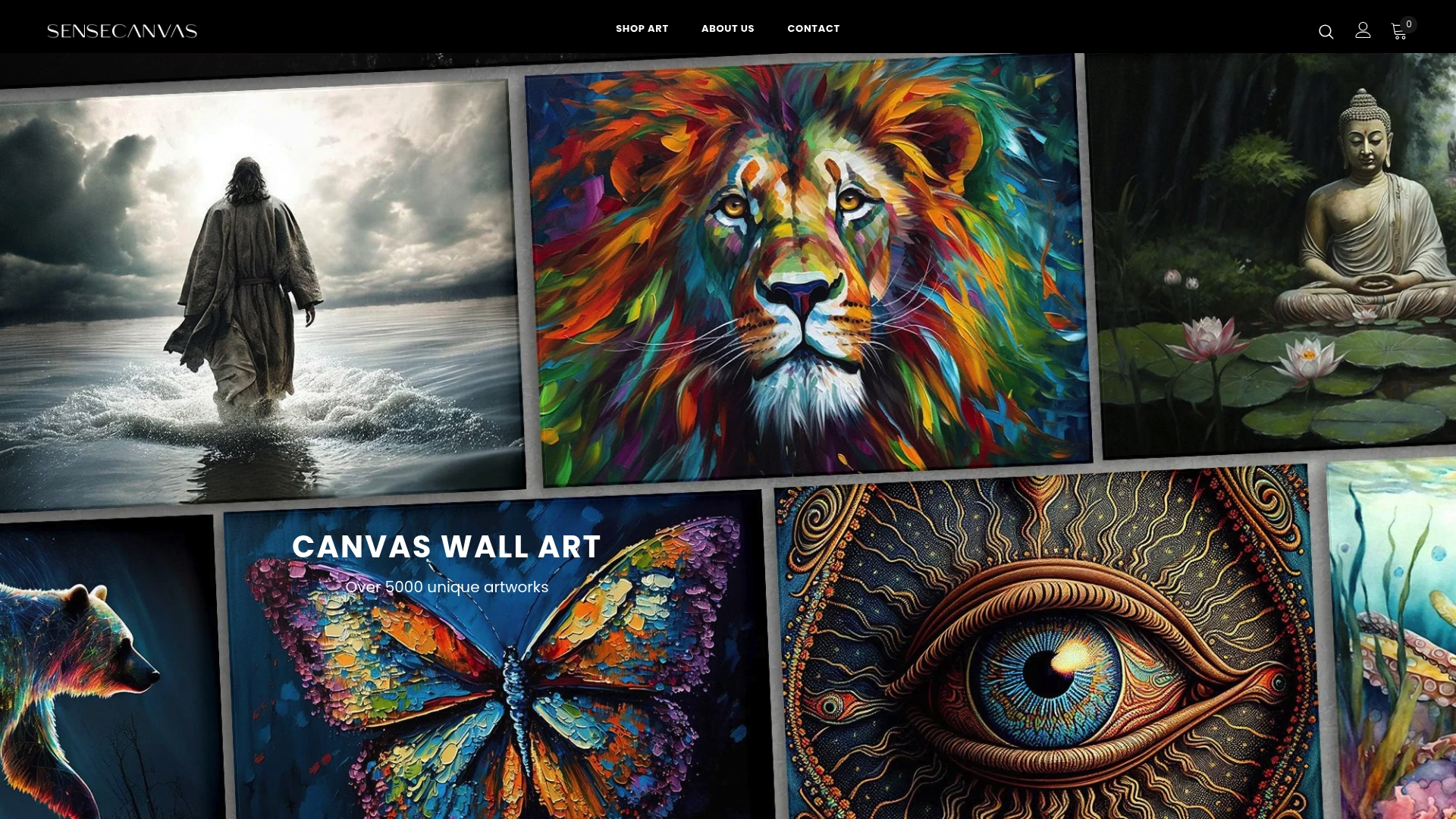
Whether you’re sourcing a single large-format anchor for a living room wall or building out a gallery arrangement with supporting prints, browse the full Sensecanvas collection to find pieces that fit your space, your palette, and your budget. Custom dimensions are available at checkout — no guesswork, no returns because the size was wrong.