Canvas Art in Reception Areas: What Office Managers Need to Know
Yes, well-chosen canvas art measurably improves a reception area. It creates a clear focal point, signals professionalism, and communicates brand tone before a single word is spoken. The single most useful thing you can do right now: measure the width of your main reception wall and your desk or seating run, then identify one spot where a statement canvas would anchor the space.
Start with one piece. Design professionals consistently recommend a single large-scale canvas over scattered gallery arrangements because it orients visitors immediately and avoids visual clutter. For double-height atrium entries, that piece often needs to be a tall piece or replaced by a vertical panel series to read proportionally in the room.
- Measure wall width and the width of your desk or seating run before you shop.
- Identify the sightline from the main doorway — that is where the focal canvas needs to land.
- For standard-height ceilings, one large canvas sized proportionally to the desk width is the most reliable starting point.
- For double-height entries, plan for an oversized piece or a vertical multi-panel series.
Table of Contents
- Why does canvas art matter in a reception area?
- How to measure your space and find the right focal point
- Which visual styles actually work in a reception area?
- Single canvas, triptych, or gallery wall — which layout fits your space?
- How lighting and mounting affect the final result
- What canvas materials and print quality actually matter
- Budget, lead times, and ongoing maintenance
- What to ask before you buy or commission a canvas
- How design professionals approach reception art — and what Sensecanvas does differently
- Key Takeaways
- Why operations teams should own the art project timeline
- Sensecanvas makes it straightforward to get reception art right
- Useful sources and further reading
Why does canvas art matter in a reception area?
Art in a reception area is a strategic asset, not decoration. The wall behind your front desk is the first thing a visitor reads about your organization, and it does its job in seconds.
Psychological research shows that presenting objects as art encourages visitors to engage in meaning-making, which increases the perceived value and depth of a space. In practical terms, a visitor standing in your lobby is already forming a judgment about your competence, your taste, and your attention to detail. A bare wall or generic stock print hands that judgment to chance.
Canvas prints add permanence that temporary signage or digital banners simply cannot match. They read as considered choices, not placeholders. That distinction matters for recruitment visits, client pitches, and vendor meetings alike. A thoughtfully curated piece signals attention to detail, while bare walls can convey an uninspired brand image — a real operational cost when your reception is the first room a prospective hire or client sees, which is why understanding why shop curated vintage fashion matters for creating cohesive visual programs.
How to measure your space and find the right focal point
The short rule: measure wall width, desk or seating width, and the sightline from the main doorway. Everything else follows from those three numbers.
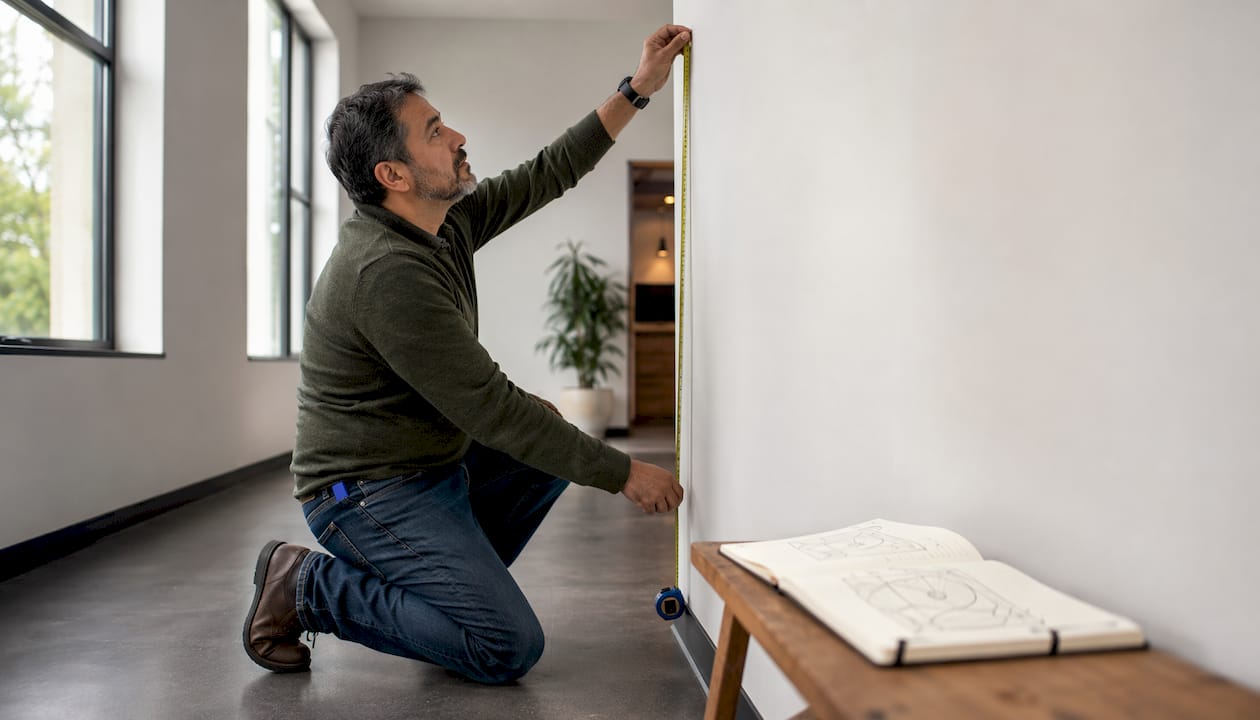
- Measure the full wall width and height. Write both down. Note any interruptions — doors, windows, HVAC vents — that reduce usable hanging space.
- Measure the desk or seating run. The canvas width should align with this furniture, not the full wall. Centering art over a desk that is narrower than the wall creates visual imbalance.
- Stand at the main doorway and note where your eye lands naturally. That is your focal point. Mark it with a piece of tape.
- Measure the distance from the doorway to the wall. Visitors standing 10–15 feet away need a canvas large enough to read clearly at that distance; small pieces disappear.
- Check eye level for both standing and seated visitors. The center of the canvas should sit at roughly 57–60 inches from the floor for standing sightlines, slightly lower if most visitors are seated in a waiting area.
For sizing, practical guidance maps roughly like this: small walls suit a medium canvas with breathing space on each side; medium walls suit one large canvas or a two-piece layout; long walls suit a wide statement piece or a multi-panel set aligned to the furniture run. For very tall, double-height spaces, standard residential canvases fail visually — plan for oversized pieces or vertically stacked panels. The Sensecanvas guide on scaling art for commercial interiors walks through these calculations in more detail.
Pro Tip: Photograph the wall from the doorway and view the image on a tablet at arm’s length. If a canvas-sized rectangle drawn on the photo looks right at that scale, the dimensions are probably correct. This takes five minutes and prevents expensive ordering mistakes.
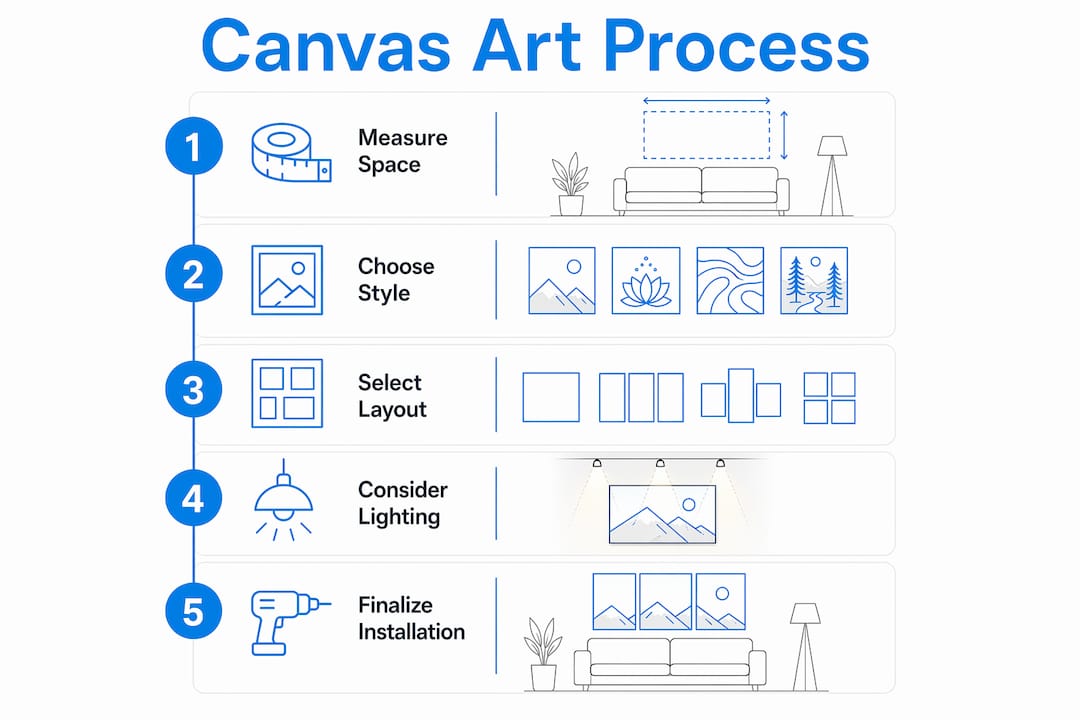
Which visual styles actually work in a reception area?
Pick styles that read clearly at a glance. Abstracts, muted nature scenes, restrained conceptual compositions, and brand-accented pieces all work well. Busy photorealism, dense text, or highly personal imagery tends to confuse a mixed audience.
Each style signals something specific. Abstract compositions in cool blues and grays read as forward-thinking and analytical — a natural fit for technology firms and financial services. Warm earth-tone nature scenes suggest stability and approachability, which suits healthcare, wellness, and professional services. Bold, high-contrast conceptual pieces project confidence and creative authority, making them a strong choice for agencies and design studios. Neutral, large-scale photography or architectural prints communicate precision and restraint, which works well in law firms and consulting practices.
Art presented in a reception setting triggers interpretive processing similar to gallery experiences, which helps visitors assign meaning and status to the space. That is why style selection is not purely aesthetic — it is brand communication. Nature-themed canvases also support wellbeing through biophilic design principles, which is worth considering for healthcare waiting areas or any space where visitor anxiety runs high.
| Style category | Brand impression | Best use cases |
|---|---|---|
| Abstract (cool tones) | Analytical, forward-thinking | Tech, finance, consulting |
| Muted nature / botanical | Warm, approachable, stable | Healthcare, wellness, professional services |
| Bold conceptual | Creative, confident, distinctive | Agencies, design studios, media |
| Architectural / neutral photography | Precise, restrained, authoritative | Law, real estate, corporate HQ |
| Brand-accented compositions | Cohesive, intentional, memorable | Any brand with strong visual identity |
Single canvas, triptych, or gallery wall — which layout fits your space?
A single large canvas usually reads best. Multi-panel layouts work when they are planned to wall proportions and kept tightly aligned; improvised gallery walls in reception areas tend to look residential rather than professional.
Single canvas: Cleanest option. One decision, one installation point, easy to clean and replace. Works on any wall with a clear focal zone. Size it to roughly two-thirds of the desk or seating width for visual balance.
Triptych (three-panel set): Strong choice for medium-to-long walls where a single canvas would look undersized. Panels should be equal in size and spaced consistently — 2–3 inches between panels is a common standard. Align the outer edges of the set with the furniture below, not the full wall width.
Small gallery arrangement: Generally avoid in reception areas unless the brand is explicitly creative or the space is a boutique studio. Multiple small pieces require precise alignment, create more visual noise, and are harder to maintain as a cohesive unit over time.
For small reception or waiting areas, one well-chosen medium canvas with generous breathing space on each side will always outperform a cluster of smaller pieces.
| Layout | Best wall type | Spacing rule | Maintenance note |
|---|---|---|---|
| Single large canvas | Any wall with clear focal zone | 6–10 in. breathing space on each side | Simplest — one piece to clean and level |
| Triptych | Medium to long walls | 2–3 in. between panels | Check alignment quarterly |
| Gallery wall | Creative/boutique spaces only | Consistent grid spacing | Most complex; hardest to keep cohesive |
How lighting and mounting affect the final result
Evaluate natural and artificial light before you commit to a final position. Canvas texture can create specular highlights — distracting bright patches — when lit poorly or placed directly opposite strong natural light.
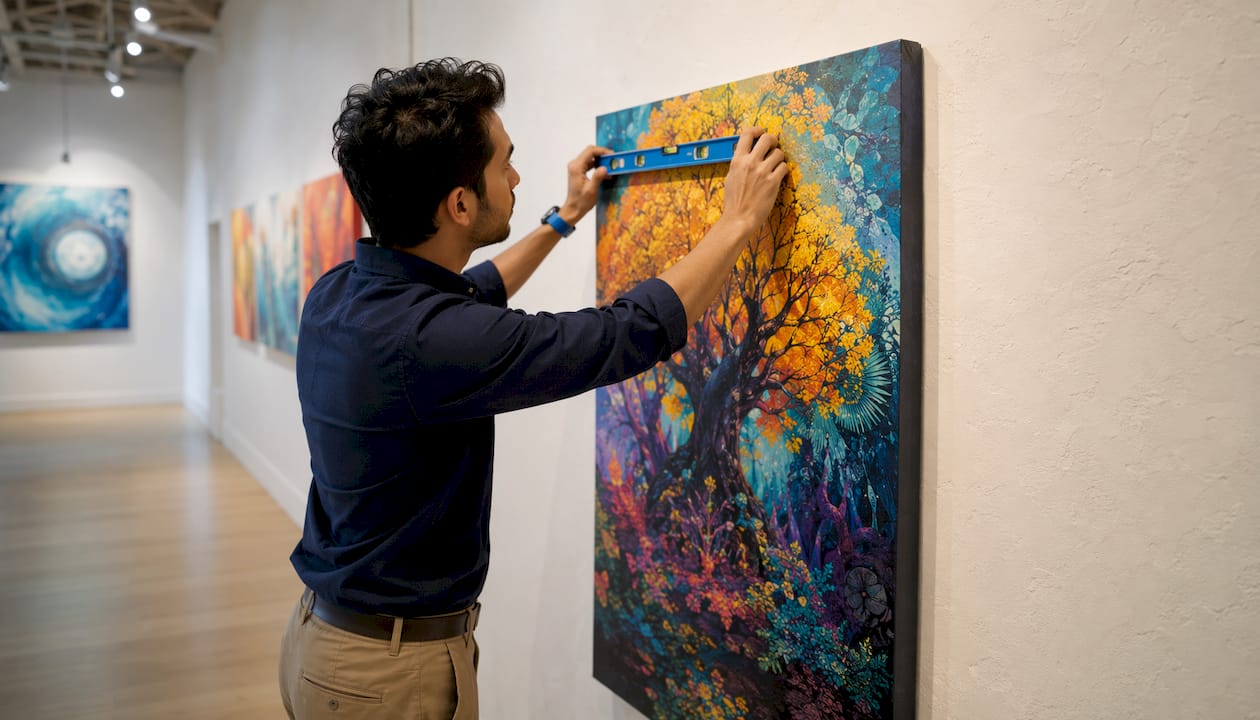
The mounting height rule is straightforward: hang the canvas so its center sits around eye level for standing visitors. If your reception has a seated waiting area directly in front of the piece, lower the center point slightly so seated visitors are comfortable. Canvas texture and finish can cause distracting reflections when placed near windows or overhead lights without consideration, so check the piece at different times of day before drilling final hardware.
For lighting fixtures, directional track lights or adjustable recessed spots work better than flat ambient lighting. Aim the beam at a shallow angle to the canvas surface — roughly 30 degrees from vertical — to bring out texture without creating glare. Matte and satin varnish finishes are more forgiving than gloss under mixed lighting conditions.
Pro Tip: Before ordering, tape a paper rectangle at the intended size on the wall and observe it during peak foot-traffic hours. Check for glare from windows, overhead fixtures, and any reflective surfaces across the room. This mock-up costs nothing and catches placement problems that photographs miss.
What canvas materials and print quality actually matter
Choose archival inks, a mid-to-high GSM canvas substrate, and a UV-protective finish for any reception-area installation. These are not premium extras — they are the baseline for a piece that needs to look sharp under commercial lighting for years.
Sealed canvas and archival varnishes are the standard recommendation for commercial lobbies because dust, UV exposure, and high foot traffic degrade unprotected prints faster than most buyers expect.
Key material and print quality specs to confirm before ordering:
- Ink type: Archival pigment inks (not dye-based) for color stability and UV resistance.
- Canvas substrate: Primed cotton or a cotton-linen blend at mid-to-high GSM for rigidity and texture.
- Varnish or coating: UV-protective matte or satin varnish; gloss is harder to manage under mixed commercial lighting.
- Wrap style: Gallery-wrapped (image continues around the edges) for a clean, frameless look; framed prints add weight and formality but require more wall clearance.
- Warranty: Ask for a minimum two-year warranty against fading, delamination, and color shift.
- Cleaning compatibility: Confirm the finish can be wiped with a dry or lightly damp microfiber cloth without damage.
Gallery-wrapped canvases are the most common choice for reception areas because they look finished without additional framing hardware. Framed prints suit more formal environments — law firms, financial institutions — where the frame itself contributes to the brand impression.
Budget, lead times, and ongoing maintenance
Plan procurement, installation, and upkeep before you approve a purchase order. The three variables that most often catch office managers off guard are lead time on custom sizes, installation scheduling, and the cost of hardware for secure commercial mounting.
| Item | Typical range | Notes |
|---|---|---|
| Entry-level canvas print (standard size) | Typical price range available | Ready-made sizes; shorter lead times |
| Mid-range custom canvas | Mid-price range available | Custom dimensions; allow production time |
| Large-format or oversized canvas | Higher price range possible | Complex installs; may need two-person hang |
| Professional installation (per piece) | Installation cost varies by region and wall type | |
| Replacement / refresh cycle | Typically several years | Depends on UV exposure and cleaning frequency |
Maintenance checklist:
- Dust the canvas surface monthly with a dry microfiber cloth; never use abrasive cleaners.
- For marks or smudges, use a barely damp cloth and blot — do not rub.
- Inspect mounting hardware every six months; tighten any loose brackets or D-rings.
- Re-seal with a compatible UV varnish if the surface shows signs of dulling after several years.
For accessibility, mount canvases so they do not protrude more than 4 inches from the wall at a height below 80 inches — this keeps the installation within ADA protrusion guidelines for high-traffic corridors. Secure commercial-grade mounting hardware (French cleats or heavy-duty D-rings rated well above the canvas weight) is non-negotiable in any space with significant foot traffic.
What to ask before you buy or commission a canvas
Start with a short checklist: size, material specs, mounting hardware, warranty, sample proofing, and installation service. If a vendor cannot answer all six clearly, that is a signal worth taking seriously.
Vendor questions to ask, in order:
- What is your production process, and do you use archival pigment inks on a primed canvas substrate?
- What is the standard turnaround time for custom sizes, and do you offer rush production?
- Can you provide a printed sample or digital proof before full production begins?
- What framing and wrap options are available, and what mounting hardware is included?
- Do you offer installation services or can you recommend a vetted installer in my area?
- What does your warranty cover, and for how long?
- Are your finishes compatible with standard commercial cleaning products?
Red flags to watch for:
- Vague material specs (“high-quality canvas” with no GSM, ink type, or varnish details).
- No sample proof or color-match process before production.
- No site-measurement service or sizing consultation for large or custom orders.
- Unclear mounting recommendations — a vendor who ships without hardware guidance is leaving the hardest part to you.
- No warranty or a warranty that covers only manufacturing defects for 30 days.
How design professionals approach reception art — and what Sensecanvas does differently
Designers treat reception art as a strategic touchpoint. The process starts with a brand outcome — what should a visitor feel and believe in the first 30 seconds — and works backward to scale, style, and material. The art is the last decision, not the first.
A practical example: a medium office reception with a 12-foot-wide wall and a 6-foot reception desk. The design brief calls for a professional, approachable tone. The right answer is one large canvas, approximately 48–60 inches wide, centered over the desk, in a muted abstract or botanical style, mounted at 58 inches to center, with a satin UV varnish finish. That is a one-day project from delivery to hang.
Sensecanvas supports exactly this kind of project. The catalog runs to over 15,000 artworks across abstract, nature, motivational, and conceptual styles, with custom sizing available so the canvas fits the wall rather than the other way around. Pricing for a single statement piece for a small reception is accessible without a significant capital outlay. The customization process lets you specify dimensions, finish, and wrap style before ordering — which is the right sequence for a commercial installation.
Key Takeaways
Canvas art in a reception area works as a strategic brand asset when it is sized to the space, matched to the brand tone, and installed with the right materials and lighting.
| Point | Details |
|---|---|
| Measure before you shop | Match canvas width to desk or seating run, not the full wall, and confirm the sightline from the doorway. |
| One focal piece first | A single large canvas reads more professionally than a gallery arrangement and is easier to maintain. |
| Confirm materials upfront | Specify archival pigment inks, UV-protective varnish, and a primed cotton or cotton-linen substrate. |
| Plan for lighting and mounting | Test for glare at peak hours and mount the canvas center at 57–60 inches from the floor for standing visitors. |
| Sensecanvas for custom sizing | With 15,000+ artworks and prices from $85, Sensecanvas lets you order to exact dimensions for a reception-ready fit. |
Why operations teams should own the art project timeline
The conventional wisdom is that art selection belongs to the design team or the CEO. In practice, the installs that go smoothest are the ones where an operations manager owns the timeline from measurement to hang.
Here is why: the design team picks the piece, but operations controls the wall, the schedule, and the maintenance budget. When operations is not in the loop until delivery day, you get canvases that arrive without the right hardware, installations scheduled during peak client hours, and pieces that nobody knows how to clean six months later.
The low-disruption approach works like this. After hours, tape a paper rectangle at the intended canvas size on the wall. Leave it up for two days and observe it during normal business hours. Check for glare at different times of day. Get a second opinion from the receptionist, who sees the space more than anyone. Then order. When the canvas arrives, schedule the hang for early morning before the office opens — a single large canvas takes under an hour with two people and the right hardware.
Schedule a site measurement before you order anything. Request a digital mock-up or a printed sample proof. Those two steps eliminate the most common and most expensive mistakes.
Sensecanvas makes it straightforward to get reception art right
Getting the art right in a reception area comes down to three things: the right size, the right style, and the right material. Sensecanvas delivers all three without requiring a design agency or a long procurement process.
With over 15,000 artworks spanning abstract, nature, conceptual, and motivational styles, and custom sizing available on every piece, Sensecanvas is built for exactly the kind of project this guide describes. Prices start at $85, so a single statement canvas for a small reception is a realistic line-item expense, not a capital project. Every piece ships with finish and wrap options specified upfront, which means you are ordering to a commercial standard, not guessing. Browse the full catalog or request a custom size at Sensecanvas — or explore a specific example like the motivational office canvas to get a feel for print quality and finish options before committing.
Useful sources and further reading
The recommendations in this guide draw on a short list of sources worth bookmarking if you are planning a reception-area art project.
Design and placement guidance:
- Reception Area Wall Art Guide for Memorable First Impressions — covers sizing rules, focal-point selection, and the single-canvas recommendation that anchors this guide.
- Lobby & Reception Art: Creating a Lasting First Impression — strong on scale for large-format and double-height spaces, and on the business case for treating art as a brand asset.
- The Benefits of Using Canvas Prints in Office and Commercial Spaces — useful for the permanence and professionalism argument when making the case internally.
Psychology of art reception:
- The Art Experience, Review of Philosophy and Psychology — the cognitive research behind why art in a reception setting prompts meaning-making and status attribution.
Sensecanvas resources:
- How to scale artwork for commercial interiors — step-by-step sizing guidance for commercial spaces.
- How canvas art fits biophilic design principles — relevant for healthcare and wellness reception areas.
- Sensecanvas catalog and custom orders — starting point for sizing, style selection, and sample requests.