Finish Rooms Fast With Large Canvas Wall Art Sized to Two Thirds
The fastest way to finish a room is with a dominant, correctly sized canvas or a cohesive grouped layout sized to two-thirds of the furniture width below it, hung with its center near eye level. The company offers custom sizes and designs for walls that do not fit off-the-shelf dimensions.
TL;DR:
- Large canvases should be sized to about two-thirds of the furniture width beneath them to ensure proper visual balance and intentional placement.
- For a standard 108-inch sofa, aim for approximately 72 inches of artwork width, with a central height around 57 to 60 inches from the floor.
- Mount hardware varies based on wall type, with drywall anchors for hollow walls and stud-mounted hooks for heavier, oversized pieces, and UV coatings help prevent sunlight fading.
- Custom sizes are essential for non-standard walls or multi-panel arrangements, with over 15,000 designs available in a wide range of styles and sizes.
- Budget considerations include splitting images into multi-panel triptychs, framing with wide mats, or adding textured DIY elements to achieve a larger-than-life look cost-effectively.
Table of Contents
- 1. Ten large canvas layouts and where they work best
- 2. How do you size and place large canvas art correctly?
- 3. Choosing between framed canvas, gallery wrap, and mounting hardware
- 4. Budget-friendly ways to get an oversized look
- 5. Lighting and staging that make large canvas art look intentional
- Sense Canvas’ take on getting scale and customization right
- What should you budget for large canvas wall art?
- How do you pick canvas care and maintenance habits that protect quality?
- How do you choose an artwork theme that fits the room?
- How do you pick colors that work with your existing decor?
- Where should you buy large canvas wall art?
- What the sizing rules actually get wrong
- Bring your wall’s exact dimensions to Sense Canvas
- Sources
- FAQ
1. Ten large canvas layouts and where they work best
Every wall has a layout that suits it, and the trick is matching scale and shape to the furniture and traffic in the room. A single statement canvas, sized to the two-thirds rule, anchors a living room or entryway without competing for attention. A triptych, three panels of one image split across canvases, fits long walls behind sofas or dining tables and reads as one cohesive piece from a distance.
A panoramic canvas, wide and short, suits stairwells and hallway runs where height is limited but length is not. A grid layout of same-size squares brings order to a home office or gallery hallway, while a gallery wall mixing frame sizes and orientations fits eclectic living rooms and reading nooks.
Over-bed placement calls for a canvas or grouping close to the width of the headboard, and above-sofa placement follows the same math but hung 8 to 10 inches above the sofa back, according to BHG’s sizing guidance. A hallway run of smaller matched canvases spaced evenly turns a narrow corridor into a mini gallery, a layout covered in more detail in Sense Canvas’ hallway art guide. Textured or three-dimensional pieces, a trend gaining traction according to Architectural Digest’s 2026 forecast, add tactile interest to minimalist rooms that need warmth without more color. Mixed media walls, combining a canvas with a mirror or shelf, work in transitional spaces like foyers.
- Single statement canvas: best for living rooms and entryways that need one clear focal point.
- Triptych: ideal for long walls behind sofas, beds, or dining tables.
- Gallery wall: suits eclectic rooms where you want visual variety without one dominant piece.
Keep accessories minimal around any large piece so the art, not the clutter, holds the eye. Renters can achieve the same effect with removable adhesive strips rated for canvas weight instead of drilled hardware.
2. How do you size and place large canvas art correctly?
Scale is the single biggest factor separating art that looks intentional from art that looks like an afterthought. BHG’s guidance on decorating large walls recommends sizing artwork, or a grouping, to roughly 66 to 75% of the furniture width beneath it. A 9-foot sofa, for example, calls for about 72 inches of combined art width.
A wall with a common furniture width and its art expanse: for a 108-inch (9-foot) sofa, aim for close to 72 inches of art across the wall, per BHG. That single ratio prevents both the shrunken look of undersized art and the cramped look of art that crowds its wall.
Center height follows its own rule: 57 to 60 inches from the floor to the middle of the piece, adjusted to 8 to 10 inches above a sofa back or 3 to 6 inches above a mantel. When hanging a grouping, leave 3 to 6 inches between individual pieces so the set reads as one composition rather than a scattered collection.
- Measure the furniture width and multiply by 0.66 and 0.75 to get your target art width range.
- Cut paper templates matching each canvas size and tape them to the wall.
- Mark hardware placement directly on the paper before removing it.
- Turn on nearby lamps to preview how the space will look once lit, a method Apartment Therapy recommends before drilling any holes.
- Install hardware at the marked points and hang the finished piece.
3. Choosing between framed canvas, gallery wrap, and mounting hardware
Gallery-wrapped canvas stretches the printed image around the sides of the frame, giving a clean, frameless edge that suits modern rooms. Framed canvas adds a visible border that works well in traditional or transitional spaces, while a straightforward stretched canvas without extra framing keeps costs down.
- Matte finishes reduce glare and suit rooms with strong overhead or window light.
- Satin finishes balance some sheen with color depth, a middle ground for most living spaces.
- Gloss finishes deepen color saturation but can reflect light sources directly, so test placement first.
Mounting hardware should match the wall: drywall anchors for hollow walls, toggle bolts for heavier oversized pieces, and stud-mounted hooks wherever the canvas exceeds a few pounds.
Pro Tip: Ask about UV-protective coatings when ordering a large custom canvas, since direct sunlight fades uncoated prints faster over time.
4. Budget-friendly ways to get an oversized look
A single high-resolution photo split into three or four panels creates a triptych effect without paying for one giant print, and most photo-editing software can divide an image into equal sections for separate canvases. Oversized mats or wide frames around a modest print can make it read much larger on the wall, a trick BHG’s budget hack guide points to as a cost-effective alternative to a full custom print.
- Multi-panel split: divide one image across two to four canvases for a triptych effect at a fraction of one large print’s cost.
- Oversized matting: frame a small print with several inches of matboard to visually expand its footprint.
- Textured DIY canvas: add joint compound or textured medium to a plain canvas for a dimensional piece with minimal material cost.
Renters can rely on adhesive hanging strips rated for the combined weight rather than drilling, which keeps the whole approach reversible.
5. Lighting and staging that make large canvas art look intentional
A picture light mounted above the frame works well for single statement pieces, while track lighting or an adjustable floor lamp suits groupings that span a wider area. Test any lighting setup during the paper mockup stage, turning lamps on to check for glare or shadowing before committing to hardware, as Apartment Therapy’s lighting guidance recommends.

Leave breathing room around large art rather than crowding it with shelves or smaller frames, and balance its visual weight against the furniture nearby instead of overwhelming the wall. Warmer bulbs deepen reds and golds, while cooler daylight bulbs can wash out a canvas with muted tones, so match the bulb to the piece’s palette.
Pro Tip: Hold the canvas in place under your existing room lighting before drilling. What looks vivid under a showroom light can shift noticeably under a warm living room lamp.
Sense Canvas’ take on getting scale and customization right
Getting the scale right matters more than getting the design right, and that is where a lot of buyers get stuck when a wall does not match a standard size. There are over 15,000 designs available with options for customization to fit unusual dimensions, suitable for spaces like narrow stairwells or extra-wide great room walls. For multi-panel or nonstandard-width walls, custom sizing solves a problem that off-the-shelf art simply cannot.
What should you budget for large canvas wall art?
Price scales with size, material, and customization, so setting a budget starts with knowing which of those three matters most for your wall. A single oversized canvas typically costs more than a grouping of smaller pieces covering the same total width, since large-format printing and stretching require more material and handling. Custom sizing, needed for unusual walls or multi-panel layouts, usually carries a premium over standard stock sizes.
Treat large canvas art as a long-term fixture rather than a seasonal purchase. A well-chosen statement piece tends to outlast trend cycles better than smaller decorative accents, since its scale makes it a structural part of the room rather than an easily swapped accessory. That makes it worth spending more on construction quality, gallery wrap or solid framing, than on chasing the trendiest available image.
Factor in installation costs too. Heavier canvases may need stud-mounted hardware or professional installation, especially in multi-panel or textured pieces that carry more weight per square foot. Prices start at a certain level, which gives buyers a starting point for comparing a single statement piece against a custom multi-panel commission for the same wall.
Consider, too, how a piece will hold value functionally, not just aesthetically. A canvas sized correctly for the wall it will occupy for years is a better investment than a smaller piece bought because it was cheaper up front, even if the larger option costs more today.

How do you pick canvas care and maintenance habits that protect quality?
Large canvas pieces need more consistent care than small prints simply because they cover more surface area exposed to light, dust, and humidity. Keep canvases out of direct sunlight where possible, since prolonged UV exposure fades colors unevenly across a large surface faster than it would on a smaller piece.
Dust gently with a soft, dry cloth or a microfiber duster rather than anything damp, since moisture can warp canvas fibers or cause the print surface to crack over time. Avoid placing large canvases near heating vents, radiators, or humid bathrooms, where temperature swings can loosen the canvas from its frame.
Check the frame and mounting hardware periodically, especially for oversized or multi-panel pieces where added weight puts more stress on wall anchors. A canvas that has shifted even slightly on its hanging wire is worth re-leveling before it stretches the hardware further.
If a canvas was ordered with a UV-protective coating, avoid cleaning products that could strip that layer. A dry cloth is almost always the safer choice over any spray cleaner, which can leave residue or interact poorly with the print surface.
How do you choose an artwork theme that fits the room?
Start with the room’s function before its color scheme. A home office suited to motivational quotes or abstract geometry supports focus, while a bedroom benefits from calmer, softer imagery like florals or muted landscapes that do not compete with rest.
Match the theme to how the space is used day to day. A dining room that hosts frequent gatherings can handle bolder, more conversational art, like a bright abstract or a striking animal print, while a hallway that people pass through quickly works well with a series of smaller, related images rather than one demanding piece.
Consider the mood you want the room to hold. Warm, saturated themes energize social spaces, while cooler palettes and simpler subjects suit spaces meant for concentration or rest. Personalized family pieces work well in more sentimental spaces like a family room or upstairs landing, where the art also carries meaning beyond decoration.
The catalog spans themes from abstract and animal prints to motivational quotes and personalized family designs, helping users match a theme to a room’s function rather than settling for whatever fits the wall size.
How do you pick colors that work with your existing decor?
The easiest starting point is pulling one or two colors already present in the room, whether that is a rug, an accent chair, or curtains, and finding art that repeats those tones. This keeps a large canvas from feeling like it was dropped into the space rather than designed for it.
Neutral rooms with a lot of white, gray, or beige can handle bolder, more saturated canvas colors since there is little competing visual noise. Rooms already rich in color and pattern usually read better with a canvas that leans more monochrome or tonal, so the art does not fight with the furniture for attention.
Consider the emotional register of the palette as well as its match to existing decor. Warm tones, reds, golds, and deep oranges, tend to energize a room, while cooler blues and greens calm it. A large canvas amplifies whichever palette it carries simply because of its size, so the color choice matters more here than it would on a small print.
Where should you buy large canvas wall art?
Online retailers offer the widest selection and, in many cases, the ability to customize dimensions for walls that do not match standard sizes, which matters most for oversized or multi-panel installations. Some online retailers allow sizing adjustments across their catalogs of designs, which solves a common problem for buyers whose walls fall between standard dimensions.
Local galleries offer the advantage of seeing a piece in person before buying, along with support for local artists, though selection is limited to what is currently on display and prices often run higher for one-of-a-kind originals. Custom commissions, whether through a gallery or an independent artist, offer full creative control but typically take the longest to complete and carry the highest cost of the three options.
For most buyers furnishing a home or office on a practical timeline, online ordering with custom sizing options offers the best balance of selection, price, and turnaround. Reserve local galleries and custom commissions for pieces meant to be genuinely one of a kind rather than a functional design solution for a specific wall.
What the sizing rules actually get wrong
The number is a starting point, not a guarantee. A piece sized perfectly to the math can still look lost on a wall if the room has high ceilings, heavy architectural detail, or a lot of competing visual weight nearby. The visual-anchor test that designers rely on, checking whether a piece could comfortably share its space with something else, catches what the measuring tape misses.
The bigger mistake is buying small out of caution. Most people undersize their large art because an oversized piece feels risky in the moment, then live with a wall that never quite settles. If the math and the anchor test both point toward “bigger,” trust them. Standard sizing works for standard walls, but plenty of walls are not standard, and that is exactly where custom sizing earns its cost. Measure first, trust the two-thirds rule as your baseline, then adjust up before you adjust down.
— Sense
Bring your wall’s exact dimensions to Sense Canvas
Once you know your target size, the harder part is finding a design available in exactly that dimension, and that is where most retailers fall short. There are over 15,000 designs available across styles like abstract, animal, motivational, and personalized family art, with sizing customization built into the ordering process to accommodate nonstandard walls. Pricing details and satisfaction guarantees are provided by the seller.
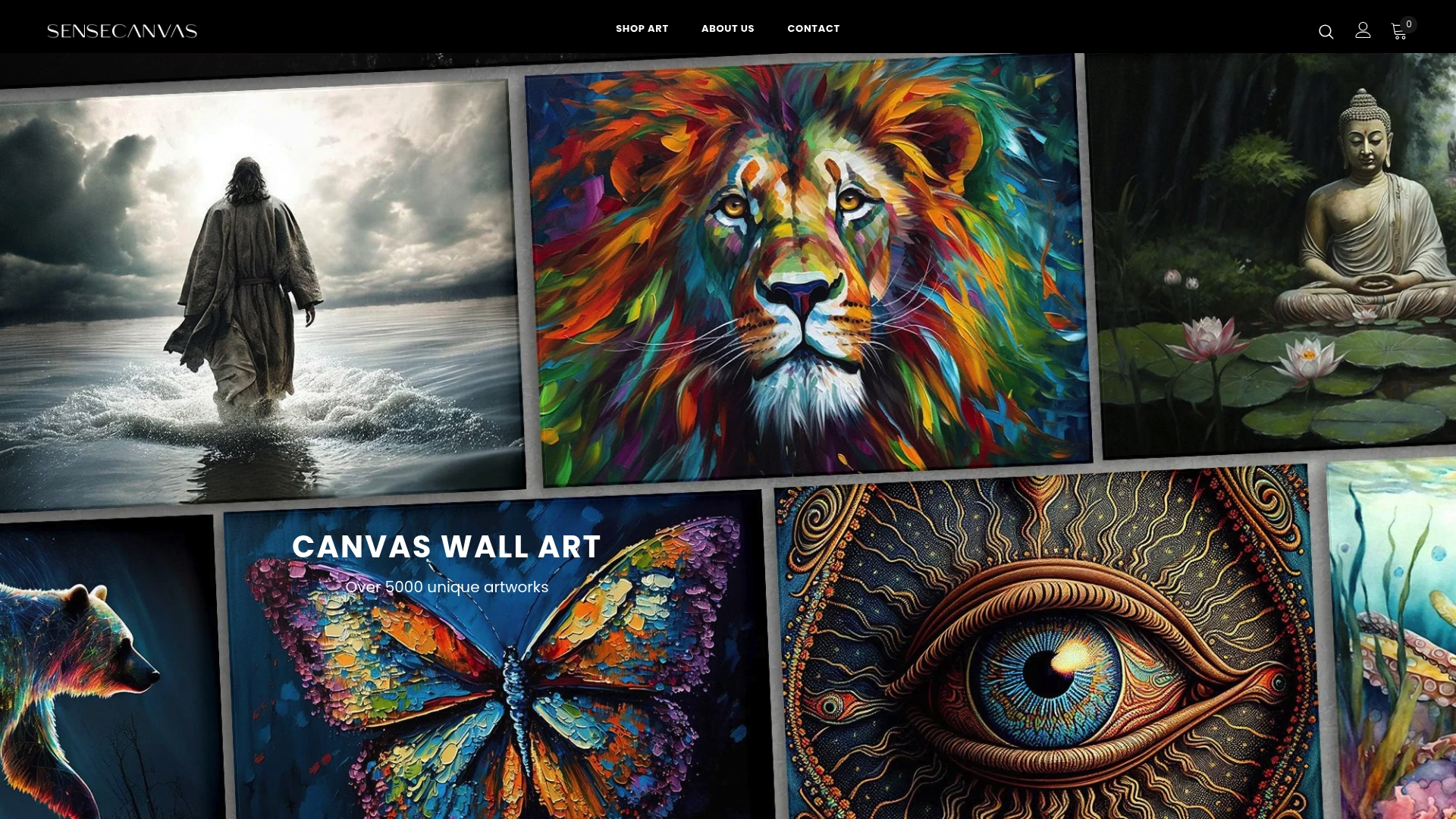
Browse the full collection or start from the Sense Canvas homepage to find a design sized to your exact wall and order it today.
Sources
- How to Decorate a Large Wall — BHG
- How to hang artwork to brighten up dull walls — Apartment Therapy
- AD PRO’s 2026 interior design forecast — Architectural Digest
FAQ
What are the latest trends in large wall art?
Textured and three-dimensional wall treatments are gaining ground as large-scale art statements, according to Architectural Digest’s 2026 forecast. Gallery walls and oversized single statement pieces remain the two dominant approaches for anchoring a room.
What are some good things to hang canvas on the wall?
Stud-mounted hooks or toggle bolts work best for larger, heavier canvases, while drywall anchors suit lighter pieces on hollow walls. Always test placement with a paper cutout before drilling, a method Apartment Therapy recommends to avoid unnecessary holes.
What are the trends in wall art for 2026?
Tactile, three-dimensional wall treatments are emerging as a way to make a wall feel like art itself, per Architectural Digest. Traditional canvas prints paired with textured elements are one way this trend shows up in real rooms.
What is the best canvas wall art?
The best choice depends on the room, but a piece sized to roughly 66 to 75% of the furniture width below it, as BHG advises, tends to work across most spaces. Sense Canvas offers customizable sizing across its catalog, which helps when a wall does not match standard dimensions.
How high should you hang large canvas art?
Center the artwork around 57 to 60 inches from the floor, adjusting to 8 to 10 inches above a sofa back or 3 to 6 inches above a mantel, according to BHG. This keeps the piece at a comfortable eye level regardless of nearby furniture.