Custom Canvas Salon Wall Art Ideas That Make One Feature Wall Work
Choose one feature wall, commit to a dominant art format (a single oversized canvas or a three-panel triptych), and keep every other wall in a repeatable, matching format. Custom canvas prints are the most durable way to execute this because you control size, finish, and color exactly. A retailer like Sense Canvas can size a piece to your exact wall, so measure your feature wall’s width and your typical seating distance before you order anything.
TL;DR:
- For feature walls, a single oversized canvas or a three-panel triptych offers the most impact, with custom sizing recommended to ensure perfect fit.
- Standard art sizes often lead to mismatched proportions, so measure your wall and seating height carefully before ordering.
- Use high-CRI LED lighting with appropriate glare control to preserve true color and avoid reflections on salon art.
- Incorporate local artwork or seasonal rotating displays to keep the space fresh without major redecoration costs.
- Custom canvas prints start at around $85 and are the most reliable solution for precise, durable salon wall art that withstands heat and moisture.
Table of Contents
- Salon Wall Art Ideas: Which Format Fits Which Wall
- Salon Decor Trends Worth Building Around
- Sizing and Placement Rules That Make Art Look Intentional
- Lighting and Materials That Keep Color True
- Match the Art to Your Brand, Not Just the Wall
- Budget and Sourcing: Getting the Right Piece for Your Price Band
- Installation and Maintenance That Hold Up in a Working Salon
- Sense Canvas: Practical Options for Salon Owners
- Tips for Choosing Art That Handles Salon Heat and Moisture
- Bringing Local Artists and Community Themes Into the Space
- Seasonal and Rotating Displays That Keep the Space Feeling New
- Perspective: Why Repeatable Art Beats Chasing Every Trend
- Order Custom Salon Canvases Built to Your Wall
- Sources
- FAQ
Salon Wall Art Ideas: Which Format Fits Which Wall
The format matters more than the subject. A gorgeous print in the wrong shape for its wall looks like an afterthought, and salons live and die by first impressions during the first ten seconds a client sits in the chair.
1. Single statement canvas. This is the default answer to “what goes on my reception wall.” One large canvas, properly scaled, reads as finished the moment it goes up, and you don’t need to layer in five smaller pieces to fill the space. It works best directly behind the check-in desk or on the wall a client faces while waiting. The sizing tip: the canvas should span roughly two-thirds of the furniture or wall segment beneath it, not the full width. Cleaning is simple. Gallery-wrapped canvas takes a dry microfiber cloth and nothing else.
2. Multi-panel triptych or polyptych. Split art across three, four, or five panels when you’re covering a long bench wall or a row of styling stations that would otherwise dwarf a single canvas. Multi-panel pieces also solve a real logistics problem: very large works are easier to transport and hang in sections than as one unwieldy sheet. The tradeoff is installation precision. Panels that sit even a half inch off from each other look sloppy, so measure and mark before you drill.
3. Coordinated grid sets. A grid of four, six, or nine same-size prints in a shared palette gives corridors and multi-station rows a steady visual rhythm without competing with the mirrors. This is the format to use where clients’ eyes travel down a hallway rather than settle on one spot. Keep spacing identical, usually two to three inches between frames, or the grid reads as uneven instead of intentional.
4. Framed editorial portraits and fashion photography. Boutique and editorial salons lean on black-and-white portraiture or fashion photography framed in slim black or brass. It signals a design-forward, high-fashion identity fast. The downside: glossy glass frames throw glare under salon lighting, so matte glazing or acrylic is worth the small upcharge.
5. Botanical and biophilic pieces. Leaf studies, abstract florals, and nature-toned canvases suit spa and wellness-positioned salons, and they pair naturally with the biophilic design trend gaining ground in commercial interiors. Botanical work also forgives imperfect lighting better than high-contrast photography does.
6. Neon or LED signage and mirrors-as-art. A neon script sign near checkout or an oversized decorative mirror used as a wall feature adds personality fast and photographs well for social media, which matters for salons that rely on client tagging. Keep neon away from direct sunlight exposure, which fades the tubing over time, and mount decorative mirrors on rated hardware since they’re heavier than they look.
7. Wall murals and textured mixed-media. For salons ready to make a bigger investment, a hand-painted or wallpaper mural transforms an entire wall rather than decorating a section of it. Textured mixed-media pieces need more breathing room around them than flat prints do, since texture reads as sculpture, not as a flat image, and crowding one with other decor flattens that effect.
- Reception and waiting walls: single statement canvas or a coordinated grid.
- Long styling rows: triptychs, polyptychs, or grid sets.
- Checkout and retail walls: neon signage, mirrors, or a smaller accent canvas.
- Spa and treatment rooms: botanical or biophilic canvas in muted tones.
Salon Decor Trends Worth Building Around
Trends shift, but a handful of aesthetic directions keep showing up in salon interiors because they solve real business problems, not just visual ones.
- Biophilic and nature-inspired. Greens, wood tones, and organic shapes calm nervous first-time clients and skew well with younger demographics booking through Instagram discovery. It’s currently one of the dominant segments in commercial salon design.
- Warm minimalism, or sensory luxury. A neutral base palette (cream, taupe, soft gray) with one or two luxe accent pieces signals premium pricing without shouting about it. This works especially well when the salon charges above the neighborhood average and needs the walls to justify it quietly.
- Modern editorial and portrait work. Fashion photography and bold black-and-white portraits fit salons that actively market their stylists’ editorial or bridal work. The art becomes a portfolio piece as much as decor.
- Vintage and retro glam. Barber-shop era typography, art deco framing, and warm brass fixtures suit classic salons or themed concept shops leaning into nostalgia.
- Bold accent and energetic palettes. Saturated color blocks and punchy graphic prints fit express or quick-turn salons targeting a younger, faster-moving clientele who want energy, not calm.
Match the finish to the aesthetic: matte finishes for warm minimalism and biophilic work, glossy or metallic accents for retro glam, and high-saturation printing for bold palette pieces. Color choice on salon walls also shapes client perception more directly than most owners assume, since ambiance research links color and lighting choices to perceived friendliness and even price tolerance.
Sizing and Placement Rules That Make Art Look Intentional
Most salon art looks accidental for one reason: it’s the wrong size for the wall it’s on. Two measurable rules fix that almost every time.
- The two-thirds rule. Your art should span roughly two-thirds to three-quarters of the width of the furniture or wall segment below it, whether that’s a reception desk, a bench, or a single station mirror.
- Eye-level guidance, seated and standing. Salons split their audience between seated clients and standing staff, so center art around 57 to 60 inches from the floor for standing eye level, then check the sightline from a seated position in the chair, since that’s where clients spend the most time.
- The mirror-reflection principle. Whatever hangs behind a client shows up doubled in the mirror they’re facing, so that wall often matters more for perceived ambiance than the wall directly in front of them.
- Grid and multi-panel spacing. Keep gaps between two and three inches for panel sets and grids; anything wider starts to look like separate, unrelated pieces instead of one composition.
A standard commercial eye-level benchmark for the center of the piece is generally used across gallery and retail installation guidance, and it holds up well in salon settings because most clients and stylists stand or sit at fairly consistent heights.
Before ordering anything, run this checklist: measure the wall width and height, tape an outline of the planned canvas size directly on the wall, then sit or stand in the spots clients actually occupy to confirm the piece reads correctly from that distance. It takes fifteen minutes and prevents an expensive resizing mistake.
Lighting and Materials That Keep Color True
Salon lighting is unusually harsh on art because it’s built for grooming precision, not ambiance, which means color accuracy and glare control need deliberate attention.
Use high-CRI LED fixtures, ideally rated 90 or above, and angle accent lights at roughly 30 degrees off the wall. That angle and color rating combination is standard gallery lighting practice for preserving true color and minimizing glare, and it works just as well over a reception canvas as it does in a museum. Track lighting systems give you the flexibility to adjust the angle later if you rearrange furniture or add pieces.

Avoid high-gloss frames anywhere near a mirror wall; the reflection off the glass fights the mirror’s own reflection and creates visual clutter. Gallery-wrapped canvas without glass, or anti-glare acrylic when framing is non-negotiable, solves this cleanly. Textured pieces need raking light, meaning the light source grazes the surface at a low angle to bring out the physical depth, while flat prints do better under wider, more even beams that don’t create hot spots.
Pro Tip: If your salon runs warm-white overhead lighting for grooming, add a separate cool or neutral-white accent light just for the art. Mixing temperatures under one fixture muddies both the haircut and the canvas.
Durability matters as much as installation quality. Look for UV-coated prints that resist fading under salon window light, and finishes that tolerate a damp cloth without streaking, since salon walls collect more airborne product residue than a typical living room.
Match the Art to Your Brand, Not Just the Wall
Skip the temptation to pick pieces one at a time based on what looks nice in the moment. Work through a short framework instead.
- Define the brand mood in three words. Calm and clinical, bold and youthful, luxe and quiet, whatever it is, write it down before browsing.
- Pick one dominant format for the whole space, canvas, framed print, or mural, so every wall speaks the same visual language.
- Choose one or two repeating elements, usually a palette or a recurring motif (botanical line work, a specific color family, a typography style), and apply it across every piece you buy.
- Place the feature piece first, then build supporting walls around it rather than the reverse.
By positioning: boutique and bridal salons lean into editorial portraits and soft neutral palettes; premium and luxury salons favor warm minimalism with one bold luxe accent; spa and wellness spaces build around biophilic canvas in muted greens and sand tones; fast and express salons do best with bold, high-energy color blocks that read well even for a client glancing up mid-appointment.
Before ordering, run a quick pre-order check: does the piece match your defined mood word, does its palette repeat somewhere else in the space, and does its size actually fit the two-thirds rule for that wall. Skipping this step is the single most common reason salon art ends up feeling mismatched.
Budget and Sourcing: Getting the Right Piece for Your Price Band
Salon owners generally choose between three sourcing routes: ready-made prints, custom-sized canvas, or commissioned original work, and the right choice depends on how precisely your walls need to be filled.
Ready-made prints and marketplace categories are the fastest entry point, and large retailers carry broad selections of canvas prints, metal signs, and neon signage sized for standard walls. The catch is that standard sizes rarely match an odd salon wall exactly, which leaves gaps or forces awkward overlap with light fixtures and outlets.
Custom canvas solves that sizing problem directly. Ordering a piece cut to your wall’s actual dimensions means no cropping guesswork and, often, a faster install because you’re not shimming or trimming to fit. Sense Canvas offers custom sizing across its catalog with prices starting from $85, which keeps a single accent piece affordable even for a first-time buildout.
Before ordering: measure the wall twice, specify the finish (matte, gloss, or gallery-wrap) and mounting hardware up front, and request a mounting template if the retailer offers one. That template turns a guessing-game install into a fifteen-minute job.
Installation and Maintenance That Hold Up in a Working Salon
Salon walls take more abuse than a living room wall, hair product mist, foot traffic, occasional bumps from rolling carts, so hardware choices matter more here than in a typical home install.
- Use wall toggles or anchors for anything over a few pounds on drywall; screws into studs or blocking for heavier canvases and multi-panel sets.
- Z-clips distribute weight evenly across large or heavy pieces and are standard practice for securing oversized art in commercial spaces.
- Clean gallery-wrapped canvas with a dry microfiber cloth; avoid glass cleaner or ammonia-based products near any UV-coated finish.
- For high-traffic or public-facing walls, security hardware (locking hooks or tamper-resistant screws) prevents accidental knocks and, in rare cases, theft near exits.
Sense Canvas: Practical Options for Salon Owners
Some online retailers offer thousands of designs across styles such as abstract, botanical, animal, and motivational themes, with options to resize pieces to fit specific salon walls rather than standard frame sizes. Pricing can vary, so it’s best to check the retailer’s site for current details.
- Request custom dimensions before ordering so the canvas matches your measured wall, not a generic size chart.
- Ask about mounting hardware and templates when you check out, since a template saves real time on install day.
- Browse by theme (abstract, floral, motivational) to keep every piece aligned with the palette you settled on in your brand framework.
- Order one feature piece first, live with it for a week, then build supporting walls once you know it reads correctly under your lighting.
Tips for Choosing Art That Handles Salon Heat and Moisture
Salons run hot dryers, steam from color processing, and near-constant humidity swings near the shampoo bowls, all of which are hard on the wrong materials. Skip anything printed on unsealed paper or raw canvas without a protective coating; both absorb moisture and warp within months near a wash station.

Gallery-wrapped canvas with a UV and moisture-resistant coating handles salon conditions well because the coating seals the surface against both fading and humidity absorption. Metal prints are another strong option for stations closest to heat sources, since metal doesn’t warp the way paper or raw canvas can.
Keep any framed piece with a wood frame away from direct proximity to blow-dryer stations, where repeated heat exposure over months can cause warping or finish cracking. If a wall sits within a few feet of a shampoo bowl or steam source, favor acrylic-faced or metal prints over anything with exposed paper edges or untreated wood framing.
For humid climates or salons that run color services heavily, ask your supplier directly whether a print’s coating is rated for moisture resistance before you order, rather than assuming standard canvas coating covers it. A five-minute question at checkout avoids a warped canvas six months later.
Bringing Local Artists and Community Themes Into the Space
Commissioning or licensing work from a local artist gives a salon something a stock print never can: a story clients can ask about while they’re sitting in the chair for forty-five minutes. It also positions the salon as invested in its own neighborhood, which matters to clients who choose businesses partly on local reputation.
Start small. Reach out to a local art school, a community art fair, or an Instagram search for artists in your city before committing to a full wall. Many will do a single commissioned canvas at a reasonable rate, especially if you offer visible credit near the piece.
Community-themed artwork doesn’t have to be literal, like a skyline print, though that works too. Abstract pieces that use a local color palette, or a series commissioned around a neighborhood’s history, achieve the same personalization without looking like a tourist gift shop. Rotate local artist features seasonally if you want an ongoing reason for repeat clients to check out what’s new on the walls.
One practical note: agree on sizing and mounting specs with the artist before the piece is finished. A local artist working in a home studio may not think about the two-thirds rule or your specific wall dimensions unless you hand them the numbers up front.
Seasonal and Rotating Displays That Keep the Space Feeling New
A salon that never changes its walls starts to feel stale to repeat clients faster than owners expect, even when the art itself is still good. The fix isn’t a full redesign twice a year, it’s a small rotating slot built into the layout from the start.
Pick one wall, ideally a smaller accent spot rather than the main feature wall, and treat it as a rotating display. Swap it seasonally: warmer palettes and botanical themes in spring and summer, richer jewel tones or vintage-glam pieces heading into fall and winter. This keeps the investment small since you’re only replacing one piece at a time rather than re-outfitting the whole salon.
Another approach: rotate in local artist features or client-favorite designs a few times a year, which pairs naturally with the community-art idea above and gives you a built-in reason to post updates on social media. A rotating slot also lets you test bolder or trendier pieces without committing them to your permanent feature wall, so an experimental neon sign or a bold graphic print can live there for a season before you decide whether it earns a permanent spot.
Keep the rotating frame or mounting hardware universal across whatever you swap in, so changing the display takes minutes, not a fresh installation project every time.
Perspective: Why Repeatable Art Beats Chasing Every Trend
Most salon owners overspend by treating every wall as its own decorating project instead of one system. The smarter move is investing real budget in a single high-impact permanent piece, then keeping one smaller wall as a rotating slot for whatever’s current. That split protects you from redoing an entire buildout every time a trend shifts, and it means fewer installation cycles wearing on your walls and your budget over time. Clients register consistency as quality, even when they can’t name why a space feels put together. The rule to follow: spend on permanence for the wall that defines your brand, spend small and often on the wall that keeps things fresh.
— Sense
Order Custom Salon Canvases Built to Your Wall
Most salon owners either overpay a decorator to source one-off pieces or settle for a generic print that’s the wrong size for the wall it ends up on. Some platforms allow browsing thousands of customizable designs and ordering canvas prints cut to exact feature-wall dimensions; pricing and shipping options vary by supplier.
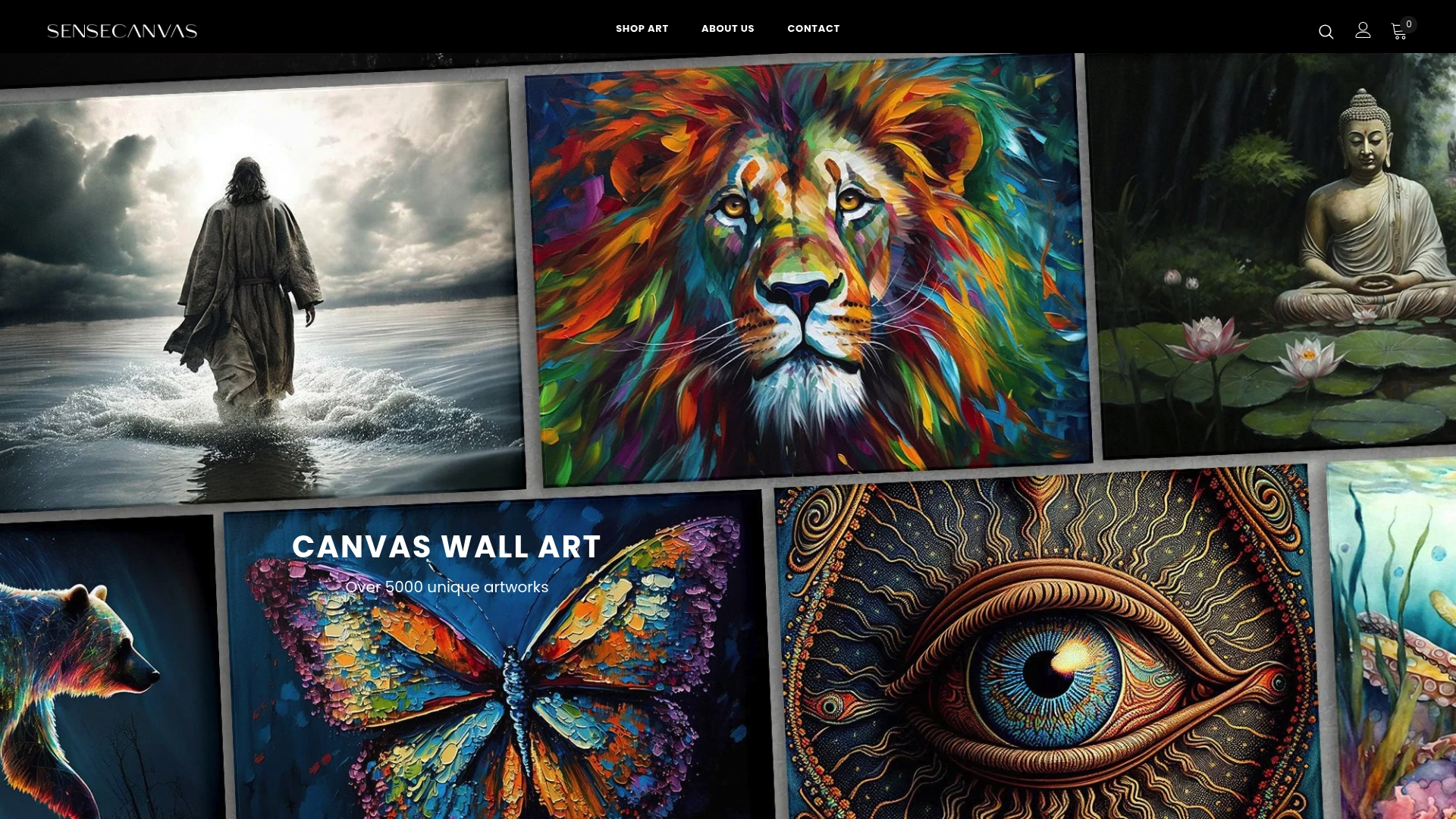
Whether you’re outfitting a reception feature wall or a full row of styling stations, the Canvas Wall Art collection covers abstract, botanical, and motivational themes that match every brand mood covered above. Salons leaning toward a spa or wellness identity can start with the floral collection directly. For an editorial or bold-statement feature wall, a piece like the Lion Amongst Sheep canvas shows the kind of high-impact single-canvas option that anchors a reception area.
Getting started takes three steps:
- Measure your feature wall and confirm your seating or standing viewing distance.
- Choose a design and request custom sizing at checkout, plus a mounting template if you need one.
- Place the order and plan your install date around the free global shipping window.
Sources
- Specifying Textured Art: A Technical Guide to Scale & Light - Oilarthub
- Gallery Lighting Design: Professional Strategies for Illuminating Art and Exhibition Spaces - Teco
- Psychology of Salon Ambiance: Lighting, Music & Scent Research (2026) | SalonBoost
FAQ
What are current salon decor trends?
Biophilic and nature-inspired design, warm minimalism with luxe accents, and modern editorial photography are among the leading directions in commercial salon interiors right now. Vintage-glam and bold accent palettes remain strong choices for salons with a specific retro or high-energy identity.
What kind of wall art is trending right now?
Large single-statement canvases and coordinated grid sets are currently the most requested formats because they scale cleanly across reception areas and multi-station rows. Botanical and abstract canvas prints are especially popular for spa-positioned salons, and Sense Canvas offers both in customizable sizing.
What is the 2/3 rule for wall art?
The rule states that a piece of art should span roughly two-thirds to three-quarters of the width of the furniture or wall segment beneath it, whether that’s a bench, a desk, or a single station mirror. Going smaller makes the piece look lost; going much larger overwhelms the wall.
What is the best color to use on salon walls?
There’s no single best color, but research on salon ambiance links neutral and warm palettes to higher perceived friendliness and price tolerance, while bold saturated colors suit fast, youth-focused salons better. The wall behind the client matters more than owners expect, since it appears doubled in the mirror they’re facing.
How much does custom salon canvas art typically cost?
Custom canvas pricing depends on size and finish, and Sense Canvas starts its designs from $85, with full customization on dimensions available at checkout. That range makes it possible to outfit a feature wall first and add supporting pieces later without a large upfront investment.