Order Custom Office Wall Art from $85: 10 Ideas That Boost Focus
The simplest way to upgrade an office wall: choose one dominant art concept and scale it correctly. A single large anchor piece or a tightly curated gallery, centered around eye-level height common in gallery wall guides, beats a scattershot mix every time. A platform carries thousands of customizable canvas designs sized for exactly this job, so the sizing and sourcing problem solves itself once you know which style fits your room.
TL;DR:
- Most retail art offers limited sizes, making custom ordering essential to match wall dimensions and ensure proper scale.
- Using one dominant art concept, such as a large abstract or a custom-sized canvas, creates a focused visual anchor that avoids clutter.
- Wall height and furniture size should guide placement, with artworks centered around 57 to 60 inches from the floor and tailored to the furniture below.
- Office art should incorporate durable materials like matte canvas and protect against sunlight and dust for longevity.
- Employee contributions and interactive displays, when paired with consistent framing, add authenticity without sacrificing visual cohesion.
Table of Contents
- 10 Office Wall Art Ideas Worth Hanging
- How to Choose the Right Size, Color, and Placement
- Why Professional Stylists Rely on One Anchor Element
- Bringing Employee Art Into the Mix
- Keeping Office Art Looking Good for Years
- Statement Piece or Curated Gallery: An Editorial Take
- Get Custom Canvas Art Sized for Your Actual Wall
- Sources
10 Office Wall Art Ideas Worth Hanging
Picking the right concept matters more than picking the “best” piece. Match the idea to the room’s job first, then let the art follow.
-
Large modern abstract. A bold abstract canvas behind a desk or in an open executive office reads as confident and current without competing with paperwork or monitors. Give it room to breathe. One big piece almost always outperforms three medium ones in the same spot.
-
Gallery wall with a consistent anchor. Mixing personal photos, framed certifications, and purchased art works when everything shares one anchor, whether that’s a frame color, a mat style, or a single dominant palette. Design guides consistently point to this anchor strategy as the fix for avoiding visual clutter in mixed-content walls.
-
Motivational typography, chosen carefully. Generic “hustle” posters tend to feel hollow fast. Quotes that actually mean something to the person who sees them daily hold up much better over months of repeated viewing, so pick lines tied to real goals rather than stock inspiration.
-
Landscape and nature prints. Mountain ranges, coastlines, and forest scenes do real work in small or windowless offices, giving the eye somewhere to rest that isn’t a wall. Retail collections built around home-office art regularly list nature scenes among the top sellers for exactly this reason.
-
Black-and-white photography. Nothing signals “professional” faster than sharp monochrome imagery, and it’s a safe pick for client-facing rooms where color risks clashing with branding.
-
Multi-panel diptychs and triptychs. Wide walls, especially in conference rooms, need scale that a single small frame can’t deliver. Splitting one image across two or three panels solves that without needing an oversized print.
-
Textured or mixed-media pieces. Creative studios and design teams often want more than flat print, and raised texture or layered materials add a tactile element that flat canvas can’t match.
-
Framed personal photography or milestone shots. A framed shot of the team’s first office, a product launch, or a founder’s early sketch humanizes a workspace in a way stock art never will.
-
Minimalist prints and line drawings. For zones meant for deep, distraction-free work, a single thin-line drawing or a stripped-back geometric print gives the eye almost nothing to snag on.
-
Botanical and biophilic art. Leaf studies, plant illustrations, and abstract greenery bring a calming, almost restorative quality, and they pair well with real plants if the office already leans that direction.
Pro Tip: Before committing to a full gallery, tape paper cutouts of your planned pieces to the wall in their actual sizes. It takes ten minutes and saves you from ordering art that looks great on a screen but wrong on the wall.
How to Choose the Right Size, Color, and Placement
Getting sizing wrong is the single most common office art mistake, and it’s the easiest one to avoid with a few numbers.
Size and scale. Center the middle of your artwork (or the visual center of a gallery) at roughly 57 to 60 inches from the floor, which is the eye-level standard used across most gallery wall guides. For a piece going over a sofa, credenza, or desk, aim for about two-thirds the width of the furniture below it, and leave 6 to 8 inches of breathing room between the frame’s bottom edge and the furniture’s top.
Color and mood. Cooler tones (blues, soft greens, grays) tend to support focused, heads-down work, while warmer accent colors can energize creative brainstorming spaces. Neutral abstracts and muted landscapes are the safer bet for client-facing rooms where you don’t want the art competing with your brand colors.
Materials that hold up in an office. Canvas prints have a matte finish that cuts glare under overhead fluorescent lighting, which framed glass prints can’t avoid. Multi-panel pieces need level, consistent spacing between panels (usually 2 to 3 inches) to read as one image instead of three mismatched ones.
Quick buying checklist:
- Measure the wall width and the furniture below it
- Pick your anchor piece before adding anything else
- Order a custom size or a small sample print first
- Check the room’s actual lighting before finalizing color
Why Professional Stylists Rely on One Anchor Element
Every well-designed office wall traces back to one rule: pick a single unifying element, whether that’s a frame finish, a color palette, or one dominant subject, and build everything else around it. Skip this step and even good individual pieces start to look like clutter.
Here’s where sizing gets genuinely hard for most people: standard retail art comes in a handful of fixed dimensions, and office walls rarely cooperate with those dimensions. Sense Canvas solves that specific problem with a catalog of more than 15,000 designs available in custom sizes, starting around $85.
- A cramped home office corner might need a narrow vertical canvas scaled to an odd wall gap standard prints can’t fill
- A wide conference room wall often needs one oversized custom canvas instead of three smaller frames fighting for attention
Both cases come down to the same fix: measure first, then order to that measurement instead of hoping a stock size works.
Bringing Employee Art Into the Mix
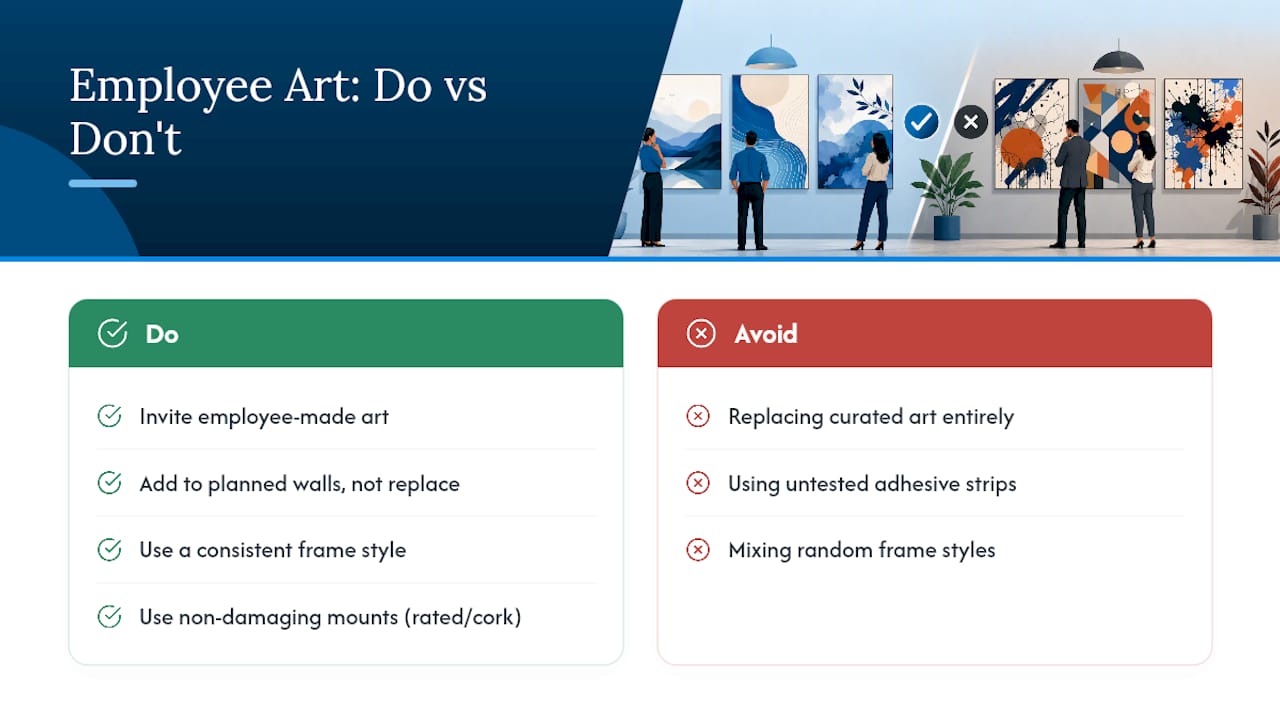
Letting employees contribute their own work, whether that’s photography, painting, or even kids’ drawings, adds a layer of authenticity that purchased art can’t replicate on its own. It works best as an addition to a planned wall, not a replacement for one. Pair employee pieces with a consistent frame style so a hallway of contributed art still reads as intentional rather than random.
Interactive installations are worth considering for common areas: a rotating “wall of the month” spot, a magnetic display board for team wins, or a chalkboard-style panel where people can sketch during breaks. These work particularly well near kitchens or lounge spaces where people naturally pause, and they give the office a living element that static prints can’t provide.
One practical constraint worth flagging: many offices have policies against adhesive strips or wall damage, a concern that shows up repeatedly in workplace decor discussions among remote and hybrid teams. Command strips rated for the piece’s actual weight, leaning canvases on shelving, or a simple cork board for employee submissions all sidestep that issue without needing landlord approval.
Keeping Office Art Looking Good for Years
Office walls take more abuse than home walls. Direct sun through south-facing windows, HVAC vents blowing dust across a canvas surface, and the occasional bumped chair all add up over a few years.
Canvas holds up better than paper prints under fluorescent lighting since the matte texture resists the yellowing that glossy paper prints show over time. Keep any piece out of direct sunlight where possible, or at minimum out of a window’s direct afternoon glare, since UV exposure is still the fastest way to fade color regardless of material.
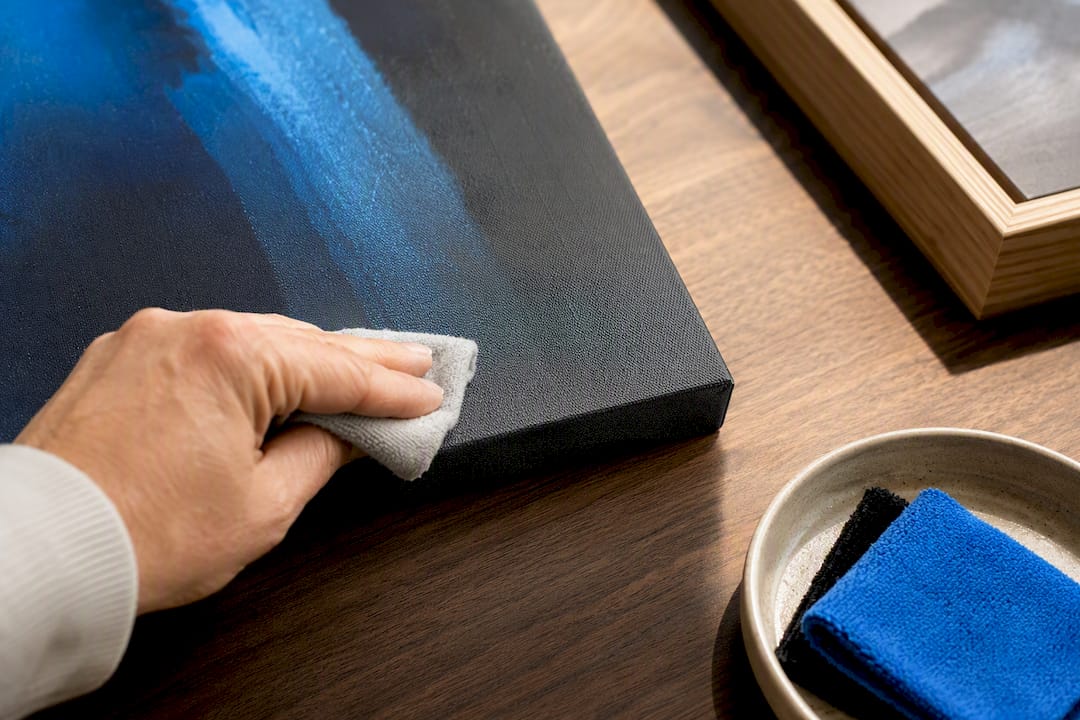
For cleaning, a dry microfiber cloth handles dust on canvas without smearing pigment, and it takes thirty seconds during a normal desk wipe-down. Framed prints under glass need occasional glass cleaner, but skip spraying directly onto the frame since moisture can warp lower-quality wood over time. If a piece hangs near a doorway or high-traffic hallway, a slightly heavier canvas or a solid-mounted frame handles accidental bumps better than a thin, unsupported print.
Statement Piece or Curated Gallery: An Editorial Take
Most people overthink this choice. If your role or personality leans toward calm, singular focus, one strong statement piece will serve you better than a gallery, because a gallery invites the eye to keep scanning, which is the opposite of what deep work needs. If you’re in a more collaborative, idea-driven role, a curated gallery gives your brain more visual variety without becoming chaotic, as long as it holds to one anchor.
Refresh art every 12 to 18 months if you can. Novelty fades faster than most people expect, and stale walls stop registering entirely.
Pro Tip: Lean a canvas against the wall for a week before hanging it. Living with a placement before committing to nail holes has saved more than a few offices from a wall they regretted.
Get Custom Canvas Art Sized for Your Actual Wall
Most retail art comes in a handful of fixed sizes and forces you to work around them instead of the other way around. Sense Canvas flips that: browse more than 15,000 designs across abstract, motivational, landscape, and photography styles, then order the exact dimensions your wall needs, starting around $85.
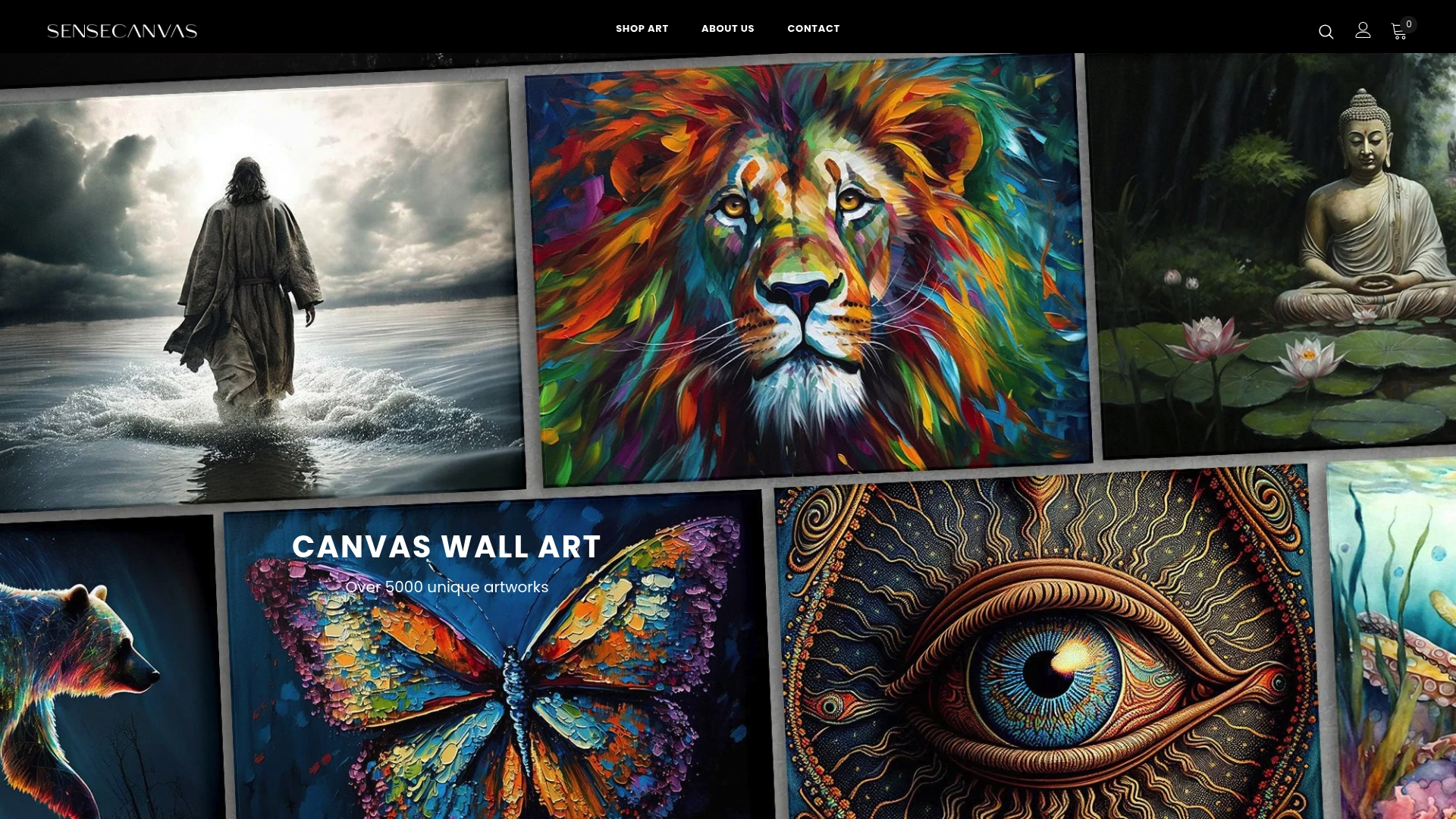
Ordering takes three steps. Measure your wall and the furniture beneath it, pick a design and customize the size to match, then preview the proportions before you buy. If you’re not sure a style will work in your space, order a smaller sample size first rather than committing to a full conference-room canvas on the first try. A motivational piece like the Get It Done canvas works well as a single focal point over a desk, while a calming abstract ocean design suits a client-facing lobby wall that needs neutral, low-distraction color. For file prep on any custom order, this guide to custom print artwork covers the basics worth knowing before you upload anything. Start by measuring your wall, then browse the full catalog at Sense Canvas to find your anchor piece.