Fit Your Mantel: Fireplace Wall Art Ideas Sized 60–75%
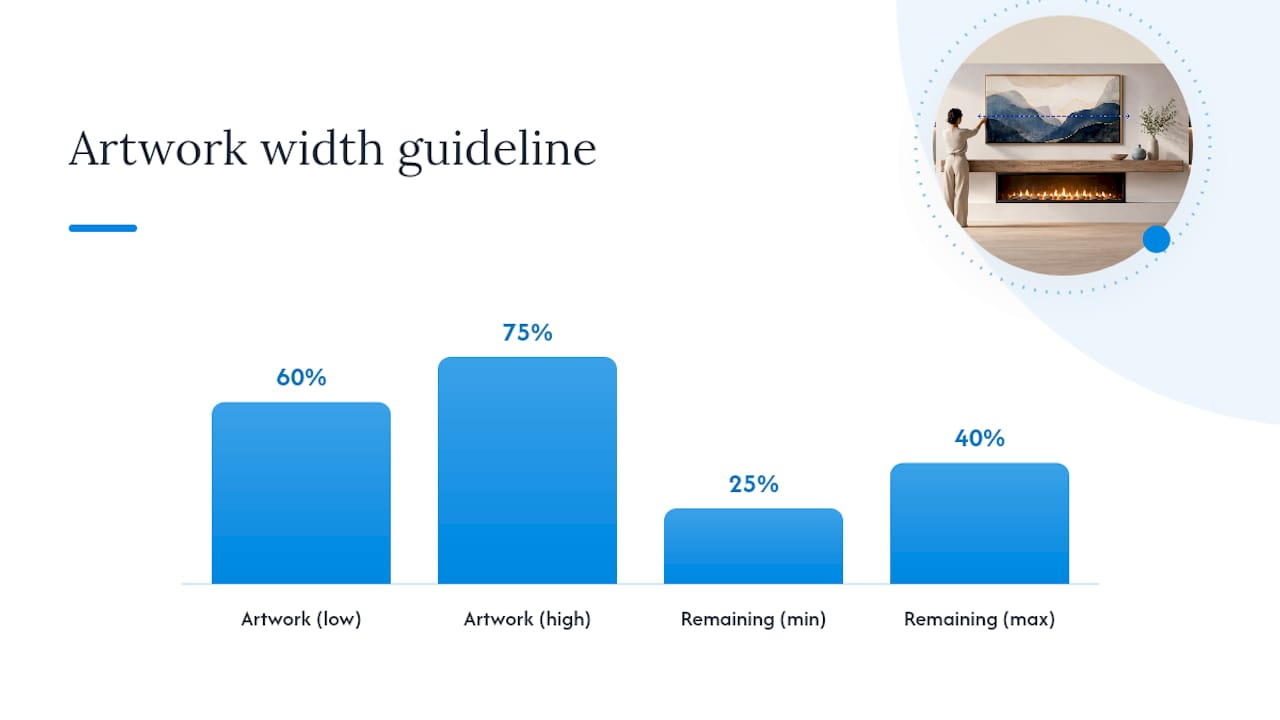
Choose one strong horizontal canvas sized at about two-thirds to three-quarters of your mantel width, and hang its bottom edge 4 to 8 inches above the mantel top, with the center landing around 57 to 60 inches from the floor. Canvas is the material to reach for first because it scales up without adding weight or glare. Custom canvas pieces can be made to specific dimensions, so hitting a width ratio doesn’t mean settling for a size that leaves awkward gaps on either side.
TL;DR:
- Use a canvas that spans 60 to 75 percent of your mantel’s width and hangs with its center around 57 to 60 inches from the floor for balanced visual impact.
- For high ceilings, choose larger artwork with increased width and height to prevent it from appearing lost or too small.
- Match the art style to the room, with bold abstracts or landscapes for a strong focal point and avoid intricate small pieces that vanish from seating distance.
- Proper mounting hardware and heat clearance are crucial to prevent damage, especially when selecting materials and installing above a working fireplace.
- Seasonal decorations should complement rather than obstruct the main artwork, and cleaning should focus on dust removal and protecting against smoke and UV damage over time.
Table of Contents
- Fireplace Wall Art Ideas Worth Actually Using
- Sizing and Placement: The Rules That Prevent a Costly Mistake
- Which Styles and Themes Actually Work Above a Mantel
- Materials, Framing, and What Holds Up Over Time
- Styling the Mantel to Work With Your Art, Not Against It
- Lighting and Mounting for the Best Effect
- Why Canvas Tends to Win Above the Fireplace
- Seasonal and Holiday Ideas for Your Fireplace Wall
- Keeping Fireplace Wall Art Clean and in Good Condition
- What I’d Prioritize If I Were Doing This Myself
- Get a Canvas Sized Exactly to Your Mantel
- Sources
Fireplace Wall Art Ideas Worth Actually Using
Not every fireplace wall needs the same treatment. The right idea depends on your mantel width, ceiling height, and how much you want the space to feel curated versus lived-in.
-
Single large horizontal canvas. This is the default for a reason. A standard mantel (48 to 60 inches) paired with one wide canvas creates an immediate focal point without visual clutter, and it’s the easiest option to get right on the first try.
-
Oversized landscape or abstract for tall ceilings. When your ceiling climbs past 9 or 10 feet, a single large-format piece needs to grow in both width and height, not just width. A canvas that would look perfect over a standard mantel can look stranded and small under a soaring ceiling.
-
Triptych or diptych for wide mantels. Extra-long mantels, especially in great rooms, sometimes look better with two or three panels rather than one massive canvas. This keeps the composition unified while letting the art span more real estate.
-
Gallery wall for eclectic collectors. If your taste runs toward collected-over-time rather than one statement piece, a cluster of smaller framed prints and canvases above the mantel reads as intentional, not messy.
-
Leaned art on the mantel. Skip the nail entirely and lean a canvas against the wall. It’s the go-to move for renters and for anyone who likes to rotate pieces seasonally without patching holes.
-
Non-art focal points. Woven textiles, sculptural wood or metal panels, or a mounted plant display work when you want texture over image. Choose this route when the room already has strong pattern elsewhere and a busy painting would compete rather than complement.
Sizing and Placement: The Rules That Prevent a Costly Mistake
Get the math wrong here and even a beautiful canvas will look off. The standard guideline that designers return to again and again:
- Width: your artwork should span 60 to 75% of the mantel’s width. A 60 inch mantel typically suits a canvas around two-thirds to three-quarters of its width. A 72 inch mantel suits a proportionally wider canvas to fit well.
- Vertical gap: leave a few inches between the top of the mantel and the bottom edge of the artwork.
- Center height: aim for the artwork’s visual center to land around the average eye level from the floor, which keeps it at natural eye level for most seated and standing viewers.
Before you order anything, tape it out. Measure your mantel width, multiply by 0.6 and 0.75 to get your low and high bounds, then cut kraft paper to that width and tape it up at the proposed height. Stand back at your usual seating spot and check the sightline. This five-minute test catches sizing mistakes that are much more annoying to fix once a canvas is on the wall. Our guide on sizing art for any wall walks through the same math for other rooms in the house.
Pro Tip: If your fireplace has a TV mounted above it, shift the art rule aside entirely, art goes beside or below the screen, not competing for the same real estate.
For high ceilings, size up on both dimensions, not just width, or the piece will look lost. And always confirm heat clearance for anything hung close to a working fireplace, canvas handles ambient warmth fine, but check manufacturer guidance for anything with adhesives or delicate finishes.
Which Styles and Themes Actually Work Above a Mantel
The mantel is a hearth wall, which means it wants presence, not fussiness. Large abstracts and moody color-field pieces tend to hold up best because they read clearly from across the room instead of losing detail at a distance.
- Bold abstracts or landscapes for a room that wants gravity and a strong anchor point.
- Botanical or coastal pieces for lighter, airier rooms where you want calm rather than drama.
- Horizontal orientation in most cases; switch to vertical only when your ceiling height genuinely calls for it.
- One dominant color pulled from the art and echoed in a throw pillow, a vase, or a rug ties the whole wall into the room instead of leaving it isolated.
Small, highly detailed pieces are the one style choice to avoid here. A piece with intricate line work or tiny text simply disappears from normal seating distance. Interior designers have also been quietly swapping the traditional overmantel mirror for a single statement canvas, it gives the same vertical anchor without bouncing light around the room the way glass does.
Materials, Framing, and What Holds Up Over Time
Material choice above a fireplace comes down to three factors: weight, glare, and how the surface handles heat and light exposure.
- Canvas is the lightest option at large sizes and produces almost no glare, which matters directly across from a window or a bank of lamps.
- Framed prints under glass look formal and crisp, but standard glass throws reflections. If you go this route, ask for non-reflective glass.
- Metal, wood, or 3D sculptural pieces add texture but often weigh considerably more. Check the mounting hardware’s weight rating before committing.
- Mounting hardware differs by wall type. Masonry above a fireplace usually needs masonry anchors rated for the piece’s weight; drywall needs studs or heavy-duty anchors rated well above the frame’s actual weight as a safety margin.
A common sizing mistake buyers make is picking a piece that looks right in a product photo but was never measured against their actual mantel width, which is exactly why the tape-out test matters more than browsing alone.
Styling the Mantel to Work With Your Art, Not Against It
The objects on the mantel either support the art above them or fight it for attention. Getting the layering right takes about ten minutes once you know the order to follow.
- Set height variation first. Place one or two taller objects (a candlestick, a small sculpture) off-center, then fill in with lower pieces like books or a small dish.
- Decide symmetry or asymmetry up front. Matched pairs on either side read as formal; an offset cluster reads as curated and current.
- Leave breathing room. Don’t crowd the mantel edge to edge, empty space is what makes the arrangement look intentional rather than accumulated.
- Keep scale in check against the art. If your canvas is bold and graphic, keep mantel objects simple. If the art is quiet and minimal, you have more room to add texture below.
- Swap seasonally without starting over. Change candles, greenery, or a runner for the season, but leave your main anchor objects in place so the wall doesn’t feel rebuilt every few months. Our placement guide for living spaces covers more mantel-specific arrangements.
Lighting and Mounting for the Best Effect
Good lighting above the fireplace usually comes down to picture lights, wall sconces, or recessed accent lighting, chosen based on how much ambient light the room already gets.
- Angle any picture light at roughly 30 degrees to the canvas surface to avoid a glare hotspot; check it again at night when lamps are on.
- For artwork wider than 48 inches, plan on two light sources rather than one to avoid uneven shadowing across the piece.
- Confirm your wall type before drilling: studs and masonry anchors for drywall, proper masonry screws for brick or stone surrounds.
Pro Tip: Test any new light fixture for a full evening before finalizing placement, sconces that look perfect at noon can throw a harsh reflection once the sun goes down.
Anything over roughly 40 pounds, or mounted into questionable masonry, is worth a professional installer rather than a guess with a drill.
Why Canvas Tends to Win Above the Fireplace
Canvas solves the two biggest problems homeowners run into above a mantel: getting a large enough piece without a heavy frame, and avoiding the glare that glass throws back at seating areas. Pricing starts at $85, which puts large-format, ready-to-hang art within reach for most budgets. Before ordering, measure your mantel, decide on horizontal or vertical orientation, and pick a finish that matches your framing preference.
Seasonal and Holiday Ideas for Your Fireplace Wall
Your mantel doesn’t need a full redecorating overhaul every time the calendar turns, but a few seasonal swaps keep the space feeling current without undermining the main artwork.
For fall, layer in warm-toned mantel accessories, amber glass, dried branches, small pumpkins, while leaving your primary canvas untouched. The goal is to shift the mood at eye level and below, not to compete with the focal piece above.
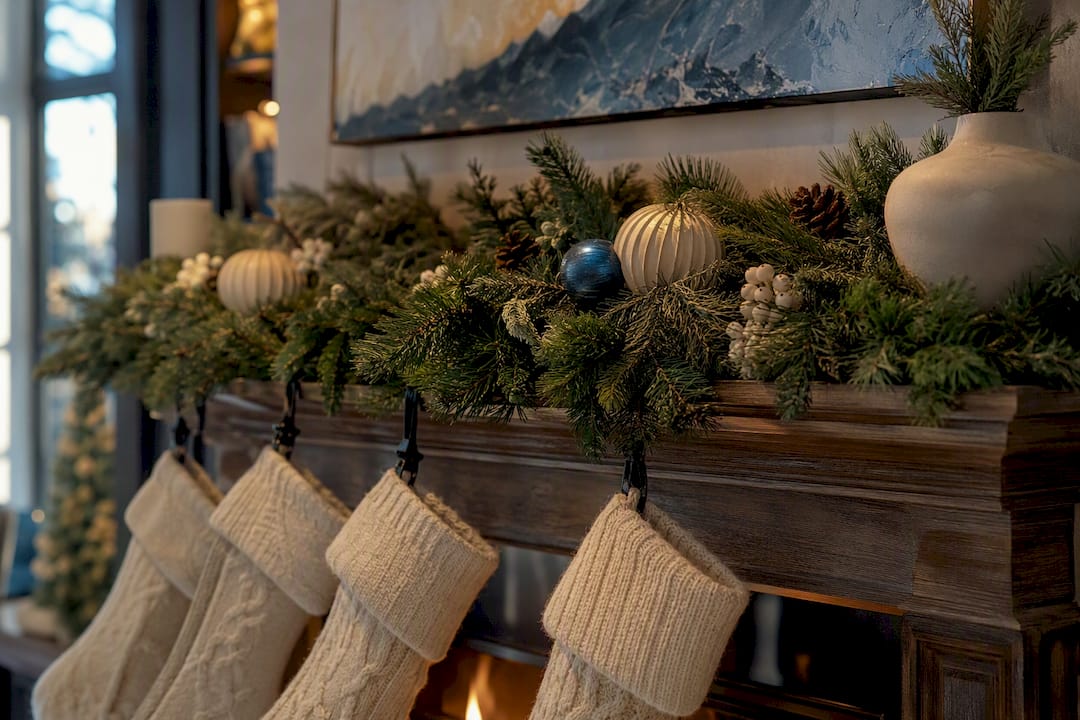
Winter and holiday season is where leaned art earns its keep. Many homeowners swap their everyday canvas for a smaller seasonal piece leaned in front of the main artwork, or simply flank the mantel with garland and let the primary canvas stay as the anchor behind it. If you hang stockings, check the clearance between the stocking hooks and the bottom edge of your artwork, that 4 to 8 inch gap disappears fast once hooks and greenery are added.
Spring and summer call for lighter styling: fresh greenery, lighter-colored ceramics, maybe a rotation to a botanical or coastal print if your main canvas leans dark or dramatic. If you’ve built your collection with a couple of interchangeable canvases in complementary sizes, seasonal rotation becomes a five-minute swap rather than a redesign.
The one rule that holds across every season: never let temporary decor obstruct the sightline to the main artwork from your primary seating area. Garland draped across the bottom third of a canvas defeats the purpose of hanging it in the first place.
Keeping Fireplace Wall Art Clean and in Good Condition
Art above a working fireplace faces more environmental stress than art anywhere else in the house, heat, occasional smoke residue, and UV exposure from nearby windows all add up over time.
Dust regularly with a dry microfiber cloth, moving in one direction rather than circular scrubbing, which can grind dust particles into a canvas surface. For framed prints under glass, a slightly damp cloth works for smudges, but keep moisture away from canvas directly since repeated dampness can affect the print surface over time.
Watch for heat drift. Even with proper clearance, a fireplace used often can create a faint warm updraft. Check your piece every few months for any subtle warping at the edges, particularly with canvas stretched on wooden frames, and adjust placement if you notice changes.
Address smoke residue quickly. A wood-burning fireplace occasionally throws a thin film of soot onto nearby surfaces. Wipe frames and canvas edges promptly rather than letting residue settle, since it becomes far harder to remove once it bonds to the surface.
Rotate away from direct sun if a nearby window throws strong afternoon light onto the piece for years at a time. UV exposure fades pigments gradually, and a mantel piece that’s been up for a decade will show it more than one that gets occasional shade.
What I’d Prioritize If I Were Doing This Myself
If you take away one thing from all of this: solve scale first, placement second, material and lighting third. A gorgeous piece hung at the wrong height or sized too small for the mantel will never look right, no matter how good the art is on its own. If you’re on the fence about size, tape it out before you buy anything. And resist the urge to fill the wall with three medium pieces when one strong canvas would do the job better.
— Sense
Get a Canvas Sized Exactly to Your Mantel
Guessing at sizes from a catalog is how most fireplace art projects go sideways, the piece looks right online and wrong on the wall. Sensecanvas builds each print to the dimensions you actually need, so hitting that 60 to 75% mantel width isn’t a matter of luck. Browse options like the bold 100 Bill Gold canvas or the moody Bitcoin Coins canvas for a sense of how large-format graphic pieces read above a mantel, then measure your own space using the width and height math covered earlier. To order, measure your mantel width, pick horizontal or vertical orientation based on your ceiling height, and choose a finish. Pricing details can be found on the provider’s website.