From $85: Cityscape Wall Art Sized to Fit Your Sofa
Pick the style that matches your room’s mood first, then figure out format and size. That order matters more than most decor guides admit: a moody photographic skyline in the wrong size looks like a rental poster, while a well-scaled silhouette or line-art skyline transforms a hallway. This guide walks through the main style directions (silhouette, photographic, abstract or synthwave, illustrated, and multi-panel), the materials each comes in, and how to size a piece so it actually anchors your wall instead of floating on it. For a customizable option once you know your direction, Sense Canvas offers cityscape designs sized to order.
TL;DR:
- Most cityscape prints should be sized to cover about two-thirds of the furniture width or 60–75% of open wall space for visual balance.
- Photographic skylines work best as a single statement piece over a large surface with ample negative space, while silhouette and line-art styles suit narrow or minimalistic rooms.
- Canvas offers a durable, matte, glare-resistant finish ideal for living rooms, whereas metal or acrylic prints provide sharp contrast but require careful lighting to avoid glare.
- Custom sizing on Sense Canvas starts at $85, allowing precise fit for odd wall dimensions or specific architectural features, with an emphasis on style and material selection first.
- When hanging, position artwork at eye level with a width approximately two-thirds of the furniture, and ensure adequate weight bearing support for larger or multi-panel pieces.
Table of Contents
- Cityscape Style Ideas for Every Room
- Materials and Formats: What Cityscape Art Is Actually Made Of
- How to Size and Place Cityscape Wall Art the Right Way
- Matching Cityscape Art to Your Interior Design Style
- Buying Checklist: What to Verify Before You Order
- Why Sense Canvas Works for Custom Cityscape Art
- How We Choose a Cityscape for a Room
- Order a Custom Cityscape Canvas from Sense Canvas
- Sources
- FAQ
Cityscape Style Ideas for Every Room
Not every skyline works in every room. A piece that reads as sophisticated over a leather sofa can look sterile in a nursery, and a skyline that pops in an office might vanish over a busy patterned couch. Here’s how the major styles behave in real spaces.
Silhouette and line-art skylines strip a city down to its outline, usually in black, white, or a single metallic tone. They’re the easiest style to place because they read as graphic shapes rather than photographs, which means they play well with almost any furniture. Laser-cut metal versions, like the steel skyline silhouettes Sportique sells, work especially well on narrow walls and hallways, where a long horizontal shape fills empty space without adding visual clutter. Minimalist spaces, entryways, and reading nooks all suit this treatment.
Photographic skylines bring in real texture: fog over a harbor, light trails on a highway, a sunset skyline in warm orange tones. These pieces carry the most visual weight, so cropping and composition decide whether they feel dramatic or just busy. A print with the horizon or a key landmark placed at a rule-of-thirds intersection, rather than dead center, tends to feel more intentional and less like a stock photo, according to Sense Canvas’s sizing guidance. These pieces do best as a single statement piece over a sofa, bed, or fireplace, where there’s enough negative space around them to breathe.
Abstract and synthwave cityscapes trade realism for mood. Think neon grids, pink and purple gradients, and geometric skylines that look pulled from an 80s arcade cabinet. This is where color becomes the whole point. A piece like Synthwave City works as a bold focal point in a game room, home studio, or teen bedroom, but it needs a fairly neutral wall and floor to avoid competing with the print’s saturation.
Illustrated and watercolor cityscapes soften everything. Hand drawn line work, muted washes, and gentle color blending make these pieces feel personal rather than architectural. They suit nurseries, reading corners, and smaller apartments where a photographic skyline would feel too heavy or corporate.
Multi-panel and panoramic layouts split one skyline across two, three, or five canvases, and the gaps between panels do real visual work. A wide multi-panel piece stretched across a long wall reads as more expansive than a single canvas of the same total width, which makes it a smart trick for rooms that feel narrow or boxy. It’s also one of the more forgiving formats for slightly imperfect walls, since small gaps hide minor unevenness that a single seamless canvas would expose.
A quick way to sort your options:
- Narrow hallway or minimalist room: silhouette or line art
- Living room statement wall: photographic skyline, single panel
- Game room, studio, or teen space: abstract or synthwave
- Nursery or reading nook: illustrated or watercolor
- Long or narrow wall you want to widen visually: multi-panel panoramic
Materials and Formats: What Cityscape Art Is Actually Made Of
The material decides how a cityscape print behaves under your lighting and how long it lasts on your wall. Here’s the breakdown by format.
Stretched or gallery-wrapped canvas wraps the printed image around wooden stretcher bars, so there’s no frame at all, just clean edges. It gives photographic and abstract skylines a soft, textured look that reduces glare, which matters a lot under overhead lighting or near a window. Canvas is also the most durable everyday choice for living rooms and offices, since it resists fading better than uncoated paper prints.
Framed prints and posters are the budget entry point and the easiest to rotate seasonally. A framed print costs less upfront, but the frame itself becomes part of the cost and part of the style decision, and swapping frames later to match new decor is more work than most people expect.
Metal and acrylic prints deliver the sharpest color and a glossy, almost backlit look that suits neon synthwave palettes and high-contrast black-and-white photography. The tradeoff is glare and fingerprints on acrylic specifically, so these work best away from direct window light or under a dedicated accent light rather than ambient overheads.
Wallpaper and full-wall murals turn an entire wall into the skyline itself. Vivawalls prices its cityscape murals by the square meter, and larger installations usually need pattern matching across seams and, often, a professional installer to avoid visible misalignment. A minimalist charcoal-and-gray city silhouette mural shows how a low-contrast, monochrome treatment can add depth to a room without overwhelming the furniture in it, which is the safer starting point if you’ve never done a mural before.
Key material comparisons:
- Canvas: matte texture, no glare, long lifespan, frameless look
- Framed print: lowest cost, easiest to swap, frame adds bulk and its own style statement
- Metal/acrylic: highest gloss and contrast, most prone to glare and fingerprints
- Wallpaper/mural: full immersive coverage, the highest installation complexity
Pro Tip: If you’re torn between canvas and metal for a synthwave piece, go canvas near windows and metal in a hallway or interior wall with controlled lighting. The finish that looks best in a showroom photo isn’t always the one that looks best in your actual room.
Custom sizing adds cost across every material, since off-the-shelf dimensions are cheaper to produce at scale. Sense Canvas lists prices starting at $85, which works as a useful reference point when comparing custom canvas against a framed print of similar size.
How to Size and Place Cityscape Wall Art the Right Way
Getting the dimensions right prevents the single most common mistake in wall art: buying something that’s technically a “cityscape print” but reads as too small for the wall it’s on.
- Measure the furniture anchor first. If the art hangs over a sofa or console, the standard rule is to fill about two-thirds of that furniture’s width. A 90-inch sofa calls for artwork roughly 54 to 60 inches wide. A 48-inch console suits a piece around 30 to 34 inches wide.
- Measure the open wall space if there’s no furniture anchor. For a bare wall, aim for the artwork to cover 60% to 75% of the available width, leaving breathing room on both sides rather than pushing edge to edge.
- Center the piece at standard eye level, roughly 57 to 60 inches from the floor to the artwork’s center, unless it hangs directly above a specific piece of furniture. In that case, leave 6 to 8 inches of space between the top of the furniture and the bottom of the frame.
- For gallery groupings or multi-panel skylines, treat the whole arrangement as one shape. Keep gaps between panels consistent, typically 2 to 3 inches, and measure the combined width the same way you’d measure a single canvas.
- Adjust for room scale. High ceilings can handle taller vertical formats or a piece hung slightly above standard eye level to fill the vertical space. Narrow walls benefit from horizontal silhouette or panoramic formats rather than a single large square canvas that eats the whole wall.
- Check weight before mounting. Large canvas pieces are light enough for standard picture hooks, but metal, acrylic, and oversized multi-panel sets often need wall anchors rated for the actual weight, not just the visual size. Sense Canvas’s sizing guide walks through these calculations room by room if you want a second reference before ordering.
Pro Tip: Tape the outline of your intended artwork size directly on the wall with painter’s tape before you buy anything. It takes five minutes and saves you from the classic mistake of ordering something that looked huge on a phone screen and tiny in person.
If you’re mounting anything over 40 pounds, or installing a multi-panel piece across drywall with uneven studs, it’s worth hiring a professional installer rather than guessing with drywall anchors.
Matching Cityscape Art to Your Interior Design Style
A skyline print only looks intentional when its colors and framing agree with the rest of the room. The easiest starting point is pulling one dominant color from the art and echoing it somewhere else nearby, a throw pillow, a rug edge, or a lamp base, so the piece feels connected rather than dropped in from a catalog.
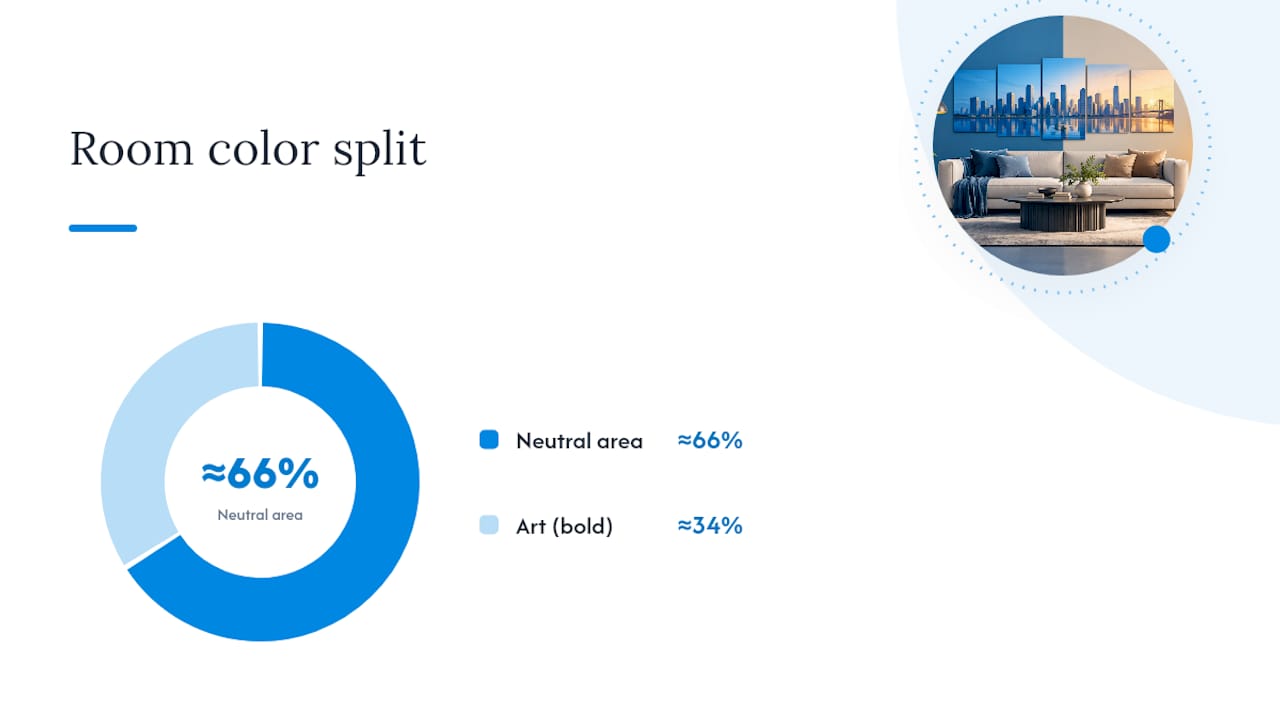
A rough two-thirds color rule helps here: let roughly two-thirds of the room stay neutral, and let the cityscape art carry the bold third. This works especially well with synthwave and abstract pieces, where the color saturation is already doing most of the visual work. Photographic and silhouette skylines are more flexible and can sit against warm wood tones, cool grays, or even busy textiles without a fight.
Framing choices should follow your room’s existing hardware, not fight it:
- Modern and minimalist interiors: frameless gallery-wrapped canvas or thin black metal frames
- Traditional or transitional spaces: wood frames in tones that match existing trim or furniture
- Industrial lofts: metal or acrylic prints with exposed edges, no frame at all
- Soft, textile-heavy rooms: illustrated or watercolor cityscapes in light wood frames
Lighting changes how each material performs. Glossy acrylic and metal prints throw glare under direct overhead lighting, so a directional accent light angled from the side reads far better than a ceiling fixture pointed straight at the piece. Matte canvas is more forgiving under mixed lighting, which is part of why it remains the most common choice for living rooms with big windows.
Scale matters as much as color. A tall, narrow photographic skyline next to a low, wide sectional sofa creates visual tension unless you balance it with a wide multi-panel layout or a horizontal silhouette instead.
Buying Checklist: What to Verify Before You Order
Before you commit to any cityscape print, run through this list. It catches the mistakes that lead to returns.
- Resolution and DPI: photographic skylines need at least 150 to 300 DPI at your intended print size, or the final piece will look soft or pixelated up close.
- Color proofing: ask whether the seller offers a digital proof or preview mockup before printing, especially for custom sizes.
- Return policy: confirm whether custom-sized or personalized pieces are returnable at all, since many printers exclude custom orders from standard return windows.
- Mounting hardware included: check whether hanging hardware ships with the piece or needs to be purchased separately.
- Lead times: custom canvas typically takes longer to produce than an off-the-shelf framed print, so factor that into any gift or event timeline.
Off-the-shelf sizes are cheaper because they’re produced in batches, so if your wall matches a standard dimension (24x36, 30x40, and similar), you’ll save money going that route. Custom sizing costs more but solves the problem of an odd wall width or a piece that needs to match an exact furniture measurement.
For sourcing, retailers like Lowe’s carry cityscape wall art in framed and frameless formats if you want to see options in person before buying. If you want a direct custom-canvas path instead, Sense Canvas lets you browse curated designs and adjust sizing before ordering.
Why Sense Canvas Works for Custom Cityscape Art
Sense Canvas carries over 15,000 designs, which gives cityscape shoppers real range beyond the handful of skylines most home decor stores stock. Every design can be resized or recomposed to fit a specific wall, a sofa width, or an odd stairwell landing, rather than forcing you to shop around standard frame sizes.
A few specifics worth knowing before you browse:
- Prices vary for custom canvas pieces; check the pricing page for current details.
- Curated cityscape options include bold abstract takes like Synthwave City alongside more traditional skyline treatments.
- Materials lean on artist-grade printing with a satisfaction guarantee and free global shipping, per the brand’s own listed terms.
How We Choose a Cityscape for a Room
Start with mood, not size. For a living room, that usually means picking between a moody photographic skyline for a formal space or a warmer illustrated skyline for a more lived-in feel. Once the style is settled, material follows the lighting: canvas near windows, metal or acrylic in controlled interior light. Size comes last, and it comes from measuring the sofa or wall, not from guessing. That order, style then material then size, is the difference between art that anchors a room and art that just occupies a wall. If you’re stuck on any step, Sense Canvas’s sizing guide and custom order flow are worth working through side by side.
— Sense
Order a Custom Cityscape Canvas from Sense Canvas
Sense Canvas is the direct route to a skyline sized exactly for your wall, not the closest match a big-box retailer happens to stock. Once you’ve settled on style, material, and dimensions using the steps above, you can browse over 15,000 designs and adjust size or composition before it ever goes to print, with prices starting at $85 and free global shipping backed by a satisfaction guarantee.
Browse the full collection at Sense Canvas to find a cityscape that fits your exact wall, or explore additional design categories if you’re furnishing more than one room. Starting an order takes a few minutes: pick a design, enter your dimensions, and preview the fit before you check out.
FAQ
What size cityscape art should I buy for above my sofa?
Aim for artwork roughly two-thirds the width of your sofa. A 90-inch sofa suits a piece around 54 to 60 inches wide, centered above the cushions with 6 to 8 inches of clearance from the top of the sofa back.
Is canvas or framed print better for a cityscape skyline?
Canvas gives a frameless, textured look with less glare and better long-term durability, which suits photographic and abstract skylines well. Framed prints cost less and are easier to swap seasonally, making them a better fit if your style changes often.
Can I get a cityscape canvas custom sized?
Yes. Sense Canvas allows custom sizing and recomposition across its full design library, with prices starting at $85, so an odd wall width or stairwell landing doesn’t limit your options.
What’s the best cityscape style for a small room?
Silhouette and line-art skylines work best in small or narrow spaces since they read as clean graphic shapes rather than dense photographic detail. A horizontal silhouette on a narrow wall also visually widens the room more than a tall vertical piece would.
How do I avoid glare on metal or acrylic cityscape prints?
Position the piece away from direct window light and use a directional accent light angled from the side rather than an overhead fixture. Glossy finishes like metal and acrylic reflect light more than matte canvas, so lighting placement matters more with these materials.