Seven Horse Wall Art Ideas to Style Any Room With Confidence
If you want horse wall art that actually looks intentional, pick one lane instead of grabbing whatever “horse picture” pops up first. Five approaches cover almost every room: photographic realism for drama, modern abstract for contemporary spaces, western/rustic for warmth, silhouette/graphic for small walls, and mixed-media upcycles for texture. Each fits a different mood.
- Photographic — wild herds or single portraits for a den or entryway that wants presence.
- Modern abstract — geometric, motion-driven pieces for a living room or office that skews contemporary.
- Western/rustic — canvas paired with real tack for a ranch-style family room.
- Silhouette/graphic — clean black-on-white shapes for a hallway, nursery, or small apartment wall.
- Mixed-media/upcycled — framed horseshoes and mounted bits for a mudroom or barn-adjacent space.
For most of these, a customizable canvas sized to your exact wall solves the guesswork faster than hunting flea markets.
Key Takeaways
Horse wall art works best when style, scale, and material choice are matched to the specific room before anything gets hung.
| Point | Details |
|---|---|
| Match style to mood | Photographic drama, modern abstract, rustic western, silhouette, or mixed-media each suit a different room and feel. |
| Size against furniture | Keep artwork width at roughly 60 to 75% of the furniture width beneath it for visual balance. |
| Hang at the standard height | Center pieces around 57 to 60 inches from the floor, with 2 to 4 inches between gallery frames. |
| Preserve real tack properly | Clean, seal, and mount horseshoes, bits, and saddles on weight-rated brackets away from sun and humidity. |
| Preview before you buy | Sense Canvas offers customizable sizing and digital mockups starting around $85 so you can check scale before ordering. |
Table of Contents
- Modern and Abstract Horse Art: Styling Contemporary Equestrian Pieces
- Photographic and Wild-Horse Canvases for Drama or Calm
- Western and Rustic Equestrian Decor With Real Tack
- Minimal Silhouettes and Graphic Motifs for Small Walls
- Mixed-Media Wall Art From Upcycled Horseshoes, Bits, and Saddles
- Gallery Walls, Composition, and Scale Rules for Horse Art
- Room-by-Room Horse Art Ideas: Living Room, Entry, Bedroom, Office
- Three DIY Horse Wall Art Projects You Can Finish in a Weekend
- Sense Canvas: Customization, Mockups, and How to Order With Confidence
- Color Schemes and Coordinating Horse Art With Your Decor
- Lighting Tips That Make Horse Wall Art Look Its Best
- Horse Wall Art for Ranch, Farmhouse, and Other Themed Rooms
- Why Room-by-Room Thinking Beats a Generic Horse Art Gallery
- Bring Your Horse Wall Art Ideas to Life With Sense Canvas
- Sources
Modern and Abstract Horse Art: Styling Contemporary Equestrian Pieces
Modern abstract horse art trades manes and muscle for layered geometric shapes, color blocking, and motion lines that suggest speed without depicting it literally. It reads as contemporary design shops build these pieces around motion-focused composition rather than realism, which is why they work in rooms that have nothing else “equestrian” about them.
Stick to two or three colors that already exist in your space, plus one accent. Matte canvas wraps with no visible frame keep the modern feel; a thin black float frame works if your room leans mid-century.
For a sofa or console, size the piece to roughly 60 to 75% of the furniture’s width.
- Sofa wall: one large horizontal canvas, centered above the cushions.
- Console table: a vertical or square piece, slightly narrower than the table.
Pro Tip: If your walls are already busy with color, choose an abstract horse piece in black, white, and one metallic tone. It reads as art first, horse second, which keeps a bold room from feeling themed.
Photographic and Wild-Horse Canvases for Drama or Calm
A single-horse portrait creates intimacy and works well in tighter spaces, while a herd or landscape scene fills a large wall with energy and motion. The choice between them is really a choice about mood, not just size.
Photographic canvases pull from an enormous well of source material. Stock libraries carry thousands of high-resolution horse images suitable for large-format printing, and artist shops sell both loose prints and finished canvas wraps.
- Panoramic herd shots suit the space above a sofa, bed, or long console.
- Narrower single-horse portraits work above a side table, in a hallway, or flanking a doorway.
- Matte canvas wraps hide glare and suit sunlit rooms; framed prints under glass need indirect lighting to avoid reflections.
If you’re torn between a dramatic panorama and a quieter portrait, measure the wall first. A too-small photo on a big wall looks like an afterthought, and an oversized print above a narrow console overwhelms the furniture beneath it.
Western and Rustic Equestrian Decor With Real Tack
A western vignette works because it mixes textures your eye reads as authentic: worn leather, patinaed brass, distressed wood, and canvas art that ties the objects together visually. Pairing canvas prints with a few real artifacts turns a flat wall into something that looks collected over years, not bought in an afternoon.
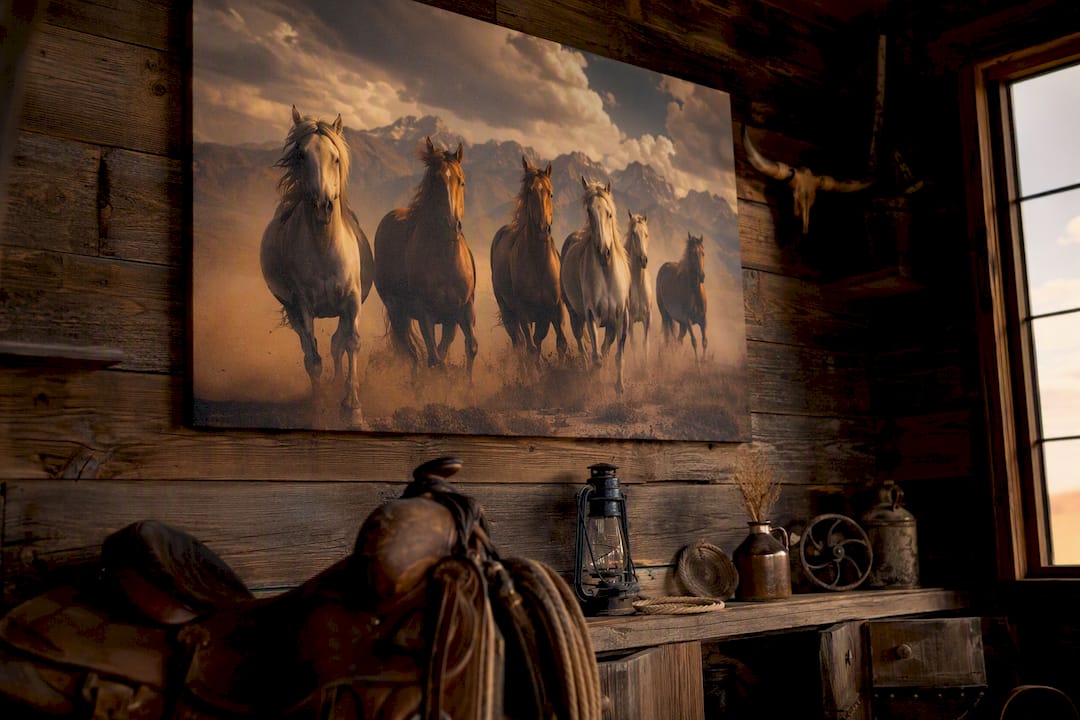
Hang a rustic-toned canvas as the anchor, then build outward with smaller objects at different depths. A pair of stirrups, an old horseshoe, or a small trophy adds horizontal reach without competing with the print for attention.
Vintage tack needs some care before it goes on display. Clean leather with a proper conditioner, let brass and iron develop a light patina rather than scrubbing them raw, and seal any painted horseshoe with a matte varnish so it doesn’t chip when you hang it.
- Anchor with one canvas print in warm, earthy tones.
- Layer in one to three real objects at varying depths.
- Use wall-rated brackets rated for the item’s actual weight, not just picture hooks.
Pro Tip: If you’re mounting a saddle indoors, put it on a proper saddle bracket, not a shelf, and keep it away from radiators or humid bathrooms. Leather cracks in dry heat and molds in damp air, so a hallway or den beats a steam-heavy laundry room every time.
Minimal Silhouettes and Graphic Motifs for Small Walls
A black silhouette against a white or pale background reads as calm and modern, which is exactly why it suits small apartments, hallways, and minimalist bedrooms where a busy photo would feel crowded. The shape does the work; there’s no texture or color competing for attention.
Pair a single silhouette with a short phrase or a horseshoe-shaped negative-space cutout to keep the wall feeling deliberate rather than sparse.
- One large silhouette centered above a narrow console or headboard.
- A grid of three to five small, identical-style silhouettes at even spacing.
- A single motif repeated in different sizes, largest in the center.
Repetition is the trick here. Three horse heads in the same style and color, evenly spaced, look curated. Three different styles crammed together look like leftovers.
Mixed-Media Wall Art From Upcycled Horseshoes, Bits, and Saddles
- Frame a painted horseshoe. Clean it with a wire brush, prime it, paint or antique it, then mount it inside a shadow box frame with a small stand-off so it casts a shadow against the backing.
- Turn bits into hangers. Mount a cleaned bit horizontally on the wall using two small screws through the rings, then drape a lightweight print or fabric swatch over the bars for texture.
- Display a saddle as a focal piece. Mounting a saddle on a covered porch or dry indoor wall works best on a purpose-built bracket, kept out of direct sun and rain if it’s outdoors.
Before any of this goes up, clean and seal the metal or leather. Antiquing brass bits and sealing painted horseshoes protects them from rust and keeps colors from fading indoors.
Pro Tip: Balance real objects against flat art by keeping a roughly 70/30 ratio: let one large canvas dominate, and treat two or three physical pieces as supporting texture, not competing focal points.
Gallery Walls, Composition, and Scale Rules for Horse Art
Three layouts cover almost every gallery wall: an anchor piece with smaller supporting frames around it, a symmetrical grid of matching sizes, or an eclectic salon wall that mixes frame styles and sizes deliberately.
Interior design convention puts the centerline of a grouping at roughly 57 to 60 inches from the floor, which lines up with average eye level, and spaces individual frames 2 to 4 inches apart so the grouping reads as one composition instead of scattered pieces.
- Anchor layout: one large canvas, two or three smaller pieces around it.
- Grid layout: identical frame sizes in even rows and columns.
- Salon layout: mixed sizes and frame finishes, arranged by eye rather than a strict grid.
Reading about how gallery walls work before you start hammering nails saves a surprising number of patched holes.
Room-by-Room Horse Art Ideas: Living Room, Entry, Bedroom, Office
The living room usually wants the biggest, boldest piece in the house, since it’s the room guests actually stand in front of. A panoramic herd shot or a large abstract canvas above the main sofa works, centered at the standard 57 to 60 inch height.
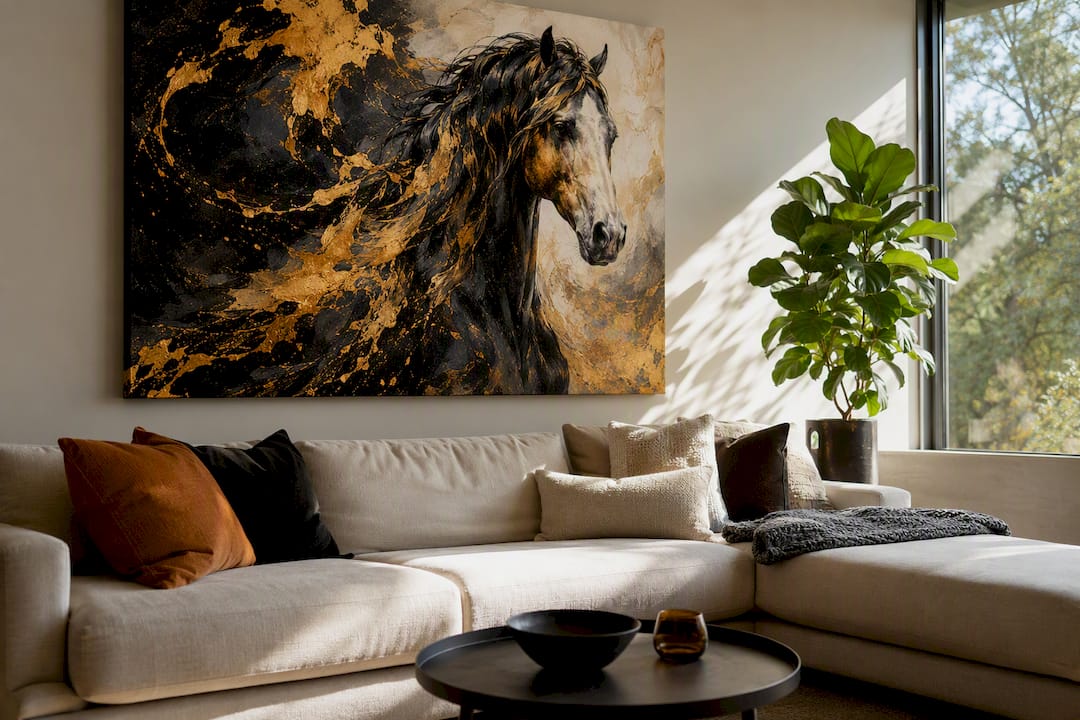
Entryways favor a single striking portrait or a small horseshoe arrangement near the door, since foot traffic makes bigger installations risky.
Bedrooms do better with quieter choices: a muted silhouette, a soft-toned photographic print, or a modern abstract piece in bedroom colors, hung centered above the headboard.
Home offices can handle more personality, whether that’s a western vignette with a mounted bit or a bold modern farmhouse mix of canvas and reclaimed wood accents.
- Living room: large photographic or abstract canvas, centered above the sofa.
- Entry: one vertical portrait or a small horseshoe cluster near eye level.
- Bedroom: silhouette or muted photography, centered over the headboard.
- Office: western or mixed-media pieces that add personality without overwhelming a work surface.
Check humidity and direct sun before committing to a spot, especially for anything leather or unsealed metal. Measure your wall, tape off the proposed dimensions with painter’s tape, and stand back before you drill a single hole.
Three DIY Horse Wall Art Projects You Can Finish in a Weekend
- Framed keepsake horseshoe. Materials: a cleaned horseshoe, wire brush, matte sealant, shadow-box frame. Clean, prime if painting, seal, then mount with a small stand-off bracket inside the frame.
- Painted silhouette on canvas. Materials: blank canvas, painter’s tape or a stencil, black acrylic paint. Sketch or tape your horse outline, fill in solid black, seal with a matte varnish once dry.
- Mixed-media bit-and-print vignette. Materials: a small print or fabric swatch, a cleaned bit, mounting screws. Hang the print first, then mount the bit slightly overlapping one corner for a layered look.
Wear gloves when handling old metal tack, and check that any wall anchor you use is rated for the actual weight of a bit, bridle, or small saddle, not just a picture frame.
Sense Canvas: Customization, Mockups, and How to Order With Confidence
Choosing the right piece gets a lot easier when you can see it on your actual wall before you buy. Sense Canvas carries over 15,000 designs, including animal themes that cover everything from a stark white horse portrait to entirely different breed styles, so matching a specific mood or color palette is rarely a problem.
Every piece can be resized and customized to fit your exact wall, with prices starting around $85 for smaller formats. Digital mockups reduce sizing errors by letting you preview scale and orientation before committing. Send a photo of your wall and ask for both a vertical and horizontal version if the piece could work either way.
- 15,000+ designs across photographic, abstract, and graphic styles.
- Custom sizing to match sofa width or gallery wall footprint.
- Prices start around $85, with mockups available before you order.
Given the strong prose sentence and table required for Key Takeaways, that section appears later. For now: measure first, mock up second, order third.
Color Schemes and Coordinating Horse Art With Your Decor
Horse wall art succeeds or fails on color coordination more than on subject matter. A stunning photographic print in the wrong palette will fight your walls instead of complementing them.
Start with your room’s dominant neutral, whether that’s warm beige, cool gray, or true white, and pick horse art that either matches that undertone or contrasts it deliberately. A gray-based living room pairs naturally with black-and-white photographic prints or monochrome silhouettes. A warm, wood-heavy room calls for sepia-toned photography or a rustic canvas with browns and rust tones that echo the wood grain.
Abstract and modern pieces give you more flexibility because you can choose the palette outright rather than working around a horse’s natural coloring. If your sofa is navy, look for an abstract horse piece that pulls navy into its geometric layers as an accent, not the dominant color, so the art reads as a complement rather than a matching set.
One common mistake: choosing horse art in a completely different temperature than the room. A cool-toned, blue-gray horse photograph looks out of place on a wall surrounded by warm terracotta and gold accents. Hold a printed sample or a phone photo of the piece against your wall in daylight before committing, since screen colors and printed colors can shift noticeably.
For rooms with a lot of pattern already, whether that’s a bold rug or patterned curtains, a quieter horse piece in two or three tones keeps the space from feeling cluttered. Save the boldest, most colorful horse art for rooms that are otherwise fairly plain.
Lighting Tips That Make Horse Wall Art Look Its Best
Even a beautifully chosen horse canvas disappears in bad lighting. Direct overhead lighting from a single ceiling fixture tends to wash out detail and cast a flat, even glow that makes photographic prints look dull.
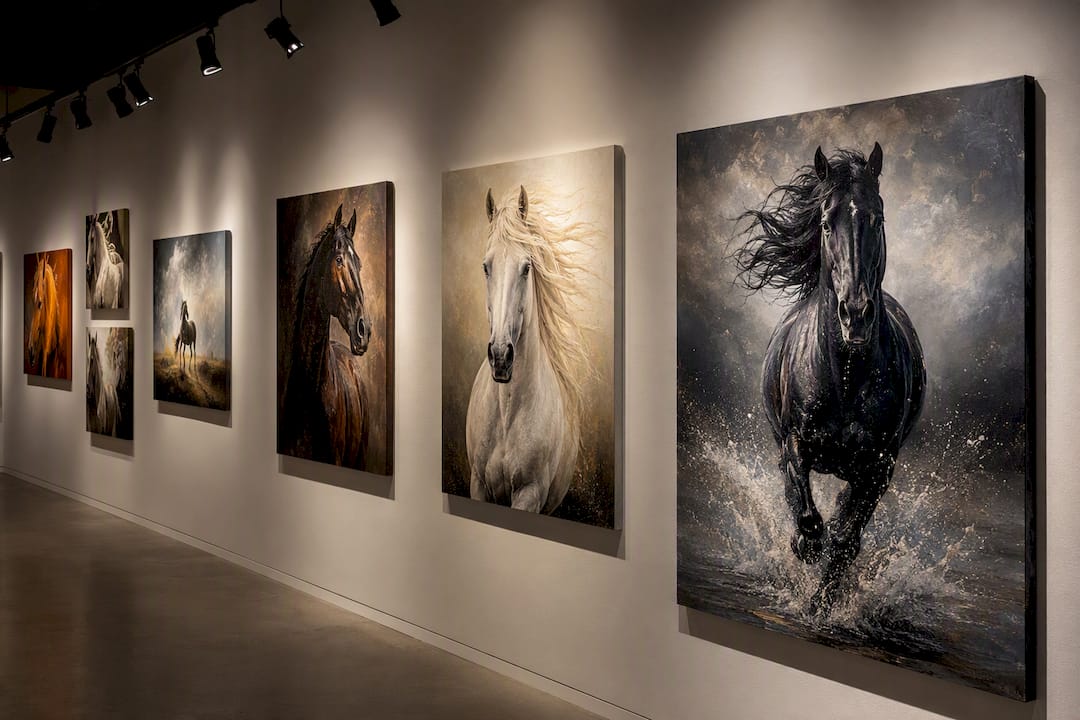
Picture lights mounted just above a frame remain the most reliable fix for a single anchor piece, especially over a fireplace or console. They wash light down across the canvas without creating glare, which matters most for framed prints behind glass.
For gallery walls, a track of adjustable spotlights lets you angle light onto specific pieces rather than flooding the whole wall evenly. Angle each light at roughly 30 degrees from the wall to avoid a hot spot in the middle of the canvas.
Natural light deserves real consideration too. A wall that gets direct afternoon sun will fade photographic prints and rustic tack finishes over time, so either choose a wall with indirect light or add UV-filtering glass if you’re framing a piece you care about long term. Matte canvas wraps handle sun exposure better than glossy or framed prints, since there’s no glass to catch glare during the brightest part of the day.
Warm-toned bulbs, generally in the 2700K to 3000K range, flatter western and rustic pieces with their browns and warm neutrals. Cooler bulbs closer to 4000K suit modern abstract pieces with grays, blacks, and metallics, since warm light can make those cool tones look muddy.
Horse Wall Art for Ranch, Farmhouse, and Other Themed Rooms
A ranch-style room wants horse art that feels lived-in rather than decorative. Weathered wood frames, sepia or black-and-white photography, and one or two real tack pieces mounted nearby build that authenticity faster than any single “statement” canvas could.
Modern farmhouse leans lighter and cleaner. Pair a horse silhouette or a soft photographic print with white shiplap or light wood tones, and keep metal accents in matte black or aged brass rather than shiny chrome. The goal is warmth without clutter, which is why farmhouse-style wall art collections tend to favor muted palettes and simple frames over bold color.
A more traditional equestrian study or den can handle richer, darker tones: deep greens, burgundy, and warm woods paired with a dramatic herd photograph or an oil-painting-style print. This is the one setting where a large, ornate frame actually works, since the room’s other furnishings can support that weight.
For a coastal or transitional space that still wants a horse motif, stick to abstract or silhouette styles in a restrained palette; a literal photographic wild horse can feel out of place next to linen sofas and driftwood accents.
Whatever the theme, resist the urge to over-decorate around the art. One strong horse piece with two or three supporting objects almost always looks better than five competing focal points crammed onto the same wall.
Why Room-by-Room Thinking Beats a Generic Horse Art Gallery
Most horse art guides show you a wall of pretty pictures and call it inspiration. That’s not particularly useful. A photo of someone else’s ranch-style den tells you nothing about whether a 40 inch canvas will overwhelm your 60 inch console, or whether your bathroom’s humidity will ruin a leather bridle within a year.
The advice that actually holds up treats horse wall art as a sizing and material problem first, style problem second. Get the scale wrong and even the most beautiful abstract print looks like an afterthought. Get the humidity or sun exposure wrong and real tack degrades no matter how carefully you displayed it.
What’s underrated is restraint. One strong anchor piece with a couple of supporting objects beats a wall crammed with five competing ideas, every time. What’s overrated is chasing a “theme” so hard that the room stops feeling like yours and starts feeling like a set piece.
Measure your wall before you fall in love with a design. Everything else, style, color, texture, follows from that one number.
— Sense
Bring Your Horse Wall Art Ideas to Life With Sense Canvas
Every style covered here, from photographic wild-horse portraits to clean abstract motion pieces, is available as a made-to-order canvas rather than a guess at a big-box store. Sense Canvas gives you over 15,000 designs and lets you resize any of them to fit the exact wall you measured earlier, which solves the single biggest risk in buying horse wall art: ordering the wrong scale.
Prices start around $85, and a digital mockup is available on request so you can see the piece against your own wall before it ships. If a bold, graphic option fits your space better than something equestrian, the same customization applies to pieces like the abstract ocean canvas, all built the same way, resized to your measurements. Pick a style from the ideas above, measure your wall, and browse the full catalog to request your mockup before you order.