Pop Art Canvas: Shop and Customize With the 60–75% Sizing Rule
If you want vibrant pop art canvas that ships ready to hang or can be built to your exact size, Sense Canvas is a solid place to start browsing and customizing. Look for colorfast inks, gallery wrap or stretched construction, and the option to request a custom size so the piece actually fits your wall instead of just filling space on it.
TL;DR:
- Choose colorfast, UV resistant inks and canvas stretched over kiln dried pine bars; check whether the listing is gallery wrapped or framed.
- Measure the wall first: artwork above furniture should span roughly 60% to 75% of its width, while custom dimensions may cost more.
- For a photo commission, start with a high resolution, minimally compressed image and export the finished file at 300 dpi to limit print softness.
- Custom prints, framing, and specialty finishes add production time, so check the seller’s estimated shipping window and tracking before ordering for a specific date.
Table of Contents
- How to Evaluate Pop Art Canvas Before You Buy
- Pop Art Styles and Placement Ideas for Your Walls
- Turning a Photo Into Pop Art That’s Ready for Print
- Hanging and Caring for Your Pop Art Canvas
- Delivery Times and Shipping for Pop Art Canvas Orders
- Sense Canvas Perspective: Why Customization Matters for Pop Art Buyers
- How to Order Your Pop Art Canvas From Sense Canvas
- FAQ
- Sources
How to Evaluate Pop Art Canvas Before You Buy
Not every canvas print holds up the same way, so a few checks before checkout save you from a disappointing wall piece. The print method matters most: look for colorfast, UV-resistant inks and canvas stretched over kiln-dried pine bars, which resist warping better than cheap particleboard frames. Pop art traditionally leans on bold, saturated color and sharp contrast, so a print that looks muddy or faded on screen will look worse on your wall.
Sizing is where most buyers go wrong. A good rule of thumb is to size wall art to roughly 60 to 75% of the furniture or wall span it sits above, following the general proportions used in room-by-room sizing guidance. For a longer wall, a two-thirds rule works similarly: the art should fill about two-thirds of the available space rather than float in a sea of blank wall. Our own guide to choosing art size for your home walls walks through specific room examples.
Before you add to cart, check these:
- Confirm the listing specifies gallery wrap (image wraps around the stretcher edges) or framed, since this changes how it hangs and whether you need a separate frame.
- Check whether custom sizing carries a price premium, since larger or non-standard dimensions often cost more than stock sizes.
- Look for a color fidelity or satisfaction guarantee, which signals the seller stands behind print accuracy.
Pro Tip: Measure your wall and bring a tape measure or painter’s tape mockup before you buy. A piece that looks right in a product photo can still be wrong for your actual space.
Pop Art Styles and Placement Ideas for Your Walls
Pop art covers more ground than most people expect, and picking the right sub-style makes the difference between a piece that fits your room and one that fights it. The movement, which took shape in the United States and Britain through the 1950s and 1960s, is defined by bold color, repetition, and imagery pulled from everyday and mass culture, with Andy Warhol and Roy Lichtenstein as its best-known figures.
A few recognizable variants to choose from:
- Warhol-style repeats: the same image multiplied in different color blocks, strong for a single large focal wall.
- Ben-Day dot or comic-style prints: halftone dot patterns borrowed from Lichtenstein’s comic panel work, good for a punchy accent piece.
- Photographic colorization: a real photo pushed through saturated, flattened color, popular for pet or portrait commissions.
- Neon and graphic abstracts, including crypto and motivational typography pieces, which suit offices and game rooms.
For placement, a living room usually calls for one large focal piece above the sofa, while a hallway or stairwell works better as a gallery wall mixing two or three smaller pop pieces. Home offices lean toward motivational typography or bold graphic abstracts, and kid-friendly spaces do well with animal line art rendered in pop color blocks rather than literal portraiture.
Educational materials from The Broad’s pop art kit point to repetition and color experimentation as entry-level techniques that work well for both first-time buyers and kids exploring the style, which is part of why pop art translates so easily from gallery wall to classroom project.

Vibrant, high-contrast palettes read clearly from across a room, a quality rooted in pop art’s core visual language of bold color and mass-culture imagery, which is why a single pop piece can anchor a room that would otherwise need several smaller works.
Turning a Photo Into Pop Art That’s Ready for Print
If you want a custom pop art canvas from your own photo rather than an existing design, the workflow is straightforward once you know the steps.
- Start with a high-resolution source photo, ideally shot in good light with a clear subject and minimal background clutter.
- In Photoshop, use the posterize and color-blocking technique to reduce the image to flat color regions, then layer in halftone or Ben-Day dot textures where you want a comic-book edge.
- If you don’t want to edit manually, Adobe Firefly’s pop art generator can produce a pop-style version from a photo in a few clicks, with export options sized for printing.
- Export at 300 dpi for the final print size, in an RGB or CMYK profile depending on what the printer requests, and build in a small bleed margin so nothing critical sits at the edge.
- For very large canvases, keep halftone dots proportional to viewing distance or switch to a vectorized pattern, since a dot size that looks sharp on a screen can turn to visible pixelation once blown up to several feet wide.
If you’d rather skip the editing entirely, ordering a custom print directly from a vendor that accepts photo uploads is usually faster than DIY editing for anyone without design software experience.
Pro Tip: Send your printer the largest, least-compressed version of your photo you have. Print quality can only be as good as the file you start with.
Hanging and Caring for Your Pop Art Canvas
A vibrant pop art canvas holds its color and shape for years when it’s hung and cared for correctly, and most damage comes down to a handful of avoidable mistakes.
- Use D-rings and wire or metal mending plates on the back of the frame rather than driving nails directly into the stretcher bars, which conservators flag as a common cause of warping and loosened canvas tension.
- Keep the piece away from direct sunlight and damp rooms like bathrooms, since both UV exposure and humidity accelerate fading and can loosen the canvas over time.
- Dust gently with a soft, dry cloth and avoid solvents or glass cleaners, which can strip ink from the print surface.
- Store an unused canvas upright rather than flat, and avoid leaving it wrapped in bubble wrap for long periods, since trapped moisture can transfer to the canvas.
This guidance tracks with Smithsonian conservation recommendations for handling and hanging stretched canvas and framed paintings, which treat even everyday decor pieces with the same basic care principles used for fine art. If a canvas arrives with a loose fit or a damaged corner, a professional framer can usually fix it with mending plates and minor adjustments rather than starting over. Our canvas art care guide covers the fuller routine for long-term upkeep.
Delivery Times and Shipping for Pop Art Canvas Orders
Shipping timelines for pop art canvas vary by whether you’re buying a stock design or a custom print, so it helps to know what to expect before you order. A ready-made, in-stock design typically ships faster than a custom piece, since custom sizing or photo-based prints require production time before they ever leave the warehouse.
Custom orders generally take longer because the canvas has to be printed, stretched, and quality-checked to the requested dimensions rather than pulled from existing stock. If your order includes framing or a specialty finish, add extra time on top of the standard production window, since framing is typically a separate step after the print itself is complete.
When you’re shopping, check the product page for an estimated production and shipping window before you buy, especially if you’re ordering for a specific date like a move-in or a gift occasion. Confirm whether shipping is included in the listed price or added at checkout, and whether the seller offers tracking once the order leaves production. Building in a buffer of extra time beyond the quoted estimate is the safest approach for anything time-sensitive, since production and carrier delays can both push a delivery date later than planned.

Sense Canvas Perspective: Why Customization Matters for Pop Art Buyers
Some canvas art providers carry tens of thousands of designs across styles like abstract, animal, motivational, and pop, and pop art is one of the categories where customization can make a practical difference. A Warhol-style repeat or a Ben-Day dot portrait only works in a room if the scale is right, so we let buyers adjust size and composition rather than forcing a fixed dimension onto a wall it wasn’t built for.
Canvases are often hand-stretched for a tight, even surface, and designs may start at a base price that keeps a vibrant statement piece within reach whether you’re filling a single accent wall or building out a full gallery layout.
— Sense
How to Order Your Pop Art Canvas From Sense Canvas
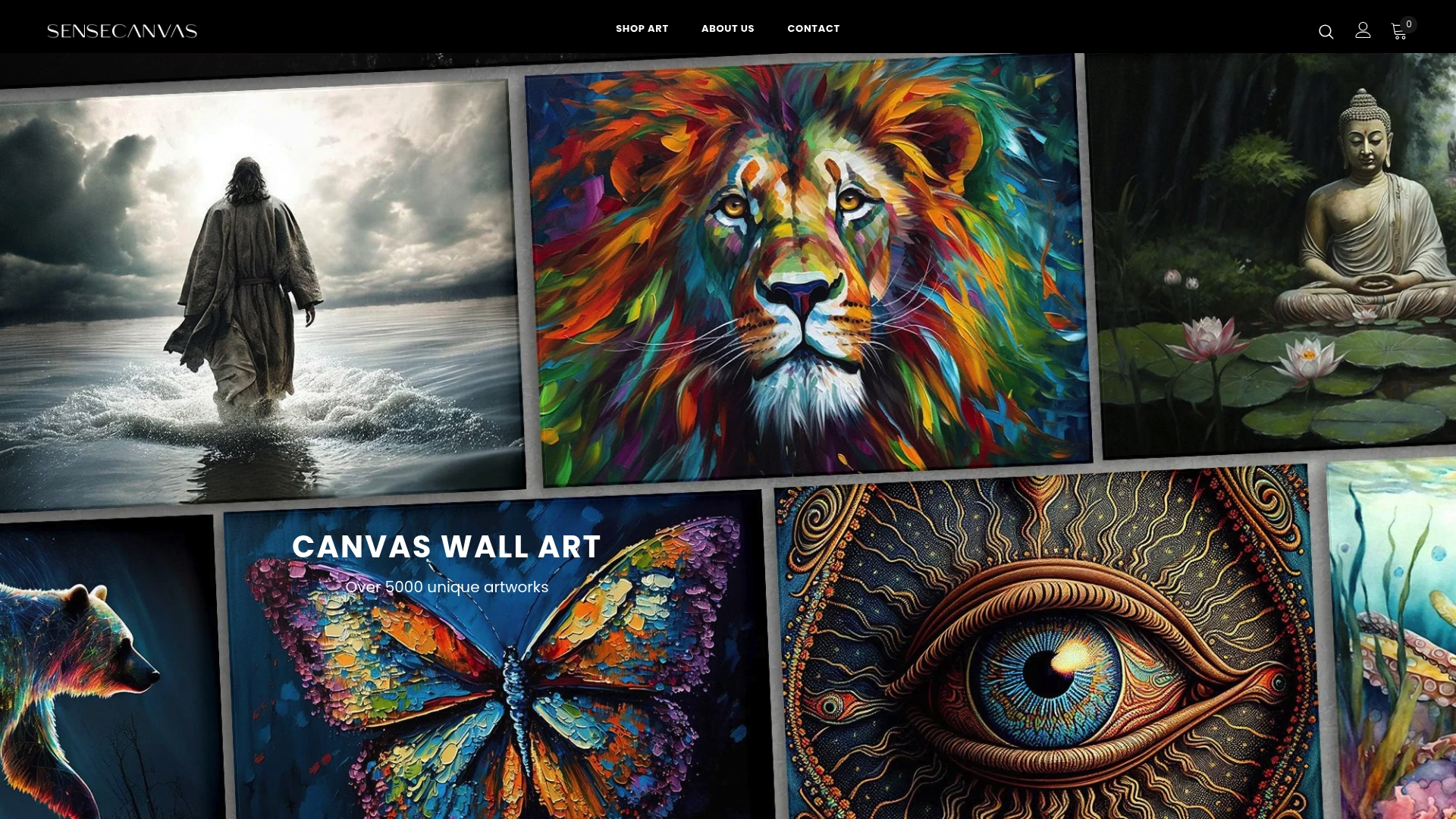
Browse our Pop collection to see the full range of pop-style designs, from Warhol-inspired repeats to bold typographic and crypto-themed pieces like our Bitcoin Coins canvas. Prices start from $85, with larger custom sizes, framing, and specialty finishes adding to that base.
Ordering takes four steps:
- Pick a design from our pop collection or any of our other 15,000-plus catalog styles.
- Choose your size and finish, or request a custom dimension to match your wall.
- Preview the mockup before you confirm the order.
- Check out, with free global shipping included.
If you’d rather work from your own photo, reach out through the product page to ask about a custom upload before you check out.
FAQ
How do you frame a canvas print?
Most canvas prints are either sold gallery-wrapped, where the image wraps around the stretcher edges and needs no separate frame, or framed, where a wood or metal frame sits around the stretched canvas. If you’re framing one yourself, a framer typically uses metal mending plates rather than nails through the stretcher bars to keep the canvas tension even.
Who are some famous modern pop art artists?
Andy Warhol and Roy Lichtenstein are the two names most closely tied to the movement, known for repeated imagery and Ben-Day dot comic styles respectively, according to the Smithsonian American Art Museum. Their techniques, bold repetition and flat color blocking, still shape how modern pop art canvases are designed today.
What is pop art for kids?
Pop art works well for kids because it relies on bold, recognizable imagery and simple techniques like repetition and color experimentation rather than fine-detail technique. Educational kits such as The Broad’s pop art resource use this accessibility to introduce the style through hands-on activities.
How do I turn a photo into pop art?
You can posterize and color-block a photo manually in Photoshop using Adobe’s pop art tutorial, or generate the effect automatically with a tool like Adobe Firefly. For printing, export at 300 dpi and keep halftone dot sizes proportional to the final print size to avoid pixelation.
How much does a pop art canvas typically cost?
At Sense Canvas, pop art canvas designs start from $85, with larger custom sizes or specialty finishes adding to that base price. Costs elsewhere vary based on size, print quality, and whether the piece is custom or stock.