A Canvas Art Care Preservation Guide That Actually Works
To preserve canvas wall art, keep its environment stable, handle it gently, dust it regularly with soft tools, keep it out of direct sunlight and away from moisture, and call a conservator the moment you see flaking, tears, mold, or water damage. That single rule covers almost everything that goes wrong with canvas art over time: temperature swings and humidity stress the fabric, light bleaches the pigment, and rough handling cracks paint or dents the surface. Get those five things right and even a $85 printed canvas from Sensecanvas will outlast the wall it hangs on.
Two things you can do right now, in under ten minutes:
- Walk over to your canvas and check whether direct sunlight touches it at any point during the day. If it does, even for an hour, move it or add a UV-filtering film to the window.
- Run a soft, dry brush or a microfiber cloth lightly across the surface, following the direction of the canvas weave, to remove surface dust before it grinds into the paint.
Pro Tip: If your canvas hangs flush against a wall with no airflow behind it, slide two small felt or cork spacers between the frame and the wall. That quarter-inch gap keeps moisture from condensing on the back of the canvas, which is one of the most common causes of mildew spotting that homeowners never think to check.
Key Takeaways
Canvas art lasts longest when its environment stays stable, its handling stays gentle, and any real damage goes to a conservator instead of a home fix.
| Point | Details |
|---|---|
| Control the environment | Keep temperature between 64 and 75°F and humidity between 40% and 55%, avoiding sudden swings. |
| Manage light exposure | Keep canvases out of direct sunlight and use UV-filtering glazing where light exposure is unavoidable. |
| Handle with care | Lift by the frame or stretcher, never press on the canvas back, and use two people for large pieces. |
| Clean conservatively | Dry dust first, spot-test any wet cleaning, and stop immediately if color or sheen changes. |
| Add backing and glazing | Use Coroplast or Gatorfoam backing plus spaced glazing for valuable originals and humid rooms. |
| Choose finished products | Sensecanvas prints ship with factory coatings and rigid stretchers that reduce ongoing maintenance needs. |
Keep this table near your hygrometer as a quick reference for the habits that actually protect canvas art over years, not just weeks.
Table of Contents
- Environment and Display: The Climate Rules That Matter Most
- Handling and Hanging Canvases Without Damaging Them
- Cleaning Canvas Prints Without Ruining Them
- Framing, Glazing, and Backing: What Actually Protects the Canvas
- Storing Canvas Art Safely for the Short and Long Term
- When to Call a Conservator and What to Do in an Emergency
- Oil, Acrylic, and Printed Canvas: Different Materials, Different Rules
- How Factory Finishing on Printed Canvas Changes Your Care Routine
- Why Museum Rules Are Worth Following at Home
- How Sensecanvas Helps You Protect Your Investment From Day One
- Frequently Asked Questions About Canvas Art Care
- Sources
Environment and Display: The Climate Rules That Matter Most
Stability matters more than hitting a perfect number. The NPS Museum Handbook recommends keeping paintings between 64°F and 75°F with relative humidity between 40% and 55%, but the real danger isn’t a room that runs slightly warm or dry. It’s a room that swings. Canvas fabric expands and contracts with humidity changes, and the paint layer on top doesn’t move at the same rate. That mismatch is what causes cracking, cupping, and eventually flaking paint.
The Henry Ford conservation guide suggests target RH and temperature ranges for oil paintings but emphasizes maintaining stable conditions over exact numbers, and warns against placing paintings near heat sources, radiators, or in uninsulated attics and basements where temperature and humidity swing hardest. A canvas hung above a fireplace looks striking in photos, but it sits in the one microclimate in your house that heats up fast and dries out even faster.
Light does its damage more quietly. Both visible and ultraviolet light cause fading that never reverses, according to the Library of Congress, and the damage accumulates regardless of whether the light feels bright or dim to your eye. A canvas facing a south-facing window for six years shows fading that no amount of cleaning will undo.
| Environmental Factor | Recommended Target | What Happens Outside It |
|---|---|---|
| Temperature | 64–75°F | Fluctuation stresses canvas and paint bond |
| Relative humidity | 40–55% | Swings cause cupping, cracking, mold risk |
| Light exposure | Indirect, UV-filtered | Fading is cumulative and irreversible |
| Wall placement | Interior walls, away from heat sources | Exterior walls and fireplaces amplify swings |
Where you hang the piece matters as much as what’s on the wall. Kitchens carry grease particles and steam. Bathrooms carry humidity spikes every time someone showers. Exterior walls without a vapor barrier run colder in winter, which invites condensation behind the frame. For gallery walls or reception area displays, interior walls with steady climate control almost always outperform a striking but risky exterior placement.
A cheap digital hygrometer, placed near (not touching) the canvas, gives you a running log of the conditions your art actually lives in.
- Check the hygrometer weekly for the first month to understand your room’s normal swing.
- Log the reading whenever you run heat, AC, or a humidifier for the first time each season.
- Note any reading below 30% or above 65% RH — those are the danger zones for canvas stress.
Pro Tip: Buy a hygrometer with memory-min/max function. It costs a few dollars more and tells you the extremes your room hit while you were at work or asleep, which is usually when the worst swings happen.
Handling and Hanging Canvases Without Damaging Them
Most canvas damage doesn’t come from the environment. It comes from human hands. The Smithsonian Museum Conservation Institute identifies handling as a leading cause of preventable damage, and their core advice is simple: lift by the frame or stretcher bars, never by pressing on the canvas back, and use clean bare hands or nitrile gloves rather than cotton gloves, which reduce your grip and make you more likely to drop the piece.
Before you hang anything, run through this quick inspection:
- Check that the stretcher bar keys (the small wooden wedges in the back corners) are seated and not loose.
- Press gently along the canvas edges to feel for any give or looseness in the staple line.
- Look for any tacky spots or flaking near the edges, which signal the piece needs attention before, not after, hanging.
- Confirm the wire or D-rings on the back are rated for the piece’s actual weight, not just what came pre-installed.
Hardware choice depends on size and weight. A small canvas under 5 pounds hangs fine on a single picture hook driven into drywall. Anything larger, especially anything over 20 pounds, needs two hooks spaced apart for stability, and ideally anchored into wall studs rather than drywall alone. If you can’t hit a stud, use drywall anchors rated for the piece’s full weight plus a margin, not the bare minimum.
For a piece that’s genuinely large or awkward, the process looks like this:
- Clear the path from storage or the wall to the destination before lifting anything.
- Have one person grip each side of the stretcher frame, never the canvas face or the top edge alone.
- Move slowly and communicate turns out loud, especially through doorways where corners catch canvas edges.
- Set the piece down on padded blocks or a soft blanket, never flat on a hard floor.
- Use a level and a laser or string line if you’re hanging multiple pieces together, since uneven spacing draws the eye more than uneven height does.
A useful rule of thumb for placement height is the “Rule of 57,” which comes from museum installation practice: center the artwork’s midpoint at 57 inches from the floor, roughly average eye level. It’s a starting point, not a law. Adjust it down for a room with mostly seated viewing, like above a sofa, and adjust for multi-piece groupings where the whole cluster, not each piece, should center around that height.
Pro Tip: Add small self-adhesive felt pads to the bottom corners of the frame before hanging. They stop the piece from scuffing the wall paint and keep it sitting flush, which reduces the wobble that loosens hanging hardware over time.
Cleaning Canvas Prints Without Ruining Them
Dry dusting is the first and safest step, and for most canvases it’s the only step you’ll ever need. Use a soft natural-hair brush or a clean microfiber cloth, and move in the direction of the canvas weave rather than in circles, which can push grit into the fibers instead of lifting it off.
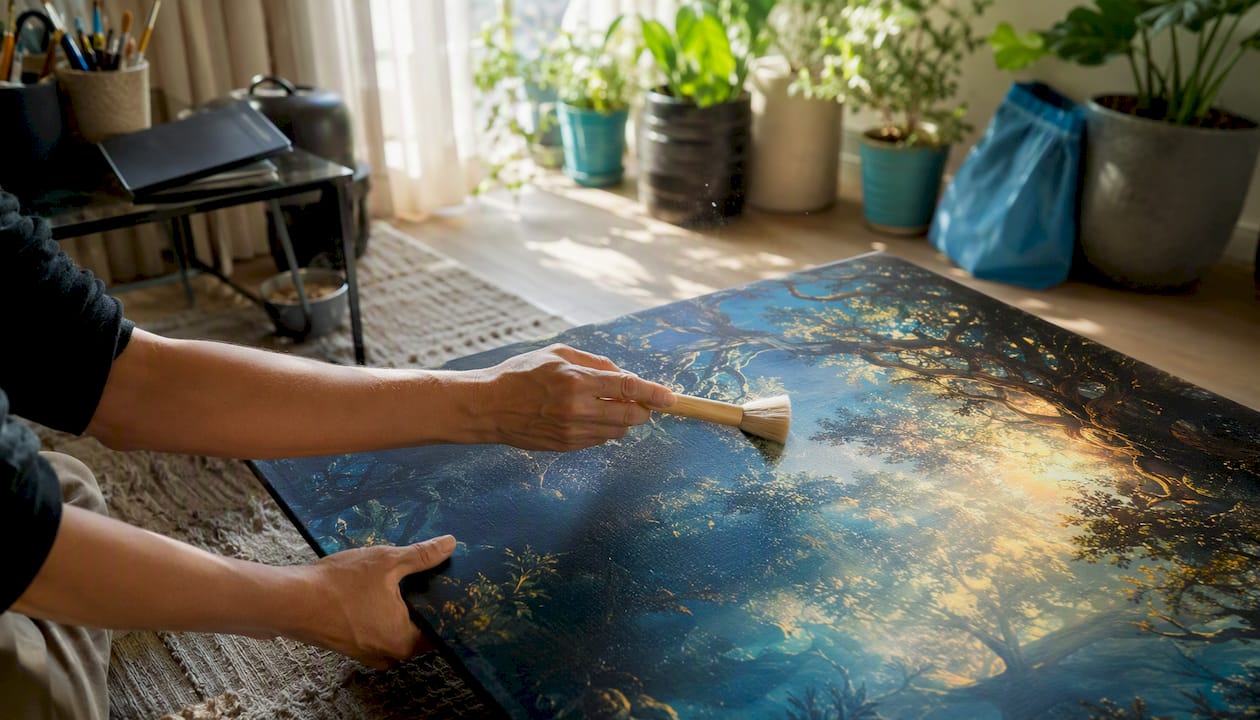
If dust dulls the surface, conservation guidance recommends testing a barely damp microfiber cloth with a few drops of pH-neutral dish soap mixed into distilled water. Test it on a small, hidden corner first. Wipe gently, then dry the area immediately with a clean, dry cloth. If you see any color transfer onto your cloth or the sheen changes where you wiped, stop immediately. That’s your surface telling you it can’t handle wet cleaning, and pushing further only makes things worse.
Skip these entirely, no matter how tempting they look:
- Household glass cleaners or solvents, which strip varnish and factory coatings.
- Vinegar or ammonia-based solutions, which react badly with oil-based paint and printed inks.
- Baby wipes, which carry lotions and fragrances that leave residue behind.
- Abrasive sponges or paper towels, which scratch delicate surfaces you can’t see are delicate until it’s too late.
Flaking paint, a tacky or sticky surface, visible mold spotting, or a gray smoke film after a nearby fire are not cleaning problems. They’re conservation problems, and reaching for a cloth at that point almost always makes the damage permanent instead of temporary.
If you spot any of those four signs, stop and set the piece aside. Document it with a few clear photos and reach out to a professional conservator before you touch it again.
Framing, Glazing, and Backing: What Actually Protects the Canvas
Glazing, meaning glass or acrylic sheeting in front of the artwork, cuts down on both dust accumulation and UV exposure. The trade-off is that glazing must never touch the paint surface directly. A spacer, even a thin one, creates an air gap that prevents condensation from forming against the canvas and prevents the glazing from pressing into any raised texture in the paint.
Backing boards do quieter but equally important work. According to the Canadian Conservation Institute, a sealed backing paired with glazing creates a microenvironment behind the canvas that buffers against rapid humidity swings and physical knocks from behind.
Backing material options, roughly ranked by protection level:
- Coroplast (corrugated plastic): lightweight, inexpensive, moisture-resistant, and the most common choice for standard home framing.
- Gatorfoam: rigid and more durable than Coroplast, better suited to larger canvases that need extra support against warping.
- Hardboard: heavier and less breathable, best reserved for pieces that stay in one climate-stable location long term.
Attachment matters as much as material. Screw or tape the backing board around the perimeter of the stretcher, leaving small gaps or drilled vent holes so trapped moisture can escape rather than pooling behind the canvas.
Varnish is where originals and prints diverge sharply. A hand-painted oil or acrylic original may carry a removable varnish layer applied by the artist, which protects the paint and can be professionally removed and reapplied decades later if it yellows. Printed canvas reproductions, by contrast, usually leave the factory with a fixed protective coating baked into the printing process, not a separate removable layer. That single difference changes what’s safe to clean with and how often a piece needs attention.
Avoid pressure-sensitive tapes and rubber-based adhesives when mounting backing boards. Over years, both can leach chemicals that discolor the canvas edge or stretcher bars. Acid-free paper tape and stainless or brass hardware age far better.
Pro Tip: If you’re framing a printed canvas yourself, ask whether the print already has a UV-resistant coating before you add glazing. Doubling up UV protection rarely hurts, but it’s an extra cost you may not need.
Storing Canvas Art Safely for the Short and Long Term
Vertical storage beats flat storage almost every time. Canvases stored flat, especially stacked on top of each other, accumulate pressure points that transfer texture and grime from one piece to the next. Store canvases upright, on padded shelving or in slotted storage racks, with a soft interleaving material like glassine or acid-free tissue between adjacent pieces.
Basements and attics are the two worst rooms in most houses for long-term canvas storage. Basements run humid and prone to flooding. Attics swing between summer heat spikes and winter cold, often the widest temperature range in the entire building. A climate-controlled closet or spare room interior wall beats either one by a wide margin.
| Storage Factor | Recommended Approach | Why It Matters |
|---|---|---|
| Orientation | Vertical, padded shelving | Prevents pressure marks and warping |
| Location | Interior climate-controlled room | Avoids humidity and temperature extremes |
| Interleaving | Glassine or acid-free tissue | Prevents surface transfer between pieces |
| Wrapping | Polyethylene, not plastic wrap | Breathable protection without trapping moisture |
Packing for a move calls for a different approach than long-term storage. Sandwich each canvas between two rigid sheets, cut slightly larger than the piece itself, and secure the sandwich with painter’s tape rather than anything adhesive that touches the canvas directly. According to Henry Ford conservation guidance, wrapping in polyethylene or polypropylene sheeting, adding corner protectors, and cushioning the whole package with foam reduces shock and abrasion dramatically during transit. For high-value or fragile pieces, a padded shipping crate isn’t overkill. It’s the difference between arriving intact and arriving with a torn corner.
A short pre-move checklist:
- Sandwich the canvas between rigid boards cut to size.
- Wrap corners separately with foam or cardboard corner guards.
- Wrap the whole package in breathable polyethylene, not sealed plastic.
- Avoid unheated moving trucks in winter, since a cold, dry ride followed by a warm, humid destination shocks the canvas fast.
- Unpack promptly rather than leaving wrapped art in a garage or storage unit for weeks.
Pro Tip: If a piece is genuinely valuable to you, whether for sentimental or resale reasons, ask a professional mover about a temporary handling frame. It’s a rigid external frame that wraps around the canvas for the move only, and it’s cheap insurance against the two riskiest moments in transport: loading and unloading.
When to Call a Conservator and What to Do in an Emergency
Water does the fastest damage of any threat to canvas art. The NPS Museum Handbook notes that water can separate the paint layer from the canvas support within minutes, which is why speed matters more than technique in the first hour after a leak, flood, or burst pipe.
If water touches a canvas:
- Move the piece away from the water source immediately, carrying it flat and supported, not by one edge.
- Do not press on the canvas surface or blot the paint layer with a towel. Blotting can smear pigment that’s already lifting.
- Air-dry the piece horizontally in a stable, moderate-humidity room, away from direct heat or fans aimed at the surface.
- Photograph the damage from multiple angles before and during drying, for both insurance and conservator reference.
- Contact a conservator within 24 to 48 hours even if the piece looks dry, since mold can develop inside the canvas weave without showing on the surface yet.
If you’re dealing with several damaged pieces at once, triage by value and vulnerability first. A watercolor on paper degrades faster than an oil on canvas, so it typically needs attention first, but among canvases, prioritize anything still actively wet or showing active mold growth over pieces that are merely damp.
For smoke or soot damage, resist the urge to wipe the surface. Soot particles are abrasive, and dragging a cloth across them grinds them into the paint rather than lifting them off. For visible mold, isolate the piece from other artwork immediately, since mold spores travel easily, and don’t attempt to brush or vacuum it yourself.
A conservator can often reverse water staining, consolidate flaking paint, or clean soot damage that would be permanent if a well-meaning homeowner tried to fix it with a damp cloth first. The window for a good outcome is usually measured in days, not months.
When you do reach out to a conservator, prepare clear photos from multiple angles, a description of what happened and when, and any environmental details (was it flood water, a burst pipe, a house fire). The American Institute for Conservation maintains a directory of professional conservators searchable by specialty and location, which is the most reliable starting point rather than a general contractor or framer.
Oil, Acrylic, and Printed Canvas: Different Materials, Different Rules
Oil paintings carry the most restrictions of the three. Many older oils have a varnish layer that yellows over decades, and that yellowing is often mistaken for the painting itself aging when it’s actually the varnish discoloring on top of stable paint underneath. Solvents that would clean an acrylic safely can dissolve oil paint or its varnish layer, so oils call for the most conservative cleaning approach of the three materials, and any flaking paint on an oil original should go straight to a conservator rather than a home fix.
Acrylic paintings tolerate light wet-cleaning better than oils do, but “better” doesn’t mean unlimited. Thick impasto areas, where the artist built up paint in raised texture, are more vulnerable to abrasion than flat passages, since a cloth catches on the raised edges and can flatten or chip them over repeated cleanings. Spot-test acrylics the same way you would an oil, even though the tolerance is generally higher.
Printed canvas reproductions play by a different rulebook entirely. Most carry a factory-applied protective coating and UV-resistant inks, which according to one canvas care resource makes them noticeably more tolerant of light damp cleaning than hand-painted originals. That coating is doing real work protecting the print underneath, so the greater risk to a printed canvas is usually heat, prolonged humidity, or physical abrasion rather than cleaning chemistry.
Quick do-not-do reference by material:
- Oil: no solvents, no aggressive wiping near flaking areas, no assumption that yellowing means the paint has failed.
- Acrylic: no abrasive pads near impasto texture, no skipping the spot test just because acrylic is generally hardier.
- Printed canvas: no assuming the coating is indestructible, no prolonged exposure to steam or direct heat sources despite the surface’s durability.
Pro Tip: Not sure whether a piece is oil, acrylic, or a printed reproduction? Look at the surface under raking light (a flashlight held at a low angle across the canvas). Genuine brushstrokes and texture indicate a hand-painted original; a flat, uniform surface with visible dot or line patterns under magnification indicates a print.
How Factory Finishing on Printed Canvas Changes Your Care Routine
Commercially produced canvas wall art isn’t finished the same way a hand-painted original is, and that difference is exactly why routine care looks different for the print hanging in your hallway than for a family heirloom oil painting. Factory production typically applies a protective coating across the printed surface, stretches the canvas over kiln-dried stretcher bars for stability, and finishes the edges with a clean wrap rather than leaving raw canvas exposed. Each of those choices reduces the maintenance burden on the owner.
The coating means a printed canvas generally tolerates dusting and occasional light cleaning without the same risk of pigment lifting that worries owners of hand-painted originals. The stretcher construction resists warping better than a loosely built frame would, which matters most in rooms where humidity isn’t perfectly controlled. The edge wrap eliminates the raw, unprotected canvas edge that would otherwise be the most vulnerable point on the entire piece.
That said, backing boards and glazing aren’t always necessary for a well-finished printed canvas the way they often are for a valuable original. A gallery-wrapped print displayed in a stable interior room, out of direct sun, usually does fine with nothing more than the finish it arrives with. Glazing becomes more relevant if the piece hangs somewhere with airborne grease, dust, or humidity swings, like a kitchen-adjacent hallway or a small space with limited airflow.
- Ask about the specific coating and stretcher material before buying if you plan to hang the piece somewhere environmentally challenging.
- Request written care instructions at purchase, since coating types vary between manufacturers and even between product lines.
- Confirm edge wrap style (gallery wrap vs. framed) since it affects both display options and vulnerability to bumps.
Pro Tip: When you order a custom canvas, ask the retailer directly what finish and stretcher type they use. A reputable seller should be able to tell you in one sentence, and that answer tells you whether you need extra backing or glazing at all.
Why Museum Rules Are Worth Following at Home
Conservators aren’t chasing a magic number. They’re chasing stability, because a canvas that experiences the same conditions day after day ages more slowly than one that swings hot and cold, humid and dry, week to week.
The honest caveat here is cost versus risk. You don’t need museum-grade climate control to protect a $85 to $300 canvas print. What you need is awareness: know where the sun hits your walls at 3 PM, know which room in your house swings hardest in humidity, and keep a $15 hygrometer somewhere you’ll actually glance at it. Small, cheap preventive habits return far more protection than any single expensive fix after damage has already happened.
If something does go wrong, the emergency steps and conservator guidance above exist for exactly that moment. Read them once now, before you need them.
How Sensecanvas Helps You Protect Your Investment From Day One
The easiest way to reduce canvas maintenance isn’t a better cleaning routine. It’s starting with a piece built to need less of one. Sensecanvas finishes every print with a protective coating and mounts it on a properly built stretcher frame, which means the two biggest maintenance headaches, surface vulnerability and warping, are addressed before the piece ever reaches your wall.

Every design in the Sensecanvas catalog of over 15,000 pieces comes available in custom sizing, so you can fit a canvas to a wall that actually has good light and airflow conditions rather than forcing an awkward size into your only available spot. Pieces start at $85, and the product listings show the finish and construction details up front, so you know exactly what you’re hanging before it arrives. If you’re ready to add a piece that’s built to hold up with minimal fuss, browse the full collection and start with a size and style that fits the wall you already have in mind.
Frequently Asked Questions About Canvas Art Care
How often should I clean a canvas painting or print?
Dust monthly with a soft brush or microfiber cloth under normal conditions. Wet cleaning should happen rarely, only when dry dusting no longer removes visible grime, and always after a spot test.
Can I hang canvas art in a bathroom?
It’s risky. Bathroom humidity spikes sharply during showers, which stresses canvas fibers and paint adhesion over time. If you must, choose a well-ventilated bathroom and a printed canvas with a factory coating rather than an original.
What’s the safest way to remove dust from a canvas without damaging it?
Use a soft, dry, natural-hair brush or a clean microfiber cloth, moving gently in the direction of the canvas weave. Avoid circular motions and never use a vacuum directly on the surface.
Do I need glass or acrylic glazing over a canvas painting?
Not always. A well-finished printed canvas in a stable room usually doesn’t need it. Valuable originals, or canvases in humid or dusty environments, benefit from glazing with a spacer so it never touches the paint.
How do I know if a canvas needs a professional conservator instead of home cleaning?
Flaking paint, a tacky surface, visible mold, water exposure, or smoke damage all call for a conservator. Attempting a home fix on any of those can turn a repairable problem into permanent damage.
Is it safe to store canvas paintings flat, stacked on top of each other?
No. Flat stacking creates pressure points that can transfer texture and grime between pieces. Store canvases vertically on padded shelving with soft interleaving material between them.
Sources
For treatment questions involving actual damage, always defer to a professional conservator rather than attempting a fix based on general reading. For preventive, day-to-day care, these resources cover the ground in more depth than any single article can: