How Art Enhances Brand Identity Spaces for Professionals
Art placed with intention is a strategic signal, not decoration. When you put the right work in the right location, it transfers perception, shifts atmosphere, and tells visitors what your brand values before a single word is spoken. That is how art enhances brand identity spaces: through a documented psychological mechanism called art infusion, where the cultural weight of an artwork spills over onto the brand it surrounds.
Three things you can do this week to start:
- Audit your current spaces. Walk every customer-facing area and note where art is absent, generic, or contradicts your brand tone.
- Identify your priority wall. Pick one high-traffic anchor point (lobby, reception, main corridor) for a pilot piece or commission.
- Draft a one-paragraph brief. Write down your brand thesis, the audience who will see the space, and the emotional response you want to trigger.
Get those three steps right and you will have a foundation that produces measurable brand clarity and a noticeably better visitor experience.
Key Takeaways
Art placed with a clear curatorial thesis and measured against defined KPIs is one of the most cost-effective tools for shifting brand perception in physical spaces.
| Point | Details |
|---|---|
| Art infusion is real and automatic | Visual art transfers luxury and prestige perceptions to co-located brands, even with brief exposure. |
| Start with a curatorial thesis | Define the one idea your space should communicate before selecting any work. |
| Measure before you install | Set a baseline on brand perception attributes and dwell time before installation, then track at 4–8 weeks and 6 months. |
| Match medium to lifecycle | Canvas prints suit rotating programs; murals and originals suit permanent flagship statements. |
| Sensecanvas for commercial pilots | Over 15,000 customizable canvas designs starting at $85 make it practical to test a brief before scaling. |
Table of Contents
- Why art matters for brand identity: measurable benefits and ROI
- How do color, scale, and placement communicate brand values?
- Which media and formats work best for commercial spaces?
- How does art integrate with environmental graphic design?
- How do you commission, buy, or license art for a commercial space?
- How do you measure art’s impact on your brand?
- What do real-world art programs actually achieve?
- What does the research actually say about art and brand perception?
- Your commissioning checklist and questions to ask an art partner
- Why art deserves a line in the strategy budget, not the décor budget.
- Sensecanvas: canvas art built for commercial spaces
- Sources
Why art matters for brand identity: measurable benefits and ROI
The business case for art in commercial spaces rests on more than aesthetics. Experimental research on art infusion shows that the presence of visual art in a brand environment transfers luxury perceptions to associated products and brands, and the effect occurs even when viewers only see the artwork briefly. That is not a soft finding. It means a well-chosen piece in your lobby is actively changing how a client evaluates your firm before they sit down.
The commercial evidence is equally direct. A 2021 study published in Sustainability found that artistic components in retail environments — show windows, furniture, stairs — positively predicted perceived brand image and marketing performance, including consumer satisfaction and store differentiation, with statistically significant regression results. Artification, the process of turning a non-art retail environment into an art-forward one, correlates with improved consumer perception across multiple empirical studies.
Specific outcomes to build your business case around:
- Brand perception lift. Curated art signals cultural capital and judgment, attributes that clients and customers associate with quality and trust.
- Longer dwell time. Art-forward spaces hold attention. Longer dwell time in retail correlates with higher purchase consideration.
- Higher perceived prestige. Industry practitioners report that curated buildings and art-forward hospitality programs command higher lease and pricing outcomes compared to equivalent unadorned spaces.
- Employee engagement. Survey data cited by practitioners in the Art of the Workplace Report links significant art exposure in offices to higher wellbeing scores and stronger preference for in-office presence.
On timeline: perception shifts register quickly, often within weeks of installation, because the art infusion effect is partly automatic. Engagement metrics like dwell time and NPS shifts typically emerge over one to three months. Lease premiums and retention benefits accrue over one to two years and require consistent curation, not a one-time purchase.
How do color, scale, and placement communicate brand values?
Design principles for art in brand spaces operate at the perceptual level. Get them right and the art feels inevitable. Get them wrong and even expensive pieces look like afterthoughts.
Color. Your art palette should either reinforce your brand’s existing color language or deliberately contrast it for tension and energy. A financial services firm using navy and white benefits from art that echoes those tones, deepening the sense of authority. A wellness brand in neutral earth tones can use art with warm amber and terracotta to amplify calm. The key is intentionality: matching art to your interior’s existing palette prevents visual noise and keeps the brand signal clean.
Scale. Scale is the most underused tool in commercial art placement. A piece that is too small reads as tentative; one that fills a wall reads as confident. General guidelines by program area:
- Lobby and reception: Large-format works (60 inches and wider) or multi-panel installations anchor the space and create immediate visual authority.
- Meeting rooms: Medium-format works (24–48 inches) that invite conversation without dominating a seated sightline.
- Corridors and circulation: Smaller works in series create rhythm and reward movement through the space.
Placement as an architectural anchor. Art placed on the first wall a visitor sees upon entry sets the interpretive frame for everything that follows. Think of it as the brand’s opening statement. Secondary anchor points include the wall directly facing a reception desk, the end of a long corridor, and any wall visible through a glass partition from outside. These sightlines are where art anchors spatial arrangements most effectively.
Pro Tip: Before ordering or commissioning, tape paper to the wall at the intended scale and live with it for two days. Scale surprises are the most common and most expensive mistake in commercial art placement.
Which media and formats work best for commercial spaces?
Choosing the right medium is a budget and lifecycle decision as much as an aesthetic one.
Originals vs. limited-edition prints vs. mass-produced prints
Original works carry the strongest cultural signal and the highest cost. They are appropriate for flagship locations, boardrooms, and spaces where the brand story explicitly includes collecting or supporting artists. The trade-off is insurance, conservation requirements, and the complexity of resale or deaccessioning.
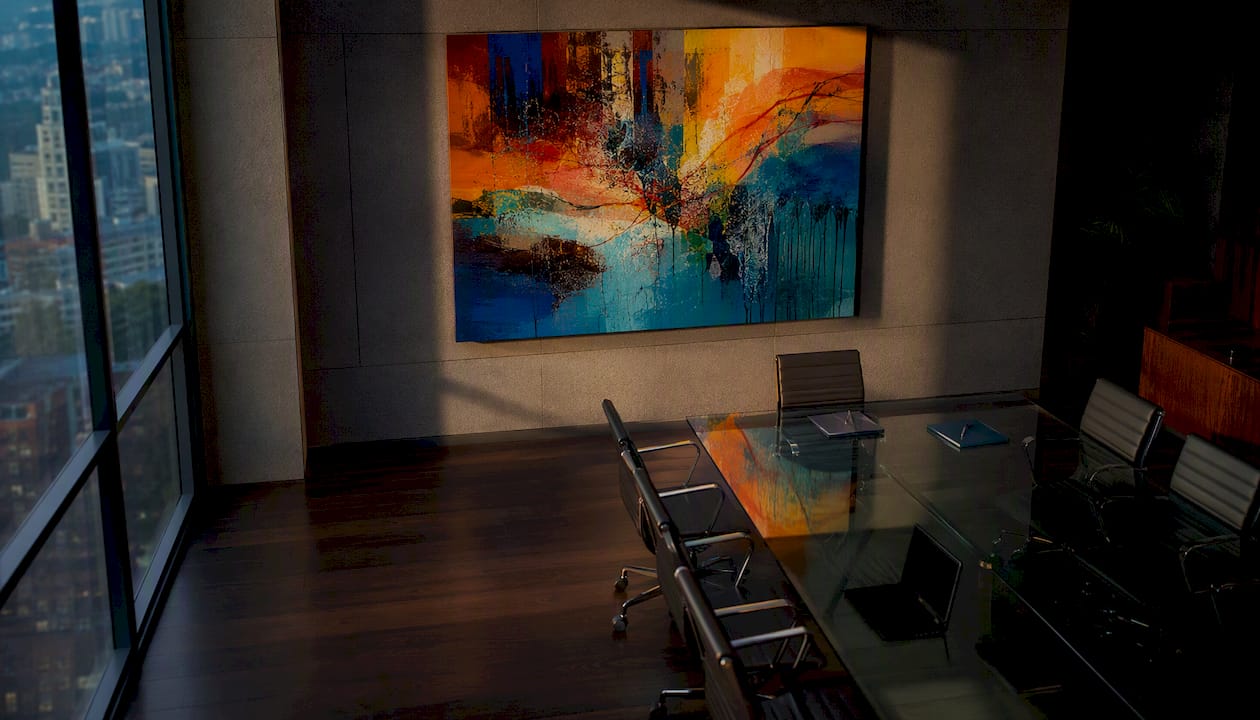
Limited-edition prints occupy the middle ground. They retain some scarcity value, are easier to insure and replace, and can be rotated without significant financial risk. For most commercial programs, limited editions are the highest-impact option per dollar spent.
Mass-produced canvas prints, when chosen with a clear curatorial thesis, deliver strong visual results at a fraction of the cost. The quality gap between a well-produced canvas print and an original is invisible to most visitors. What matters is the image, the scale, and the placement, not the provenance.
Murals and site-specific commissions
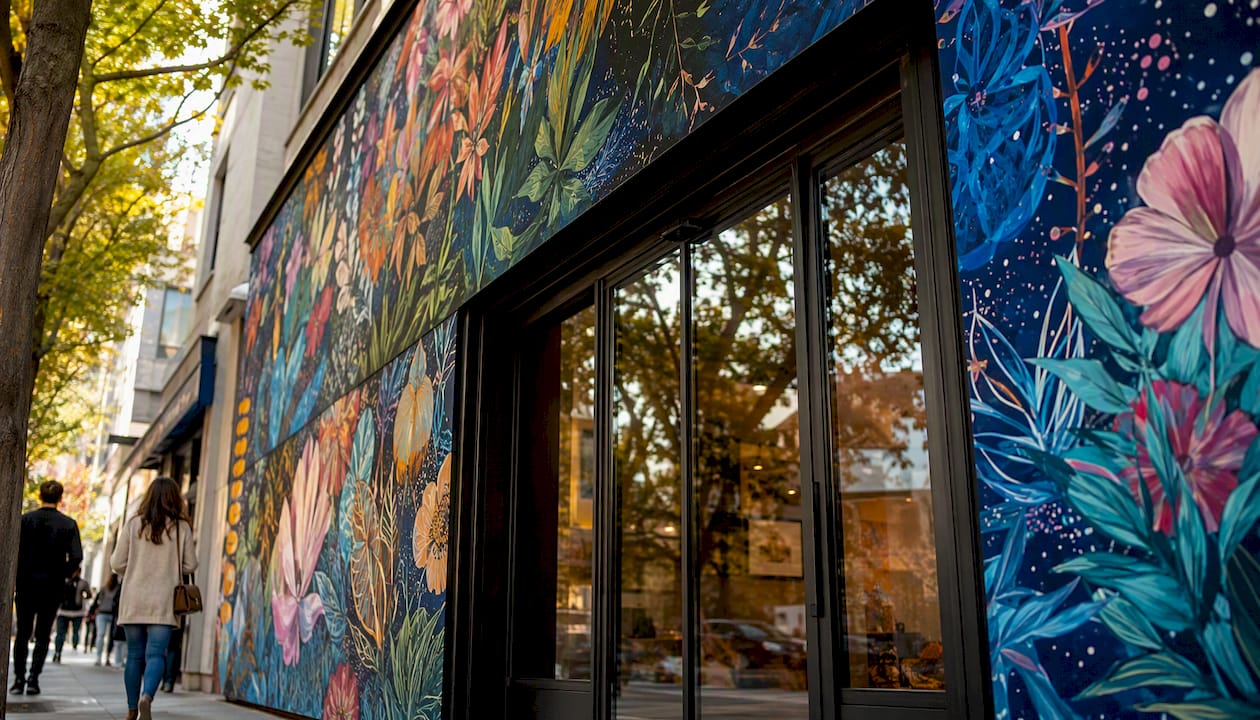
Murals are permanent brand statements. They work best when the brand story has a strong local or cultural dimension, and when the space is stable enough to justify a five-plus-year commitment. Commissioning a local artist creates authenticity that amplifies brand stories beyond aesthetics, particularly for brands whose identity is tied to community or place. The downside: murals are expensive to change and nearly impossible to move.
Digital displays and interactive media
Digital and AR-enabled installations add value in high-traffic retail environments, experiential showrooms, and event spaces where novelty and shareability are explicit goals. They tend to distract in professional services environments where the brand signal should be calm authority. Maintenance costs for digital displays are ongoing and often underestimated; budget for hardware refresh cycles of three to five years.
Maintenance and lifecycle notes
- Canvas prints: dust regularly, avoid direct sunlight, replace every five to eight years as colors shift.
- Murals: budget for touch-up every two to three years in high-traffic zones.
- Digital displays: factor in annual software and hardware maintenance at roughly 10–15% of installation cost.
- Originals: require professional conservation assessments every three to five years and appropriate climate control.
How does art integrate with environmental graphic design?
Environmental graphic design (EGD) covers the full system of signage, wayfinding, branded graphics, and spatial communication in a built environment. Art and EGD fail when they are planned separately and succeed when they share a visual language from the start.
The core principle is hierarchy. EGD carries functional information (where to go, what a space is called). Art carries emotional and cultural information (what this brand values, how it sees the world). When both layers use the same material palette, typographic restraint, and color logic, the space reads as coherent. When they compete, visitors feel visual noise without being able to name it.
Practical integration approaches:
- Murals as wayfinding. A large-scale mural at a corridor junction can orient visitors spatially while communicating brand narrative. The mural becomes a landmark (“turn left at the forest mural”) without a single directional sign.
- Brand motifs embedded in artworks. Commissioning artists to incorporate abstracted versions of brand marks, color fields, or typographic elements into their work creates continuity between the art program and the broader brand system.
- Material language consistency. If your EGD uses brushed aluminum and matte black, art frames and mounting hardware should follow the same logic. Mismatched materials break the visual system even when the art itself is strong.
Production considerations worth specifying early: substrate durability (canvas, aluminum, acrylic face-mount), UV protection for sun-exposed walls, anti-graffiti coatings for exterior or semi-public murals, and coordination between digital display specs and physical art dimensions when both appear in the same zone.
Art-led interior design that integrates EGD from the schematic phase consistently produces more coherent results than programs where art is added after the signage system is already installed.
How do you commission, buy, or license art for a commercial space?
Writing a commissioning brief
A good brief is one page. It should answer five questions:
- Who is the primary audience for this space (clients, employees, the public)?
- What is the brand thesis — the one idea this space should communicate?
- Where exactly will the work be placed, and what are the dimensional and lighting constraints?
- What medium, style, or subject matter is in or out of scope?
- Are there accessibility, cultural sensitivity, or content restrictions?
Keep the brief tight. Overly prescriptive briefs produce safe, forgettable work. Give artists a clear thesis and real creative latitude.
Budgeting by scale and medium
Budget ranges vary significantly by market and artist profile, but a useful working framework:
- Single canvas print (commercial quality, large format): $85–$500 depending on size and customization.
- Limited-edition print from an emerging artist: $500–$5,000 per work.
- Site-specific mural commission (mid-scale): $8,000–$40,000 including design, materials, and installation.
- Original works from established artists: $5,000 and up, with no ceiling.
Treat art spend as a mix of capital expenditure (permanent installations, originals) and operating expenditure (rotating prints, digital content licenses). The operating budget gives you flexibility to refresh without a capital approval cycle.
Timeline and roles
| Phase | Key roles | Typical duration |
|---|---|---|
| Brief and scoping | Brand lead, curator | 2–4 weeks |
| Artist/vendor selection | Brand lead, procurement | 3–6 weeks |
| Commission or production | Artist, project manager | 6 weeks |
| Installation | Facilities, installer | 1–5 days |
| Measurement baseline | Brand lead, operations | Ongoing |
Contract essentials
Every art procurement agreement should address:
- IP and licensing. Who owns the image rights? Can the brand use the work in marketing materials?
- Insurance. Who insures the work during transit and installation, and who carries ongoing coverage?
- Maintenance obligations. Is the artist or vendor responsible for any conservation or repair?
- Rotation and deaccession rights. Can the brand move, lend, or sell the work?
Questions to ask providers
- Can you show examples of work installed in spaces with a similar brand profile to ours?
- How do you handle scale and substrate decisions for the specific wall dimensions we have?
- What is your process if the installed work does not meet the brief?
- Do you carry professional liability insurance for installation?
- How do you handle IP licensing for commercial display and marketing use?
Art curation for interiors follows the same brief-writing logic whether you are working with a gallery, a studio, or a direct vendor.
How do you measure art’s impact on your brand?
Measurement is where most art programs fail. Not because the impact is absent, but because no one set a baseline before installation.
Priority KPIs to track:
- Dwell time in key zones (lobby, retail floor, breakout areas)
- NPS or CSAT scores, segmented by space or visit type
- Brand perception attributes from intercept surveys (words visitors associate with the brand)
- Event attendance and meeting duration for corporate collections
- Social amplification: organic posts, tags, and shares featuring the space
A three-step pilot measurement method:
- Baseline survey (two weeks before installation). Ask a sample of visitors or employees to rate the space on three to five brand attributes (e.g., “innovative,” “trustworthy,” “welcoming”) and record dwell time in the target zone using simple observational counts.
- Short-term pilot (four to eight weeks post-installation). Repeat the same survey and counts. Look for directional shifts, not statistical significance at this stage.
- Six-to-twelve-month follow-up. Run the full survey again and add any available commercial data (sales per square foot, lease renewal rates, employee retention in the relevant office).
Collecting data cheaply. A QR code near the artwork linking to a three-question survey costs nothing and captures real-time feedback. Observational dwell-time counts require one person with a clicker for two hours on a representative day. Neither requires a research budget.
Realistic expectations. Perception attributes shift within weeks. Dwell time and NPS move within one to three months. Commercial outcomes like lease premiums or retention improvements require a twelve-to-twenty-four-month horizon and consistent curation throughout.
What do real-world art programs actually achieve?
Large-scale corporate collection: cultural capital and long-term positioning
A global professional services firm builds a curated collection across its headquarters floors, commissioning works from artists whose practices connect to the firm’s geographic markets. The objective is to signal cultural sophistication and long-term thinking to senior clients. Over two years, the firm tracks longer average meeting durations in collection-adjacent conference rooms and higher event attendance for client receptions held in the collection spaces. The lesson: corporate art activations that communicate values without words produce engagement outcomes that are trackable with simple metrics.
Retail: placemaking and dwell time
A mid-size specialty retailer commissions a large-format mural for its flagship store entry, working with a local artist whose visual language echoes the brand’s nature-forward identity. The mural becomes a social media landmark: customers photograph it and tag the brand organically. Foot traffic to the store increases in the months following installation, and average transaction time in the mural-adjacent zone rises. The lesson: art that is genuinely site-specific and culturally connected generates earned media that paid advertising cannot replicate.
Workplace and coworking: employee engagement and wayfinding
A coworking operator installs a series of medium-format canvas works across its floor plates, each series themed to the neighborhood’s history and organized to orient members through the space. Members report higher satisfaction with the environment in post-installation surveys, and the art series becomes a navigation tool: “meet me by the harbor prints” replaces room numbers in casual communication. The lesson: art can carry wayfinding function without a single directional sign, and the impact of art on branding extends to how people feel about returning to a space.
What does the research actually say about art and brand perception?
The academic foundation for art in brand spaces is more specific than most practitioners realize.
Art infusion theory holds that the presence of visual art transfers its cultural associations, particularly luxury and prestige, to co-located products and brands. The working paper summarizing art infusion experiments demonstrates this effect across packaging, advertising, and product design contexts, and argues the transfer is partly automatic, not solely dependent on conscious appreciation of the artwork.
Where the evidence is thin: most art infusion studies use controlled lab settings with brief exposures. Real commercial spaces involve longer dwell times, social context, and competing stimuli. The direction of the effect is reliable; the magnitude in any specific deployment is not predictable from the research alone.
Practitioner takeaways from curatorial frameworks:
- Define a curatorial thesis before acquiring anything. The thesis ties subject matter, medium, and artist story back to brand positioning and becomes the rubric for every acquisition and rotation decision.
- Choose art perceived as high-culture or culturally specific to cue luxury and sophistication. Generic decorative art produces no measurable art infusion effect.
- The artist’s story and the display decisions (lighting, framing, placement) matter as much as the image itself. A poorly lit original underperforms a well-presented print.
- Early-stage integration of art into spatial planning, treating it as a structural anchor rather than a finish, consistently produces stronger outcomes than retrofitting art into a completed space.
Your commissioning checklist and questions to ask an art partner
Kickoff and procurement checklist
- Define your curatorial thesis in one sentence.
- Map all placement locations with dimensions, lighting conditions, and foot traffic levels.
- Set a total budget split between capital (permanent works) and operating (rotating or licensed works).
- Identify your internal decision-makers and their approval thresholds.
- Shortlist three to five artists, galleries, or vendors whose work aligns with the thesis.
- Issue a written brief to each shortlisted provider.
- Evaluate proposals against: brand thesis alignment, audience fit, budget/scale feasibility, and maintenance requirements.
- Negotiate IP, insurance, and rotation rights before signing.
- Coordinate installation with facilities at least four weeks in advance.
- Set your measurement baseline before the work goes up.
Ten questions to ask any art partner
- What is your process for understanding a brand before making recommendations?
- Can you provide references from commercial or workplace installations?
- How do you handle scale and substrate decisions for non-standard wall dimensions?
- What IP rights does the purchase or commission include for commercial display?
- Who is responsible for installation, and do you carry liability insurance for it?
- How do you handle a piece that does not meet the brief after delivery?
- What is your recommended maintenance schedule for the medium you are proposing?
- Can you support a rotating program, and what does that cost annually?
- How do you incorporate cultural or demographic considerations into your selections?
- What does your timeline look like from brief to installed work?
Decision rubric. Before approving any piece, check four things: Does it advance the curatorial thesis? Does it fit the audience who will see it daily? Is it within budget at the right scale? Can it be maintained without specialist intervention? If any answer is no, go back to the brief.
Why art deserves a line in the strategy budget, not the décor budget.
Most brand leaders I talk to treat art as a finish. Something that gets specified in the last two weeks of a fit-out, chosen by a committee with no brief, and installed without a measurement plan. The result is walls covered in pleasant, forgettable images that do nothing for the brand.
The research is clear that art infusion works. The practitioner evidence is equally clear that it works best when art is treated as infrastructure: planned early, briefed rigorously, and activated over time. The brands that get this right are not necessarily spending more. They are spending with a thesis.
The failure mode I see most often is decoration-by-committee: too many stakeholders, no curatorial point of view, and a final selection that offends no one and communicates nothing. The antidote is a single decision-maker with a clear brief and the authority to say no to safe choices.
For organizations with multiple locations, the scaling challenge is real. A curatorial thesis that works in a New York flagship may feel disconnected in a regional office. The solution is a flexible framework: a consistent brand thesis with locally sourced artists at each site. That approach produces coherence without uniformity, which is exactly what a distributed brand needs.
Sensecanvas: canvas art built for commercial spaces
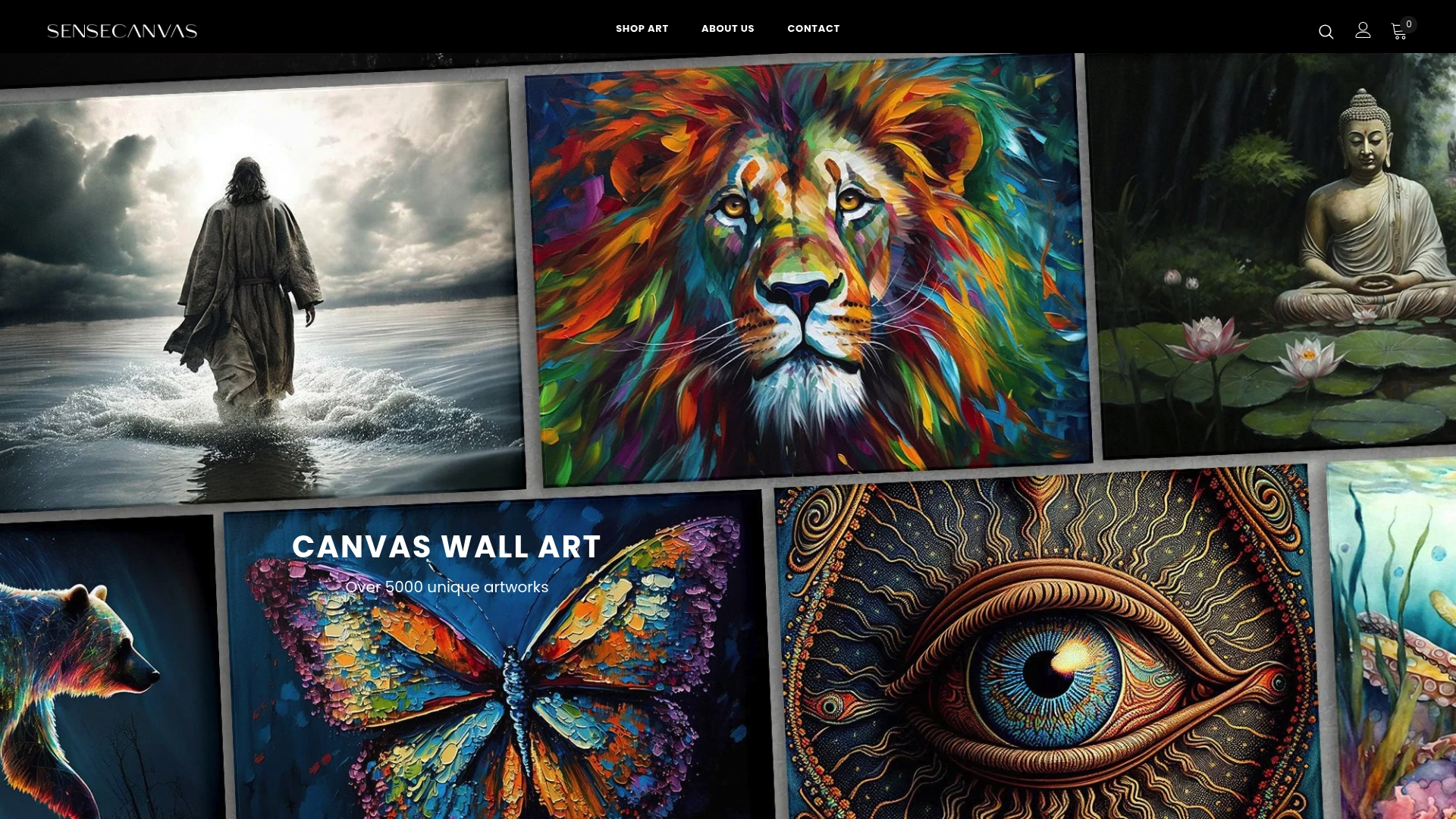
Finding art that actually fits a commercial brief, the right scale, the right finish, the right image, without a six-week procurement cycle, is harder than it should be. Sensecanvas offers over 15,000 canvas designs across abstract, nature, motivational, and thematic categories, all customizable by size and finish to match your specific wall dimensions and brand palette. Prices start at $85, which means you can pilot a single anchor piece before committing to a full program.
For business owners and office managers, the practical path is straightforward: browse by theme to find works that align with your curatorial thesis, order a sample size to check color and finish in your actual lighting conditions, then scale up. The full canvas collection covers the range from bold statement pieces for lobbies to quieter series works for corridors and meeting rooms. If you know your wall dimensions and brand direction, you can have a pilot piece ordered and on its way within a day.
Sources
- Art infusion: The influence of visual art on the perception and evaluation of consumer products
- Art Infusion research overview (working paper / summary)
- Artification and store performance (Sustainability, 2021)
- Cultural brand building in corporate spaces | Basa Studio
- The art you choose is your brand — No Walls Studio