Street Art on Canvas: A Buyer's Guide to the Style
Street art on canvas is the studio adaptation of public urban art techniques, spray paint, stenciling, wheatpaste layering, translated onto a stretched surface for indoor display. Two things set it apart from a generic graphic print. First, the visual cues: deliberate drips, layered textures, and stencil edges that mimic a concrete wall rather than a flat digital design. Second, provenance: an authentic piece comes from an artist’s studio practice, not a mass print run, which is why institutions like Tate treat the genre as a serious extension of public art rather than decor with a graffiti filter.
- Visual cues: stenciled crispness, intentional overspray, textured surfaces that read like brick or pavement.
- Provenance cues: signed editions, documented materials, and a traceable link back to the artist’s practice.
Key Takeaways
Street art on canvas works as a genre because it preserves the visual rawness of public urban art, drips, texture, stencil crispness, while trading a wall’s impermanence for a piece that lasts.
| Point | Details |
|---|---|
| Definition | Street art on canvas adapts public techniques like spray paint and stenciling for studio display. |
| Graffiti vs. street art | Graffiti is text and tag driven; street art is image driven and reads instantly to a general audience. |
| Spot an original | Check for visible texture, hand signatures, edition numbers, and provenance documents. |
| Display carefully | Avoid direct sunlight and humid rooms; use UV-protective varnish on heavily inked pieces. |
| Where to buy customizable pieces | Sensecanvas offers gallery-ready, street-art-style canvases starting at $85 with size and finish customization. |
Table of Contents
- What Is Street Art on Canvas, Exactly?
- How Street-Art Techniques Translate to Canvas
- What Street Art on Canvas Actually Looks Like
- Original Studio Work vs. Mass-Produced Prints
- Hanging and Caring for Street-Art-Style Canvases
- Bring That Energy Into Your Own Space
- Frequently Asked Questions
- Sources
What Is Street Art on Canvas, Exactly?
Street art on canvas didn’t start as a marketing category. It started as artists who’d spent years working walls, fences, and rail cars deciding they wanted a version of that work that could survive a decade indoors without being buffed by a city crew. The migration from public surfaces into galleries and private collections picked up momentum through the 1980s and accelerated once collectors realized these pieces held up as serious art, not novelty. Curators at institutions like the Straat Museum frame this shift as an evolution rather than a compromise: the canvas gives artists time and permanence while the work keeps its instinct for public, unfiltered visual commentary.
Street art and graffiti get lumped together constantly, but they’re not the same thing.
- Graffiti centers on lettering, tags, and stylized text, often coded for a specific subculture.
- Street art leans on imagery, stencils, and symbols meant to read instantly to a general audience.
- Graffiti’s roots are tied to identity and territory; street art often carries a message, joke, or critique.
- On canvas, the two frequently blend, but a knowledgeable buyer can usually tell which tradition a piece draws from more heavily.
Pro Tip: Before buying, ask the seller for basic provenance: the artist’s name, the year the piece was made, the materials used, and whether it’s a one-off or part of an edition. A seller who can’t answer those questions in a sentence probably doesn’t know the piece’s history either.
How Street-Art Techniques Translate to Canvas
Artists don’t just swap a brick wall for a canvas and call it done. Each tool carries over with adjustments for a smaller, more controlled surface.
- Spray cans for gradients, atmospheric backgrounds, and fast coverage.
- Stencils for crisp, repeatable graphic shapes and portraiture.
- Paint markers for fine linework, tags, and detail work over spray layers.
- Rollers for flat background fields that mimic a fresh coat on a wall.
- Texture paste or sand mixed into paint to simulate the relief of concrete or brick before any color goes down.
| Material | Typical Use | Studio Consideration |
|---|---|---|
| Spray paint | Backgrounds, gradients, atmospheric depth | Needs ventilation and multiple thin coats to avoid pooling |
| Acrylic paint | Detail work, layering, mixed media base | Dries fast, allows heavy texture buildup |
| Paint markers | Fine lines, tags, precise accents | Best applied over a fully dry base layer |
Artists working this style often skip standard gesso altogether because it’s too thin to hold the relief they want. Instead, they build up sand or heavy texture paste first, so the surface actually absorbs paint the way a rough wall would.
Pro Tip: A “happy accident,” a drip that runs slightly off course, a spot of overspray at a stencil’s edge, isn’t a flaw in this genre. It’s evidence of process. Studios that over-clean these marks in the name of polish end up with something that looks like a poster, not a painting.
What Street Art on Canvas Actually Looks Like
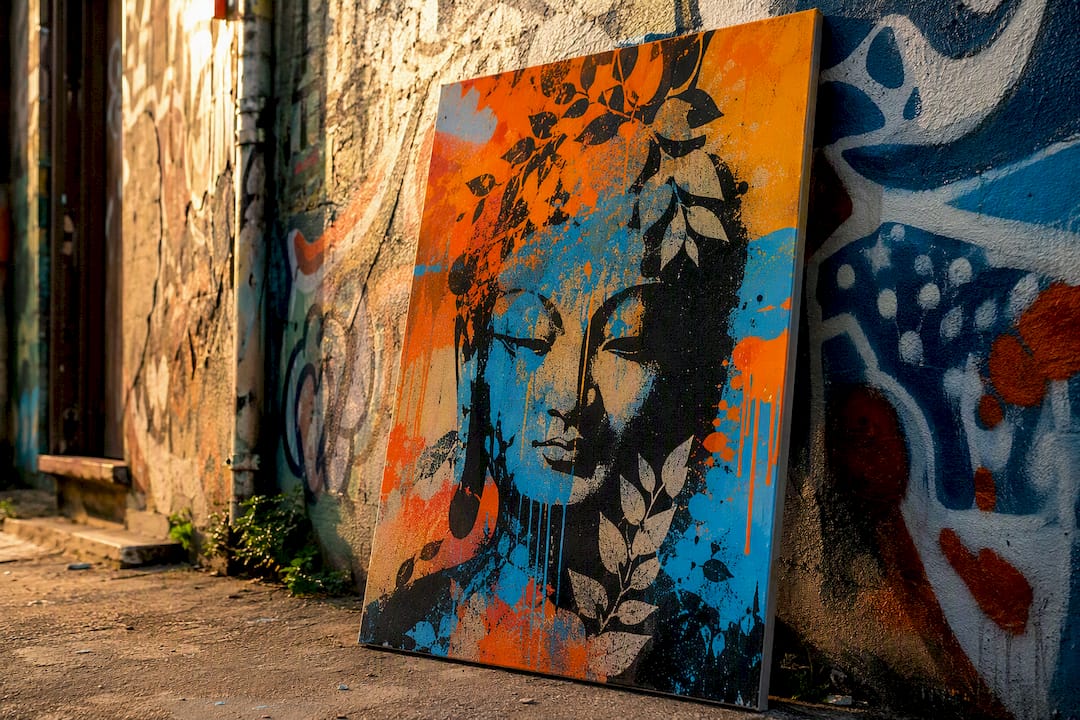
Picture a wall, then picture that wall’s energy compressed onto a four-foot rectangle. That’s the visual target. Bold, layered color fields sit next to sharp black stencil work. Drips run down from letters or figures like they were caught mid-motion. Surfaces often carry visible texture, built-up ridges and rough patches that catch light differently than a flat print.
A handful of names define the visual vocabulary most buyers reference, whether they know it or not:
- Banksy — stencil-driven, satirical imagery with crisp black-and-white contrast and social commentary baked into the composition.
- Shepard Fairey — bold, poster-style propaganda aesthetics, heavy use of red, black, and cream, and repeated iconography.
- Futura 2000 — abstract, atomized spray work with sweeping arcs and a painterly, almost cosmic sense of movement rather than representational imagery.
In the market, you’ll typically encounter three formats: limited-edition stencil prints signed and numbered by the artist, original mixed-media canvases built entirely by hand, and mural-to-canvas studies where an artist reworks a public piece at gallery scale.
Original Studio Work vs. Mass-Produced Prints
This is where buyers get burned most often. A flat, perfectly even surface with no texture at all is a strong signal you’re looking at a print, not a painting. Run your fingers lightly across a genuine mixed-media piece and you should feel actual ridges from paint layers or texture paste.
Before buying, check for these signals:
- Surface texture: visible brush or spray buildup versus a smooth, uniform print surface.
- Signature and edition numbers: originals are typically signed by hand; editions state a specific run size (like 45/100).
- Provenance documents: a certificate of authenticity, gallery invoice, or direct studio record.
- Edge inspection: stencil edges on an original show slight, human irregularity; a printed reproduction shows mechanically perfect lines.
Ask the seller directly: What materials were used? Was any part of the image transferred rather than painted? If it’s an edition, how large is the run? A dealer who hesitates on these basics is a red flag.
Pro Tip: Carry a small magnifier when shopping in person. Genuine spray and stencil work shows tiny, organic variations at the edges, real paint has texture even under magnification. If something looks suspiciously uniform at 10x zoom, or if you’re weighing a purchase above a few thousand dollars, it’s worth paying for a professional authentication before you commit.
Hanging and Caring for Street-Art-Style Canvases
These pieces are more sensitive to environment than a standard print because of their heavy pigment loads and built-up textures.
- Do keep the piece out of direct sunlight; spray paint and acrylic pigments fade faster than oils under UV exposure.
- Do consider a UV-protective varnish for heavily inked or spray-based works.
- Don’t hang in bathrooms or other high-humidity rooms, especially if the piece includes texture paste or collage elements.
- Don’t wipe a textured surface with a wet cloth. Dry, soft dusting is the safer default.
If a piece includes fragile collage elements, unstable texture buildup, or represents a significant investment, a conservator should handle any cleaning or stabilization. For scaling these pieces into a room without overwhelming it, pairing bold canvases with the right sense of proportion matters as much as the art itself, and thinking through wall placement and adjacent fixtures, including how interior doors and trim frame a room, helps the piece breathe rather than compete with its surroundings.
How Sense Approaches Street-Art-Style Wall Decor
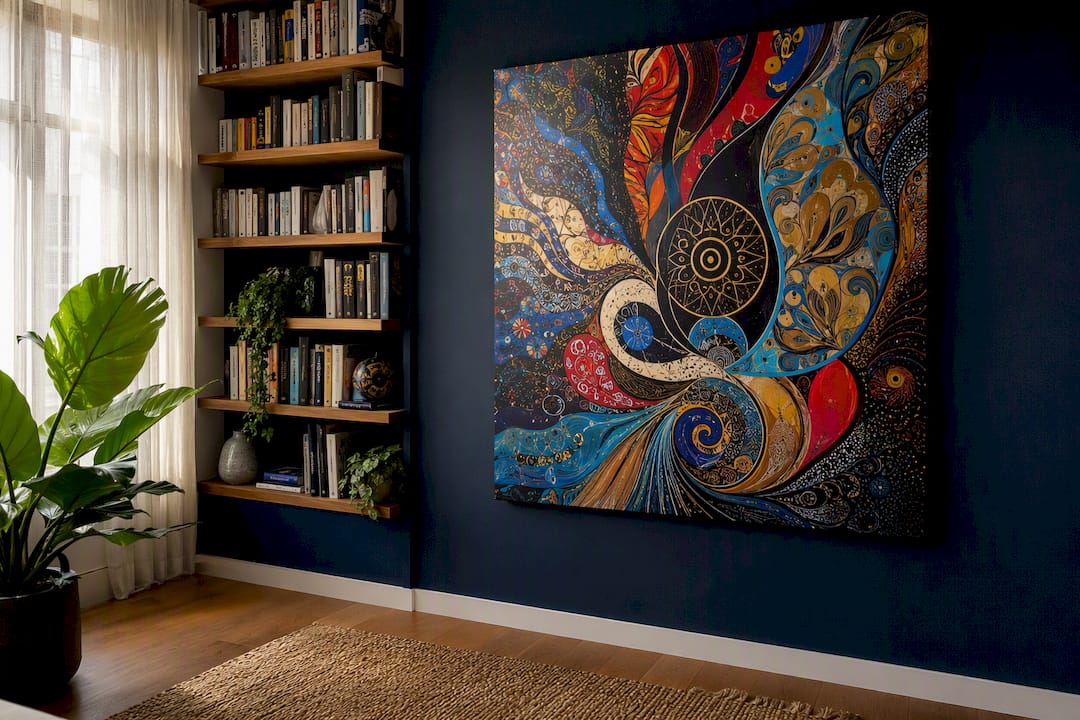
We built our street-art-inspired collection around one idea: the energy has to survive the trip from wall to living room. That means bold color, visible layering, and textures that don’t get sanded down for the sake of looking “clean.” Buyers can customize size, framing, and finish to fit a specific wall or aesthetic without losing what made the style work in the first place. With more than 15,000 designs in the catalog, there’s enough range to find a piece that reads as urban and intentional rather than generic.
Bring That Energy Into Your Own Space
If you want gallery-ready, street-art-style wall decor without hunting down an original or gambling on a print’s authenticity, Sensecanvas gives you a customizable, ready-to-hang option starting at $85, with sizing built to fit your actual wall instead of a standard frame size.

Bold, graphic pieces like the Poker Cards canvas or the Bitcoin canvas show how pop-culture imagery and street-art-adjacent boldness translate into finished wall pieces. If your space leans toward texture and depth over flat graphics, layering techniques for bold decor can guide how a piece interacts with your existing wall setup. Head to the Sensecanvas catalog, pick a size, and customize a piece that fits your wall today.
Frequently Asked Questions
Is street art on canvas the same as a graffiti print? Not quite. Graffiti prints usually reproduce lettering or tags, while street art on canvas leans on imagery, stencils, and accessible visual messages, though the two traditions often overlap in a single piece.
Do I need special care for a heavily textured canvas? Keep it out of direct sunlight and humid rooms, and skip wet cleaning. Dry dusting is safest, and a conservator should handle anything with fragile collage or paste elements.
How can I tell if a piece is a real original and not a print? Look for physical texture you can feel, a hand signature, an edition number if applicable, and provenance documents from the seller or gallery.
Is unsanctioned public street art legal to reproduce on canvas? That depends on copyright and the artist’s own rights to their imagery. Studio-made canvases sold through legitimate galleries or platforms are a separate, sanctioned category from unsanctioned public work.
Can I get a custom size for a street-art-style canvas? Yes. Retailers like Sensecanvas let buyers select specific dimensions and finishes so a bold, textured piece fits a particular wall rather than a standard frame size.