Why Celestial Art Themes Trend in 2026: The Full Story
Celestial art themes are surging in 2026 for reasons that go well beyond aesthetics. The core drivers are:
- Cultural escapism: Gen Z and Millennials are turning to cosmic imagery as a counterweight to digital overload, climate anxiety, and rapid technological change.
- Ancient symbolism meets futurism: Stars, moons, and zodiac motifs carry thousands of years of meaning, yet they slot naturally into sci-fi-inflected, forward-looking visual culture.
- Measurable market momentum: Moon phase wall decor searches grew 63% year-over-year on major print-on-demand platforms as of May 2026.
- Social media amplification: Pinterest officially designated “Extra Celestial” as a top 2026 trend, with searches for related styles like “alien core” up 80% and “opalescent” textures up 115%.
- Wellness and spirituality: The mindfulness movement has made cosmic symbolism feel personally meaningful, not just decorative.
Each of these threads connects to something deeper. The rest of this article traces where celestial art came from, how it evolved, and exactly why it resonates so powerfully right now.
How ancient cultures built the foundation for celestial art
The roots of celestial art run far older than most people realize. The Roman lunula, a crescent-shaped amulet, has archaeological evidence dating back to the fourth millennium BC, with examples preserved today at the Metropolitan Museum of Art, the Victoria and Albert Museum, and the National Archaeological Museum in Athens. Associated with fertility, protection, and the rhythms of the female body, it was one of the earliest known uses of a celestial motif as wearable meaning.
Across cultures, the pattern repeats. Ancient Egyptians painted constellations on pyramid walls. Babylonian scholars mapped the heavens and embedded that knowledge into art and architecture. Islamic astronomical traditions, rich with geometric star patterns, shaped centuries of visual culture across the Middle East and North Africa, a legacy that continues to influence contemporary designers.

What these traditions share is the use of cosmic imagery to express things that resist ordinary language: protection, destiny, the passage of time, and the desire to belong to something larger than oneself. That function has never gone away. It just keeps finding new forms.
How celestial themes evolved through the major art periods
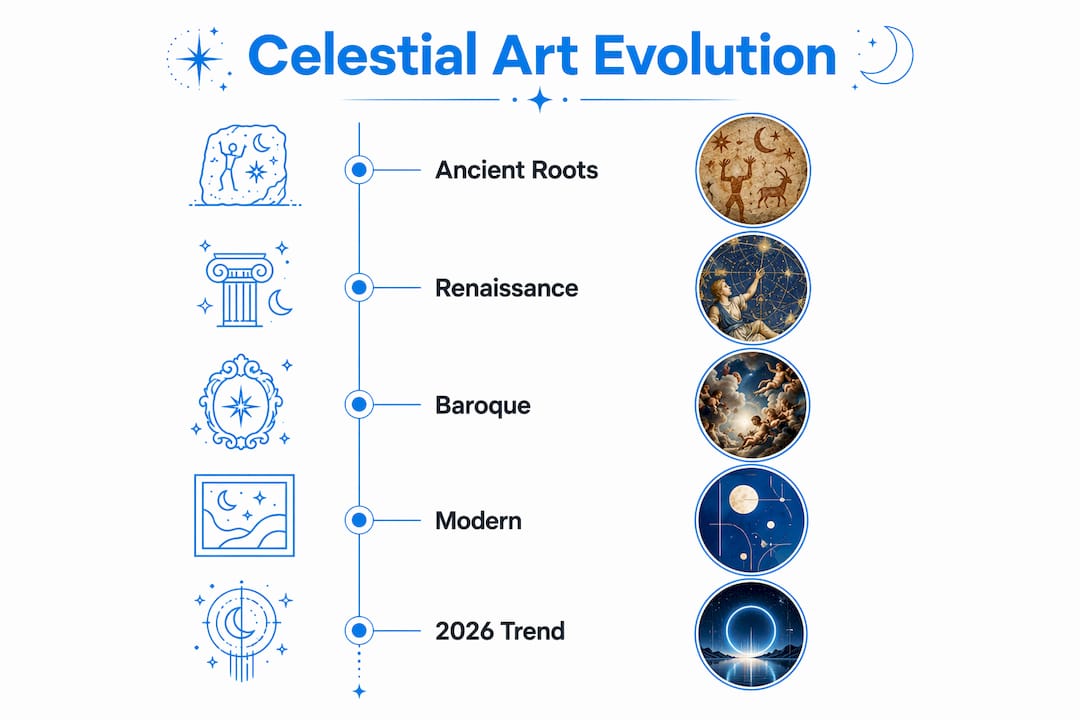
The story of celestial art across Western art history is one of shifting motivations, from scientific curiosity to theatrical grandeur to raw emotional expression.
Renaissance
The Renaissance fused artistic ambition with scientific inquiry. The development of the telescope in the 17th century gave artists access to celestial detail that earlier generations could only imagine. Planetary depictions became more accurate, and the cosmos entered painting as a subject worthy of serious intellectual attention, not just religious allegory.
Baroque
Baroque artists used celestial imagery theatrically. The heavens became a stage for divine drama, with light pouring from above and figures reaching upward into luminous skies. The symbolism was deliberate and emotionally charged, designed to overwhelm the viewer with the scale and power of the cosmos.
Romanticism
Romanticism brought the night sky into the emotional interior. Artists like Vincent van Gogh treated the cosmos not as a scientific subject or a divine backdrop, but as a mirror for human feeling. Starry Night (1889) remains the most cited example: its turbulent, swirling forms express awe, longing, and the vertiginous sense of being small against something infinite.
- Renaissance: Scientific accuracy meets symbolic depth; celestial bodies as objects of knowledge.
- Baroque: Theatrical light and divine drama; the heavens as a source of awe and power.
- Romanticism: Emotional and mystical engagement; the night sky as a reflection of inner life.
- 20th century: Space exploration imagery enters art directly. Cartier created “Sputnik” earrings after the 1957 satellite launch; Ilias Lalaounis commemorated the Apollo 11 moon landing with gold-and-ruby drop earrings commissioned by Aristotle Onassis.
What drives the modern celestial aesthetic right now
Contemporary celestial art has moved decisively away from the literal, heavy-handed cosmic imagery of the 1970s and 1990s. The current aesthetic favors subtlety, narrative depth, and technical finesse.
Materials and craft
Lab-grown diamonds now account for roughly half of all stones used in celestial-themed jewelry. Blackened metals, black rhodium plating, oxidized silver, and acid etching create depth and contrast that evoke a night sky without spelling it out. These choices reflect a broader shift: celestial motifs as sophisticated design language, not costume.
Intentionality in home decor
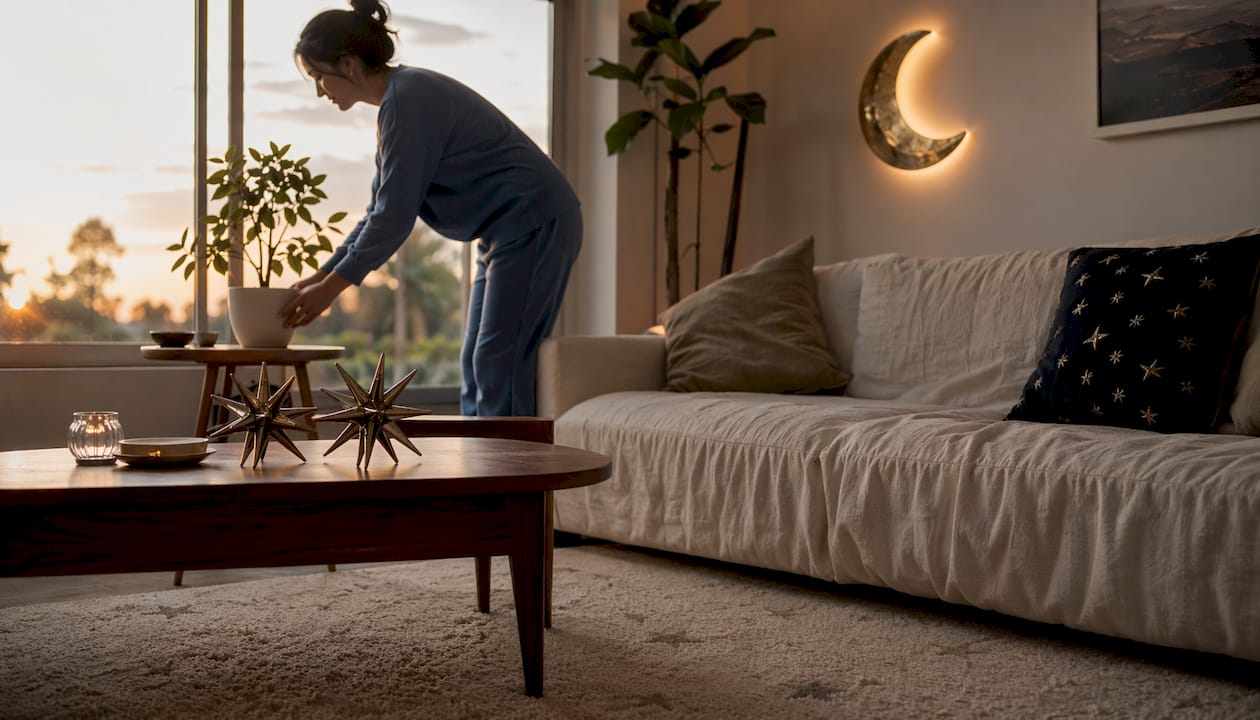
Interior designers in 2026 recommend using celestial motifs as accent elements rather than dominant patterns. A brass starburst mirror, moon-shaped sconces, or star-etched hardware can carry the theme without overwhelming a room. As Austin-based designer Sarah Stacey puts it: “You don’t need a whole night sky constellation map across your ceiling. One piece is enough. Let it be something someone notices unexpectedly.”
Cultural depth
Modern designers draw from Islamic, Nordic, and Celtic astronomical traditions, blending them with minimalism and personal storytelling. The result feels globally informed rather than culturally generic. Zodiac-specific constellation pieces, moon-phase motifs tied to personal transformation, and star imagery linked to guidance and aspiration all give buyers a way to wear or display something that means something specific to them.
Pro Tip: When incorporating celestial art into a room, choose one statement piece with genuine craft behind it, such as a moon-phase canvas or a starburst mirror, rather than scattering multiple literal motifs. The restraint is what makes it feel intentional.
What the 2026 trend data actually shows
The numbers behind celestial art’s current popularity are striking, and they reveal something interesting about where the trend stands in its cycle.
| Metric | Data point | Source |
|---|---|---|
| Moon phase wall decor search growth | 63% year-over-year (may 2026) | Printful 2026 platform data |
| Pinterest “alien core” search growth | 80% increase | Pinterest Predicts 2026 |
| Pinterest “opalescent” texture searches | 115% increase | Pinterest Predicts 2026 |
| Mytheresa fine jewelry category growth | Triple-digit rates, celestial pieces leading | Financial Times, 2026 |
The gap between print-on-demand platform data and broader analytics tools is telling. Major POD platforms show celestial designs as a high-momentum category, while mainstream analytics tools give the trend only passing mentions. That gap signals an early-mover window: consumer demand is running ahead of seller-side competition.
The cultural context behind the numbers matters too. Trend analysts connect the celestial surge directly to the pressures of digital life, AI-generated environments, and climate anxiety, particularly among younger demographics. Space has always represented hope and reinvention. In 2026, it also represents a visual escape from a world that feels relentlessly technical. The “Extra Celestial” aesthetic on Pinterest captures this precisely: it merges sci-fi glamour with age-old cosmic symbols to create something that feels both futuristic and deeply human. You can see this same appetite for 2026 interior art trends playing out across home decor categories more broadly.
Who is actually buying and engaging with celestial art in 2026
The primary audiences for celestial art in 2026 skew younger, but the demographic picture is more layered than a simple Gen Z story.
Gen Z and Millennials are the most visible drivers. Pinterest’s “Extra Celestial” trend prediction explicitly names these two groups as the core audience, drawn to sci-fi aesthetics, fluid identity expression, and the emotional charge of cosmic imagery. For these buyers, celestial art is personal. Moon-phase prints tied to transformation, constellation pieces linked to specific astrological signs, and zodiac-themed home decor all offer a way to make a space feel like a reflection of who they are.
Wellness and spirituality communities represent a distinct but overlapping segment. The rise of mindfulness culture, astrology apps, and spiritual self-care practices has created a large audience that sees celestial motifs as carriers of genuine meaning, not just visual style. Moon symbolism tied to cycles and renewal, star imagery linked to guidance, and sun motifs connected to vitality all resonate with this group.
Luxury consumers are a third force. The triple-digit growth in fine jewelry at platforms like Mytheresa, with celestial pieces leading, points to a high-end audience seeking timeless investment pieces. For them, the appeal is the combination of ancient symbolism with contemporary craft, something that feels both classic and current.
Home decorators and interior design enthusiasts round out the picture. The celestial home decor trend cuts across age groups, appealing to anyone drawn to moody, atmospheric interiors with deep blues, warm golds, and metallic finishes. Opalescent finishes and iridescent textures, which saw a 115% search increase on Pinterest, are particularly popular with this audience. For a sense of how these aesthetics translate into wall art, the visual language of opalescent design trends offers useful context.
Bring celestial art into your space with Sensecanvas
Celestial art belongs on your walls, not just on your mood board. Sensecanvas offers over 15,000 canvas art pieces, including celestial and cosmic themes, with custom sizing and prices starting at $85. Every piece ships ready to hang, with vivid print quality that holds up in any room.
Explore the full collection at Sensecanvas and find the piece that fits your space.
Key Takeaways
Celestial art themes are trending in 2026 because they fuse ancient cosmic symbolism with contemporary escapism, wellness culture, and measurable consumer demand across demographics.
| Point | Details |
|---|---|
| Ancient roots drive modern resonance | Celestial motifs like the Roman lunula date to the fourth millennium BC, giving them symbolic weight that purely decorative trends lack. |
| 63% search growth confirms momentum | Moon phase wall decor searches have shown a significant year-over-year increase on major print-on-demand platforms as of May 2026, signaling strong momentum. |
| Subtlety defines the 2026 aesthetic | Contemporary celestial art favors accent pieces and sophisticated materials over literal, dominant cosmic patterns. |
| Gen Z and Millennials lead demand | Pinterest’s “Extra Celestial” trend explicitly names these groups as the core audience, driven by escapism and identity expression. |
| Early-mover window still open | POD platform data outpaces mainstream analytics, signaling that seller-side competition has not yet caught up with consumer demand. |