The Role of Narrative in Themed Art, Explained
Narrative gives a theme its story. It takes a subject like “loss” or “nature” and turns it into a specific sequence of events with an emotional arc, using visual devices that guide your eye through a moment compressed into a single frame or space. Theme tells you what a piece is about. Narrative tells you how that meaning actually happens on the canvas.
Three techniques do most of the work:
- Composition and sequencing direct where your eye lands first and what it reads next.
- Symbol and metaphor compress backstory into a single object or gesture.
- Point of view and framing decide who is narrating and what gets left out.
The sections below walk through how to spot these devices, the historical and contemporary works that use them best, and a five-step method for reading (or choosing) narrative-rich art in your own space.
Key Takeaways
Narrative turns a theme into a lived story by using composition, symbol, sequencing, and point of view to compress time into a single visual moment; for a unique perspective on how narrative framing enhances comprehension and engagement, see what are chess stories and why they boost your game.
| Point | Details |
|---|---|
| Theme vs. narrative | Theme is the subject; narrative is the specific sequence and emotional arc that tells it. |
| Six narrative modes | Monoscenic, continuous, synoptic, panoptic, progressive, and sequential each pace a story differently. |
| Composition drives reading | Eye-path, cropping, and framing act as sequencing tools even on a single static canvas. |
| Use the five-step method | Observe, identify theme, locate devices, infer sequence, then confirm with context or artist statement. |
| Sensecanvas curates for narrative | Over 15,000 designs and customizable pieces starting at $85 let you match composition to your space. |
Table of Contents
- What Is the Role of Narrative in Themed Art?
- What Are the Main Narrative Modes in Art?
- How Do Artists Build Narrative Visually?
- Narrative in Action: From Trajan’s Column to Modern Murals
- How Do You Read Narrative in a Piece of Art?
- How Sensecanvas Approaches Narrative-Rich Canvas Art
- Find Narrative-Rich Canvas Art for Your Space
- Why Narrative Matters in the Rooms We Actually Live In
- Sources
What Is the Role of Narrative in Themed Art?
Narrative in visual art is the mechanism that turns a theme into an experience. A theme is the subject, a concept like grief, ambition, or the ocean. Narrative is the specific story that theme gets told through: a sequence of events, a cause and effect, an emotional arc that unfolds even though you’re looking at a static image.
The National Museum of Women in the Arts frames it this way: a “nature” theme could sit flat as a landscape, or it could get narrated as a season-by-season transformation, where the story is change itself. That’s the whole distinction in one example. Theme is the noun. Narrative is the verb.
The compression trick: Painting and sculpture can’t unfold over minutes the way film does, so narrative art has to compress an entire sequence of time into one frozen composition. A single canvas has to imply a “before” and an “after” using nothing but what’s visible right now.
Scholars studying this compression problem argue that visual narrative depends less on anything resembling written sentences and more on how space itself gets composed. A Boston University essay on narrative and space makes the case that paintings “hold” a narrative moment through arrangement rather than unspooling it the way prose does.
A few quick contrasts make this concrete:
- A single figure staring out a window (theme: isolation) becomes narrative once you notice the discarded letter on the floor.
- A wolf in a forest (theme: wildness) becomes narrative once the composition shows it mid-chase, muscles coiled, prey just out of frame.
- A cracked vase (theme: mortality) becomes narrative once light falls specifically on the crack, implying the moment it happened.
Tate’s overview of narrative art adds a useful historical note: Western painting leaned heavily on stories audiences already knew, myth, scripture, history, so a single scene could trigger a whole narrative in the viewer’s head without showing all of it.
What Are the Main Narrative Modes in Art?
Once you know the vocabulary, you start seeing narrative structure everywhere, not just in obviously story-driven pieces. Art historians sort narrative art into a handful of recurring modes, and each one solves the “compress time into space” problem differently.
- Monoscenic shows a single moment from a story, trusting the viewer to know or infer what came before and after. A crucifixion painting is monoscenic: one scene, maximum emotional weight.
- Continuous repeats the same figure multiple times within one unified space to show a sequence of actions, the way a medieval manuscript might show a saint traveling, praying, and dying in a single landscape.
- Synoptic condenses several related events into one composition without repeating characters, letting background and foreground carry different moments simultaneously.
- Panoptic shows multiple distinct scenes side by side without repeating characters, closer to a grid of separate but related moments.
- Progressive builds a story forward across a fixed sequence, panel by panel, each one advancing the plot.
- Sequential relies on discrete, ordered panels the viewer reads in a fixed order, the mode comics and graphic novels depend on entirely.
The Wikipedia entry on narrative art traces this taxonomy back through simultaneous narration in antiquity, and it holds up well as a working reference for spotting modes in the wild.
Medium shapes which mode an artist reaches for. Murals and tapestries favor continuous and panoptic modes because they have wall-length real estate to spread scenes across. Comics and illustrated sequences favor sequential and progressive modes because panels are already built for order. Choosing a mode isn’t just style. It’s pacing. A monoscenic painting forces one gut-punch moment. A continuous or sequential piece paces the story out, giving the viewer time to build anticipation the way a page-turn does.
How Do Artists Build Narrative Visually?
Composition does the heaviest lifting. Where an artist places the horizon, the light source, or the strongest color against a muted background tells your eye where to look first and where to travel next. That eye-path is a sequence, even on a single static canvas, and it functions the same way sentence order functions in prose.
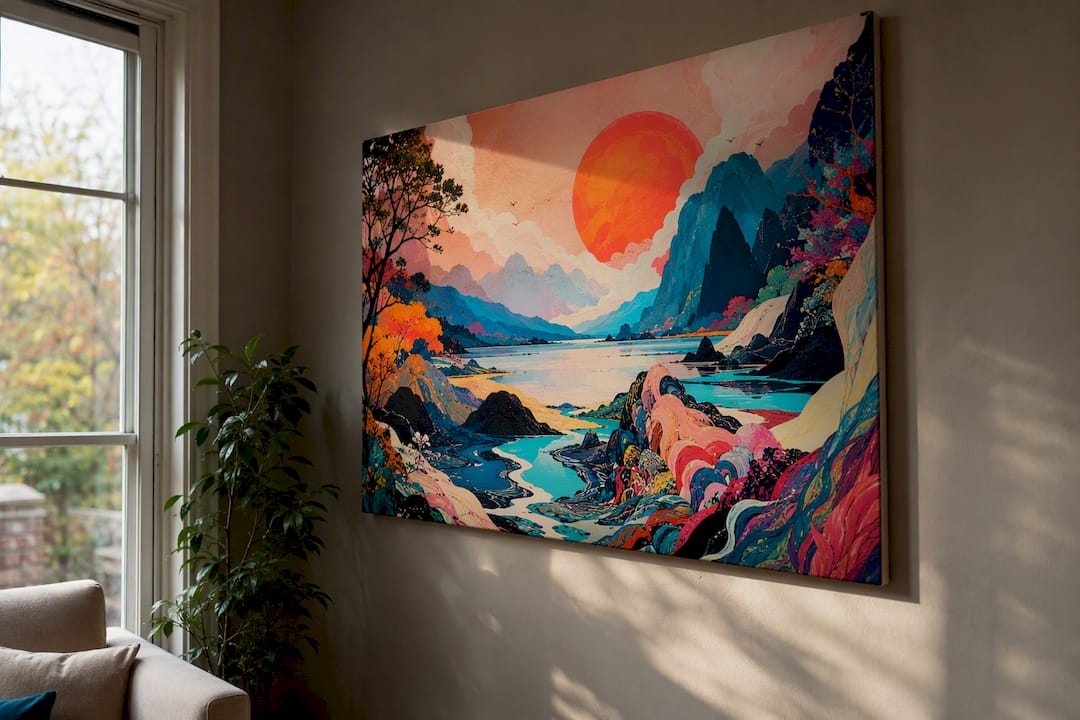
Symbol carries backstory without a caption. A skull means mortality across most Western traditions; a specific tattoo or object might mean something only to the artist and the one person who’d recognize it. Cultural symbols travel across audiences. Personal symbols reward close looking and research into the artist’s intent.
Color, light, and texture set pace and mood the way a film score does. A high-contrast, saturated palette reads as urgent or dramatic. A desaturated, evenly-lit scene reads as calm, memory, or aftermath. Rough, layered texture can imply chaos or time passing; smooth, flat color can imply stillness or control.
Point of view decides who’s narrating. A painting shot from above puts the viewer in a god’s-eye, detached position. A painting cropped tight on a face puts the viewer inside the emotion. Cropping itself implies action outside the frame, which is one of the sneakiest narrative tools available: what’s cut off matters as much as what’s shown.
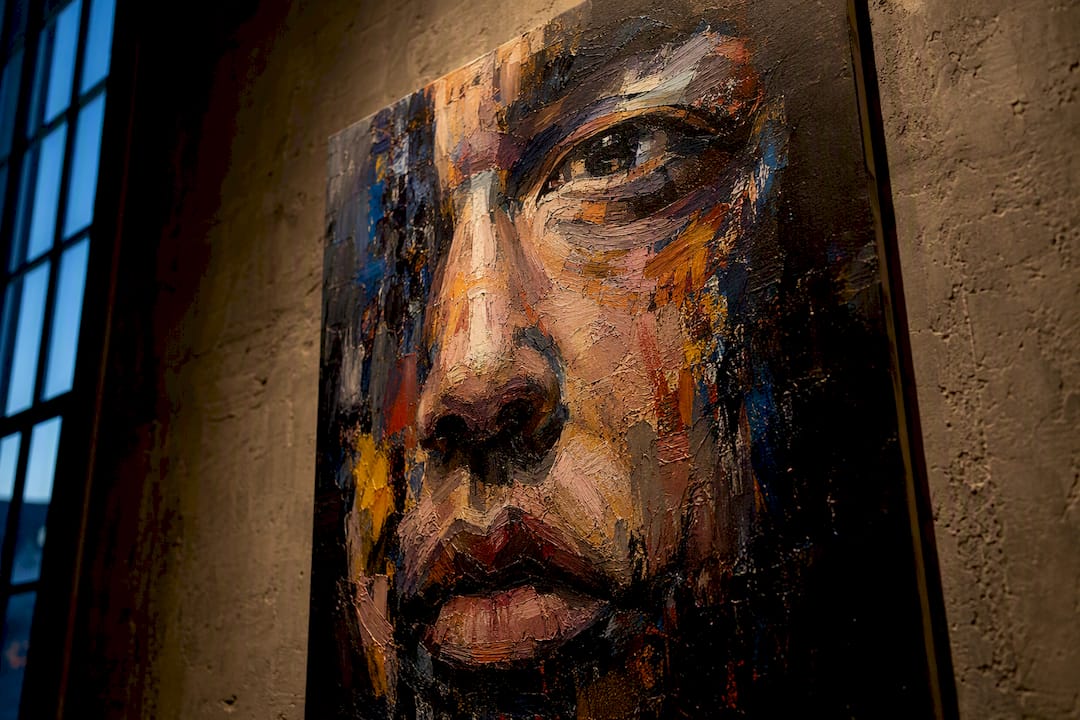
Sequencing devices, repetition, panels, montage, and layering, let artists imply time passing without literal timestamps. Repetition of a figure across a canvas (continuous mode) reads as movement. Layering translucent imagery reads as memory intruding on the present.
Space itself can narrate. Installations and themed environments build story through what you walk through, not just what you look at. Research on theme parks and thematic landscapes shows that most large-scale themed environments blend explicit storytelling (signage, characters) with implicit storytelling (props, pacing, sightlines) to create a unified narrative experience. Every object in the room is doing narrative work, whether it’s a theme park queue line or a single canvas hung at eye level in an entryway.
Pro Tip: Artists at the Royal Academy’s storytelling and composition resource use rough preliminary sketches to test how a composition’s rhythm affects the story before committing to final work. You can apply the same logic when picking art: sketch out (mentally or on paper) where your eye lands first in a room, then choose a piece whose composition supports that path instead of fighting it.
Narrative in Action: From Trajan’s Column to Modern Murals
Two ancient works show how differently narrative mode can shape the same instinct to tell a story in stone or paint.
- Trajan’s Column wraps a continuous spiral of relief carvings around its shaft, repeating the emperor’s figure dozens of times to narrate an entire military campaign as one unbroken sequence. Mode: continuous. Technique: repetition plus spatial compression of a multi-year campaign into a single object.
- Jacques-Louis David’s The Death of Socrates freezes one monoscenic moment, the philosopher mid-speech, cup in hand, disciples in visible anguish. Mode: monoscenic. Technique: composition and gesture do the narrating; nothing repeats, everything points to one instant.
Contemporary practice pushes the same modes into new territory.
- Large-scale murals depicting overlooked historical figures often work in a panoptic or synoptic register, placing multiple related scenes or symbols in one composition to correct a historical record the mainstream canon left out. Curators researching recent narrative-themed exhibitions note that the strongest contemporary narrative work tends to be revisionist or intensely personal, art that insists on a story the dominant version left out.
- Decisive-moment photography, the tradition built around catching one instant that implies everything before and after, operates almost entirely in monoscenic mode. A single frame, no repetition, no sequence, all narrative weight loaded onto composition and timing.
Mapping mode and technique onto specific artifacts like these is the fastest way to build the vocabulary permanently, rather than just recognizing “storytelling” in the abstract.
How Do You Read Narrative in a Piece of Art?
Reading narrative art isn’t guesswork once you have a method. Museum educators teach a version of this five-step approach, and it works whether you’re standing in a gallery or deciding what to hang above a couch.
- Observe the whole composition before focusing on any one detail. Note the strongest color, the brightest light, and where your eye lands first.
- Identify the subject or theme. What’s the general subject: a figure, a landscape, an abstract pattern?
- Locate the narrative devices. Look for repetition, symbols, framing choices, and cropped edges that imply action outside the frame.
- Infer the sequence or point of view. Ask what happened just before this moment, and whose perspective you’re seeing it from.
- Confirm with context. Check the title, artist statement, or cultural background to see whether your read matches the intended story.
When you’re evaluating a piece for your own space, four quick questions cut through most of the guesswork:
- Does this piece pull my eye somewhere specific, or does it feel static?
- What’s the one object or color doing the most narrative work here?
- Does the mood match the room’s actual function, or fight it?
- Would I still find something new in this piece after six months of walking past it?
The Getty’s teacher resource guide on narrative includes a classroom exercise worth stealing for personal use: pick any image and write a four-part story from it, beginning, middle, climax, and conclusion, using only visual clues. It works surprisingly well as a test for whether a piece you’re considering actually has narrative depth or is just decorative. If you can’t invent even a rough four-part story from it, the piece may be theme without narrative. For matching narrative art to an actual room, how wall art transforms a room walks through pairing composition and mood with specific spaces.
How Sensecanvas Approaches Narrative-Rich Canvas Art
Sensecanvas curates its catalog with composition and motif in mind, not just subject matter, because a themed piece only works as decor if the story reads clearly from across the room. That curation spans why art affects room mood and the role of art in home decor, both built to help you match narrative weight to a specific space.
- The catalog runs to over 15,000 designs, giving you real range across mode and mood.
- Customizable pieces start at $85, with sizing built around specific walls rather than one-size prints.
- Filters and blog guides help you narrow toward pieces with the composition or symbolism that actually fits your room’s story.
Find Narrative-Rich Canvas Art for Your Space
If you’ve made it this far, you already understand narrative better than most shoppers browsing wall art by color alone, and that puts you in a good position to choose a piece that actually holds up over years of daily looking. Sensecanvas is built around that same idea: a catalog organized by story and mood, not just subject tags, so you can shop by the composition and symbolism that fit your space rather than settling for whatever’s popular.

Browse the full collection at Sensecanvas to see how mode and composition play out across themes, or start with a specific example like the abstract ocean piece, a synoptic composition that layers motion and stillness in one frame. Every piece can be resized and customized to fit your wall, starting at $85. If you’re deciding between two pieces, use the five-step reading method above on each one first, then pick whichever one still gives you something new after the third or fourth look.
Why Narrative Matters in the Rooms We Actually Live In
Homes and offices are full of walls that say nothing. A narrative piece changes that instantly: a customer once described replacing a blank entryway with a continuous-mode forest scene, and the hallway stopped feeling like a pass-through and started feeling like a room with a story of its own.
— Sense