Art Budget for Businesses: Rules of Thumb and How to Set One
A practical art budget for most U.S. offices falls within a common range per square foot, or a moderate share of your total fit-out spend — and you can start sourcing immediately with options like Sensecanvas, where canvas prints begin at $85.
Here is a quick-reference starting point before you dig into the frameworks:
- Per square foot: $5–$20/sq ft for most commercial projects; basic acquisitions can run as low as $0.75–$1.75/sq ft
- Percent of fit-out: 3%–5% of your total design or renovation budget, including framing and installation
- Per employee: a typical planning figure for open-plan offices
- Per room: typical budgets vary by room type
An art budget for businesses is simply the planned spend a company sets aside to acquire, install, and maintain wall art in commercial spaces. It is not a budget for running an art business. Every dollar in this budget should serve a functional purpose: brand reinforcement, employee wellbeing, or client first impressions.
Table of Contents
- What are the main frameworks for setting an art budget?
- How much should each room get?
- How do you get strong visual impact on a tight budget?
- A ready-to-use checklist and template for ordering art
- Key Takeaways
- The case for treating art as a line item, not an afterthought
- Sensecanvas makes the reproducible-print side of your art budget easy
What are the main frameworks for setting an art budget?
Four methods cover most situations. The right one depends on how your project is scoped.
| Framework | Best for | Calculation | Limitation |
|---|---|---|---|
| Percent of fit-out | New builds or full renovations | A modest share of total design budget | Useless if no renovation is planned |
| Per square foot | Space-driven projects | A common range multiplied by total sq ft | Wide variation depending on style and quality |
| Per employee | Headcount-driven offices | Typical budget range multiplied by headcount | Misses high-traffic common areas |
| Per room | Targeted refreshes | Typical budgets by room type | Requires room-by-room planning |
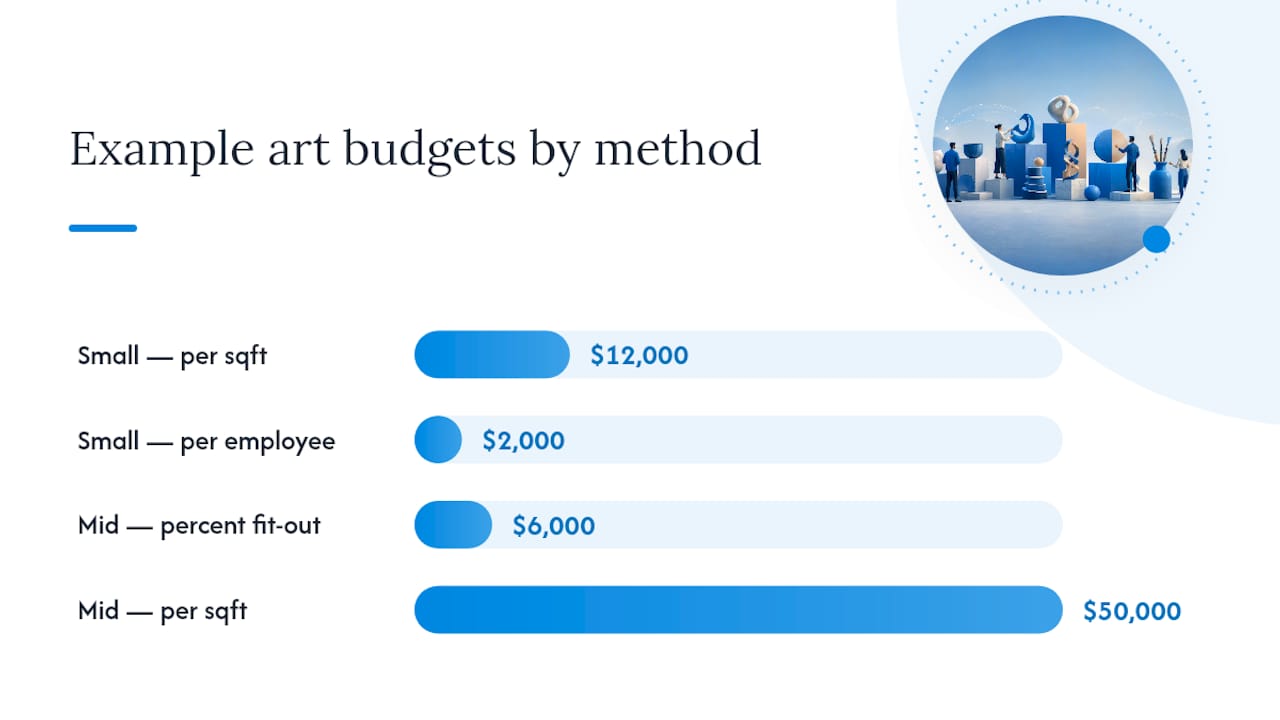
Worked example 1 — small office (1,200 sq ft, 8 employees): Using the per-sqft method at $10/sq ft gives a $12,000 total art budget. Cross-check with the per-employee method: 8 × $250 = $2,000. The gap tells you the per-employee figure works for workstations but not for a reception wall. Use the higher figure and allocate the difference to common areas.
Worked example 2 — mid-sized office (5,000 sq ft, renovation budget $200,000): 3% of $200,000 = $6,000. At $10/sq ft, the same space would suggest $50,000. The percent-of-fit-out method tends to underestimate art spend in design-forward offices. Use it as a floor, not a ceiling.
How much should each room get?
Allocate your budget by visibility, not by square footage. High-visibility zones should receive 40%–60% of total art spend, secondary zones 20%–30%, and 10%–20% should be held for rotation and replacement.
| Room | Budget range | Recommended piece size | Priority |
|---|---|---|---|
| Reception | — | 48×36 in. or larger focal piece | High |
| Boardroom | $500–$2,000 | 36×24 in. per wall; 2–3 pieces | High |
| Open-plan workstations | $150–$400/zone | 18×24 in. or gallery clusters | Medium |
| Private offices | $150–$500 | 24×18 in. single piece | Low |
| Corridors | $50–$200/piece | 12×16 in. or horizontal panoramics | Low |
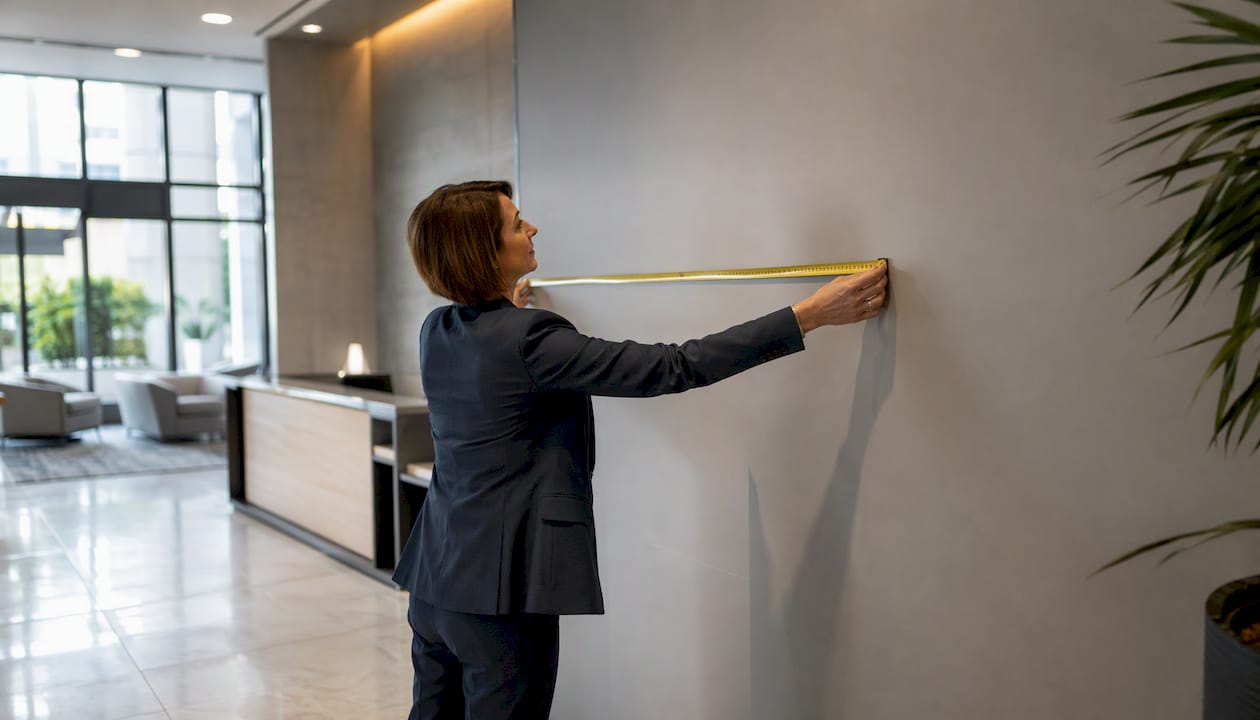
For reception specifically: measure the focal wall first. A wall that is 10 ft wide × 9 ft tall can carry a single 60×40-inch statement piece centered at eye level (57–60 inches from floor to center), with breathing room on all sides. Canvas art in reception areas works best when the piece fills 50%–75% of the wall width — anything smaller reads as an afterthought to a visiting client.
How do you get strong visual impact on a tight budget?
A constrained budget does not mean bare walls. These tactics consistently deliver high visual return per dollar:
- Art rental: Monthly fees run $38–$750+ per piece, which converts a large upfront purchase into a predictable operating expense. Useful for startups or offices in temporary spaces
- Gallery clusters: Three to five smaller prints arranged as a balanced gallery wall can fill a large surface for $200–$600 total
Pro Tip: For a $500 reception focal wall, one 48×36-inch canvas print ($150–$250) plus a simple floating frame ($80–$120) and professional installation ($75–$100) lands you a polished result under budget. The frame does most of the heavy lifting.
A ready-to-use checklist and template for ordering art
Copy this template into your procurement doc or purchase request:
- Room: _______________
- Wall dimensions (W × H): _______________
- Target budget for this wall: $_______________
- Preferred format: Print / Commission / Rental
- Material specs: Canvas / Paper / Mixed media; framed / unframed
- Deadline (art installed by): _______________
- Approver: _______________
- Installation notes: Surface type, weight limit, fire-code requirements
Pre-order checklist:
- [ ] Site survey completed and wall dimensions confirmed
- [ ] Mounting surface type identified (drywall, concrete, partition)
- [ ] Weight rating of wall verified with facilities
- [ ] Fire code and adhesive restrictions checked with building management
- [ ] Insurance quoted for pieces over $2,500
- [ ] Physical sample or proof approved before full order placed
- [ ] Stakeholder sign-off received (brand, HR, facilities)
- [ ] Installation scheduled and contractor confirmed
Save this template in your procurement folder alongside vendor quotes. Run through the checklist before every order, not just the first one.
Key Takeaways
A well-planned art budget allocates 3%–5% of fit-out spend or $5–$20 per square foot, including framing and installation, prioritizes high-visibility zones first, and combines commissioned statement pieces with reproducible prints to balance impact and cost.
| Point | Details |
|---|---|
| Core rule-of-thumb | Allocate 3%–5% of fit-out budget or $5–$20 per square foot, including framing and installation. |
| Prioritize by visibility | Put 40%–60% of art spend in high-visibility zones like reception and boardrooms first. |
| Mix commissions and prints | Commission one or two focal pieces; fill volume spaces with reproducible canvas prints to control cost. |
| Plan for ongoing costs | Reserve 5%–10% of purchase price annually for cleaning, replacement, and rotation. |
| Sensecanvas for prints | Sensecanvas offers over 15,000 customizable canvas designs starting at $85, covering the reproducible-print side of a mixed-sourcing strategy. |
The case for treating art as a line item, not an afterthought
Most offices I see treat art as the last item on the fit-out checklist — whatever is left after furniture, lighting, and AV gets spent on a few generic prints from a big-box store. That approach almost always produces spaces that feel unfinished, and it misses the actual function art serves in a commercial environment.
The real value of a structured art budget is not aesthetic. It is operational. A well-chosen reception piece shapes a client’s first impression before anyone says a word. A boardroom with art that inspires teams sets a different tone for a negotiation than bare walls do. These are measurable outcomes, not decoration.
The mixed-sourcing model described here works because it separates the two jobs art does in an office: statement pieces carry brand weight in focal zones, and reproducible prints deliver visual coverage at scale. Trying to commission everything is slow and expensive. Buying only prints misses the moments where a single strong piece would do more work than ten average ones.
Start with the frameworks, map your zones, and set a per-room figure before you browse anything. The checklist keeps the procurement honest.
Sensecanvas makes the reproducible-print side of your art budget easy
The hardest part of a mixed-sourcing strategy is finding a reliable source for high-quality reproducible prints in the exact sizes your walls need. Sensecanvas solves that directly: over 15,000 designs across abstract, nature, motivational, and specialty themes, all available in custom sizes and starting at $85 per canvas.
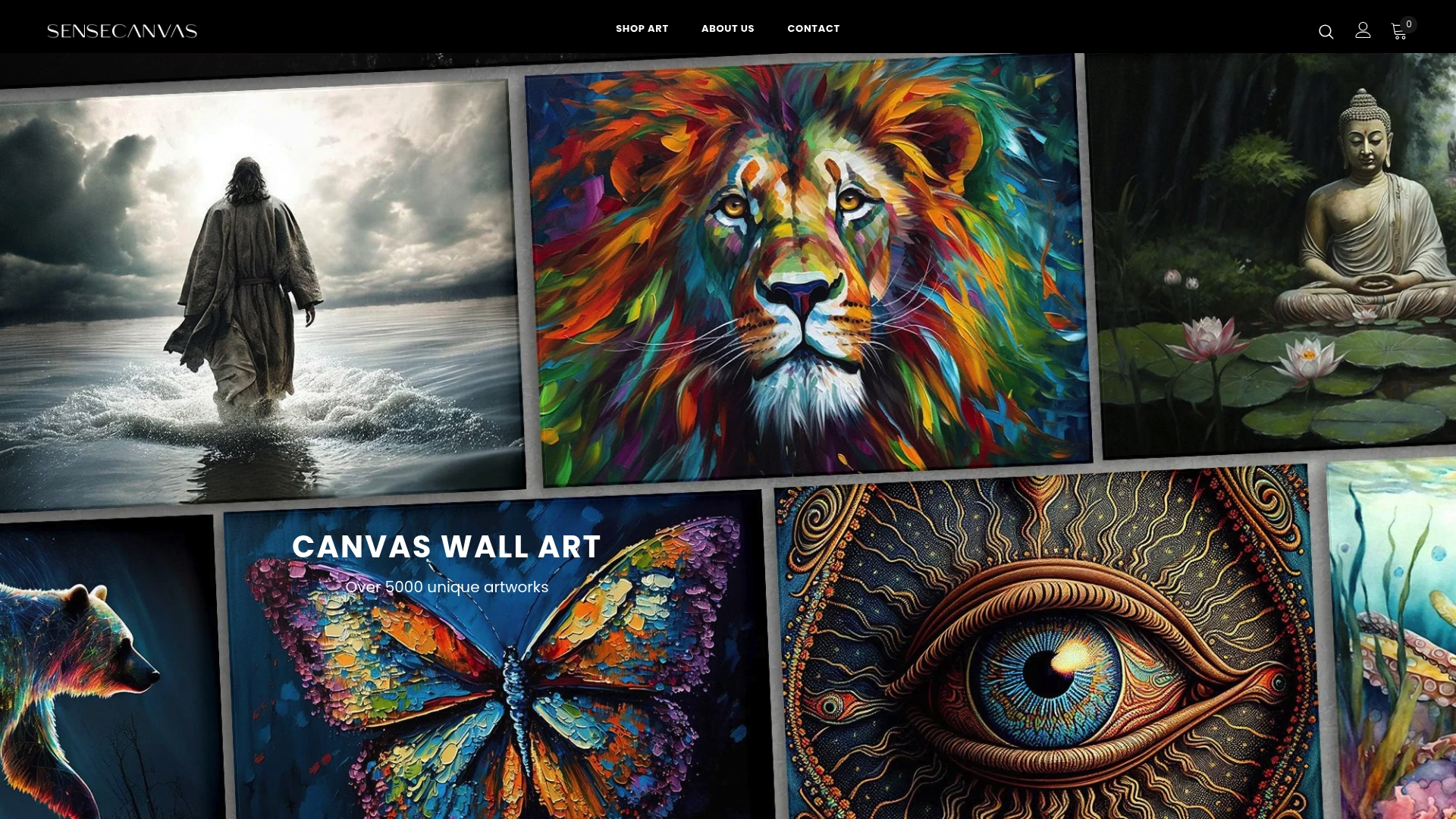
For a 1,200-square-foot office, you could furnish every secondary zone and corridor with Sensecanvas prints for well under $2,000, leaving your commission budget intact for the one or two focal walls that genuinely need it. Every piece ships ready to hang, and custom sizing means you are not forcing a standard dimension onto a wall that needs something specific.
Browse the full canvas collection and filter by theme, size, or color palette to match your brand. If you need a custom size or want to discuss a business order, the product pages include sizing options at checkout.