National Parks Canvas Ideas for Every Room in Your Home
The best national parks canvas ideas start with one question: do you want a park to look like a place, a memory or a design? A sweeping Yosemite landscape, a flat-color vintage poster look and a set of small prints from the parks you have visited each do a different job on a wall. This guide walks through the styles, the parks worth putting on canvas, how to size and arrange them, and how to make the result personal.
TL;DR
- Pick a style first: realistic landscape, vintage poster, or a mix of small park prints. The style decides which rooms it suits.
- Yellowstone, Yosemite, Grand Canyon and Death Valley have the deepest history as art subjects, but your own parks make the most meaningful canvas.
- Size to the wall and furniture, not to the image: a large single canvas for a focal wall, a grid of matching sizes for a gallery wall.
- Mountain and forest scenes in soft, foggy tones calm bedrooms and offices; bold poster colors suit hallways, dens and kids’ rooms.
- Personalize with a trip you took, a size that fits your wall, or a set that marks a family milestone.
Table of Contents
- Why national parks make such good wall art
- Four styles of national park canvas to consider
- Which parks make the strongest subjects
- Room-by-room ideas
- How to build a national parks gallery wall
- Choosing size, orientation and color
- Mixing park art with other decor
- Personalizing national parks art
- Perspective: what we see when people choose park art
- Find your park canvas at Sense Canvas
- FAQ
- Sources
Why national parks make such good wall art
These places were turned into pictures long before they were protected. The National Park Service notes that landscape art played a major role in establishing the Service and inspired leaders to protect and preserve these places. When you hang a park on your wall, you are joining a long tradition of using images to make people care about a landscape.
That history also explains why the subject is so flexible. The same canyon can be a luminous painterly scene, a graphic two-color poster or a quiet black-and-white study. You are choosing a treatment, not just a location.
Four styles of national park canvas to consider
Realistic landscape
This is the classic choice: a wide, photographic or painterly view of a valley, peak or lakeshore. It works best when it is big and when the room has some quiet around it. Think above a sofa, at the end of a hallway, or across from a window where it reads like a second view.
If the idea of bringing the outdoors in appeals to you, our guide to canvas landscape prints covers composition, orientation and what to look for in print quality.
Vintage poster style
Vintage park art has a distinct look: flat shapes, limited colors, bold lettering. It has real roots. The National Park Service describes how silkscreen posters made between 1938 and 1941 publicized the parks and educated visitors, and says modern reproductions have made the designs more popular. Earlier, Dorothy Waugh created 17 travel posters for the Service between 1934 and 1936, a moment often described as a turning point in American graphic design.
Photography entered the poster story later. In 1966 the Service contracted with Ansel Adams for images, and six posters were printed in 1968 and sold through the Government Printing Office from 1969. So if you like a black-and-white mountain with deep contrast, you are in that lineage too.
Vintage looks are the easiest style to mix with mid-century furniture, leather chairs and warm wood. They also photograph well, which matters if the room is a rental listing or a home office on camera.
Soft, atmospheric mountains
Foggy ridgelines, misty forests and still lakes are the calm end of the range. They are not tied to one park, which is the point: the mood carries the room. Our Foggy Mountains canvas, Icy Foggy Mountain canvas and Forest Lake Landscape canvas are examples of this look. They suit bedrooms, reading corners and offices where you want the wall to lower the temperature of the room rather than raise it.

Small prints, big set
The other approach is not one big picture but many small ones. At the Flora of the National Parks exhibition in 2016, pieces ranged from intimate 12-inch works to 7-foot panoramas. That range is a useful reminder: scale is a creative choice. A set of twelve-inch canvases, one per park, can say as much as one giant panorama.
Which parks make the strongest subjects
The Park Service’s own art collections point to Yellowstone, Yosemite, the Grand Canyon and Death Valley as subjects painters captured early. Each suggests a different wall.
| Park or landscape | Visual character | Works well in |
|---|---|---|
| Yosemite | Granite walls, waterfalls, valley light | Living rooms, entryways |
| Yellowstone | Geysers, hot-spring color, wildlife | Dens, kids’ rooms, cabins |
| Grand Canyon | Layered reds and oranges, huge scale | Living rooms, offices |
| Death Valley | Pale dunes, minimal shapes, wide horizons | Bedrooms, minimalist spaces |
| Zion | Red canyon walls against green and blue | Dining rooms, hallways |
The table is a starting point. The best choice is almost always a park you have stood in. A canvas of a trail you hiked with your family beats a famous view you have never seen.
Room-by-room ideas
Living room
This is where one large landscape pays off. Choose a horizontal canvas over the sofa and keep the surrounding wall quiet. A rule designers repeat is that art over furniture looks best when it is roughly two-thirds the width of the piece below it. Treat that as a rule of thumb, and tape paper to the wall at the planned size before you commit.
Bedroom
Go for low contrast and cool tones: mist, snow, lakes, evergreen forest. Avoid busy, high-contrast images directly across from the bed. A vertical canvas of a single peak works nicely on a narrow wall beside a dresser.
Home office
A landscape with depth gives your eyes somewhere to rest during a long day. Mountain scenes also work as a quiet nod to ambition without the cliché of a motivational slogan. If you prefer words, our collection also includes motivational designs, but a park image does the job more subtly.
Kids’ room and playroom
A wildlife-themed park poster, a bison, a bear, a bighorn sheep, brings the subject to life. Poster-style graphics are good here because the flat shapes are easy for small children to read.

Entryway or hallway
This is the place for a vintage poster look. Hallways are viewed in passing, so bold shapes and strong colors do more than delicate detail.
How to build a national parks gallery wall
A gallery wall is the natural answer if you have visited several parks. Here is a simple process.
- Choose a unifying element. One color family, one illustration style or one canvas depth. Without it, a set of park images reads as a collection of souvenirs.
- Pick two or three sizes. A large anchor canvas plus a few small ones looks planned. Twelve different sizes looks random.
- Plan on the floor. Lay the canvases out on the floor or cut paper templates and tape them to the wall.
- Keep gaps equal. Consistent spacing, usually a couple of inches, ties mixed sizes together.
- Hang the center of the group near eye level. Treat the arrangement as one unit, not as separate pictures.
- Leave room to grow. If you plan to add parks as you travel, keep one wall edge open.
A grid of identical canvases is the most formal option. A salon-style cluster is looser and more personal. For a calendar-style display, a row of equal-sized vertical canvases, one per park you have visited, is clean and easy to extend.
Choosing size, orientation and color
Size. Measure the wall and the furniture, then pick the canvas. Too-small art floats and looks timid. In a room with a high ceiling, go taller than you think.
Orientation. Horizontal suits wide scenes such as canyons, valleys and lakes, and furniture-anchored spots. Vertical suits waterfalls, redwoods and tall peaks, and narrow walls. A triptych or panoramic format helps if your wall is wide but you want to keep a single image.
Color. Pull one or two colors from the room. Red-rock canyons love warm woods, terracotta and denim. Misty forests sit well with white, sage and natural linen. Black-and-white mountain scenes go anywhere.
Finish. Canvas has a texture that softens glare, so it handles bright rooms better than glass-fronted frames. Gallery-wrapped edges mean you can hang without a frame, which keeps the look modern.
Mixing park art with other decor
Park canvases pair well with natural textures: wood shelves, woven baskets, stone and plants. Minerals and crystals add another earthy note, and these crystal decoration ideas show how stone accents can sit alongside wall art without fighting it. Keep the palette consistent: if the canvas is a rust-red canyon, a quartz or amber accent on a nearby shelf echoes it.
For the design logic behind this, see how canvas art fits biophilic design principles, and our nature themed canvas art ideas for wider inspiration beyond the parks.
Personalizing national parks art
Personal is what turns a decorative object into something people comment on. A few ways to do it:
- Mark a trip. Choose the park from your honeymoon, a family road trip or a first solo hike.
- Make a set of your visited parks. Add one canvas each time you go.
- Give it as a gift. For a retirement, a housewarming or an anniversary, a park with meaning to the recipient beats a generic landscape.
- Support the artists. Many parks run residencies. Zion, for example, has an Artist-in-Residence program inviting professional artists to live and work in Zion Canyon. Looking at the work that comes out of programs like this is a good way to find a style you love.
Perspective: what we see when people choose park art
People rarely regret a landscape canvas, but they often regret the wrong size. In our experience the most common slip is buying small. A scene that looks grand on a screen can shrink fast on a wall, so we encourage customers to size up and use the paper template trick. The second tip: choose by mood first, subject second. If a mountain scene makes the room feel the way you want, it is the right one, whether or not it is a named park.
That is why every design in our catalog of more than 15,000 pieces can be customized for size or composition, and why we focus on artist-grade materials and handcrafted quality. A canvas should feel like part of the room, not an afterthought.
— Sense
Find your park canvas at Sense Canvas
If you are ready to put a mountain, forest or lake on your wall, browse our canvas wall art collection. Every design is exclusive to us and can be customized for size or composition, with free global shipping and a satisfaction guarantee. Prices start from $85, and the botanical wall art ideas guide shows how an $85 canvas can anchor a room. For a mountain look, start with our Foggy Mountain Forest Landscape canvas.
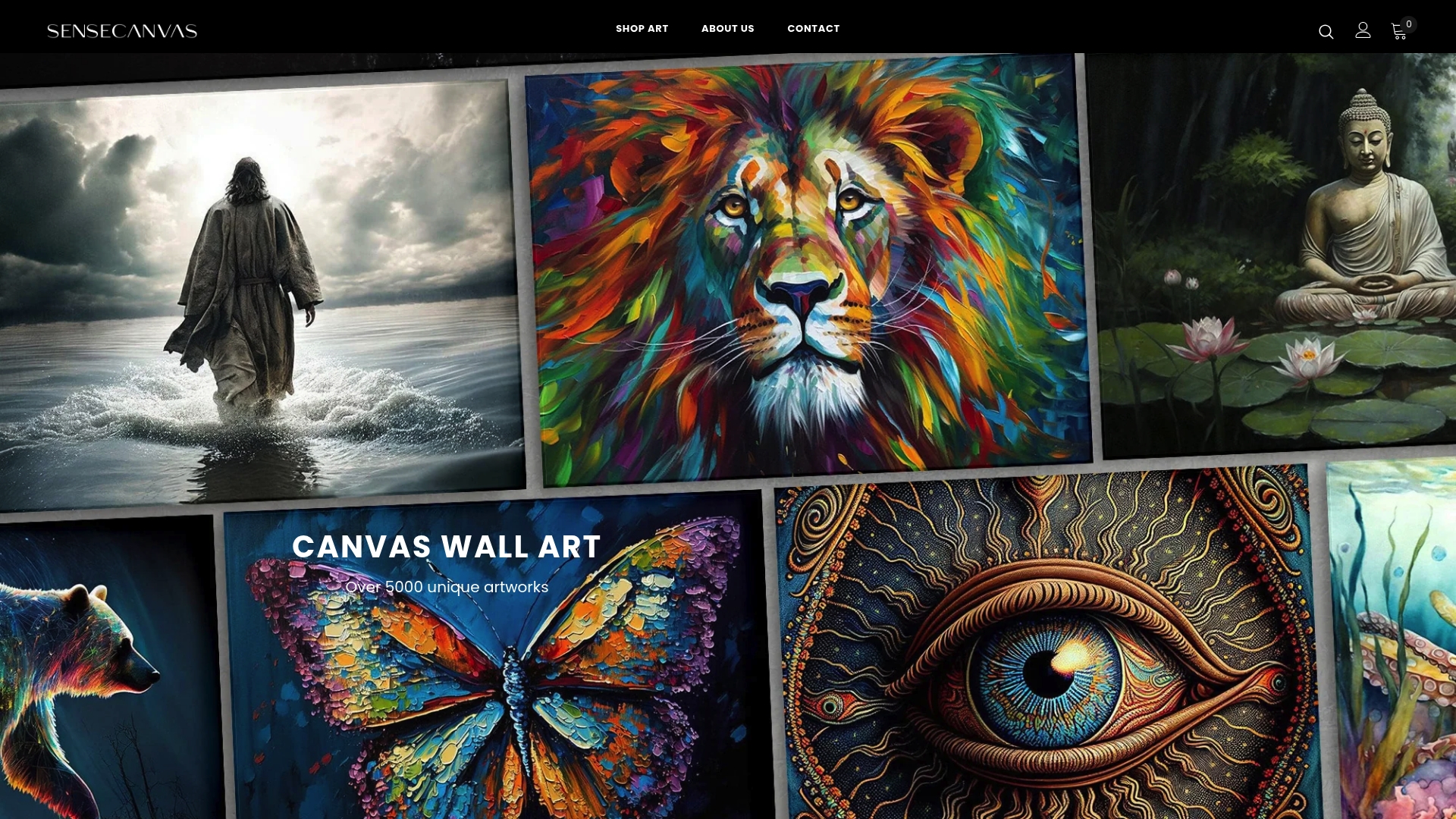
If you want a full park scene, tell us the layout of your wall and we will help you choose a size that fits.
FAQ
What size canvas is best for a national park print?
It depends on the wall. Over a sofa, aim for roughly two-thirds the width of the sofa. For a focal wall, go larger than feels comfortable at first. Taping a paper template to the wall is the easiest check.
Is vintage national park poster style a good choice for canvas?
Yes. The flat colors and bold shapes of the poster style hold up well on canvas, and the National Park Service documents the history of 1930s silkscreen park posters. It suits hallways, dens and mid-century rooms.
Can I make a gallery wall from several parks?
Yes. Keep a unifying element such as a color family or consistent canvas depth, choose two or three sizes, and keep the gaps equal. A grid of matching sizes is easiest if you plan to add parks over time.
Which mountain scenes suit a bedroom?
Soft, low-contrast scenes such as misty ridgelines, snow, still lakes and evergreen forests. They keep the room calm, while bright, high-contrast images are better kept for living areas and hallways.
Sources
- Treasured Landscapes: National Park Service Art Collections
- 50 Nifty Finds #39: An NPS Art Factory
- 50 Nifty Finds #34: Poster Boy for Parks
- Blazing A Trail: Dorothy Waugh’s National Parks Posters
- Artwork of Stephanie Ryan, Klondike Gold Rush National Historical Park
- Artists of Zion National Park
- Crystal decoration ideas for your walls