Western Wall Art Ideas for Rustic and Modern Rooms
The best western wall art starts with one strong subject, such as a horse, a mountain range or a single longhorn, printed large on canvas and matched to the room’s colors. A themed wall of boots, stars and horseshoes rarely works. This guide covers which subjects and styles to pick, how to adapt them to rustic, cabin and modern rooms, and how to size and hang the result.
TL;DR
- Pick one subject (horses, landscapes, wildlife, cacti, abstract desert color) and let it carry the wall instead of mixing five Western icons.
- Rustic rooms suit warm, natural tones. Modern rooms suit simplified silhouettes and generous empty space in the image.
- Measure first. Tape the outline on the wall, step back, and choose the canvas size from the furniture below it.
- For a cabin, favor landscapes and wildlife in muted palettes that sit quietly next to timber.
- Custom size and composition are the easiest way to make western canvas art fit your exact wall or a gift.
Table of Contents
- What counts as western wall art
- Western wall art ideas by room style
- Rustic cabin wall art ideas
- Making it feel collected, not themed
- Choosing the right size
- Where and how high to hang it
- One statement piece or a gallery wall
- Our perspective
- Personalizing western art for a home, office or gift
- Browse canvas art at Sense Canvas
- FAQ
- Sources
What counts as western wall art
Western art is wider than cowboys. Art historians point to landscapes, daily life, Native American ritual and dress, the bond between people and animals, and wildlife such as bison, bears and panthers as established Western subjects. Narrative scenes are part of the tradition too: The Met holds an oil-on-canvas by Frederic Remington from 1907 showing soldiers led by a scout crossing the frontier.
For home decor, the useful subject list is shorter and easy to sort:
- Horses and cattle: running herds, a lone horse in profile, longhorns.
- Open landscapes: mesas, plains, desert at dusk, mountain ranges. Thomas Moran made Yellowstone and the Tetons a signature subject, using prismatic color to capture the American West.
- Desert plants: cacti, agave, sage, dry grasses.
- Wildlife: bison, bears, elk, wolves, eagles.
- People and rodeo: riders, ranch life, vintage-style cowboy scenes.
- Abstract Western: desert color fields, terrain lines, textured earth tones.
Styles run from traditional realism through impressionistic, expressive work to modern abstract pieces. Pick the style first and the subject second. A realistic horse and an abstract horse look like two different decor decisions.
Contemporary Western art is also broader than the nostalgic Wild West. A Smithsonian American Art Museum exhibition, reported by Smithsonian Magazine, shows artists of Black, Asian American, Indigenous, LGBTQ+ and Latinx backgrounds presenting the West as a lived, varied experience. If the cowboy cliché feels dated to you, that is your cue to lean on landscape and abstraction.
Western wall art ideas by room style
Rustic and farmhouse rooms
Houzz describes rustic style as natural, rugged and cozy, drawing on woods, plains, rivers and lakes. Its palette advice is warm hues taken from wood and stone: cream, wheat, chestnut, umber, terra-cotta and sepia, with art that evokes regional creatures, landscapes and traditions.
In practice:
- A large landscape canvas in sepia or umber over a leather sofa or a stone fireplace.
- A single horse or bison in warm browns above a farmhouse table or sideboard.
- A pair of matching vertical canvases, such as desert plants, flanking a window or door.
Farmhouse rooms usually run lighter than lodge rooms. Choose images with cream and wheat backgrounds so the art does not turn the wall into a dark patch.
Modern and minimalist rooms
Modern Western art keeps the subject and changes the composition: large areas of negative space, simplified silhouettes, fewer details. That is why a single running horse on a pale background can look at home in a mid-century or minimalist room. If that is your direction, our guides on minimalist canvas art sizing and mid-century wall art width cover proportions in detail.
Traditional rooms with a contemporary twist
Western Horseman makes a point worth borrowing: a good home mixes mediums, and contemporary Western art can create interesting tension and depth in a traditional setting. A bold abstract canvas in desert tones over a classic wood console is a strong example. It reads as a choice, not a theme.
Rustic cabin wall art ideas
A cabin already has strong materials: timber walls, stone, small windows. The art should work with them, not compete.

One cabin-focused guide suggests a long list of options: botanical prints, maps, landscape paintings, woven textiles, wildlife sketches, nature photography, vintage signs, antlers and tapestries, plus natural frames, muted palettes and matte finishes so the art feels part of the landscape. That is one writer’s advice rather than a rule, but it matches how cabins look when they are done well.
For canvas specifically:
- Landscapes first. Mountains, lakes, forest and plains echo the setting outside.
- Wildlife second. Elk, bear, wolf and eagle images work in a great room or over a bed. Our animal collection is a good place to browse.
- Matte over glossy. Canvas already diffuses light, which helps in cabins with low, warm lighting.
- Keep palettes muted. Forest greens, slate, rust and cream sit well beside logs. Neon accents do not.
- Mind scale. High ceilings and big timber beams swallow small art. Go larger than you think.
For a lodge-style great room, one oversized canvas above the fireplace is usually better than a scatter of small pieces. See our notes on fireplace wall art sizing.
Making it feel collected, not themed
The most common mistake with Western decor is repeating the same icon across every surface. Interior designers quoted by Architectural Digest advise restraint and intentional gestures over literal word art, underscaled pieces, mass-produced canvases, overly matched sets and cluttered galleries.
Some ways to apply that:
- Limit the Western content. One focal piece plus quieter supporting art. Everything else in the room should come from your general style.
- Pull colors from the art. If the canvas has terra-cotta in it, repeat that once in a pillow or ceramic, not everywhere.
- Choose imagery over slogans. A landscape ages better than a quote about ranch life.
- Avoid matched sets unless the room is formal. Two or three related but different images look more considered than three identical frames.
- Mix textures. Canvas beside wood, metal or woven pieces keeps the wall from reading as one note.
Choosing the right size
Size is where most wall art goes wrong. Western Horseman’s advice is to measure the furniture below the piece, the usable wall width and any architectural details, then outline candidate sizes with painter’s tape and view them from across the room. Western Life Today adds that a large painting suits a mantel, oversized sofa or king-sized bed, but may overpower a small desk or bathroom wall.
A quick planning table (these are our working guidelines, not industry standards):
| Location | What to aim for | Good Western fit |
|---|---|---|
| Above a sofa | A canvas clearly narrower than the sofa, but substantial | Wide landscape or horse herd |
| Above a fireplace | One bold piece, scaled to the mantel | Large landscape or single animal |
| Bed headboard wall | Wide horizontal or a pair | Desert horizon, abstract terrain |
| Entry or hallway | Vertical, medium size | Cactus, single horse, wildlife |
| Office wall | One statement piece visible from the desk | Mountain range, abstract earth tones |
For exact proportions, we go through the numbers in how to choose art size for your home walls, sizing and hanging art above a sofa and bedroom wall art sizing. Smaller homes should read canvas art for small spaces before committing to a big format.
Where and how high to hang it
Western Horseman suggests mounting a piece so the center of the frame sits about 62 inches from the floor, adjusted to your preference. In rooms with high ceilings, such as many cabins, that slightly higher center helps the art hold its place. Over furniture, hang it low enough that the two read as one group.
A few placement habits that work:
- Tape a paper template first and live with it for a day.
- Center art on the furniture or window below it, not just the wall.
- Keep eye level in mind in seating areas: people are mostly sitting.
- Avoid direct sun, which fades any print over time.
One statement piece or a gallery wall
Designer Bunny Williams has observed that many people struggle to group art and end up hanging single pieces that are too small for the wall. Her answer is varied groupings that look studio-like and professional.
Use a single statement canvas when:
- The wall is plain and large, such as above a fireplace or bed.
- The image has strong presence: a horse, a mountain range, a bold abstract.
- You want a calm room.
Use a Western gallery wall when:
- You have a long stair wall or hallway.
- You own mixed pieces: a canvas, a vintage photo, a small sculpture, a woven textile.
- You are comfortable varying sizes and frames.
In a gallery, make one canvas the anchor and let the others be smaller. Keep spacing consistent and avoid putting five cowboy images next to each other.
Our perspective
We see Western wall art requests come in two kinds. Some people want a literal Western room. Far more want one piece that nods to the West, a horse, a desert, an open sky, without turning the room into a saloon. For the second group, we steer toward composition over props.
That is also why we offer designs that can be adjusted for size or composition. A wall rarely matches a standard frame size, and a landscape that is perfect on a wide sofa wall can feel cramped on a narrow hallway. Each design on our site is exclusive to us, our canvases are handcrafted with artist-grade materials, and we ship free worldwide with a satisfaction guarantee. Our animal, abstract and floral collections are where most Western-leaning customers start, and our horse wall art ideas guide shows how one subject behaves across different rooms.
Our advice: choose the image you would still want to look at in five years, then fit the size to the wall. Do not do it the other way around.
— Sense
Personalizing western art for a home, office or gift
Customization matters most in three situations.
Your home. If your wall is an odd width, ask for a custom size rather than settling for the nearest standard. Wide, narrow or very tall formats all change how an image feels. Tell us if you want the composition adjusted so the focal point stays in the visual center.
An office. A single large landscape or abstract earth-tone piece gives a space character without clutter. For a business, choose images with open space and calm color, and avoid anything too themed for client-facing rooms.
A gift. Housewarmings, retirements and cabin gifts suit a landscape or an animal tied to the person’s interests. Our personalized family designs are an option when a name or monogram is the point. Check the product page for the available options before ordering.

Browse canvas art at Sense Canvas
If you are ready to choose, start with our animal, abstract and floral collections, which hold many Western-friendly images, from horses and wildlife to earthy abstracts. Each can be sized to your wall, and shipping is free worldwide with a satisfaction guarantee.
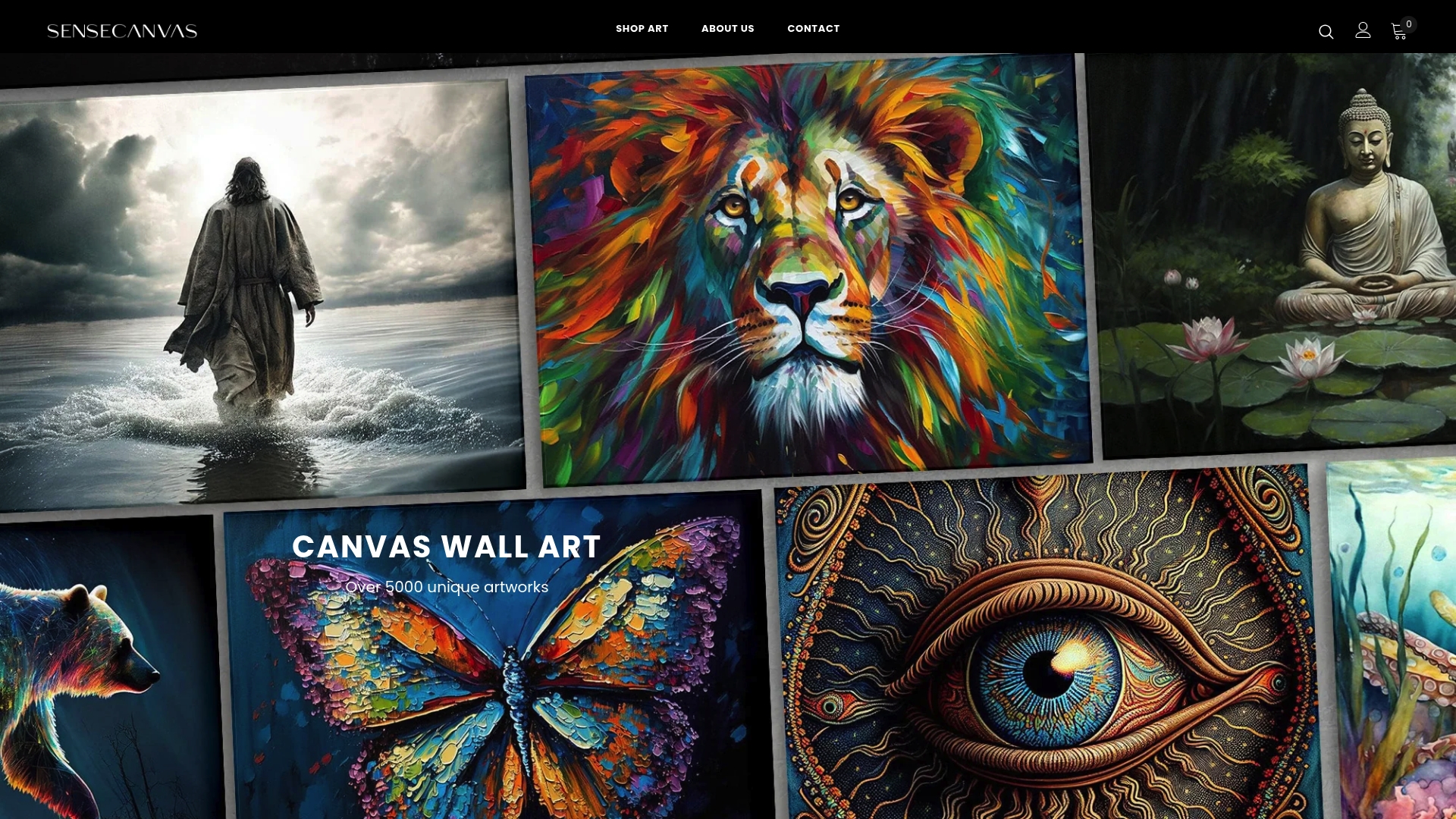
If you want to see everything in one place, our full canvas catalog is organized so you can narrow by style and then check size options on each product page.
FAQ
What is the easiest way to start with western wall art?
Buy one large, well-composed canvas rather than several small themed items. A landscape or a single horse in colors that already appear in your room is the safest choice. Add other Western touches only if the first piece feels right.
What colors work for rustic western canvas art?
Warm, natural tones such as cream, wheat, chestnut, umber, terra-cotta and sepia, which Houzz ties to rustic style. These sit well beside wood and stone. For a lighter farmhouse feel, choose images with cream or pale backgrounds.
How big should western wall art be over a sofa?
It should look substantial but still clearly sit within the sofa’s width. Measure the furniture and the usable wall, then tape the outline to the wall and check it from across the room, as Western Horseman recommends. Our sofa-hanging guide gives specific ratios.
What wall art suits a rustic cabin?
Landscapes, wildlife, maps and nature photography in muted palettes tend to work best, and matte finishes and natural frames help them blend with timber. Canvas is a good fit because it has no glare. Go larger than you expect if the ceilings are high.
Can western art look modern?
Yes. Modern Western pieces keep traditional subjects but use simplified silhouettes and large areas of empty space, which suits minimalist and mid-century rooms. Abstract desert color studies are another route.
Sources
- The Metropolitan Museum of Art: Bronze Statuettes of the American West, 1850–1915
- The Met: Frederic Remington, On the Southern Plains
- The Met: Thomas Moran, The Teton Range
- Western wall art: history and styles
- Smithsonian Magazine: These Artists Are Redefining the American West
- Houzz: Your Guide to Rustic Style
- Western Horseman: The Art of Display
- Western Life Today: Western Art for Your Home
- Architectural Digest: Living Room Wall Decor Ideas
- Architectural Digest: Bunny Williams and J. Pocker’s gallery wall guide
- Log cabin wall art ideas