Desert Wall Art Ideas: Canvas Styles for Every Room
The best desert wall art matches the mood you want in the room. Wide, quiet landscapes calm a bedroom. Saturated sunsets energize a living room. Minimal cactus silhouettes suit a small office. Pick the subject first, then the palette, then the size and layout. This guide walks through each step, with ideas for every room and for gifts.
TL;DR
- Choose a desert subject that fits the room’s job: panoramic dunes and mesas for rest, sunset skies for warmth, cacti and botanicals for a lighter touch.
- Pull two or three colors from the artwork (sand, terracotta, sage) and repeat them in pillows, throws or ceramics so the piece feels planned.
- Size the art to the furniture below it. We suggest roughly two-thirds of the width of a sofa or headboard, then adjust for the room.
- A single canvas is calm and bold, a multi-panel layout suits long walls, and a set of smaller pieces suits gallery-style groupings.
- Custom size and composition options make desert canvas art easy to fit awkward walls or give as a gift.
Table of Contents
- What desert wall art can show
- How desert art changes the mood of a room
- Colors and decor styles that pair well
- Choosing canvas size
- Single canvas, multi-panel or a set
- Desert art room by room
- Desert art as a gift
- Perspective
- Bring a desert canvas home
- A quick planning checklist
- FAQ
- Sources
What desert wall art can show
The desert is not one look. It is a family of subjects, and each one pulls a room in a different direction. Knowing the options keeps you from buying a generic sunset when what you wanted was something quieter.
Wide landscapes
Panoramic dunes, flat-topped mesas, canyon walls and long empty horizons are the classic desert landscape canvas. The composition leaves a lot of open sky or open ground, which gives the eye somewhere to rest. These work best in horizontal formats above sofas, beds and consoles. If you like the idea of big scenery in general, our guide to canvas landscape prints covers how format and composition change the feel of a scene.

Sunsets and golden hour
Glowing orange, magenta and violet skies over dark rock outlines are the most dramatic option. They add warmth even in a room with little natural light. They also carry the most color, so they do the most work in a neutral room and can overwhelm a space that is already busy.
Cacti and desert plants
Saguaros, prickly pears, agave and yucca can be shown as a full scene or as a close, almost botanical study. A single saguaro against a pale sky reads modern and graphic. A cluster of cacti in warm light reads more rustic. Because the shapes are simple, this subject scales down well for small walls and hallways.

Red rock and national park views
Arches, buttes and layered sandstone give you strong geometry and rich rust tones. If your taste leans toward specific places, our national parks canvas ideas show how to bring those views into each room.
Abstract and minimal desert
Some of the most livable pieces never show a cactus at all. Stacked bands of sand, clay and dusty rose suggest dunes or strata, and a plain sun circle over soft hills suggests a horizon. These suit modern rooms and anyone who wants the desert mood without the Southwest theme.
Western and wildlife touches
Longhorns, wild horses and lone riders sit at the edge of the desert theme. They push a room toward ranch and rustic. We cover that direction in our Western wall art ideas, and a piece like our Texas longhorn canvas pairs naturally with sandy, earthy landscapes.
How desert art changes the mood of a room
Color temperature and empty space do most of the work. Warm oranges and reds make a room feel cozy and lived in. Pale sand, cream and soft sage make it feel airy and slow. Big areas of sky or empty ground in the artwork read as breathing room, which is why a sparse desert horizon can calm a crowded space.
Here is how that plays out in practice:
| Mood you want | Desert subject | Palette to look for |
|---|---|---|
| Calm and restful | Wide dunes, pale horizon, minimal abstract | Sand, cream, soft sage, dusty rose |
| Warm and social | Sunset over mesas, red rock canyons | Terracotta, burnt orange, gold |
| Fresh and light | Single cactus, agave, botanical close-up | Muted green, off-white, pale blue sky |
| Bold and dramatic | Large canyon scene, night sky over rock | Deep rust, charcoal, indigo |
These are design principles, not rules. Light matters too. A north-facing room tends to look cooler, so a warm sunset piece can balance it. A bright south-facing room can handle cooler, paler desert tones without feeling flat.
Colors and decor styles that pair well
Desert art is easy to decorate around because the palette is already earthy. Benjamin Moore describes the Southwest palette as built on ochre, sand, muted greens and other terrestrial hues. It also notes that traditional Southwestern style draws on Native American, Spanish and agricultural influences, and that modern elements can refresh it.
That gives you a simple recipe:
- Pick one anchor color from the art. Terracotta, sand or sage works well.
- Repeat it twice. A throw and a vase is enough. More than that starts to look matched.
- Add one contrast. Deep blue, black or off-white keeps the earth tones from going muddy.
- Mix textures. Linen, wool, rattan, wood and clay echo the dry, natural feel of the desert.
Styles that suit desert canvas art
- Boho: Layered textiles, plants and woven baskets with a sunset or abstract dune piece.
- Modern and minimalist: One large, quiet landscape or a minimal sun-and-hills composition on a clean wall.
- Rustic and Western: Wood furniture, leather and iron accents with a red rock or cactus scene.
- Scandinavian and soft neutral: Pale sand tones and a single cactus or horizon piece for warmth without clutter.
- Eclectic: A desert panorama as the anchor with smaller, unrelated art around it.
A small object on a shelf or console below the art can carry the theme further. A mineral piece such as this cactus carving in yellow calcite is the kind of sculptural accent that echoes a cactus canvas without repeating it.
Choosing canvas size
Start with the wall, not the art. Measure the width of the furniture the piece will sit above, and the space from the top of that furniture to the ceiling.
Our rule of thumb is simple:
- Above a sofa, bed or console: aim for the art (or the whole group) to span about two-thirds of the furniture’s width. Leave a hand’s width or two of gap above the furniture so the two read as one unit.
- On an open wall: go larger than feels comfortable. Undersized art is the most common mistake, and it looks lost on a big wall.
- Hanging height: center the piece so its midpoint is around eye level, which for most people is roughly 57 to 60 inches from the floor. On a high-ceilinged wall, a little higher is fine when furniture sits below.
- Orientation: horizontal for wide furniture and panoramic scenes, vertical for narrow walls, doorways and stairwells.
If your wall is an odd size, that is where customization helps. Our designs can be customized for size or composition, so you are not forced to choose between a piece that is too small and one that crowds the wall.
Tight on space? Our guide to canvas art for small spaces shows how to keep a room from feeling cluttered while still using a statement piece.
Single canvas, multi-panel or a set
The layout changes the effect as much as the subject does.
Single canvas
Best when you have one strong image and a wall that can support it. A single piece feels calm and decisive. It suits a panoramic horizon above a sofa, a saguaro silhouette in an entryway, or an abstract dune piece in a bedroom.
Multi-panel arrangement
A scene split across two, three or five panels adds rhythm and suits long, wide walls. It also adapts to tricky spaces, because you can change the gaps. Keep spacing consistent and fairly tight, a couple of inches is a common choice, so the eye reads the panels as one image. A three-panel canyon scene above a long console is a good example.
A set of smaller pieces
Use a set when you want a gallery wall with a shared theme, for example a cactus, a sunset and an abstract sand pattern in matching tones. Lay the pieces out on the floor first. Keep a common color thread and a consistent distance between frames, and the group will look curated rather than collected.
| Situation | Best fit |
|---|---|
| One hero image, a clear wall | Single canvas |
| Long wall above a sofa or bed | Multi-panel |
| Hallway or stair wall | Set of smaller pieces, or a tall vertical |
| Mixing subjects in one palette | Set of three to five |
| Awkward or narrow wall | Custom-sized single piece |
Desert art room by room
Living room
This is where a large horizontal piece shines. Hang a wide landscape or a three-panel scene above the sofa, and pull one tone into cushions. A sunset canyon scene adds warmth to a neutral room. If the room is already full of pattern, choose the minimal abstract version.
Bedroom
Go quiet. Pale dunes, soft horizons and muted cacti support rest. Hang the piece above the headboard, and keep the palette close to your bedding so the room stays restful. If you also like mountain scenery, our mountain wall art ideas offer more calm landscape directions.
Home office
A wide horizon gives you somewhere to rest your eyes between tasks. A bold desert sunset can add energy to a room that feels flat. Hang it where you will see it from your desk, not behind you.
Entryway and hallway
Vertical or smaller pieces suit narrow walls. A single cactus or agave study is a friendly first impression and does not crowd a tight space.
Commercial and business spaces
For offices, waiting rooms and shops, large landscapes in warm neutrals feel welcoming and rarely clash with other decor. Interior designers can use consistent palettes across multiple pieces to tie a space together.
Desert art as a gift
Desert canvas art makes a good gift for people who love road trips, the Southwest or a calm, earthy look. Three things make it feel personal rather than generic:
- A place that matters to them. A landscape from somewhere they have traveled or dream of visiting.
- Their existing palette. If you know their room is warm or cool, choose accordingly.
- A personal touch. Our designs can be customized, and our personalized family collection offers name-based pieces that pair well with a landscape in a gallery grouping.
Size is the safe-gift problem. When you are unsure of the wall, choose a medium piece that works in many places, or ask the recipient’s household about a spot first.
Perspective
We see the same thing again and again with desert art: people fall for a sunset, then hesitate because they worry it will not suit the rest of the room. Our advice is to start from the feeling, not the picture. Decide whether the room should be calm, warm or bold, and a desert subject can deliver any of the three.
That is why we offer more than 15,000 exclusive designs, each of which can be customized for size or composition. A desert piece that is too small looks lost, and one that is too large crowds the room. Getting the dimensions right matters as much as the image.
We also care about how the art is made. Our canvases are designed to be handcrafted from premium, artist-grade materials and to be easy to install, so the piece looks as good in a year as it does on day one.
Sense
Bring a desert canvas home
If you are ready to choose, browse our full range of canvas wall art and filter by the subjects and moods above. Prices start from $85, every design is exclusive to us, and you can customize size or composition to fit your wall. Our satisfaction guarantee and free global shipping are part of every order.
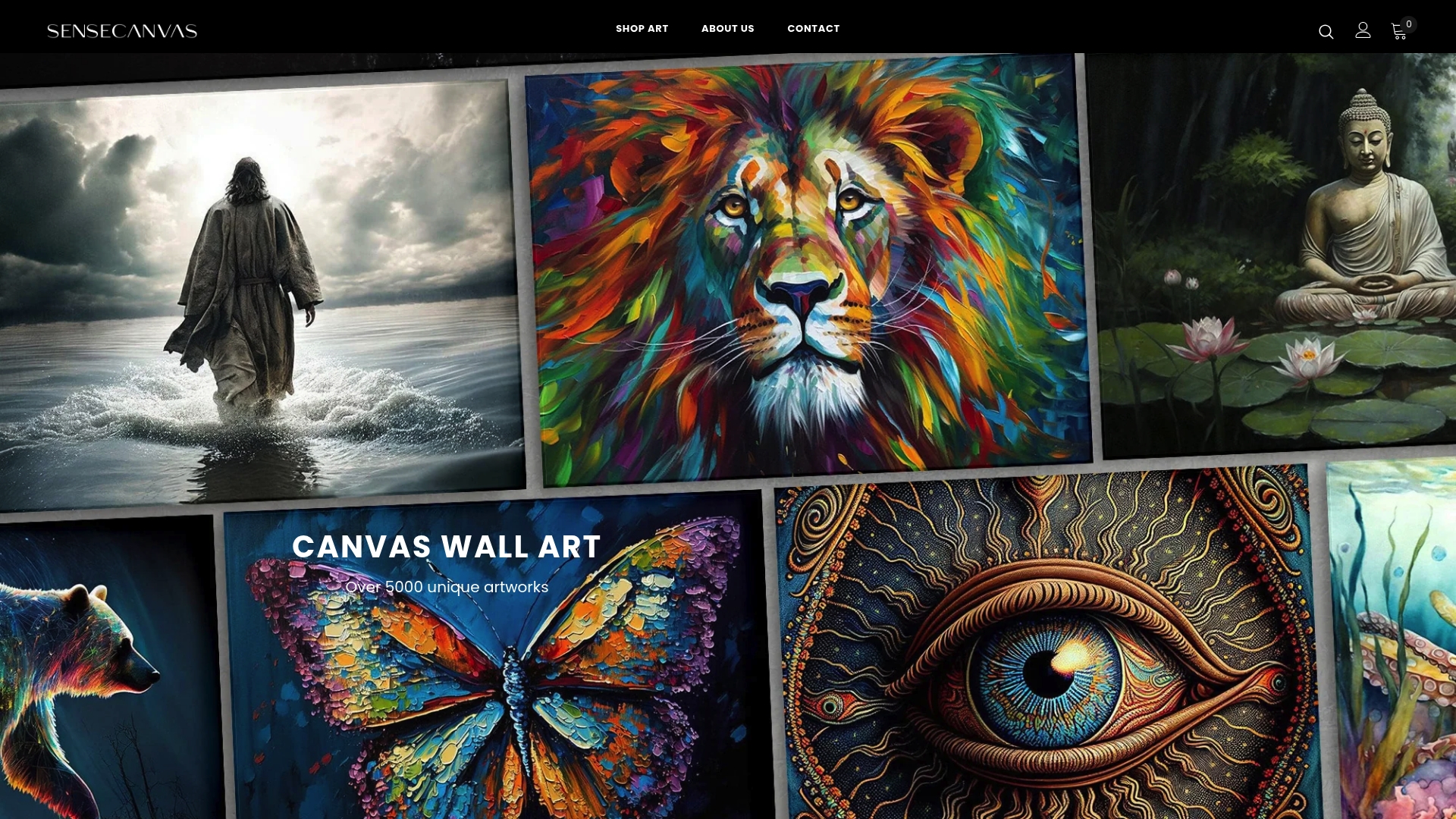
Want to see what else is available alongside your desert pick? Our full collection includes floral pieces and other nature subjects that pair well with earthy palettes, and our nature themed canvas ideas can help you build a cohesive wall.
A quick planning checklist
- Decide the mood: calm, warm, fresh or bold.
- Choose the subject: landscape, sunset, cactus, red rock or abstract.
- Pick two or three colors from the art to repeat in the room.
- Measure the wall and the furniture below it.
- Choose single, multi-panel or set based on the wall shape.
- Check the light in the room at the time of day you use it most.
- Order the size you measured, and customize if the wall is unusual.
FAQ
What colors go best with desert wall art?
Start with the earthy tones already in the art: sand, terracotta, ochre and muted green. Benjamin Moore’s Southwest palette is built on that kind of terrestrial range. Add one contrast, such as deep blue or off-white, to keep the room from looking flat.
What size desert canvas should I hang above my sofa?
We suggest a piece, or a group of panels, about two-thirds the width of the sofa. Leave a small gap above the cushions and center the art near eye level. If your wall is an unusual size, a custom size lets you match it.
Is desert wall art only for Southwestern homes?
No. Minimal dunes, soft horizons and single cactus studies fit modern, boho and Scandinavian rooms as well as rustic ones. What matters is repeating the artwork’s palette in a few accents so it looks intentional.
Is a multi-panel canvas better than a single piece?
It depends on the wall. A single canvas suits one strong image, while multi-panel layouts suit long walls above sofas, beds or consoles. Multi-panel layouts also work well when you want the image to feel larger than one canvas allows.
Can I give desert canvas art as a gift?
Yes. Choose a scene tied to a place they love and match it to the colors in their home. Because our designs can be customized for size and composition, it is easier to fit the piece to the recipient’s space.