Vintage Travel Canvas: How to Choose, Style and Display It
The best vintage travel canvas pairs a bold, simplified destination scene with a size and color palette that suits your room. Start with the era you love, match the dominant colors to something already in the space, and size the canvas to the furniture beneath it. This guide covers all of that: where the look comes from, how to pick a style, how to hang it, and what to know about rights and care.
TL;DR
- Vintage travel art is defined by flat color, strong lines and mood over realism. The classic era ran from the 1920s to the 1960s.
- Pick one era (Art Deco, WPA national parks, jet age) and keep the rest of the wall consistent with it.
- Size the canvas to roughly two thirds of the width of the sofa, console or bed it hangs above.
- Keep canvas away from direct sun and swings in humidity so the colors stay rich.
- Check the source of any image before you print it: a museum may own the object without owning the copyright.
Table of Contents
- What makes vintage travel canvas look the way it does
- Retro travel wall art styles to choose from
- How to match color and size to your room
- Vintage travel art ideas for every room
- Arranging a vintage travel gallery wall
- Perspective
- Check image rights before you print vintage travel art
- Keep canvas travel art looking vivid
- Find your canvas at Sense Canvas
- FAQ
- Sources
What makes vintage travel canvas look the way it does
Vintage travel art was advertising. Before color photography took over, artists had to sell a place with a few shapes and a limited palette. The Library of Congress places the golden age of travel posters in the 1920s to the 1960s, when graphic design, bold lines and deep colors were used to make a destination feel like a mood rather than just a location. The same source notes that the era ended in the 1960s, when agencies moved to flashy color photographs that put place over mood.
That history explains why the look works on a wall today. A poster built to be read from across a train platform also reads well from across a living room. You get:
- Flat planes of color instead of fine detail, which stay clear at large sizes.
- Simple, confident composition: a skyline, a mountain, a steamship, one dominant subject.
- Typography as part of the art: a destination name set in a period lettering style.
- A feeling of anticipation: the scene says you should go, not that you have been.
The pieces are also scarce in their original form. A dealer quoted by Fine Books & Collections says part of the appeal is that posters were ripped down to make room for the next ad, and the same article reports a 1928 railway poster by Cassandre that sold for $162,500 at Swann Galleries. Most of us will never hang an original, which is exactly why a canvas print in the same spirit is such a practical way to bring the look home.
Retro travel wall art styles to choose from
Not every “vintage” travel piece looks alike. Decide which of these directions fits you before you browse.
Art Deco and early railway style
Think streamlined ships, trains and skylines in the 1920s and 1930s, with strong geometry and dramatic perspective. This is the most formal option and suits dining rooms, offices and hallways.
WPA and “See America” national parks
Many of the Library of Congress’s travel posters were made by the Works Progress Administration between 1936 and 1943, and others came from the United States Travel Bureau to boost domestic tourism, with national parks and the catchphrase “See America” (Library of Congress). The look is minimalist: layered mountains, a single bright sun, a limited number of inks. It is the easiest style to live with because the palettes are often earthy. If this is your direction, our national parks canvas ideas for every room show how to place it.

Mid-century and jet age
From the 1940s to the 1960s, travel art got brighter and more playful: turquoise water, orange sunsets, palm trees, airplane wings. It works well in bedrooms, sunrooms and home bars where you want warmth and a little humor. If air travel is your theme, our guide to a gallery-ready aviation wall mixes museum-style reproductions with minimalist prints.
Vintage travel tags and luggage labels
Smaller and more graphic, these show a city name on a tag or stamp. They are good for grids of three or four canvases, or for a narrow wall where a single large piece would crowd the space.
How to match color and size to your room
This is where most people go wrong, and it is simple to fix.
Color: borrow, do not match
Pull one or two colors from the canvas that already exist in the room, such as a throw pillow, a rug stripe or a lampshade. You do not need to match everything. Vintage travel art is usually built on a limited palette, so repeating just one tone ties it into the room.
| Room color base | Travel art palette that works | Example subject |
|---|---|---|
| Warm neutrals (cream, tan, wood) | Teal and burnt orange | Coastal resort, desert road |
| Cool grays and whites | Navy, red and mustard accents | City skyline, ocean liner |
| Dark or moody walls | Gold, cream and deep green | Art Deco train, European capital |
| Bright or colorful rooms | A single dominant color | Minimalist national park scene |
Size: fit the furniture, not the wall
A common mistake is a canvas that is too small for the piece below it. As a practical rule, aim for a canvas or grouped set that spans about two thirds of the width of the sofa, bed or console. Hang it so the center sits around average eye level. Our cityscape wall art sizing guide walks through measuring to your sofa, and the same logic applies to any skyline or landmark scene.

If your space is compact, a single vertical piece draws the eye up and avoids clutter. Our small spaces canvas guide covers this in more detail.
Orientation
- Horizontal suits sofas, beds and long consoles, and most landscape or skyline scenes.
- Vertical suits narrow walls, entryways and tall subjects like lighthouses or towers.
- Square is the safest for grids and for travel tag designs.
Vintage travel art ideas for every room
Living room
One large piece above the sofa makes a strong focal point. Choose a scene with a calm horizon line so it does not compete with the furniture. A national park or coastal scene is a forgiving choice for most color schemes.
Bedroom
Go softer here: pastel beach scenes, sleepy villages, or a sunset. Hang the piece above the headboard, roughly centered on the bed.
Kitchen and dining area
European cafe, wine-region and city scenes suit these rooms. Avoid hanging canvas directly beside a stove, where heat and grease build up.
Bathroom
Steam is hard on any art, so size and position matter. Our guide to bathroom canvas placement and steam safety gives specific rules.
Home office and business spaces
Travel art signals curiosity and ambition without the formality of corporate abstracts. A set of three canvases of cities where a company has clients or offices can make a meeting room feel personal. A single large national park scene works well in a reception area.
Gifts
Vintage travel canvas is a natural gift for a couple’s first home, a retirement, a wedding anniversary or a graduate moving to a new city. Pick the destination that carries meaning: where they met, where they honeymooned, where they grew up. Because we let you customize size and composition, you can fit the gift to the wall it will hang on.
Arranging a vintage travel gallery wall
A group of canvases looks intentional when a few rules are followed. These are practical layout principles, not strict measurements.
- Start with an anchor. Place the largest or boldest piece first, near eye level, and build outward.
- Keep gaps consistent. Use the same spacing between every canvas. A tighter gap feels cozy, and a wider one feels airy.
- Limit the palette. Stick to a handful of colors across the set and repeat one accent every couple of pieces to create rhythm.
- Mix scale. One large canvas with two or three smaller ones is more interesting than a grid of identical sizes.
- Leave breathing room above furniture. Keep the lowest edge a few inches above the sofa or console so the art does not look like it is sitting on it.
- Lay it out on the floor first. Or cut paper templates and tape them to the wall before you drill anything.
If you rent, you may not want to drill at all. Our guide to hanging canvas without nails explains when adhesive strips are enough. To add depth to a set, layering textures with canvas prints shows how to combine canvas with other materials.
Good light also changes how flat color reads. Our piece on wall art lighting covers aim and glare so the deep blues and reds of a travel scene do not wash out.
Perspective
We think vintage travel art is one of the most forgiving ways to bring a story into a room. The bold shapes and limited palettes were designed to be understood quickly, and that is why they sit so comfortably next to modern furniture.
At Sense Canvas, every design we offer is exclusive to our platform and can be customized for size or composition, so a travel scene is not a one-size-fits-all purchase. You can scale it to the wall, crop the composition to the space, and choose the subject that matters to you.
We print on premium artist-grade materials, handcraft each piece and back it with a satisfaction guarantee and free global shipping. A canvas that is easy to install and made to look vivid for years is what we want hanging in your home or office.
Sense
Check image rights before you print vintage travel art
An old poster is not automatically free to reproduce. If you plan to commission a custom print from an image you found, or you are an interior designer sourcing for a client, check the rights first.
- The object and the copyright are different things. Museums often hold the physical piece without owning the copyright. The Stark Museum of Art, for example, says artists or their assignors may retain copyright and that any royalties or conditions the owner sets are the applicant’s responsibility.
- Follow the owner’s reproduction terms. The same museum asks that images be reproduced in full, without cropping or overlays, with the full credit line in printed materials. Other institutions set their own terms, so read the rights page of whoever holds the image.
- Look for the original artist. A mid-century poster may be old, but the artist’s estate can still hold rights depending on the work and its publication history.
- Use designs you have clear rights to. Our designs are exclusive to our platform, which means you are not guessing about an unknown source.
For commercial projects such as a hotel, restaurant or office, ask the rights holder in writing and keep the reply with your project files.
Keep canvas travel art looking vivid
The flat, saturated colors that make vintage travel art special are also the first thing to suffer from poor placement. Conservation guidance from the Canadian Conservation Institute says paintings should hang where humidity and temperature stay fairly constant, with relative humidity not above 60% or below 40%, and away from open doors, windows and heating or cooling ducts. The same page warns that light damage cannot be reversed and that prolonged exposure to light causes fading, so avoid direct sunlight.
Translated to a home:
- Hang away from a window that gets direct afternoon sun, or use curtains or shades at that time of day.
- Keep canvas off the wall directly above a radiator or vent.
- Dust gently with a dry, soft cloth.
- In a bathroom or kitchen, choose a spot away from steam and cooking heat.
For a fuller routine, see our canvas art care and preservation guide.
Find your canvas at Sense Canvas
If you want a bold, graphic piece for your wall, our catalog has more than 15,000 unique designs across abstract, animal, floral, pop and other themes, and each can be customized for size or composition. Pieces are handcrafted on premium artist-grade materials, are easy to install, and come with a satisfaction guarantee and free global shipping.
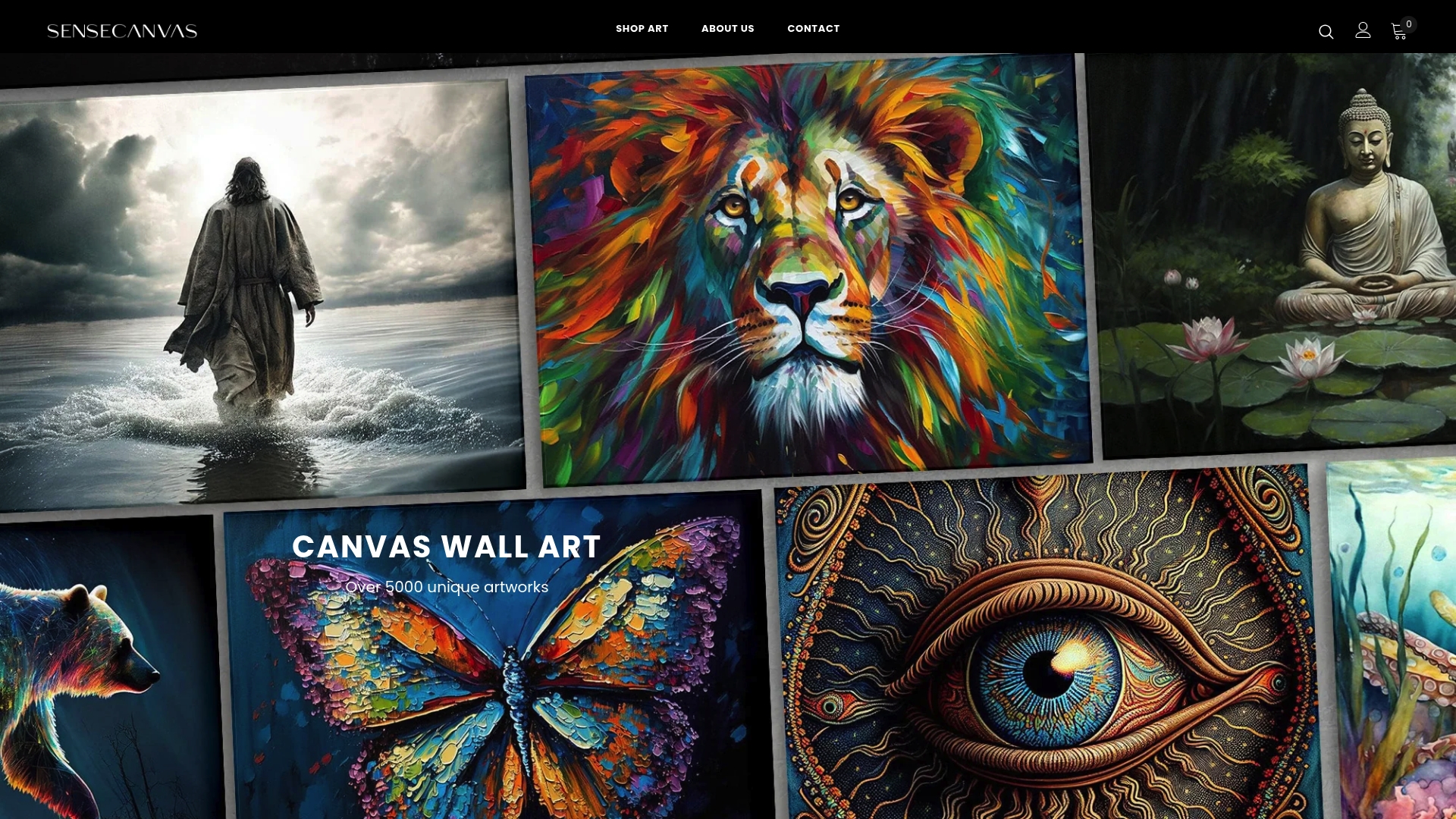
Browse the full collection to find the colors and subjects that suit your room, or start from the Sense Canvas home page to explore every category.
FAQ
What is vintage travel canvas?
It is a canvas print inspired by travel advertising from roughly the 1920s to the 1960s. The style uses bold lines, flat color and simplified scenes of cities, parks and coastlines. The Library of Congress describes these posters as built to convey a mood more than a place.
What size vintage travel canvas should I buy?
Match it to the furniture below. A single piece or grouped set that spans about two thirds of the sofa, bed or console usually looks balanced. Because we offer customization for size, you can fit the canvas to your exact wall space.
Where should I hang retro travel wall art?
Living rooms, bedrooms, hallways, home offices and reception areas all work well. Choose a wall without direct sun, and keep the center near eye level. Avoid spots right above heat sources or inside steamy bathrooms.
Can I use a vintage poster image for a custom canvas?
Only if you have the right to reproduce it. A museum may own the physical poster without owning the copyright, and the artist or estate may still hold rights, as the Stark Museum of Art’s reproduction policy illustrates. Confirm permission with the rights holder before printing.
Is vintage travel art a good gift?
Yes, when the destination has personal meaning, such as a hometown, a honeymoon spot or a favorite national park. Pick a size that fits the recipient’s wall and a palette that suits their home.